
- Release Year: 2014
- Platforms: Windows
- Publisher: UIE Inc.
- Genre: Compilation, Strategy, Tactics
- Game Mode: Single-player
- Setting: Historical events, War
Description
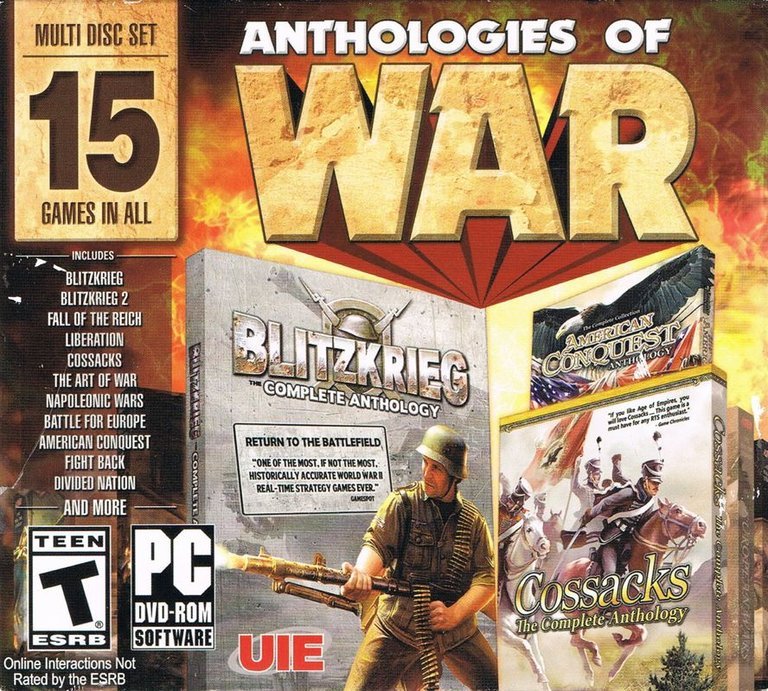
‘Anthologies of War’ is a retail compilation released in 2014 for Windows, bundling four historical strategy games: ‘Blitzkrieg Anthology’, ‘Blitzkrieg 2 Anthology’, ‘Cossacks: Anthology’, and ‘American Conquest: Anthology’. Each title focuses on real-time or turn-based tactical warfare, spanning various historical conflicts and settings, from World War II to colonial-era battles. The collection offers a mix of large-scale battles, resource management, and military strategy, catering to fans of historical war simulations.
Anthologies of War Free Download
Anthologies of War Cheats & Codes
PC
Press Shift + C to open console and enter the following codes:
| Code | Effect |
|---|---|
| #johnconnor | Disable AI |
| #iamback | Enable AI |
| #igotnukes | Instant victory |
| #whiteflag | Instant defeat |
| #warbonds | +500 resources |
| #orbitalcommand | Disable fog of war |
| #warbonds |
Given you |
| #income |
Given you |
| #overtime |
Given you |
| #landcp |
Given you |
| #navalcp |
Given you |
| #aircp |
Given you |
Anthologies of War: A Comprehensive Retrospective
Introduction
Anthologies of War is a unique compilation that stands as a testament to the enduring fascination with historical warfare in video games. Released in 2014 by UIE Inc., this collection bundles four distinct strategy anthologies—Blitzkrieg Anthology, Blitzkrieg 2 Anthology, Cossacks: Anthology, and American Conquest: Anthology—into a single retail package. While it may not be a standalone title, its significance lies in its role as a curated museum of real-time and turn-based strategy games, each offering a deep dive into different historical conflicts. This review will explore the game’s development context, narrative and thematic depth, gameplay mechanics, and its lasting impact on the strategy genre.
Development History & Context
The Studio and Vision
UIE Inc., the publisher behind Anthologies of War, is not a traditional game developer but rather a company specializing in compiling and distributing collections of existing games. The vision for Anthologies of War was straightforward: to provide players with a comprehensive bundle of historically themed strategy games, each with its own unique setting and gameplay style. The compilation was designed to appeal to fans of military history and strategy gaming, offering a diverse range of experiences from World War II to the colonial era.
Technological Constraints and Era
The games included in Anthologies of War were originally released between the late 1990s and early 2000s, a period marked by significant advancements in real-time strategy (RTS) and turn-based mechanics. The technological constraints of the era influenced the design of these games, with limitations on unit counts, AI complexity, and graphical fidelity. Despite these constraints, the developers of the individual titles within the anthology managed to create immersive and engaging experiences that have stood the test of time.
The Gaming Landscape at Release
By 2014, the strategy genre had evolved considerably, with modern titles like Company of Heroes 2 and Total War: Rome II pushing the boundaries of what was possible in terms of graphics, scale, and gameplay depth. Anthologies of War arrived in a market where nostalgia for classic strategy games was growing, offering a convenient way for players to revisit or discover these influential titles. The compilation’s release on DVD-ROM also reflected the transition from physical media to digital distribution, as many players were beginning to prefer downloading games directly.
Narrative & Thematic Deep Dive
Plot and Setting
Anthologies of War does not present a single overarching narrative but instead offers four distinct historical settings, each with its own storyline and thematic focus:
-
Blitzkrieg Anthology: This collection focuses on World War II, allowing players to command forces across various theaters of the war, from the Eastern Front to the Western Front. The narrative is rooted in historical accuracy, with missions based on real battles and campaigns.
-
Blitzkrieg 2 Anthology: A sequel to the original Blitzkrieg, this anthology expands on the World War II theme, introducing new campaigns and gameplay mechanics. The narrative continues to emphasize historical authenticity, with a focus on tactical decision-making and resource management.
-
Cossacks: Anthology: Set in the 17th and 18th centuries, Cossacks shifts the focus to the conflicts of early modern Europe, including the Thirty Years’ War and the Great Northern War. The narrative explores the rise of nations and the struggles for dominance in a rapidly changing world.
-
American Conquest: Anthology: This anthology takes players to the New World, covering the colonial period and the struggles between European powers and indigenous peoples. The narrative is rich in historical detail, with missions that reflect the complexities of colonization, trade, and warfare.
Characters and Dialogue
The games within Anthologies of War do not feature deeply developed characters or extensive dialogue, as is typical of many strategy games. Instead, the focus is on the player’s role as a commander, making strategic decisions that shape the outcome of battles and campaigns. The dialogue that does exist is primarily functional, providing mission briefings and objectives rather than character-driven storytelling.
Underlying Themes
The overarching themes of Anthologies of War revolve around the nature of warfare, the impact of historical events on societies, and the strategic challenges faced by military leaders. Each anthology explores these themes in its own way:
-
Blitzkrieg Anthology: Themes of sacrifice, heroism, and the brutality of war are central to the World War II setting. Players are confronted with the moral and tactical dilemmas faced by commanders during the war.
-
Cossacks: Anthology: The focus here is on the rise and fall of empires, the role of technology in warfare, and the shifting alliances that defined early modern Europe.
-
American Conquest: Anthology: This anthology delves into themes of exploration, colonization, and the clash of cultures. Players must navigate the complexities of establishing and maintaining colonies while dealing with the challenges of warfare in a new and unfamiliar land.
Gameplay Mechanics & Systems
Core Gameplay Loops
Each anthology within Anthologies of War features its own unique gameplay mechanics, but they all share a common focus on strategic decision-making and resource management. The core gameplay loops typically involve:
-
Resource Gathering: Players must gather resources such as food, wood, and gold to build and maintain their armies and infrastructure.
-
Base Building: Establishing and expanding a base is crucial for producing units, researching technologies, and defending against enemy attacks.
-
Unit Production and Management: Players must carefully manage their units, balancing offense and defense while considering the strengths and weaknesses of different unit types.
-
Combat and Tactics: The games emphasize tactical combat, with players needing to position their units effectively, use terrain to their advantage, and adapt to changing battlefield conditions.
Combat and Character Progression
Combat in Anthologies of War is primarily real-time, with players issuing orders to their units and watching as battles unfold. The games feature a variety of unit types, from infantry and cavalry to artillery and naval forces, each with its own strengths and weaknesses. Character progression is limited, with most games focusing on unit upgrades and technological advancements rather than individual character development.
UI and Innovative Systems
The user interface (UI) in the games within Anthologies of War is functional but not particularly innovative. The UI is designed to provide players with the information they need to make strategic decisions, such as resource levels, unit status, and mission objectives. Some of the games introduce innovative systems, such as the morale system in Cossacks, which affects unit performance based on their confidence and leadership.
Flawed Systems
While the games within Anthologies of War are generally well-regarded, they are not without their flaws. Some of the common criticisms include:
-
AI Limitations: The artificial intelligence in some of the games can be predictable and exploitable, leading to repetitive gameplay.
-
Balancing Issues: Certain units or strategies can be overpowered, making some missions easier or harder than intended.
-
Outdated Mechanics: Given the age of the games, some mechanics may feel dated compared to modern strategy titles, particularly in terms of unit pathfinding and combat animations.
World-Building, Art & Sound
Setting and Atmosphere
The settings of the games within Anthologies of War are richly detailed, with each anthology offering a distinct historical atmosphere. From the battlefields of World War II to the colonial landscapes of the New World, the games immerse players in their respective time periods through detailed maps, authentic unit designs, and historically accurate architecture.
Visual Direction
The visual direction of the games varies depending on the anthology. Blitzkrieg and Blitzkrieg 2 feature a more realistic art style, with detailed unit models and environments that reflect the gritty nature of World War II. Cossacks and American Conquest, on the other hand, adopt a more stylized approach, with vibrant colors and exaggerated unit designs that emphasize the grandeur of early modern warfare.
Sound Design
The sound design in Anthologies of War plays a crucial role in enhancing the immersive experience. The games feature authentic sound effects, from the roar of artillery to the clashing of swords, as well as period-appropriate music that sets the tone for each historical setting. The voice acting, while limited, is generally well-done, with mission briefings and unit commands adding to the authenticity of the experience.
Reception & Legacy
Critical and Commercial Reception
Anthologies of War received mixed reviews upon its release. Critics praised the compilation for its value and the quality of the individual games, particularly for fans of historical strategy titles. However, some reviewers noted that the games felt dated compared to modern strategy titles, with outdated mechanics and graphics. Commercially, the compilation performed modestly, appealing primarily to niche audiences of strategy gamers and history enthusiasts.
Evolution of Reputation
Over time, Anthologies of War has gained a reputation as a valuable collection of classic strategy games. While it may not have achieved the same level of acclaim as standalone titles like Civilization or Total War, it is appreciated for its historical depth and the diversity of experiences it offers. The compilation has also benefited from the growing interest in retro gaming, with many players rediscovering the charm of older strategy titles.
Influence on Subsequent Games
The games within Anthologies of War have had a significant influence on the strategy genre, particularly in the realm of historical warfare. The Blitzkrieg series, for example, helped popularize the real-time tactics subgenre, inspiring later titles like Company of Heroes. Cossacks and American Conquest also contributed to the evolution of grand strategy games, with their emphasis on resource management and large-scale warfare.
Conclusion
Anthologies of War is a compelling compilation that offers a diverse range of historical strategy experiences. While it may not be a groundbreaking title in its own right, it serves as a valuable archive of influential games that have shaped the strategy genre. The compilation’s strengths lie in its historical depth, strategic gameplay, and the variety of settings it offers. However, its age and outdated mechanics may limit its appeal to modern audiences.
Final Verdict: Anthologies of War is a must-play for fans of historical strategy games and a fascinating time capsule for those interested in the evolution of the genre. While it may not stand up to the polished mechanics and graphics of modern titles, its historical authenticity and strategic depth make it a worthwhile experience for anyone with an appreciation for classic strategy gaming.
Score: 7.5/10 – A solid compilation that offers a rich historical experience but is held back by its age and outdated mechanics.