
- Release Year: 2022
- Platforms: Windows
- Publisher: PhthaloGold
- Developer: PhthaloGold
- Genre: Puzzle
- Perspective: Diagonal-down
- Setting: Fantasy
Description
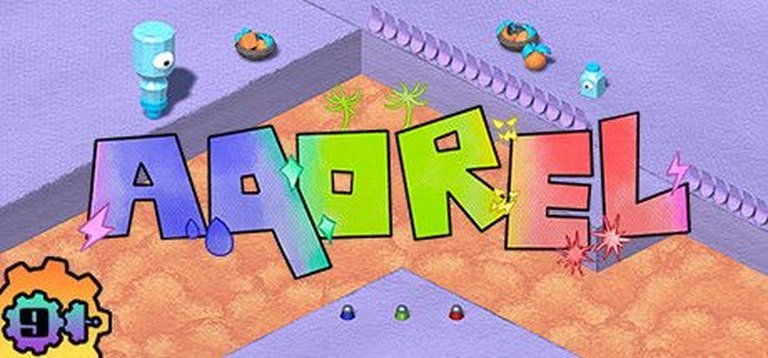
Aqorel is an isometric logic puzzle game set on a strange, colorful planet where players combine elemental seasonings to create paths and deliver items, solving puzzles through unique and evolving elemental interactions across 12 levels that progress from friendly to challenging.
Where to Buy Aqorel
PC
Aqorel Guides & Walkthroughs
Aqorel: A Crystalline Curio – A Deep-Dive Review of a Forgotten Puzzle Experiment
Introduction: A Whisper in the Bundled Crowd
In the vast, often-overlooked archives of 2022’s indie puzzle scene, Aqorel exists as a spectral title—a game known more for its bundle affiliation than its individual merit. Released quietly on May 19, 2022, by the singular developer PhthaloGold, this isometric logic puzzle game was conceived not as a standalone flagship, but as one of nine disparate titles in the CosmOS 9 collection, a curious anthology “discovered on a mysterious video game console drifting in outer space.” This framing device, more evocative than the game itself, sets the stage for an analysis of a title that promised a “unique and evolving elemental system” but delivered an experience that garnered a “Mostly Negative” reception (33% positive from 27 Steam reviews) and near-total critical silence. My thesis is this: Aqorel is a fascinating case study in promising mechanical innovation hamstrung by a lack of iterative design, opaque execution, and the crushing weight of being a single, unremarkable component in an otherwise intriguing meta-project. It is less a failed masterpiece and more a compelling misfire—a game that identifies an interesting design space but lacks the polish, tutorialization, and compelling layer to fully explore it.
Development History & Context: The Solitary Vision of PhthaloGold
PhthaloGold, the developer and publisher, operates with the hallmarks of a true indie—a solo or micro-team entity with minimal public presence. The MobyGames entry, added by a community member in 2023, and the scant development log on itch.io (a single “Small Update” fixing control menu bugs and adding a speed-up toggle on May 23, 2022) paint a picture of a project developed in near-total isolation. There is no “About” page, no developer blog, no credited designers beyond the studio name. This context is crucial: Aqorel was not born from a funded studio with a QA department or a narrative designer; it was the vision of a single creator or a very small group, utilizing the accessible but demanding Unity engine.
The technological constraint was not hardware, but scope. With a reported 12-level structure, the game fits the mold of a “short, experimental indie puzzle game,” a genre buoyed by the success of titles like Baba Is You (2019) and The Witness (2016). However, where those games built expansive rule-sets or sprawling environments, Aqorel‘s constraint seems to have been its own narrow conceptual lens. The gaming landscape of early 2022 was dominated by major releases (Elden Ring, God of War Ragnarök) and a thriving indie scene on Steam and itch.io. In this crowded market, a puzzle game needed either unparalleled hook, exceptional aesthetic, or stellar word-of-mouth to rise. Aqorel, released as part of a $15.46 bundle (CosmOS 9), chose the bundle-as-discovery model, a viable but risky strategy that often buries individual titles. Its lack of marketing, minimal storefront presence (no Metascore, no critic reviews on Metacritic or OpenCritic), and immediate “Mostly Negative” user consensus suggest it failed to find its audience or justify its place in the bundle’s narrative.
Narrative & Thematic Deep Dive: The Story of a Planet Without a Plot
- Aqorel* presents a profound narrative void, which is itself a notable design choice. The storefront description offers a bare-bones premise: “Cook up different solutions to elemental puzzles as you make deliveries on a strange planet.” There is no protagonist, no named characters, no dialogue, and no text logs to collect. The “strange colorful planet” is a pure puzzle space, a tabula rasa.
This minimalist approach can be a strength (see Portal‘s environmental storytelling), but here it feels like an absence. The thematic core—implied by the “elemental seasonings” mechanic and the delivery objective—touches on ideas of alchemy, transformation, and utility. The player is a cosmic courier, using fundamental forces (not classical elements, but specific “seasonings” like Salt, Pepper, etc., based on the blurb) to navigate a world. The theme is one of pragmatic magic: understanding a system to achieve a simple goal. However, without any narrative layer—no logs explaining why deliveries are happening, no hints of a civilization, no environmental storytelling in the level design—this theme remains inert. The planet does not feel strange; it feels generic. The deliveries have no weight. The game is a pure, unadorned logic engine, and for a game aspiring to be more than a abstract puzzle toy, this is a critical failure. It offers no reason to care about the “what” or “why,” only the “how.”
Gameplay Mechanics & Systems: The Elemental Alchemy That Fizzles
The core innovation of Aqorel is its “elemental seasoning” system. The player, on an isometric, fixed-screen grid, must deliver an object (a package) to a goal. To traverse the terrain—which includes obstacles like chasms, walls, and presumably different terrain types—the player must combine and apply elemental seasonings from a limited palette. The official description states: “Combine and use the elements to interact in different ways to solve each puzzle.” A typical puzzle might require combining “Salt” (perhaps to create a solid path) and “Pepper” (to remove an obstacle) in a specific sequence.
Core Loop & Puzzles: The loop is: 1) Assess the obstacle-filled grid, 2) Select and combine seasonings from a UI, 3) Apply the resulting compound to the relevant tile, 4) Move the package. The system is “evolving,” meaning new elements or interactions are introduced across the 12 levels. This is a sound, Stephen’s Sausage Roll-esque premise for a deep puzzle game.
Where It Falters: The overwhelming negative user feedback points to systemic flaws:
1. Opaque Mechanics & Feedback: The most common complaint in the sparse reviews and forum posts (like the “Level Skip Bug?” thread) is a lack of clarity. Without a robust tutorial—the Steam page mentions only “New interactions introduced”—players are left to guess how elements combine and what they do. A puzzle game lives or dies on its communication of rules. If applying “Salt” to water creates ice, the visual feedback must be immediate and unambiguous. The “Mostly Negative” score suggests this feedback loop is broken.
2. Control & UI Issues: The May 2022 update fixed a “Controls Menu issues during gameplay” and added a “Speed-Up Toggle.” These are red flags for an indie puzzle game. A controls menu during gameplay suggests a pause mechanic interfering with flow, and a speed-up toggle implies a default pace that is frustratingly slow. The need for these fixes post-launch indicates a rocky start and UX deafness.
3. Pacing & “Friendly to Challenging” Arc: The claim of a gentle learning curve rings hollow against user reports. A good puzzle game introduces mechanics with clear, solvable puzzles before complicating them. The perceived jump from “friendly” to “challenging” likely felt like a cliff, not a ramp, due to poor teaching of the underlying systems.
4. Lack of Iterative Depth: With only 12 levels, a puzzle game must make each one count. If the system is not communicated perfectly in the first few levels, the entire game collapses. There’s no evidence of a “aha!” moment cascade that defines great puzzle games; instead, the Steam consensus points to frustration.
In summary, Aqorel’s systems are conceptually interesting but executionally flawed. It identifies a novel interaction space (culinary alchemy for navigation) but fails to build a comprehensible, satisfying language for the player to speak within it.
World-Building, Art & Sound: Aesthetic Over Substance
The game’s presentation is its most consistently praised aspect, albeit faintly. Tags like “Colorful” and “3D” “Isometric” are accurate. The world is a low-poly, bright, somewhat whimsical environment. The planet is “strange” in color palette but not in form; the isometric grids are standard puzzle-game fare. There is a coherence to the visual design—a single, unified aesthetic that suggests the CosmOS 9 bundle’s “mysterious console” lore.
However, this aesthetic does no heavy lifting for gameplay. The environment lacks the iconic, readable geometry of a Baba Is You or The Witness. Obstacles are generic blocks; “elemental” effects are likely simple color swaps or particle effects. There is no diegetic integration of the puzzle into the world; it feels like a abstract board game laid onto a generic 3D plane.
Sound design is virtually undocumented. No Steam tags mention audio, and no reviews comment on it. The silence on this front suggests either an unremarkable soundtrack or a development focus entirely on the core puzzle logic at the expense of audio feedback—another critical misstep, as sound is a vital cue for puzzle validation and player satisfaction.
The atmosphere is therefore one of sterile, colorful abstraction. It is inoffensive and clear, but ultimately forgettable. It serves the puzzles without enhancing them, and without a narrative to give it weight, it amounts to a pleasant but empty skin.
Reception & Legacy: The Sound of a Stone Dropping in a Void
Critical Reception: Aqorel exists in a state of critical nullity. There are no critic reviews on Metacritic (Metascore: tbd) or OpenCritic. It was not featured in any “Best of 2022” lists (like IGN’s 77 titles scoring 8+). This is not mere oversight; it is testament to its complete lack of industry penetration. No major outlet saw it as worth reviewing, likely due to its obscurity, lack of press kits from a one-person studio, and immediate negative player signals.
Commercial & Player Reception: The Steam data is stark. As of the latest scrape, it holds a “Mostly Negative” rating (33% positive from 27 reviews). For a small indie puzzle title, 27 reviews is a minuscule sample, indicating extremely low sales. The negative reviews, while few in number, are vocally critical. Common themes from the community discussions and review summaries include: “Boring,” “Broken mechanics,” “Unclear how to play,” “Not fun.” The “Level Skip Bug?” discussion hints at softlocks or progression blockers—a fatal flaw in a puzzle game where progression is the entire game. The Backloggd average rating of 1.9/5 from 5 ratings reinforces this dismal picture.
Legacy & Influence: Aqorel has no discernible legacy. It did not spawn clones. It is not cited in developer post-mortems. Its only claim to continued existence is as a component of the CosmOS 9 bundle on Steam and itch.io. Ironically, its legacy is entirely parasitic on the bundle’s meta-narrative. The bundle itself is a curiosity—a collection of nine short, weird games with a unifying fictional origin story. Within that context, Aqorel is likely remembered, if at all, as the “puzzle game with the seasoning system” among buyers who explored the whole bundle. It has not, and will not, influence the puzzle genre. Its only potential influence is as a cautionary tale: a good core idea is worthless without flawless execution and player empathy.
Conclusion: A Flawed Artifact of Ambitious Solitude
Aqorel is not a bad game in the sense of being offensively poorly made or technically broken (though bugs exist). It is a frustratingly under-realized game. Its elemental seasoning system is a genuinely clever seed for a puzzle mechanic, offering the potential for combinatorial creativity. However, this seed was planted in barren soil: a barren of comprehensive tutorials, of clear visual and audio feedback, of iterative puzzle design that teaches and expands upon its own rules, and of any narrative or aesthetic hook to motivate the player through inevitable frustration.
In the taxonomy of indie puzzle games, Aqorel resides in the “Curio” category—a brief, puzzling experience that is more interesting to think about than to actually play. Its place in video game history is as a footnote to the CosmOS 9 bundle, a piece of a larger, perhaps more successful, art project. As a standalone title, it is a failure, not because its vision was poor, but because its execution was so incomplete that the vision remains entirely hidden from the player. For the historian, it serves as a reminder that innovation requires more than a novel idea; it demands the discipline of game design, the empathy of teaching, and the polish of refinement. Aqorel provided the idea but neglected the rest, leaving behind only a faint, negative impression and a bundled key for those curious enough to seek out this particular ghost in the machine. Final Verdict: 4/10 – A conceptually interesting but critically flawed puzzle experiment, notable only for its part in a curious bundle and its swift, negative reception.