
- Release Year: 2010
- Platforms: Windows, Xbox 360
- Publisher: Immanitas Entertainment GmbH, Just A Game GmbH, Microsoft Corporation
- Developer: Games Distillery, s.r.o.
- Genre: Action
- Perspective: Top-down
- Game Mode: Co-op, Online PVP
- Gameplay: Arcade, Customization, Naval, Power-up collection, Shooter, Twin-stick
- Setting: Steampunk
Description
Aqua is a top-down twin-stick arcade shooter set in a steampunk universe, where players command Captain Benjamin Grey of the Emperean Navy to repel returning Gothean adversaries after the Gothean War. Featuring upgradeable ships (Speedboat, Cruiser, Gunship), diverse weapons from nailguns to torpedoes, and tactical squad deployments (Fighter, Sieger, Healer, Sonar), the game blends fast-paced naval combat against land, sea, and air enemies with story-driven missions involving escorts and environmental puzzles. Collectible aquaflux powers screen-clearing attacks, while multiplayer supports co-op and competitive modes.
Gameplay Videos
Where to Buy Aqua
PC
Aqua: Review
Introduction
In the vast, often-overlooked annals of Xbox Live Arcade history, few titles encapsulate the idiosyncrasies of the early 2010s digital marketplace as vividly as Aqua (2010). Developed by Slovakian studio Games Distillery and published by Microsoft Game Studios, this twin-stick shooter eschewed the minimalist chaos of its contemporaries (like Geometry Wars) in favor of a sprawling, narrative-driven steampunk epic set on a drowned Earth. At its core, Aqua is a paradox: a game that ambitiously blends arcade action with tactical squad commands, wrapped in a striking visual style yet hampered by repetitive mission design. Its legacy lies in its daring premise and artistic execution—a bold, if flawed, attempt to redefine a crowded genre. This review dissects Aqua through the lenses of its development, narrative, mechanics, artistry, reception, and enduring place in gaming history.
Development History & Context
Aqua emerged from the ambitions of Games Distillery, a then-fledgling Slovak developer founded in 2005. The project began as a prototype for a simple “shooter set on water,” but the team’s vision quickly expanded into a free-roaming naval saga with story-driven objectives. Constrained by the technical limits of Xbox Live Arcade’s 800 MS Points pricing structure, the developers meticulously balanced depth with accessibility, iterating through multiple prototypes. Key features like the squad-command system and hand-drawn cutscenes were added later in development, following feedback from early test sessions that revealed gameplay pacing issues.
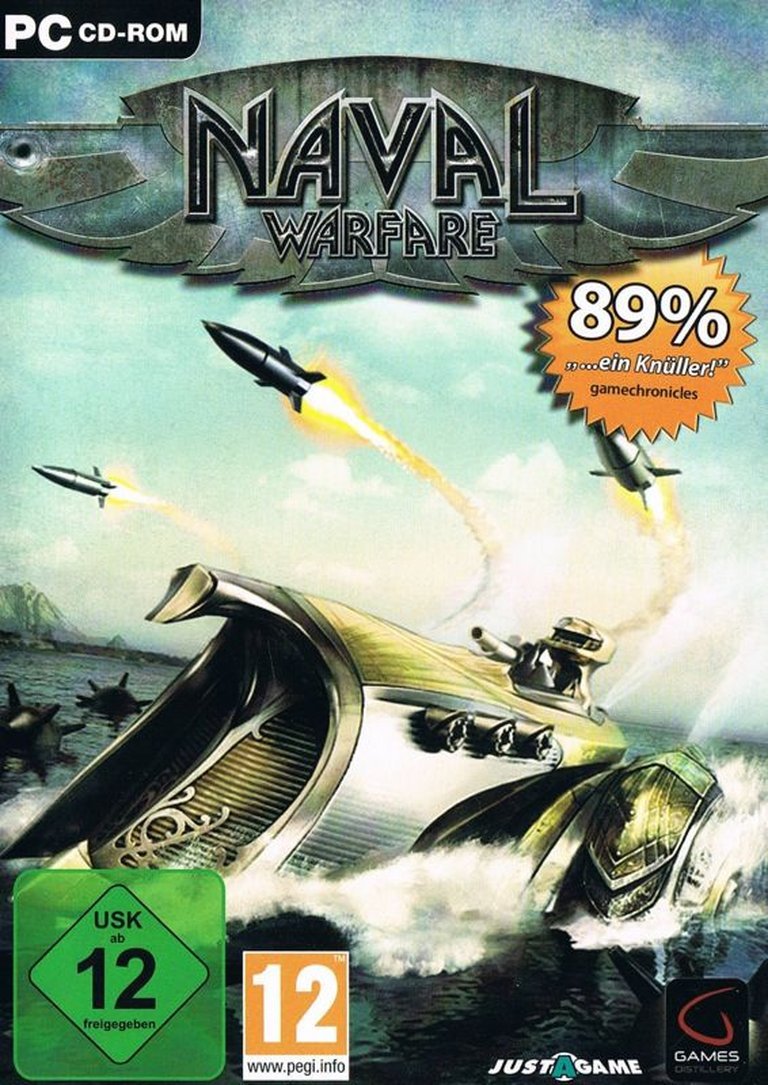
Announced in April 2010, Aqua arrived in a market saturated with twin-stick shooters (Geometry Wars, Super Stardust HD) but hungry for innovation. Its May 19, 2010, Xbox Live Arcade release positioned it alongside titles like Metal Slug XX, emphasizing arcade thrills. The PC port, retitled Naval Warfare and published by Immanitas Entertainment, followed on May 25, 2011, but arrived with technical flaws and minimal marketing, hindering its impact. Games Distillery’s subsequent work (e.g., Hydrophobia) revealed a studio fascinated by water mechanics and narrative immersion—a signature that defined Aqua as a foundational, if underappreciated, effort.
Narrative & Thematic Deep Dive
Set in a post-cataclysmic world where continents are submerged beneath floodwaters, Aqua spins a tale of political intrigue and survival. Captain Benjamin Grey, a celebrated hero of the Emperean Empire, and his engineer companion Polly Edison discover a resurgent threat: the Gothean Empire, armed with new technology, attacks Emperean headquarters. Their mission escalates into a globe-spanning conspiracy involving the shadowy entity Cerbera, which manipulates warring factions (including the Samureans) for unknown ends.
The narrative unfolds through nine missions framed by hand-drawn motion comics, a stylistic choice praised for its painterly charm. Themes of futile nationalism permeate the story: Grey and Edison’s quest to expose Cerbera forces them to confront distrust within their own ranks, emphasizing the futility of war in a world where land—and survival—is scarce. The open-ended finale, showing an escape module fleeing smoldering ruins, underscores the cyclical nature of conflict. While characters like Grey are archetypal war heroes, the world-building compensates through its factions’ unique naval aesthetics, from the brass-clad Empereans to the airships of the Gotheans.
Gameplay Mechanics & Systems
At its core, Aqua is a twin-stick shooter with tactical depth. The left analog stick maneuvers a naval vessel through oceanic battlegrounds, while the right stick directs fire—controls refined from Geometry Wars. Players select from three ship classes: nimble Speedboats, balanced Cruisers, and heavy Gunships, each customizable with weapon upgrades (e.g., flamethrowers, torpedoes) and attributes like speed or armor. A unique “boost” mechanic allows rapid movement but disables weaponry, adding risk-reward decisions.
Combat is frenetic, with enemies attacking from sea, land, and air. Key systems include:
– Aquaflux Special Weapon: Collecting energy particles from downed foes fills a gauge for a screen-clearing blast.
– Squad Tactics: Docking at hire stations deploys AI-controlled squads (Fighters, Siegers, Healers, Sonar), commanded via context-sensitive orders (e.g., “Defend” or “Attack”).
– Mission Variety: Escort duties, battery destruction, and switch-based puzzles dominate, though the latter is underdeveloped.
Multiplayer is local-only (a notable omission), featuring co-op “Arena” mode (endless waves) and “Chase” (checkpoint racing). The campaign’s nine missions suffer from repetitive escort objectives, a critical flaw noted by critics like IGN’s Ryan Clements, who argued they disrupted the game’s pace.
World-Building, Art & Sound
Aqua’s steampunk aesthetic is its defining triumph. The world, rendered in a vibrant top-down perspective, blends Victorian-era machinery (riveted hulls, propellers) with futuristic elements (energy weapons, airships). Hand-drawn cutscenes, lauded by Eurogamer as “beautiful,” evoke the graphic novel style of Overboard! (a frequent comparison), with dynamic paneling and rich ink textures. Environments—from fog-shrouded archipelagos to industrial fortresses—emphasize scale, though the ocean’s uniformity limits visual diversity.
Sound design complements the atmosphere: Milan Malik’s soundtrack marries orchestral bombast with nautical themes, while ambient waves and cannon fire enhance immersion. However, critics like PC Action noted the lack of radio chatter, which could have deepened the naval experience. Despite this, the art direction remains a standout, proving Games Distillery’s eye for cohesive world-building.
Reception & Legacy
Aqua’s reception was mixed, reflected in a Metacritic score of 61/100 (Xbox) and 57/100 (PC). Critics universally praised its art and setting: GameSpot called the steampunk world “unique and atmospheric,” while 1UP commended the cutscenes. Gameplay earned divided reactions—Eurogamer lauded the customization system, but IGN and GameSpot decried escort missions and sluggish pacing. The lack of online multiplayer was a recurring gripe, with Resolution Magazine noting it diminished replayability.
Commercially, Aqua underperformed initially (8,300 Xbox 360 units by January 2011) but grew to 31,000+ by year-end, suggesting niche appeal. Its legacy is as a genre innovator: it added tactical squad commands and narrative depth to twin-stick shooters, influencing later games like Pawarumi (2018). Yet, it remains a cult favorite, remembered for its ambition more than its execution. On platforms like Steam, its $0.49 price tag and MobyGames score of 6.6 reflect its status as a “hidden gem.”
Conclusion
Aqua is a testament to the risks and rewards of mid-budget digital development. It excels as a visually arresting, narratively ambitious steampunk epic, with art and sound design that elevate its core shooter mechanics. However, its gameplay is undermined by repetitive missions and a lack of multiplayer polish, limiting its accessibility. For historians, Aqua represents a crucial experiment in blending arcade action with tactical depth—a bridge between genre classics and modern hybrids. While it may not rank among the titans of twin-stick shooters, its distinct voice and artistic merit secure it a place in gaming history as a flawed, fascinating artifact of an era when XBLA fostered bold creativity.
Verdict: A stylistically triumphant but mechanically inconsistent shooter, Aqua is essential for fans of steampunk and twin-stick innovation. Its legacy endures in its artistry and the lessons it offered developers about marrying action with narrative ambition.