
- Release Year: 2004
- Platforms: Windows
- Publisher: magnussoft Deutschland GmbH
- Developer: magnussoft Deutschland GmbH
- Genre: Action
- Perspective: Side view
- Game Mode: Hotseat, Single-player
- Gameplay: Arcade, Paddle, Pong
- Setting: Underwater
Description
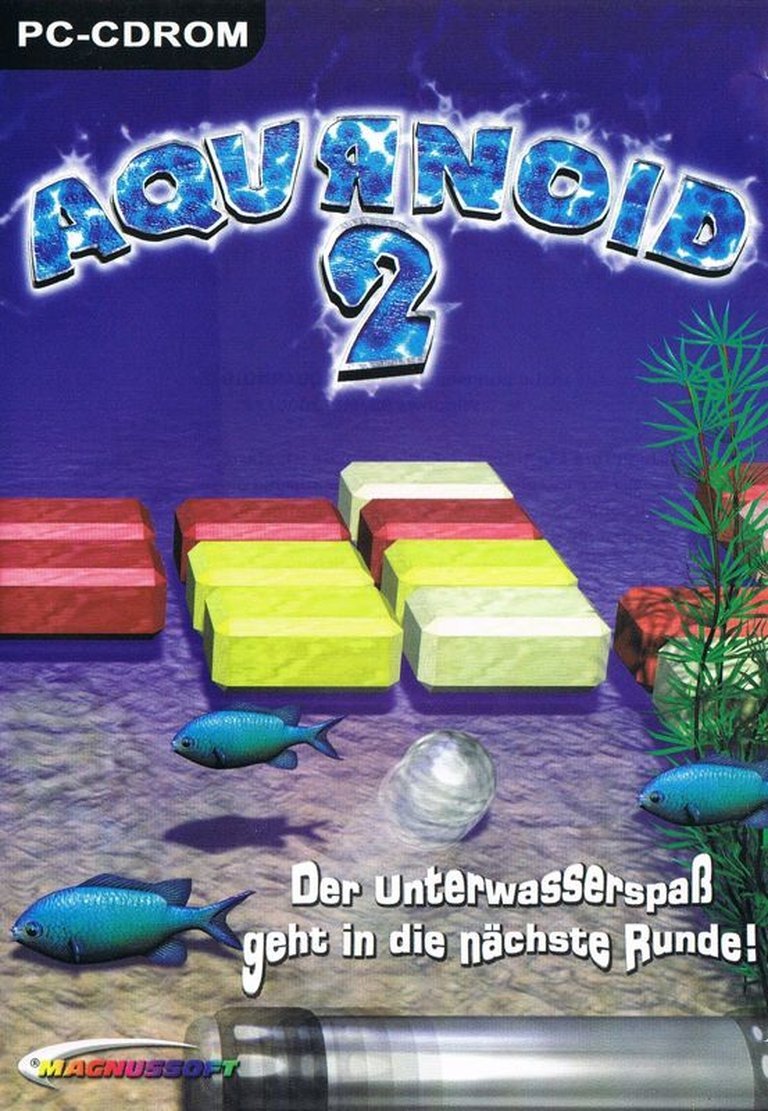
Aquanoid 2 is a sequel to Aquanoid Gold, set in an underwater world filled with aquatic creatures and vegetation. The game is a brick-breaking arcade title where players use a racket to bounce a ball and destroy bricks, which may contain power-ups like extra lives or hindrances. Starting with basic equipment, players unlock new features as they progress through over 300 levels across three difficulty settings. The game includes a multiplayer mode, password-saving for levels, and a built-in level editor, with support for both English and German languages.
Gameplay Videos
Aquanoid 2 Patches & Updates
Aquanoid 2 Reviews & Reception
retro-replay.com : Aquanoid 2 takes the classic brick-breaking formula and submerges it in a lush underwater environment, making each level feel like an aquatic adventure.
gamehouse.com : Bat the ball at the bricks to clear the waters and collapse the wall. Chill out and rack up you score!
Aquanoid 2 Cheats & Codes
PC
Enter codes as a password.
| Code | Effect |
|---|---|
| NZHF[level number] | Level select |
| CERTIFICATE | Unlocks Level 10 |
| GYPSUM | Unlocks Level 20 or Last level |
| LEVIATHAN | Unlocks Level 30 |
| PREDECESSOR | Unlocks Level 40 |
| SKELETON | Unlocks Level 50 |
| VULTURE | Unlocks Level 60 |
| FREQUENCY | Unlocks Level 70 |
| BUCCANEER | Unlocks Level 80 |
| TRADITION | Unlocks Level 90 |
| REFLEX | Unlocks Level 100 |
| AFFLUENCE | Unlocks Level 110 |
| HOSTAGE | Unlocks Level 120 |
| MEMORIAL | Unlocks Level 130 |
| ZODIAC | Unlocks Level 140 |
Aquanoid 2: A Deep Dive into the Underwater Brick-Breaking Classic
Introduction: The Legacy of Aquanoid 2
Aquanoid 2 (2004) is a testament to the enduring appeal of the brick-breaking genre, a subgenre that traces its roots back to Breakout (1976) and Arkanoid (1986). Developed and published by magnussoft Deutschland GmbH, this sequel to Aquanoid Gold (1992) submerges players in a vibrant underwater world, blending classic arcade mechanics with modern twists. While the genre had seen countless iterations by 2004, Aquanoid 2 distinguished itself through its lush aquatic aesthetics, expansive level design, and robust feature set, including a level editor, multiplayer mode, and a password save system.
This review will explore Aquanoid 2 in exhaustive detail, examining its development history, narrative and thematic elements, gameplay mechanics, artistic and auditory design, reception, and legacy. By dissecting these components, we aim to determine whether Aquanoid 2 is a forgotten gem or a niche curiosity in the pantheon of arcade-style games.
Development History & Context
The Studio and Creators
Aquanoid 2 was developed by magnussoft Deutschland GmbH, a German studio known for its budget-friendly PC games in the early 2000s. The team behind the game was small but experienced:
– Maik Heinzig (Programming) – A prolific developer with credits on over 70 games, including Jack’s Sokoman and Aquanoid 2 Gold.
– Sascha Feyrer (Art) – Responsible for the game’s underwater visuals, with a portfolio spanning 12 other titles.
– Aumeso (Music) – Composed the game’s soundtrack, contributing to its immersive aquatic atmosphere.
– Egon Maase (Sound FX) – Designed the game’s audio effects, adding depth to the underwater setting.
The game was built using The Games Factory, a game-making tool popular among indie developers in the early 2000s. This choice of engine allowed for rapid development but also imposed technical limitations, particularly in physics and collision detection.
The Gaming Landscape in 2004
By 2004, the brick-breaking genre was no longer a dominant force in gaming. The arcade era had waned, and 3D graphics were becoming the standard. However, Aquanoid 2 carved out a niche by:
– Embracing nostalgia while modernizing the formula with underwater themes and power-ups.
– Catering to casual gamers with its pick-up-and-play mechanics and password save system.
– Offering extensive replayability through its level editor and multiplayer mode.
The game’s release on CD-ROM for Windows reflected the era’s distribution methods, targeting budget-conscious PC gamers who sought simple, addictive experiences.
Narrative & Thematic Deep Dive
Plot and Setting
Aquanoid 2 presents a modest but engaging narrative framed around an underwater adventure. Players assume the role of an intrepid explorer tasked with restoring balance to submerged realms that have been encased in mystical bricks. The game’s premise is lightweight but effective, providing context for the brick-breaking action.
Key narrative elements include:
– Environmental storytelling through level design, with each zone representing a different underwater ecosystem (e.g., coral reefs, shipwrecks).
– Optional encounters with marine life, such as dolphins triggering bonus rounds or octopi transforming bricks into obstacles.
– Unlockable “tidal logs” that expand on the game’s lore, hinting at a larger conspiracy behind the encased ecosystems.
While the story is secondary to gameplay, it elevates Aquanoid 2 beyond a mere score-chasing exercise, giving players a sense of purpose.
Themes
The game explores several themes:
1. Restoration and Balance – The player’s mission to “free” the underwater world from its brick prison mirrors ecological restoration.
2. Exploration and Discovery – Each level introduces new challenges and creatures, reinforcing the idea of uncovering hidden depths.
3. Risk and Reward – The power-up system embodies this theme, as players must weigh the benefits of bonuses against potential pitfalls.
Gameplay Mechanics & Systems
Core Gameplay Loop
Aquanoid 2 adheres to the classic brick-breaking formula but introduces strategic depth through its mechanics:
– Paddle and Ball Physics – The paddle can be upgraded with magnetic properties, extended reach, or defensive shields.
– Ball Variants – Players unlock specialized balls, such as speed-boosted or multiball variants, which alter gameplay dynamics.
– Brick Types – Over 15 brick types, including regenerative algae bricks and indestructible “cracker” bricks, require different strategies to clear.
Power-Ups and Hazards
The game’s risk-reward system is central to its appeal:
– Beneficial Power-Ups:
– Multiball – Splits the ball into multiple projectiles.
– Paddle Extender – Increases the paddle’s width.
– Magnetic Paddle – Attracts power-ups automatically.
– Hazardous Power-Ups:
– Control Inversion – Reverses paddle movement.
– Ball Splitting – Fragment the ball unpredictably.
This system ensures that no two playthroughs are identical, as players must adapt to sudden changes in gameplay conditions.
Progression and Difficulty
- Three Difficulty Tiers – From casual “leisurely dives” to punishing “deep-sea gauntlets.”
- Password Save System – Allows players to resume progress without completing levels in one sitting.
- Level Editor – Enables custom stage creation, extending replayability.
Multiplayer Mode
The game supports up to four players in split-screen matches, where competitors race to clear bricks or sabotage each other with special abilities. This mode is a standout feature, offering a rare social experience in a genre typically dominated by solo play.
World-Building, Art & Sound
Visual Design
Aquanoid 2’s underwater aesthetic is its most striking feature:
– Vibrant Environments – Coral reefs, kelp forests, and sunken ships create a dynamic backdrop.
– Sprite Work – Crisp animations for the paddle, ball, and power-ups enhance immersion.
– Particle Effects – Bubbles, ripples, and light shafts contribute to the game’s aquatic ambiance.
The art style strikes a balance between cartoony charm and realism, ensuring it remains visually appealing even on modern systems.
Sound Design
- Music – Aumeso’s soundtrack complements the underwater theme with soothing, melodic tracks.
- Sound Effects – The echoing clang of breaking bricks and the soft chime of power-ups reinforce the game’s tactile feedback.
Reception & Legacy
Critical and Commercial Reception
Aquanoid 2 received limited critical attention upon release, likely due to its niche appeal. However, it developed a cult following among fans of brick-breaking games, praised for its:
– Expansive level design (300+ levels).
– Innovative power-up system.
– Multiplayer and level editor features.
The game’s lack of mainstream recognition is attributable to its budget release and the genre’s declining popularity in the mid-2000s.
Influence and Legacy
While Aquanoid 2 did not spawn a major franchise, it influenced later entries in the Aquanoid series, including:
– Aquanoid 2 Gold (2008) – A refined version with additional levels.
– Aquanoid 3D (2010) – A 3D iteration that expanded on the underwater theme.
The game’s level editor and multiplayer mode set a precedent for future brick-breaking titles, proving that the genre could evolve beyond solitary arcade experiences.
Conclusion: A Hidden Gem of the Brick-Breaking Genre
Aquanoid 2 is a polished, content-rich sequel that successfully modernizes the brick-breaking formula. Its underwater setting, strategic power-ups, and robust feature set make it a standout title in a crowded genre. While it may not have achieved widespread acclaim, its dedicated fanbase and influence on later games secure its place as a cult classic.
Final Verdict: 8.5/10 – A must-play for fans of arcade-style games and a fascinating artifact of early 2000s PC gaming.
Aquanoid 2 proves that even the simplest mechanics can feel fresh when wrapped in creative world-building and thoughtful design. For those willing to dive beneath the surface, it offers an underwater adventure worth exploring.