
- Release Year: 2002
- Platforms: Windows
- Publisher: Binary Zoo
- Developer: Binary Zoo
- Genre: Sports
- Perspective: 3rd-person
- Game Mode: Hotseat, Single-player
- Gameplay: Turn-based
- Average Score: 55/100
Description
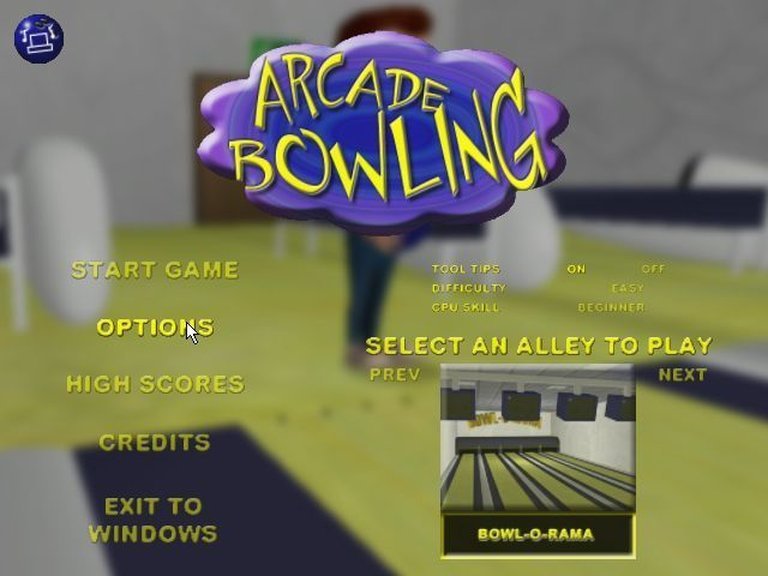
Arcade Bowling is a classic ten-pin bowling game designed for up to four players, released in 2002 for Windows. The game is entirely mouse-controlled, offering two different control systems for shooting and spin. Players can choose from various themed alleys, each with unique aesthetics but identical gameplay mechanics. The game features 3D animations for every shot, character reactions to good or bad shots, and three levels of difficulty. It also includes in-game music and the option to play tracks from a CD, making it a comprehensive bowling experience.
Arcade Bowling Reviews & Reception
metacritic.com (55/100): So for serious Skeeball aficionados, this design won’t compare to the feel of the real deal.
Arcade Bowling: A Nostalgic Strike in Early 2000s Casual Gaming
Introduction
Arcade Bowling (2002) arrived during a transitional era for video games, as the industry grappled with the rise of home consoles and the decline of traditional arcades. Developed by UK-based studio Binary Zoo, this PC title sought to capture the simplicity of arcade sports classics like Pong and PBA Bowling while leveraging accessible mouse controls and vibrant aesthetics. Though overshadowed by flashier contemporaries, Arcade Bowling represents a charming—if flawed—attempt to bring the communal joy of arcade bowling to home computers, blending straightforward gameplay with a lighthearted tone that masks its technical limitations.
Development History & Context
Studio Vision & Constraints
Binary Zoo, a small British studio led by multi-hyphenate developer David Kirk (design, programming, graphics, and audio), prioritized accessibility over innovation. Released in 2002, the game targeted casual players amid a crowded market dominated by AAA franchises and emergent online multiplayer experiences. Its mouse-only control scheme reflected the era’s limited expectations for PC sports games, avoiding complex joystick or keyboard inputs that might alienate non-enthusiasts.
Technological Landscape
Stuck between the pixelated charm of ’90s arcade titles and the burgeoning 3D revolution, Arcade Bowling relied on rudimentary 3D animations and static pre-rendered environments. The decision to avoid hardware-intensive graphics ensured compatibility with low-end Windows PCs but left the game visually outdated compared to contemporaries like AMF Bowling 2004.
Arcade Nostalgia
By the early 2000s, traditional arcades were vanishing in the West, but their spirit endured in compilations like Midway Arcade Treasures. Arcade Bowling tapped into this nostalgia, offering a single-screen multiplayer experience reminiscent of Golden Tee Golf’s tavern-friendly design, albeit without the depth or polish.
Narrative & Thematic Deep Dive
Absence of Story, Presence of Personality
As a sports simulation, Arcade Bowling lacks a narrative but injects personality through its cartoonish avatars and reactive animations. Players select from a roster of exaggerated characters—each with playful idle animations—who celebrate strikes with goofy dances or crumple into despair after gutter balls. Opponents mock or cheer depending on performance, creating a light rivalry dynamic.
Thematic Flaws
The game’s six alleys (Bowl-O-Rama, Coalmine, Candycane Court, etc.) are purely cosmetic, offering no gameplay variations. This missed opportunity to tie environments to mechanics—e.g., ice physics in Candycane Court—underscores the game’s reliance on superficial charm over meaningful design.
Gameplay Mechanics & Systems
Mouse-Driven Controls
The core innovation lies in its two mouse-controlled schemes:
1. Power + Spin: Adjust ball speed and rotation first, then final direction.
2. Power + Direction: Set trajectory first, then spin.
While intuitive for newcomers, the lack of analog input or precision (e.g., no adjustable angle) reduces skill expression. The right mouse button’s dual function for moving the bowler and releasing the ball often feels clunky.
Progression & Replayability
Three difficulty tiers (affecting AI opponent consistency) and local high-score tracking cater to casual competition. However, the absence of unlockables, career modes, or online leaderboards limits long-term engagement.
Technical Shortcomings
Unskippable 3D ball animations and repetitive AI behavior (opponents react in binary “good/bad” cycles) highlight the game’s budgetary constraints. The turn-based pacing, while fitting for multiplayer, feels sluggish in single-player.
World-Building, Art & Sound
Visual Design
The alleys feature distinct themes—retro diner (Bowl-O-Rama), industrial (Coalmine), whimsical (Flower Power Boulevard)—but share identical layouts. Low-poly bowler models and flat textures reflect early 2000s asset limitations, though the candy-colored palette injects whimsy.
Audio
Marie Lakin’s upbeat soundtrack channels arcade authenticity, with jazzy loops and punchy sound effects. The option to play custom CDs from the user’s library was a novel but underutilized feature.
Atmosphere
Despite its simplicity, Arcade Bowling succeeds in emulating the rowdy camaraderie of arcade cabinets, particularly in four-player mode where taunts and celebrations amplify the social experience.
Reception & Legacy
Commercial Performance & Ports
No critical reviews are archived, but its re-release on iPhone (2008) and Nintendo DSi (2009) suggests moderate commercial interest. Bundled in 10 Total Sports PC Games (2007), it found a second life as budget software.
Industry Impact
While not revolutionary, Arcade Bowling foreshadowed the casual gaming boom later popularized by Wii Sports. Its mouse-driven approach influenced browser-based sports games, albeit without the cultural footprint of Coolmath Games classics.
Modern Reappraisal
Retro enthusiasts occasionally praise its pick-up-and-play appeal, but the game remains a footnote—a testament to the challenges of adapting arcade simplicity to home platforms without innovation.
Conclusion
Arcade Bowling is a time capsule of early 2000s casual gaming: unambitious yet endearing, constrained by technology but buoyed by earnest charm. Its lack of depth and repetitive design prevent it from standing alongside arcade greats, but as a local multiplayer relic, it offers a fleeting strike of nostalgia. For historians, it exemplifies the awkward transition of arcade sports to PC, balancing accessibility with creative stagnation. While not a masterpiece, it deserves recognition for preserving the spirit of bowling alleys and arcades in an era of rapid industry change.
Final Verdict: A 5/10 experience—worth a frame or two for curiosity seekers, but hardly a perfect game.