
- Release Year: 2000
- Platforms: Windows
- Publisher: The Code Zone
- Developer: The Code Zone
- Genre: Card, Poker, Puzzle, Tile game
- Perspective: 2D
- Game Mode: Single-player
- Gameplay: Cards, Falling block puzzle, Strategy, Tiles
Description
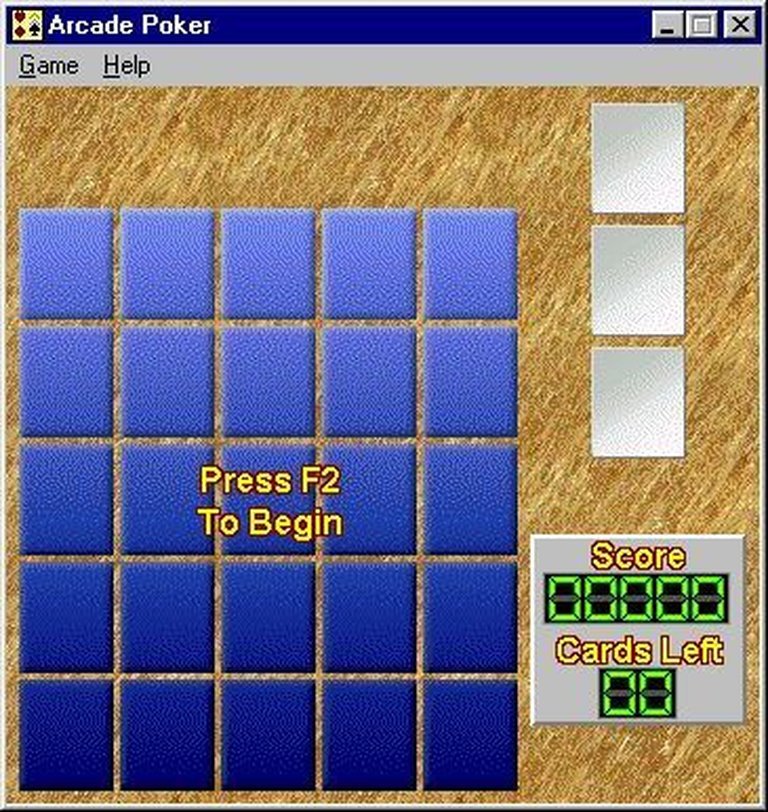
Arcade Poker is a unique strategy game blending elements of Tetris and Poker, where players strategically place falling cards into a 5×5 grid to form winning poker hands like flushes or straights. Developed by The Code Zone, this single-player game challenges players to optimize card placement using arrow keys, with customizable preview views and adjustable difficulty settings. Offering configurable controls, in-game help, and a high-score system, it combines puzzle mechanics with classic card-game strategy.
Arcade Poker: Review
An Unlikely Hybrid That Anted Up Against Convention
Introduction
In the year 2000—an era dominated by Deus Ex’s immersive sim ambitions and The Sims’ life-simulation revolution—a peculiar anomaly quietly shuffled onto Windows PCs: Arcade Poker. Developed by the unassuming studio The Code Zone, this fusion of falling-block puzzles and poker-hand strategy remains a fascinating footnote in gaming’s experimental era. Its thesis was audacious in its simplicity: What if Tetris met poker in a 5×5 grid? While lacking the bombast of AAA contemporaries, Arcade Poker’s quiet ingenuity warrants excavation—not as a lost classic, but as a case study in genre-blending minimalist design.
Development History & Context
Studio & Vision:
The Code Zone operated in the shadows of early-2000s shareware culture, specializing in budget-friendly compilations. Arcade Poker was one of ~20 interchangeable titles bundled into packages like Poker Potpourri—a commercial strategy akin to digital vaudeville. Led by John “FlyMan” Hattan (coding) and Shelley Hattan (documentation), the team leveraged Star Division’s StarView engine and sprite libraries from Chromewav’s SpriteLib. Their goal was not revolution but accessibility: a poker-themed puzzle game operable via arrow keys or joystick, designed for casual players wary of complex UIs.
Technological Constraints:
Built for Windows 98/2000-era hardware, Arcade Poker embraced austerity:
– Fixed window size (non-resizable, rejecting screen-real-estate norms).
– MIDI music (courtesy of Microsoft’s sound libraries).
– No GPU acceleration—a deliberate choice for compatibility.
This “functional over flash” approach mirrored the constraints of small-scale development, where reconfiguring card back designs or dynamic backgrounds was deemed extraneous.
Gaming Landscape:
2000 saw poker’s digital resurgence (WSOP games, Texas Hold’em simulations), but Arcade Poker rejected realism. Instead, it aligned with abstract puzzle hybrids like Puzzle Quest, predating them by years. Its release amid Bejeweled’s ascent (2001) reveals a missed opportunity to capitalize on the “casual puzzle boom”—a fate sealed by its compilation-only distribution.
Narrative & Thematic Deep Dive
Arcade Poker is a game without narrative—yet its thematic core is unmistakable: the tension between order and chaos.
- Cards as Characters: Each falling card (♠️♥️♦️♣️) is a transient agent of potential. Unlike Tetris’ impersonal blocks, cards carry cultural weight—aces intimidate; deuces frustrate. Their anthropomorphic absence becomes a narrative in itself: players project meaning onto suites.
- Dialogue of Systems: The “preview window” (showing upcoming cards) functions as a “fate vs. agency” mechanic. Reducing preview slots (via settings) amplifies existential dread—a Dark Souls-like embrace of limited foreknowledge.
- Thematic Resonance: The high-score chase mirrors poker’s risk-reward psychology. Flopping a royal flush feels like mythmaking; cascading failed hands evoke tragic hubris.
Gameplay Mechanics & Systems
Core Loop:
1. Card Fall: Cards descend Tetris-style into a 5×5 grid.
2. Placement Strategy: Lateral movement (←/→ keys) positions cards.
3. Hand Building: Create poker hands (pairs, straights, flushes) horizontally/vertically.
4. Preview Manipulation: Up/down keys reorder upcoming cards—a genius risk-management tool.
Innovations & Flaws:
– Dynamic Difficulty: Configurable preview windows (1-3 cards visible) let players self-tailor challenge—a proto-“roguelike” option ahead of its time.
– Combo Potential: Chaining hands triggers cascading clears (e.g., a flush clears, dropping new cards into position for a straight).
– UI Limitations: Static score displays and unskippable animations (e.g., hand resolution) disrupt flow. No “undo” or predictive highlights weaken strategic depth.
– Scoring Imbalance: High-value hands (royal flush) disproportionately reward luck over skill, undermining long-term replayability.
Control Schema:
Rebindable keys/joystick support hinted at accessibility foresight, yet the lack of mouse control—a staple of 2000s PC puzzles—felt archaic.
World-Building, Art & Sound
Visual Language:
– Minimalist Grid: The 5×5 board evokes graph paper—a “spreadsheet of fate” reinforcing mathematical rigor. Cards are crisply rendered but static; no animated flips or 3D effects.
– Environmental Storytelling: An unchanging casino-green background and rigid borders suggest a lonely, endless poker table. The absence of avatars or spectators heightens the solipsism.
Sound Design:
– MIDI Chirps: Staccato fanfares for successful hands mimic slot-machine pavlovian rewards.
– Absence as Atmosphere: No ambient casino noise (e.g., chatter, clinking chips) isolates the player, mirroring single-player focus.
The austere presentation frames Arcade Poker as a meditative puzzle game—closer to Lumines than Poker Night at the Inventory.
Reception & Legacy
Launch Reception:
No contemporaneous reviews survive—evidence of its buried existence within compilations. Commercial performance is unrecorded, but its rebundling across 20+ packs implies modest profitability.
Cultural Legacy:
– Genre Hybrid Pioneer: Its fusion of poker scoring with falling-block mechanics presaged Poker Quest (2020) and Poker Poker Magic (2024).
– Compilation Culture Relic: As digital storefronts erased the “budget bundle” model, Arcade Poker became a fossil of pre-Steam distribution.
– Invisible Influence: The “preview manipulation” mechanic reappeared in Puyo Puyo Tetris’ swap systems, while its focus on combinatorial strategy foreshadowed deck-builders like Slay the Spire.
Conclusion
Arcade Poker is neither masterpiece nor failure—it’s a curious mutant. Its marriage of poker math to Tetris tension remains compelling, hampered only by an identity crisis: too abstract for poker purists, too sparse for puzzle fanatics. Yet within its 5×5 grid lies a microcosm of game design’s experimental spirit. Today, as indie devs deconstruct genres daily, we owe quiet gratitude to oddities like Arcade Poker—proof that even small bets can yield conceptual riches.
Final Verdict: A 3-star artifact of early-2000s ingenuity, best remembered as a stepping stone toward bolder hybrids. Not essential, but enlightening for historians of gaming’s eclectic DNA.