
- Release Year: 2010
- Platforms: Windows
- Publisher: Bohemia Interactive Studio s.r.o., Meridian4, Inc., MobyPlus, Morphicon Limited
- Developer: Bohemia Interactive Studio s.r.o.
- Genre: Compilation
- Perspective: First-person
- Game Mode: LAN, Online PVP, Single-player
- Average Score: 92/100
Description
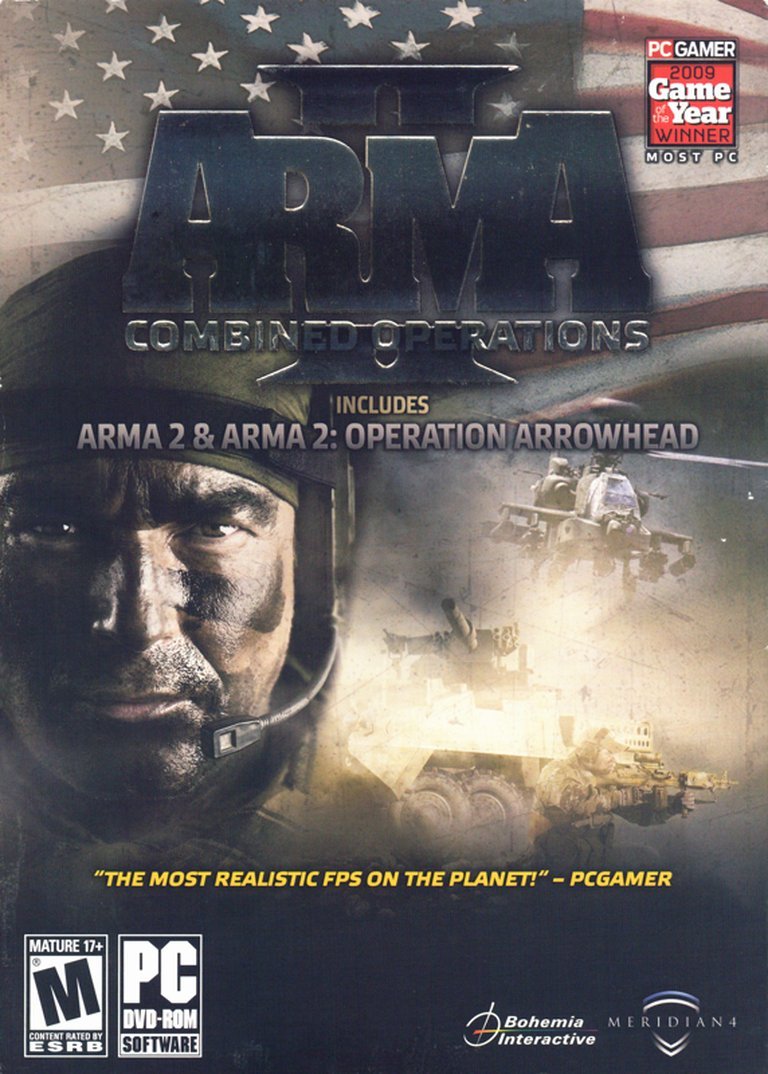
Arma II: Combined Operations is a military simulation game that combines two titles: Arma II and Arma II: Operation Arrowhead. Set in a realistic modern-day environment, players experience the detailed life and missions of a US soldier. The game offers an immersive tactical experience with a focus on realism, featuring a variety of terrains, factions, weapons, and vehicles. It supports both single-player and multiplayer modes, allowing for large-scale battles with up to 100+ players online.
Gameplay Videos
Arma II: Combined Operations Cracks & Fixes
Arma II: Combined Operations Patches & Updates
Arma II: Combined Operations Guides & Walkthroughs
Arma II: Combined Operations Reviews & Reception
metacritic.com (100/100): Revolutionary gameplay even in alpha state. This will spur an entirely new direction for game design in what you could even call a new genre.
pcworld.com : Challenging partly by design and partly due to sluggish controls, ARMA II’s biggest appeal is its moddability.
ign.com (78/100): Proving that a game can be both brilliant and awful all at the same time.
worthplaying.com : Serious military simulations that would rival what the military uses to train troops.
moddb.com (100/100): Truly an amazing instalment when both games are put together, a must have for FPS and Simulation game lovers.
Arma II: Combined Operations Cheats & Codes
PC
Hold [Left Shift] and press [Numpad -]. Release the keys and type the cheat code (case-insensitive).
| Code | Effect |
|---|---|
| ENDMISSION | End the current mission |
| CAMPAIGN | Unlock All Campaign Missions |
| MISSIONS | Unlock All Single Player Missions |
| SAVEGAME | Save Game |
| TOPOGRAPHY | Generate Map in EMF Format |
| GETALLGEAR | Unlock All Armory Items |
| FLUSH | Flush Video Memory |
| FREEZE | Freeze Game |
| CRASH | Forced Crash Dump |
Arma II: Combined Operations: Review
A Landmark in Military Simulation and Modding Culture
1. Introduction
In the pantheon of military simulation games, Arma II: Combined Operations stands as a towering achievement—and a divisive one. Released in 2010 as a bundle of 2009’s Arma II and its 2010 expansion Operation Arrowhead, Bohemia Interactive’s opus carved a niche for unforgiving realism in an era dominated by the cinematic spectacle of Call of Duty and Battlefield. While its clunky mechanics and technical shortcomings drew criticism, its sprawling sandbox, modding potential, and hyper-authentic combat systems birthed a legacy that reshaped gaming. This review argues that Arma II is not just a game but a platform—a flawed yet visionary canvas that empowered players to redefine military simulation and spawned genres like the survival-horror phenomenon DayZ.
2. Development History & Context
Studio Vision and Technological Ambition
Bohemia Interactive, founded in 1999, had already established itself with Operation Flashpoint: Cold War Crisis, a pioneer in military sims. Arma II aimed to refine this vision using the proprietary Real Virtuality 3 engine, designed to render vast terrains (up to 225 km²) with dynamic weather, ballistics, and AI behavior. The engine supported multicore CPUs and DirectX 9, a technical leap for 2009, though performance optimization remained a challenge.
The Gaming Landscape of 2009–2010
At release, mainstream shooters prioritized accessibility over realism. Arma II defiantly bucked trends, offering systems like material penetration physics, deflection mechanics, and centimeter-precise AI pathfinding. The Operation Arrowhead expansion (2010) introduced thermal imaging, UAV controls, and a new Central Asian setting, Takistan, mirroring NATO’s contemporary conflicts in Afghanistan.
Constraints and Compromises
Bohemia’s ambition clashed with technical limitations. The AI—praised for tactical suppression fire but mocked for vehicular incompetence—epitomized this duality. Patches like v1.05 (2009) and v1.11 (2011) gradually stabilized the experience, yet the game’s complexity ensured it remained a demanding, niche title.
3. Narrative & Thematic Deep Dive
Operation Harvest Red: Chernarus in Flames
The base game’s campaign follows Master Sergeant Matthew Cooper, a U.S. Marine embedded in Chernarus, a post-Soviet state ravaged by civil war. The Chernarussian Movement of the Red Star (ChDKZ), a communist insurgency, executes a false-flag bombing to frame democratic forces. The narrative branches based on player choices: alliances with nationalist guerillas, moral compromises, and multiple endings—ranging from nuclear escalation to hard-won peace.
Operation Arrowhead: The Takistan Gambit
The expansion shifts to Corporal Howard Drake, part of a NATO task force destabilizing Takistan’s dictatorship. Themes of imperialism and counterinsurgency emerge, with missions involving civilian casualties and rogue warlords. Unlike Arma II’s bleak tone, Arrowhead embraces Hollywood-esque set pieces, like SCUD missile chases.
Layered Themes
Both campaigns interrogate the fog of war and the soldier’s role as pawn or hero. The absence of clear villains—rebels, Russians, and NATO all harbor ulterior motives—reflects Bohemia’s commitment to moral ambiguity.
4. Gameplay Mechanics & Systems
Combat: Brutal Realism
- Ballistics: Bullets drop over distance and penetrate materials authentically. A sniper shot at 800 meters requires adjusting for wind and gravity.
- AI: Allies use cover intelligently but falter in vehicles. Enemy squads flank and suppress, though erratic pathfinding occasionally breaks immersion.
- Vehicles: Over 130 drivable units, from bicycles to AH-64 Apache helicopters, each requiring nuanced control.
UI and Progression: A Double-Edged Sword
The command radial allows for complex squad orders but feels cumbersome mid-firefight. Inventory management, while realistic, is a logistical headache.
Modding: The Game’s True Legacy
Bohemia’s open SDK catalyzed a modding renaissance. DayZ (2012) transformed Arma II into a survival-horror juggernaut, while custom missions and terrains extended its lifespan. The modding scene’s creativity offset the base game’s roughness.
5. World-Building, Art & Sound
Chernarus: A Living, Breathing Battleground
Based on satellite data of the Czech countryside, Chernarus blends dense forests, crumbling Soviet bloc towns, and sprawling military bases. Day-night cycles and dynamic weather (e.g., fog obscuring snipers) heighten tension.
Art Direction: Gritty Authenticity
Low-poly models and muted textures age poorly, but the art style’s ruggedness suits the war-torn setting. Operation Arrowhead’s Middle Eastern palette—dusty hues and sun-bleached villages—contrasts starkly.
Sound Design: Immersive Chaos
Gunshots echo realistically, and radio chatter (voiced in native languages) amplifies immersion. The lack of a cinematic score underscores the bleakness of war.
6. Reception & Legacy
Initial Reviews: Praise and Frustration
Critics lauded its ambition (Game Chronicles: “The ultimate military simulator”) but panned its bugs (HonestGamers: “Calls on players to finish the hard work”). With a 72% MobyScore, it polarized audiences.
The DayZ Effect
Dean Hall’s DayZ mod (2012) revitalized Arma II, propelling sales to 2.3 million copies by 2015. Its success birthed the survival genre and inspired PUBG and Fortnite.
Industry Impact
Arma II proved niche sims could thrive via community-driven content. Its DNA lives on in Arma 3 (2013) and Bohemia’s Vigor (2019).
7. Conclusion
Arma II: Combined Operations is a paradox: a janky, impenetrable simulator that became a cornerstone of PC gaming. Its unflinching realism and modding freedom birthed genres, while its flaws—clunky UI, uneven AI—remain cautionary tales. For historians, it represents a turning point where players co-opted development; for soldiers of fortune, it’s still the closest thing to war without enlisting. Bohemia’s vision was imperfect, but its ambition reshaped gaming—a legacy no bug could erase.
Final Verdict: Arma II is less a game than a platform for possibilities, securing its place as a cult classic and a testament to simulation’s power.