
- Release Year: 2012
- Platforms: Windows
- Publisher: Tradewest, Inc.
- Genre: Compilation
- Average Score: 72/100
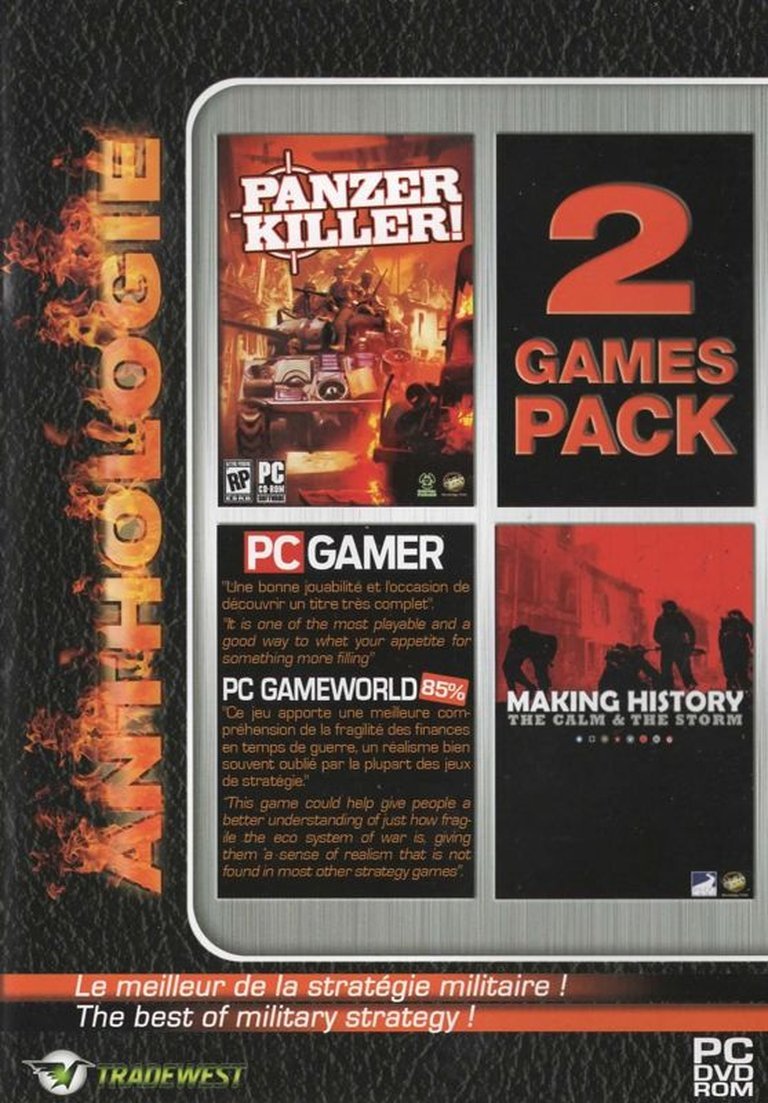
Description
Armed Forces: Anthologie is a 2012 Windows compilation bundling two military strategy games: ‘Making History: The Calm & The Storm’ and ‘Panzer Killer!’, released on DVD-ROM. This collection offers players tactical warfare experiences where they command armed forces and engage in historical reimaginations of conflict scenarios.
Armed Forces: Anthologie Cracks & Fixes
Armed Forces: Anthologie Reviews & Reception
metacritic.com (70/100): This is a piece of history that is a worthy investment of both your time and money.
gamefaqs.gamespot.com : An exemplary collection of truly classic games.
pocketgamer.com : Three games from the very dawn of time that certainly didn’t deserve the indignity of being woken from their undead slumber
metacritic.com (75/100): With a ton of great games that still hold up to today’s standards, as well as all the extras and the little touches that show that Anthology was lovingly crafted as opposed to hastily slapped together, as many similar collections tend to be, it’s hard to find any reason not to recommend it.
Armed Forces: Anthologie Cheats & Codes
PC – Comanche 4 (from Armed Forces Collection)
During gameplay, press the ` key, input the following codes and press Enter.
| Code | Effect |
|---|---|
| 8cdd5735 | Invisibility (enemy won’t target/attack you) |
| doubledouble | Full Reload, Infinite Stingers, Hydras, Hellfire |
| 6b28e699 | Temporary Invincibility (Lasts about 15 mins.) |
PC – Delta Force 2 (from Armed Forces Collection)
Hit ~ and then enter the following codes.
| Code | Effect |
|---|---|
| revelations | 8 Art. Rounds |
| thetrooper | God Mode |
| stilllife | Invisibility |
| sunandsteel | Reload |
| diewithyourbootson | Unlimited Ammo |
PC – F-16 Multirole Fighter (from Armed Forces Collection)
First press ”T” Then type one of the following codes to activate the cheat.
| Code | Effect |
|---|---|
| you got what i need | Unlimited ammunition |
| goes here | Reload weapons food |
| big gulp | Refuel |
| youre here forever | Invincibility |
| damn that corner | Disable crashes |
| chiliburger | Repair damage |
| spindive | Plane cannot be hit |
| upside down | Auto level and fly upside down |
| paperairplane | Paper airplane |
| water boy | Cannot crash on water |
| show throttle | Display throttle |
| show mach | Display speed in mach units |
| show velocity | Display air speed |
| show ground speed | Display ground speed |
| show fuel | Display fuel usage |
| show fuel usage | Display fuel usage as % |
| show altitude | Display altitude in feet |
| show aoa | Display angle of attack |
| blackout | Toggle blackouts |
| flameout | Toggle flameouts |
| flatspin | Toggle flatspins |
PC – Armed Forces Corp
During game play press ‘T’ to open the chat/team speak window, then type the following codes.
| Code | Effect |
|---|---|
| god | God mode |
| guns | All weapons |
| ammo | Full ammo in all weapons |
| kfa | All Weapons and Ammo |
| tears | Unlimited Ammo |
| poltergeist | Ghost Mode |
| maphole | Skip Level |
Armed Forces: Anthologie: Review
Introduction
In the early 2010s, as the video game industry accelerated toward hyper-realistic shooters and sprawling open worlds, a quieter trend emerged: the curated anthology. These compilations served as digital time capsules, bundling niche or aging titles to preserve their legacy and introduce them to new audiences. Among these, Armed Forces: Anthologie, released on May 30, 2012, by Tradewest, Inc., stands as a fascinating artifact. This Windows-exclusive DVD-ROM package gathered two 2007 titles—Making History: The Calm & The Storm and Panzer Killer!—under a single banner, offering players a dual perspective on World War II. While neither game achieved mainstream acclaim, the compilation’s value lies less in cohesive entertainment and more in its role as a historical document of mid-2000s strategy gaming. This review deconstructs Anthologie through the lens of its historical context, gameplay mechanics, cultural impact, and legacy to argue that, despite its flaws, it represents a vital snapshot of a genre at a crossroads.
Development History & Context
Armed Forces: Anthologie emerged from a confluence of industry trends and technological constraints. The late 2000s saw WWII strategy games grappling with a shift: while titles like Company of Heroes (2006) prioritized visceral action, developers like Muzzy Lane Software (creators of Making History) pursued a more cerebral, turn-based approach to geopolitics. Making History was lauded for its depth but criticized for its steep learning curve, reflecting a market hungry for accessible historical simulation. Panzer Killer!, developed by an uncredited studio (common for budget titles), exemplified the tactical niche, focusing on armored combat in the vein of Panzer General but with less polish.
Technologically, both titles were products of their era. Released in 2007, they operated on the cusp of DirectX 10 adoption, constrained by mid-range PC hardware and limited AI sophistication. Their inclusion in Anthologie in 2012—a year dominated by cinematic shooters like Call of Duty: Modern Warfare 3 and open-world epics like The Elder Scrolls V: Skyrim—was an anachronism. Compilations like Activision Anthology (2002) had proven that retro bundles could preserve legacy, but by 2012, the model struggled against digital distribution and rising development costs. Tradewest, Inc., a publisher with roots in the 1980s arcade scene, likely aimed to capitalize on niche strategy enthusiasts and budget-conscious players, positioning Anthologie as a “greatest hits” package for WWII connoisseurs.
Narrative & Thematic Deep Dive
Anthologie’s two titles offer contrasting narratives, unified only by their WWII setting but diverging sharply in scope and tone. Making History: The Calm & The Storm eschews traditional storytelling, instead presenting a sandbox of alternate history. Players assume leadership of any nation from 1936 to 1945, with events like the Munich Crisis or Pearl Harbor branching based on diplomatic decisions. Dialogue is sparse, confined to event texts, treaty proposals, and newsreel-style announcements. The narrative emerges from player agency: aligning with the Axis as Germany or forging an unlikely alliance as Turkey. Themes center on the fragility of peace, the cost of imperialism, and the butterfly effect of political choices. For instance, a failed appeasement of Japan might trigger a Pacific War decades earlier, highlighting the game’s core thesis: history is not inevitable, but a tapestry of human error.
Panzer Killer!, by contrast, adopts a more conventional, mission-driven narrative. Players command a tank crew through scripted campaigns, such as the Battle of Kursk or North Africa. Dialogue is functional—tactical orders, radio chatter, and scripted vignettes—designed to immerse in the chaos of armored warfare. Themes revolve around camaraderie, the dehumanization of war, and the mechanical terror of tank combat. A recurring motif is the crew’s vulnerability: one mission tasks players protecting medics from strafing, emphasizing that even “heroes” are cogs in a larger machine.
The compilation’s overarching narrative is one of duality: Making History’s grand, abstracted geopolitics versus Panzer Killer!’s intimate, visceral combat. This dissonance reflects a broader tension in historical games of the era—whether to prioritize systemic simulation or human drama. Neither title fully resolves this, but together they form a fragmented portrait of WWII’s multifaceted horror.
Gameplay Mechanics & Systems
Making History’s core loop revolves around resource management, diplomacy, and military production. Players allocate funds to industry, research technologies (e.g., radar or atomic bombs), and negotiate alliances or sanctions. Turn-based ground combat is abstracted, focusing on army stacks and strategic movement, while naval and air battles occur in real-time. The system’s innovation lies in its “what-if” engine: historical events like the Molotov-Ribbentrop Pact can be altered, creating domino effects. However, this ambition is hampered by clunky UI—micromanaging trade routes feels like navigating spreadsheets—and AI that often blunders into nonsensical wars.
Panzer Killer! shifts to real-time tactics, where players control individual tanks and infantry. Mechanics include armor-penetration calculations, terrain cover, and command points for special abilities (e.g., smoke screens). Missions emphasize combined arms, requiring players to coordinate armor with anti-tank guns or infantry. The system’s strength is its tactile feel: the satisfying thump of a Tiger’s 88mm cannon or the panic of a flanking maneuver. Yet, it falters in execution. Enemy AI relies on predictable patterns, and mission objectives often devolve into “find and destroy” slogs. Progression is linear, with no persistent upgrades, reducing replayability.
Anthologie’s greatest mechanical flaw is its lack of cohesion. The compilation forces players to switch between radically different systems, with no unifying progression. UI inconsistencies further jar the experience—Making History’s text-heavy menus clash with Panzer Killer!’s minimalist HUD. The inclusion of both games feels arbitrary, lacking the thematic curation seen in later anthologies like Atari 50: The Anniversary Celebration.
World-Building, Art & Sound
Making History’s world is a meticulously rendered, though dated, map of Europe, Africa, and the Pacific. Borders shift dynamically, and cities are represented as colored pins. The art style blends historical photos with simple 3D sprites for units, creating a “living map” aesthetic. Sound design is functional: period-appropriate marches (e.g., “Lili Marleen”) punctuate menus, while battles erupt with sampled gunfire and explosions. The overall effect is a museum diorama—educational but emotionally detached.
Panzer Killer! offers a grittier, more immersive world. Battlefields are rendered in detailed 2D isometric views, with crumbling buildings, hedgerows, and tank tracks leaving persistent marks. Art leans into realism, with historically accurate Panzer IVs and T-34s, albeit with low-poly models. Sound design excels here: the metallic groans of tank treads, the whistle of incoming shells, and the static-crackle of radio transmissions evoke the claustrophobia of armored warfare.
Anthologie’s art and sound highlight its two worlds: the strategic abstraction of Making History contrasts sharply with Panzer Killer!’s tactile chaos. Neither title pushes graphical boundaries for its time, but their preservation in 2012 underscores a commitment to authenticity. The compilation’s DVD-ROM format allowed for high-resolution assets, though the absence of modern conveniences like quick-save or resolution options betrays its age.
Reception & Legacy
At launch, Armed Forces: Anthologie received minimal critical attention, overshadowed by AAA blockbusters. Its parent titles fared better: Making History earned praise for its ambition (e.g., a 7.5/10 from GameSpot for its “what-if” scenarios) but criticism for its complexity. Panzer Killer! passed in relative obscurity, noted only for its niche appeal. Commercially, Anthologie was a footnote, with MobyGames recording only one collector by 2024—a stark contrast to compilations like Activision Anthology (2002), which celebrated gaming’s origins with unlockable patches and 80s soundtracks.
Its legacy, however, is more nuanced. In the 2010s, as retro gaming gained scholarly traction, Anthologie emerged as a case study in historical games studies. Academic work, such as Hartman, Tulloch, and Young’s “Video Games as Public History” (2021), highlights compilations as archives of interactive history. Anthologie embodies this: Making History’s sandbox fosters “historical empathy” by letting players navigate moral dilemmas, while Panzer Killer!’s tactile combat simulates war’s physicality. Yet, its lack of modern accessibility—no tutorials, no quality-of-life updates—limits its pedagogical utility compared to Ubisoft’s Valiant Hearts: The Great War (2014), which seamlessly blends gameplay with historical facts.
Culturally, Anthologie reflects a bygone era of physical media and niche PC gaming. Its influence is indirect; later WWII titles like Company of Heroes 2 (2013) adopted Making History’s dynamic event systems, while Panzer Killer!’s focus on armored combat prefigured games like Squad’s DLCs. Yet, its true legacy is preservation: in 2024, MobyGames’ archival efforts ensure it remains a reference point for researchers studying strategy games’ evolution.
Conclusion
Armed Forces: Anthologie is less a cohesive experience and more a historical curiosity—a time capsule of mid-2000s strategy gaming. Its strengths lie in its dual perspectives on WWII: Making History’s grand geopolitical tapestry and Panzer Killer!’s intimate combat snapshots. Yet, these are bound by technical limitations, mechanical dissonance, and an era’s design philosophies that prioritized simulation over accessibility. For modern players, its dated UI and steep learning curve make it a challenging relic.
Still, Anthologie deserves a place in video game history. As a physical compilation, it exemplifies the 2010s’ tension between digital distribution and legacy preservation. Thematically, it captures the genre’s early experiments with alternate history and tactical authenticity. While it lacks the polish of later titles like Hearts of Iron IV (2016), its inclusion of two distinct WWII experiences offers a valuable, if fragmented, document of how games grapple with history’s complexities. In the end, Armed Forces: Anthologie is not a masterpiece, but a testament to the enduring power of preservation—and a reminder that even flawed artifacts can illuminate the past.