
- Release Year: 2004
- Platforms: Windows
- Publisher: Cinergi Interactive LLC, City Interactive S.A., Electronic Arts, Inc., Noviy Disk
- Developer: Black Hole Entertainment
- Genre: Strategy, Tactics
- Perspective: Diagonal-down
- Game Mode: LAN, Online PVP, Single-player
- Gameplay: Base building, Experience progression, Hero units, Real-time strategy, Resource Management, RPG elements, Squad management, Underground Exploration
- Setting: Fantasy
- Average Score: 70/100
Description
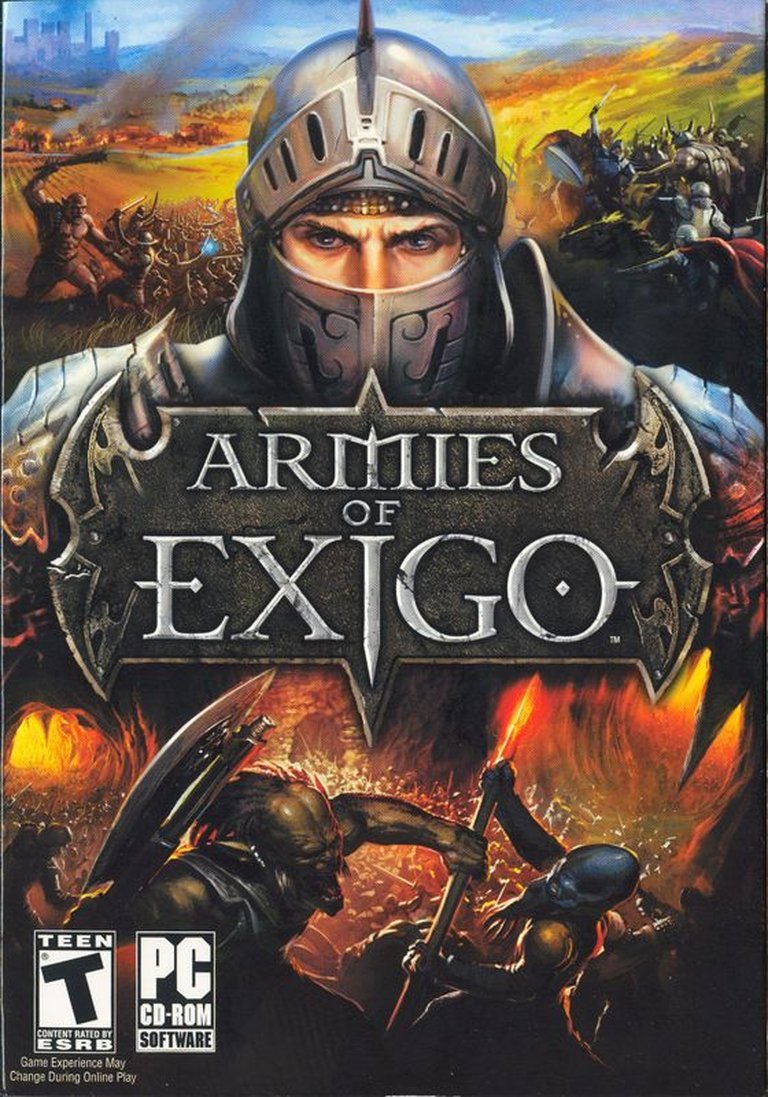
Armies of Exigo is a real-time strategy game with role-playing elements set in a fantasy world, where a young hero, guided by prophecy, must lead the council to defend the land of Men from a returning bestial invasion. Players command one of three factions, engage in base building, manage resources like gold, wood, and gems, explore underground passages, form supergroups, and control heroes and units that gain experience, blending traditional RTS mechanics with RPG progression.
Gameplay Videos
Armies of Exigo Free Download
Armies of Exigo Cracks & Fixes
Armies of Exigo Patches & Updates
Armies of Exigo Reviews & Reception
metacritic.com (69/100): It is simply one of the best handling RTS games that I’ve ever played, and I played just about all of them.
monstercritic.com (69/100): It is simply one of the best handling RTS games that I’ve ever played, and I played just about all of them.
ign.com (70/100): The perfect game for that nostalgic masochist in your life.
Armies of Exigo Cheats & Codes
PC
| Code | Effect |
|---|---|
| god | never loss health. |
| kill | kill by one hit. |
| i see dead people | show all the map. |
| warpten | speed construction of building and units |
| sharp and shiny | up grades weapons. |
| level increase | level up. |
| greed good | unlimited gold,un limited wood,un limited crystal. |
| unit | unit amount zero , unit limit 200. |
Armies of Exigo: The Competent Clone That Couldn’t Conquer the Throne
In the crowded annals of early-2000s real-time strategy, few titles embody the genre’s creative tension between homage and innovation quite like Armies of Exigo. Released in 2004 by the Hungarian debutante Black Hole Entertainment and published by Electronic Arts, the game arrived at a moment when Blizzard’s Warcraft III had firmly established the RTS-RPG hybrid as the gold standard. Exigo’s legacy is not one of groundbreaking revolutions, but of meticulous craftsmanship and astute, if unoriginal, design. It stands as a fascinating case study: a technically proficient, lavishly produced game that was ultimately consumed by the very giants it sought to emulate, leaving behind a cult following that still debates its merits nearly two decades later. This review will argue that Armies of Exigo is a quintessential “nearly great” game—a title whose sum of excellent parts never quite transcended its derivative whole, yet whose ambition in tactical depth and production value marks it as a significant, if flawed, entry in the RTS canon.
Development History & Context: A Hollywood Backed Debut
The genesis of Armies of Exigo is as unusual as the game’s dual-layer battlefield. The studio, Black Hole Entertainment, was founded in 2001 in Budapest, Hungary, by a group of hardcore RTS enthusiasts. Its most notable backer was Andrew Vanja, a Hollywood producer with credits on Total Recall, Terminator 3, and Rambo. Vanja’s involvement, as reported by IGN’s E3 2004 preview, was not about acquiring a film license but about applying a cinematic sensibility to an original game concept. This intersection of Hollywood production values and Central European development talent shaped Exigo’s identity: it was to be a visually spectacular, story-driven RTS that felt like a blockbuster film.
The technological context of 2004 was one of transition. 3D acceleration was standard, but Exigo pushed for impressive unit counts (reportedly 200+ on screen) and detailed environments. Its custom engine allowed for the key feature of seamless underground warfare, a technical challenge that required designing a fully functional second map layer with interconnected tunnels. This was a deliberate attempt to innovate within a saturated market where Warcraft III (2002), Age of Mythology (2002), and the Lord of the Rings: Battle for Middle-earth (2004) had all recently raised the bar for fantasy RTS. Black Hole’s vision, as stated in MobyGames’ description, was to create an “RPS (RTS-RPG hybrid) in the tradition of Warcraft III.” This openly derivative goal was both its greatest asset—providing a familiar, accessible framework—and its fatal flaw, as it failed to establish a unique identity strong enough to compete with the franchises it mimicked.
Narrative & Thematic Deep Dive: A Patchwork Prophecy
Armies of Exigo’s plot is a quintessential example of early-2000s fantasy storytelling, pulling liberally from Tolkien-esque wellsprings and the emerging “dark god” trope popularized by games like Warcraft III. The narrative is structured around three campaigns, each from the perspective of one of the game’s factions: the Empire (humans, elves, dwarves), the Beasts (orcs, goblins, lizardmen), and the Fallen (a race of insectoid/eldritch void creatures).
The Empire campaign centers on Alric do Rei, a young mage thrust into the role of High Lord of the Council of Mages after his master’s death. The core prophecy involves the ancient wizard Ruannon Flamebringer, who millennia ago defeated the “Two Fathers of the Fallen” and sealed them away. He created the Three Seals and the Obsidian Tower to guard the Heart of the Void, an artifact that can merge the world with the Fallen’s dark plane. Alric, styled the “Chaosbringer” for a catastrophic defensive spell, is the true successor to Ruannon. His journey involves uniting the squabbling human lords, forming an alliance with the Beasts, and confronting the Fallen’s champion, Keran Kessertin. Key allies include the steadfast commander Dunehelm Bellangere and the enigmatic leader of the Order of Ruannon.
The Beast campaign follows Tyron Gral, the messianic chieftain of the beast hordes, who receives visions from the “Ancient Spirits” commanding him to exterminate the surface dwellers. His son, Dragga, initially loyal, gradually recognizes the true existential threat posed by the Fallen. After Tyron is killed by the lizard queen Sseeth for his extremism, Dragga assumes leadership and brokers the crucial alliance with Alric. The Beast narrative explores themes of tribal honor, perceived Manifest Destiny, and the painful necessity of overcoming ancient hatreds for survival.
The Fallen campaign, unlocked later, reveals the antagonists’ perspective. Keran Kessertin, a Voidwalker in disguise, masterminds the invasion. He is an elite chanter serving the enigmatic Ageless Ones and the Dark Dreamer. His plot involves breaking the Three Seals. A crucial secondary antagonist is Princess Domina of the Dark Elves, banished underground. She forges a temporary alliance with Keran, using her necromantic powers to massacre dwarves and elves alike in service of her own revenge, ultimately helping break the Third Seal. Her tragic arc—a queen consumed by vengeance—is one of the narrative’s more compelling elements. The campaign culminates in the Field of Sorrows and the Chamber of Screams, where Keran’s forces release the Two Fathers. In the finale at the Obsidian Tower, Alric is killed, Dragga destroys the Heart of the Void, and Keran is left staring at its ruins, his fate ambiguous.
Thematically, the game grapples with prophecy vs. agency (Alric fulfilling Ruannon’s legacy), * unity through necessity* (the forced Empire-Beast alliance), and the corruption of power (Domina’s fall, Keran’s transformation into an Avatar). However, the execution is notably blunt. Dialogue is functional, often expository, and the plot’s twists—like Vangarath’s betrayal or Keran’s reveal—are telegraphed. The “ancient evil return” premise is exhaustingly familiar, and the three-way conflict resolves into a predictable “good vs. evil” alignment by the end, with the Beasts’ initial antagonism quickly sidelined. The narrative’s saving grace is its cinematic presentation. As IGN noted, the influence of producer Andrew Vanja is clear in the “edgy” pre-rendered cutscenes, which, while not technically superior to Blizzard’s work, are packed with dramatic lighting and character close-ups that lend a sense of epic gravitas missing from the script itself.
Gameplay Mechanics & Systems: The Two-Front War
At its core, Armies of Exigo is a traditional base-building RTS with RPG elements, adhering closely to the Warcraft III template. Players gather three resources—gold, wood, and gems—to construct a tiered tech tree of buildings and train units. Each faction has a distinct roster and architectural style, but the fundamental loop of “build worker, gather resources, build army, attack” is unchanged.
The game’s most significant and celebrated innovation is its dual-layer gameplay. Every map has a surface and an underground layer, connected by pre-set tunnels or manually dug passages (using specialized units like the Beast’s “Tunnelers” or the Fallen’s “Burrowers”). This is not merely a graphical effect; it is a complete, parallel battlefield. Units can move, fight, gather, and build entirely underground. As IGN’s E3 preview observed, this allowed for strategic strikes behind enemy lines, such as emerging behind an opponent’s catapult batteries. Critically, spellcasters on one layer can affect the other—an underground mage could cast a poison spell that bubbles up to damage surface units, or a seismic spell could collapse tunnels. This feature directly addresses a common RTS frustration: being bombarded from an unreachable position. It adds a crucial layer of reconnaissance and counter-play, as players must defend both their main base and their tunnel networks.
Complementing this is the unit leveling system. Nearly all combat units (excluding mechanical units and most spellcasters) gain experience from killing enemies and can level up to level 5, becoming stronger with each rank. This creates a sense of persistent attachment to one’s forces, encouraging careful micro-management to preserve veteran units. However, the implementation is slow and subtle, lacking the flashy hero-centric focus of Warcraft III. The Empire and Beasts level individually; the Fallen use a collective “Soul Trap” system, a more abstract approach that fits their hive-mind aesthetic.
The game also introduces the “supergroup” mechanic (also called “number groups” or “hotkey groups”). Players can assign multiple pre-selected squads to a single number key, allowing for the swift deployment of complex, combined-arms forces. This was praised by some reviewers, like Game Informer, as an “awesome” quality-of-life feature for managing large armies.
However, the gameplay systems are not without flaws. Critics were divided on the underground layer’s utility. While some, like GameSpy, saw it as a “modest innovation,” others, such as FOK!games and Gaming Nexus, found it underdeveloped. The criticism was that underground maps often felt like isolated side-quests with limited strategic impact on the main surface battle, questioning “what the nut of it is” (FOK!games translation). The terrain-destruction spells promised at E3 were present but not as transformative as hoped.
The AI and pacing received mixed reviews. GameStar complained of difficulty spikes that oscillated between “too easy and too hard” and an AI that “cheats on all corners.” This inconsistency could frustrate players. Furthermore, the late-game economy and unit control were noted as potentially unwieldy with large armies, a common issue in RTS of this era but one Exigo did not solve.
In terms of faction design, the Empire represents a balanced, versatile human/elf/dwarf alliance with strong defensive units and spellcasters. The Beasts are aggressive, relying on cheap, numerous melee units and powerful ogres. The Fallen are the most exotic, featuring bio-organic units, spellcasters that channel power from their “Heart of the Void,” and a collective experience mechanic. While functional, reviewers consistently noted the lack of a truly iconic, defining unit or ability on par with the Warcraft Archmage’s Blizzard or the Zerg’s Lurker. The factions, while different, did not feel revolutionary.
World-Building, Art & Sound: A Polished but Familiar Fantasy
Armies of Exigo’s presentation is where the game most clearly distinguishes itself from its competitors and fulfills the promise of its Hollywood backing. The visual direction is high-fidelity for its time. Using a custom 3D engine, the game features lush, detailed environments—verdant human farmlands, oppressive beastish badlands, and cold, crystalline fallen caverns. Unit models are rich in polygons and animation (as Gry OnLine noted, “models do not suffer from lack of polygons”), and the pre-rendered cutscenes, while not Blizzard-tier, are moody and professionally composed. The art style avoids Warcraft’s stylized cartoonishness, opting for a more “realistic” (in the context of 2004 fantasy) and somber aesthetic, which helped it evade direct copyright comparisons. The UI is clean, and the game maintained impressive frame rates even in massive battles, a point highlighted by multiple reviewers (GameZone, Gry OnLine).
The sound design and music are a point of contention. The score was composed by Jeremy Soule, a legendary figure in game music (The Elder Scrolls, Guild Wars). However, several reviews, most notably Computer Gaming World, harshly criticized the sound as “laughably weak,” suggesting the developers “didn’t quite have enough time” for audio. This is a puzzling critique given Soule’s involvement, but it may point to implementation issues—weak battlefield音 effects, unmemorable unit vocalizations, or a mix that failed to deliver the impact expected. The campaign’s narrative weight was carried more by the visuals and text than by an iconic soundtrack.
The world-building is competent but unoriginal. Noran is a standard fantasy continent with human kingdoms, elven forests, dwarven mountains, and beastish wastes, plus the underworld realm. The Fallen’s “void” aesthetic is the most memorable addition, with organic, chitinous architecture. The three-layer conflict (surface empires, beast hordes, fallen invaders) provides clear narrative stakes but offers no deeper lore than the typical “ancient evil awakens” trope. The setting serves its functional purpose as a playground for the three factions but lacks the rich, cohesive mythos of Warcraft or Warhammer.
Reception & Legacy: The Bridge That Wasn’t Crossed
Upon release in late 2004, Armies of Exigo received a generally positive but lukewarm critical reception. Its Metacritic score of 69 and MobyGames average of 75% (based on 46 critics) place it solidly in “mixed or average” territory. The critical consensus is remarkably consistent: this is a very well-made, polished, and fun RTS that is fatally hamstrung by its profound lack of innovation.
The most common refrain was that it was a highly competent Warcraft III clone. Deaf Gamers stated it “combines Starcraft with Warcraft,” while Eurogamer called it “a clone of Warcraft III, presented with a nicer graphics engine.” Armchair Empire bluntly noted it “mimics Blizzard’s classics to the point of near-copyright infringement.” The praise was directed at its execution: the graphics engine, the smooth unit handling, the variety of missions, and the well-balanced races (a point made by GameSpy, PC Games Germany, and others). The underground mechanic was cited as its sole true differentiator, but even that was often seen as a “modest” or “embryonic” innovation that wasn’t fully fleshed out (Gaming Nexus, GameSpy).
The commercial performance was underwhelming. Despite EA’s distribution, the game vanished from shelves quickly. Its online multiplayer, reliant on GameSpy, was shut down in October 2006, effectively severing its most promising long-term play avenue. It did not receive a sequel or any major expansions from Black Hole Entertainment. The studio’s subsequent work, like Warhammer: Mark of Chaos (2006), suggests they moved towards more established licenses, perhaps acknowledging that an original RTS IP was a tough sell against Blizzard and later, Relic Entertainment’s Company of Heroes (2006).
Its legacy is that of a “what if.” It demonstrated that a non-American studio could craft an RTS with production values rivaling the best in the genre. Its underground warfare concept, while imperfectly realized, was a genuine attempt to deepen RTS tactics. A dedicated, if small, modding community has kept it alive, with projects like “The Third Prophecy” mod aiming to rework its systems and extend its story (visible on ModDB). Fan comments on sites like ModDB and MobyGames frequently express nostalgia and a belief that the game was “ahead of its time” in terms of tactical depth, or at least a “great game for its time” that was tragically overlooked.
However, its historical impact is minimal. It did not influence major RTS design trends. The two-layer concept was not widely adopted. It is rarely cited in developer post-mortems or “greatest RTS” lists. Instead, it occupies a space as a curated footnote—a game that RTS aficionados remember fondly for its ambition and feel, but which historians note as a prime example of the genre’s saturation problem in the mid-2000s. It proved that copying Blizzard’s formula with competence was not enough; one needed a Warcraft or a StarCraft—a unifying vision, iconic art, and revolutionary mechanics—to truly capture the throne.
Conclusion: A Formidable Base, An Unbuilt Keep
Armies of Exigo is a game of glorious potential and cautious execution. It is the best argument for the “competent clone” school of game design. Every system—from the smooth unit pathfinding and impressive scale to the intriguing underground layer and persistent unit leveling—works with palpable purpose. Its presentation, from Jeremy Soule’s score (where implemented well) to its detailed 3D models, screams “premium product.” Yet, for all this polish, it feels hollow at its core because it has nothing new to say. Its story is a collage of fantasy tropes. Its factions, while distinct, are reassemblages of familiar archetypes. Its revolutionary two-layer battlefield, its one truly unique selling point, remains a fascinating but underutilized mechanic, more of a tactical gimmick than a paradigm shift.
In the grand history of video games, Armies of Exigo will not be remembered as a classic. It did not define a generation, spawn a franchise, or fundamentally alter the RTS landscape. But it should be remembered as a masterclass in derivation. It proves that with sufficient talent, budget, and understanding of genre conventions, a derivative game can be exceptionally fun, well-balanced, and visually impressive. It is a testament to the fact that execution can be a form of artistry in itself. For the historian, it is a snapshot of a studio swinging for the fences against a titan, landing a solid double, and then being forgotten because the game was already in extra innings. For the player, it remains a deeply satisfying, if familiar, 20-hour campaign and a robust multiplayer experience that, in its heyday, offered some of the most strategically dense and visually spectacular battles of 2004. Armies of Exigo may not have conquered the throne, but it built a formidable base right next to it, and for that, it deserves a place in the archives—not as a king, but as a formidable and forgotten duke.