
- Release Year: 2005
- Platforms: Windows
- Publisher: 1C Company, CITY interactive Sp. z o.o., Groove Media Inc.
- Developer: Jarhead Games Inc.
- Genre: Action
- Perspective: 1st-person
- Game Mode: Single-player
- Gameplay: Railgun sequences, Shooter, Squad-based
- Setting: Africa, Somalia, War
- Average Score: 73/100
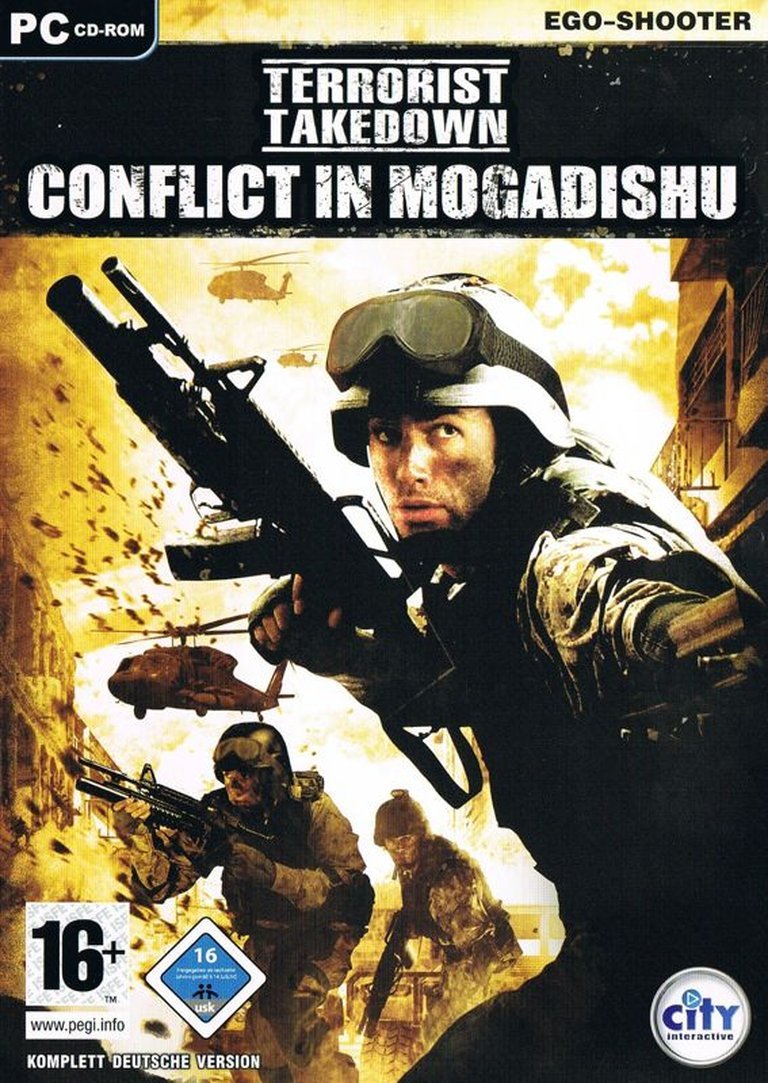
Description
Army Ranger: Mogadishu is a first-person shooter set during the infamous ‘Black Hawk Down’ incident in Somalia in 1993. Players take on the role of a U.S. Army Ranger squad commander, navigating through hostile environments such as fortified oil tankers, towns, and desert landscapes while battling rebel forces. The game features squad-based tactics, allowing players to issue commands like ‘hold position’ or ‘engage,’ as well as vehicle-based combat, including helicopter and Hummer sequences. The campaign culminates in a tense nighttime rescue mission to save downed Black Hawk personnel, blending historical context with intense tactical gameplay.
Gameplay Videos
Army Ranger: Mogadishu Free Download
Army Ranger: Mogadishu Cracks & Fixes
Army Ranger: Mogadishu Guides & Walkthroughs
Army Ranger: Mogadishu Reviews & Reception
metacritic.com (56/100): No multiplayer options almost seems to be a crime for a modern FPS game. The limited squad-based interaction doesn’t help to elevate the game to a higher standard.
myabandonware.com (90/100): It worked great on my PC.
Army Ranger: Mogadishu Cheats & Codes
PC
While playing the game, press the 9 Key to access the console and then type the following codes and Press ENTER.
| Code | Effect |
|---|---|
| MPGOD | God Mode |
| MPHEALTH | Full Health |
| MPKFA | All Weapons/Ammo |
| MPGUNS | All Guns |
| MPAMMO | All Ammo |
| MPMAPHOLE | Skip Level |
Army Ranger: Mogadishu: A Flawed but Fascinating Relic of Early 2000s Military Shooters
Introduction: A Game Caught Between Eras
Army Ranger: Mogadishu (2005) is a curious artifact—a first-person shooter that attempted to capitalize on the growing interest in modern military conflicts but ultimately stumbled under the weight of its own ambitions and the rapid evolution of the genre. Released during a pivotal moment in gaming history, it arrived just as titles like Call of Duty 4: Modern Warfare (2007) were redefining the standards for military shooters. While Army Ranger: Mogadishu (also known as Terrorist Takedown: Conflict in Mogadishu in Europe) aimed to deliver a gritty, squad-based experience set during the infamous 1993 “Black Hawk Down” incident in Somalia, it instead became a cautionary tale of how quickly a game could feel outdated.
This review will dissect Army Ranger: Mogadishu in exhaustive detail, exploring its development, narrative, gameplay mechanics, technical execution, and legacy. We’ll examine why it failed to resonate with critics and players alike, while also acknowledging the fleeting moments where it hinted at something more ambitious. Was it a bold experiment ahead of its time, or a rushed cash-in on a tragic real-world event? The answer, as we’ll see, is far more nuanced.
Development History & Context: The Birth of a Budget Military Shooter
The Studio Behind the Game: Jarhead Games and the Terrorist Takedown Series
Army Ranger: Mogadishu was developed by Jarhead Games, a studio that specialized in budget-friendly military shooters. The game was part of the Terrorist Takedown series, which began in 2004 with the original Terrorist Takedown. These games were published by Groove Games in North America, City Interactive in Germany, and 1C Company in Russia, targeting a niche audience of players hungry for military-themed action but unwilling or unable to invest in AAA titles.
Jarhead Games was no stranger to the first-person shooter genre, having previously worked on titles like World War II: Sniper – Call to Victory and Marine Sharpshooter II: Jungle Warfare. Their games were often built on licensed engines, and Army Ranger: Mogadishu was no exception—it utilized the LithTech Jupiter engine, a middleware solution that had powered other early 2000s shooters like No One Lives Forever and Shogo: Mobile Armor Division. While LithTech Jupiter was capable of delivering decent visuals for its time, it was already showing its age by 2005, especially when compared to the proprietary engines used by industry leaders like id Software (Doom 3) and Valve (Half-Life 2).
The Vision: A Squad-Based Shooter Set in a Real-World Conflict
The game’s premise was ambitious for a budget title: players would take on the role of a U.S. Army Ranger commander during the Battle of Mogadishu (1993), a real-life military engagement that had been popularized by Mark Bowden’s book Black Hawk Down (1999) and Ridley Scott’s 2001 film adaptation. The developers aimed to blend squad-based tactics with rail-shooter sequences, offering players the chance to command a team of Rangers while also engaging in vehicle-based combat (e.g., manning a helicopter’s minigun or a Humvee’s mounted machine gun).
The game’s story and script were penned by Bryan Ekman, who also served as the game’s art director and executive producer. Ekman’s vision was to create a game that felt authentic to the events of Mogadishu, though the final product would struggle to balance historical accuracy with gameplay accessibility.
Technological Constraints and the Gaming Landscape of 2005
By 2005, the first-person shooter genre was in the midst of a renaissance. Half-Life 2 (2004) had set a new benchmark for physics, storytelling, and immersion, while Far Cry (2004) showcased the potential of open-ended combat in lush, dynamic environments. Meanwhile, Doom 3 (2004) pushed the boundaries of lighting and atmosphere, and Halo 2 (2004) demonstrated the power of console shooters with its tight controls and epic multiplayer.
Army Ranger: Mogadishu, however, was constrained by its budget, engine, and development timeline. The LithTech Jupiter engine, while serviceable, lacked the advanced features of its competitors. The game’s AI, physics, and level design were all limited by the engine’s capabilities, resulting in a product that felt stiff, repetitive, and outdated upon release.
Moreover, the game’s lack of multiplayer was a glaring omission. By 2005, online multiplayer had become a standard feature for shooters, thanks to the success of games like Counter-Strike, Battlefield 1942, and Halo 2. Army Ranger: Mogadishu’s sole focus on single-player content made it feel isolated and incomplete in an era where players expected to test their skills against others.
The Team Behind the Game
The development team for Army Ranger: Mogadishu was relatively small, with 47 people credited, including:
– Beau Brennen (Project Lead, Lead Programmer)
– Bryan Ekman (Art Director, Story and Script)
– Sean Kolton (Sound Effects)
– Brian Youds (Music, credited as Bryan Youds)
– Michael Richard Dobson (Voice Actor)
Many of the team members had prior experience in the industry, having worked on other military shooters and action games. However, the constraints of the project—both in terms of time and resources—meant that their collective talent was never fully realized in the final product.
Narrative & Thematic Deep Dive: A Missed Opportunity for Historical Storytelling
Plot Overview: A Loose Retelling of the Battle of Mogadishu
Army Ranger: Mogadishu positions the player as the commander of a squad of U.S. Army Rangers deployed to Somalia during Operation Gothic Serpent (1993). The game’s campaign loosely follows the events leading up to and including the Battle of Mogadishu, where U.S. forces attempted to capture key lieutenants of the Somali warlord Mohamed Farrah Aidid. The mission famously went awry when two Black Hawk helicopters were shot down, leading to a prolonged urban battle that resulted in 18 American deaths and over 1,000 Somali casualties.
The game’s 10 missions task players with:
– Protecting supply convoys
– Defending the U.S. base from mortar attacks
– Arresting key officials
– Rescuing hostages
– Destroying enemy facilities
– Conducting a nighttime rescue operation for the downed Black Hawk personnel
While the game’s premise is inherently dramatic, its execution leaves much to be desired. The narrative is thin, with minimal character development and little emotional weight. The dialogue is functional but unremarkable, and the voice acting—while competent—lacks the gravitas needed to sell the game’s serious subject matter.
Themes: War, Leadership, and the Cost of Conflict
Army Ranger: Mogadishu attempts to explore themes of war, leadership, and the human cost of conflict, but it does so in a superficial manner. The game’s portrayal of the Somali rebels is one-dimensional, reducing them to faceless enemies rather than complex figures with their own motivations. This lack of nuance undermines the game’s potential to offer a thoughtful commentary on the real-world events it depicts.
The game’s squad-based mechanics are intended to emphasize the importance of teamwork and leadership, but the AI’s limitations make these themes feel hollow. Your squadmates are largely incompetent, often failing to follow orders or respond intelligently to combat situations. This undermines the player’s sense of command and makes the game’s attempts at tactical depth feel like an afterthought.
Missed Opportunities: What Could Have Been
Army Ranger: Mogadishu had the potential to be a groundbreaking military shooter, but it squandered its opportunities in several key areas:
1. Historical Authenticity: The game could have delved deeper into the political and humanitarian context of the Somali conflict, offering players a more nuanced understanding of the events. Instead, it presents a simplistic “us vs. them” narrative that does little to educate or engage.
2. Character Development: The game’s protagonist and squadmates are cipher-like figures with no discernible personalities. A stronger focus on character arcs and relationships could have made the story more compelling.
3. Moral Complexity: The real-life Battle of Mogadishu was a tragic and controversial event, with significant collateral damage and questionable strategic decisions. The game could have explored these moral gray areas, but it instead opts for a black-and-white portrayal of heroism and villainy.
Gameplay Mechanics & Systems: A Flawed Foundation
Core Gameplay Loop: Repetition and Frustration
Army Ranger: Mogadishu is, at its core, a linear first-person shooter with squad-based elements. The gameplay loop revolves around:
1. Moving through a level (often a Somali village, desert, or urban environment).
2. Engaging enemy forces (who spawn in predictable locations).
3. Issuing basic commands to your squad (e.g., “Engage,” “Hold Position,” “Cease Fire”).
4. Completing objectives (e.g., rescuing hostages, destroying targets).
Unfortunately, this loop quickly becomes repetitive and frustrating due to several key issues:
1. Poor Enemy AI
The game’s enemies are braindead, exhibiting little to no tactical awareness. They stand in place, fire in predictable patterns, and rarely take cover. This makes combat feel unnatural and unchallenging, as players can often cheese their way through levels by exploiting the AI’s stupidity.
2. Unforgiving Difficulty
While the enemy AI is dumb, the game’s difficulty is punishing due to artificial constraints:
– Limited ammo and health: Players are expected to complete missions in one go, with no opportunity to resupply. This forces players to conserve resources to an unreasonable degree, leading to frustration when a single mistake results in failure.
– Unreliable squadmates: Your AI-controlled teammates are useless in combat, often failing to engage enemies or follow orders. This forces players to do all the heavy lifting, making the squad mechanics feel superfluous.
3. Clunky Controls and Mechanics
The game’s controls are crowded and unintuitive, with multiple commands mapped to the same keys. The leaning mechanic is particularly janky, allowing players to phase through walls in a way that feels more comical than tactical.
The grenade-throwing mechanic is another major flaw. Grenades are thrown in a fixed, awkward trajectory that often results in self-inflicted damage, especially in tight corridors. This design choice feels unnecessarily punishing and adds little to the gameplay.
4. Rail-Shooter Sequences: A Mixed Bag
The game features vehicle-based rail-shooter segments, where players man a helicopter’s minigun or a Humvee’s mounted machine gun. While these sequences offer a change of pace, they are repetitive and shallow, with enemies spawning in predictable locations and offering little challenge.
Weaponry and Combat: A Mixed Arsenal
Army Ranger: Mogadishu features nine authentic military weapons, including:
– M9 Beretta (pistol)
– CAR-15 (carbine)
– M16 with M203 Grenade Launcher
– M249 SAW (light machine gun)
– M40A1 Sniper Rifle
– Frag Grenade
– Shotgun
– LAW (rocket launcher)
While the weapon variety is decent, the gunplay feels unsatisfying. The M249 LMG, in particular, is notoriously inaccurate, making it useless in most situations. The sniper rifle is the most reliable weapon, but its slow rate of fire makes it impractical in the game’s fast-paced combat scenarios.
Progression and Mission Structure
The game’s 10 missions are linear and scripted, with little room for player agency. Objectives are clearly marked on the in-game map, but the lack of flexibility makes the game feel rigid and predictable.
The mission design is uninspired, with most levels consisting of:
– Moving from Point A to Point B
– Clearing out enemy spawns
– Repeating the process
There is little variation in the gameplay, and the lack of set-piece moments makes the campaign feel monotonous.
User Interface and HUD
The game’s UI is functional but dated, with a cluttered HUD that can be difficult to parse in the heat of combat. The mission map is useful for navigation, but it does little to enhance the tactical depth of the game.
World-Building, Art & Sound: A Superficial Portrayal of Mogadishu
Setting and Atmosphere: A Missed Opportunity for Immersion
Army Ranger: Mogadishu attempts to recreate the chaotic streets of Mogadishu, but its level design and art direction fall short of capturing the grittiness and tension of the real-world conflict.
Level Design: Repetitive and Uninspired
The game’s levels are linear and corridor-like, with little environmental variety. Most missions take place in:
– Desert landscapes
– Somali villages
– Urban ruins
– Military bases
While these settings are functionally adequate, they lack the detail and immersion of contemporary shooters like Far Cry or Call of Duty 2. The textures are muddy, the lighting is flat, and the architecture is repetitive, making the world feel generic and unremarkable.
Atmosphere: A Lack of Tension
The game fails to convey the tension and chaos of the Battle of Mogadishu. The enemy spawns are predictable, the sound design is underwhelming, and the lack of civilian presence makes the world feel sterile and artificial.
Visual Direction: A Budget Aesthetic
Army Ranger: Mogadishu’s visuals are serviceable but unremarkable. The game runs on the LithTech Jupiter engine, which was capable of decent graphics for its time but was already outdated by 2005.
Character Models and Animations
The character models are stiff, with limited animations that make movement feel unnatural. The player’s hands do not animate when firing weapons, a glaring oversight that breaks immersion.
Environmental Details
The game’s environments are functional but lack polish. Buildings are barely interactive, with doors and windows serving as mere textures rather than dynamic elements. The destruction physics are nonexistent, making the world feel static and lifeless.
Sound Design: A Forgettable Audio Experience
The game’s sound design is one of its weakest aspects, with minimal ambient noise and repetitive gunfire effects.
Music: Generic and Unmemorable
The game’s score, composed by Brian Youds, is functional but forgettable. The tracks are generic military-themed pieces that do little to enhance the atmosphere or elevate the tension.
Voice Acting: Competent but Uninspired
The voice acting is competent, with Michael Richard Dobson delivering a serviceable performance as the protagonist. However, the dialogue is wooden, and the lack of emotional range makes the characters feel one-dimensional.
Ambient Sounds: Almost Nonexistent
The game lacks ambient sounds, such as distant gunfire, civilian chatter, or environmental noise. This makes the world feel empty and artificial, further undermining the game’s attempts at immersion.
Reception & Legacy: A Game Quickly Forgotten
Critical Reception: A Resounding Thud
Army Ranger: Mogadishu was panned by critics, earning an average score of 36% on Metacritic (based on 6 reviews) and a MobyGames score of 5.2/10. Critics universally derided the game for its:
– Outdated gameplay mechanics
– Poor AI
– Repetitive level design
– Lack of innovation
Key Criticisms from Reviews
- GameZone (56%): “No multiplayer options almost seems to be a crime for a modern FPS game. The limited squad-based interaction doesn’t help to elevate the game to a higher standard.”
- PC Action (Germany) (54%): “The enemies are dumb and don’t even take cover. The missions are linear and repetitive.”
- Shooterplanet (43%): “A budget shooter like any other. Not a hidden gem or particularly well-made.”
- Jeuxvideo.com (25%): “A complete waste of time. It’s hard to believe such a game was released.”
- gameZine (UK) (20%): “If you’ve never played a first-person shooter before, you might like it a bit. Otherwise, avoid.”
- Absolute Games (AG.ru) (15%): “Standard decorations, cloned streets, rooms and enemies, poor special effects, dull palette.”
Player Reception: A Niche Following
Despite its poor critical reception, Army Ranger: Mogadishu developed a small but dedicated fanbase among players who appreciated its:
– Budget-friendly price
– Short campaign (which could be completed in a day)
– Nostalgic charm (as a relic of early 2000s shooters)
On MobyGames, the game holds a player score of 2.8/5, with reviews praising its weapons variety and mission structure while criticizing its difficulty spikes and janky mechanics.
Commercial Performance: A Quick Fade into Obscurity
Army Ranger: Mogadishu was not a commercial success, failing to make a significant impact in a crowded market dominated by AAA shooters. Its lack of multiplayer and outdated design made it unappealing to mainstream audiences, and it quickly faded into obscurity.
Legacy: A Footnote in Military Shooter History
Army Ranger: Mogadishu is rarely remembered today, overshadowed by superior military shooters like:
– Delta Force: Black Hawk Down (2003)
– Call of Duty 4: Modern Warfare (2007)
– Medal of Honor: Allied Assault (2002)
However, it holds a minor place in gaming history as:
– One of the first games to attempt a realistic portrayal of the Battle of Mogadishu.
– A cautionary tale of how quickly a game could become obsolete in the fast-evolving FPS genre.
– A nostalgic curiosity for fans of budget military shooters.
Influence on Subsequent Games
Army Ranger: Mogadishu had little direct influence on the evolution of military shooters. However, its failures served as a lesson for future developers, highlighting the importance of:
– Strong AI
– Polished gameplay mechanics
– Multiplayer support
– Historical authenticity
Conclusion: A Flawed but Fascinating Relic
Army Ranger: Mogadishu is a deeply flawed but fascinating artifact of the early 2000s FPS boom. It attempted to capitalize on the growing interest in modern military conflicts but ultimately failed to deliver a compelling experience. Its outdated mechanics, poor AI, and repetitive design make it difficult to recommend, even to fans of the genre.
However, the game is not without merit. Its ambitious premise, authentic weaponry, and attempts at squad-based gameplay hint at what could have been a groundbreaking title had it been given more time, resources, and polish. Instead, it remains a cautionary tale—a reminder of how quickly a game can be left behind in an industry that moves at breakneck speed.
Final Verdict: 5/10 – A Nostalgic Curiosity, But Not a Classic
Army Ranger: Mogadishu is worth a look for history buffs and FPS completists, but it is not a game that will hold up to modern standards. Its short campaign and budget price make it a low-risk experiment, but players expecting depth, innovation, or polish will be deeply disappointed.
In the grand tapestry of military shooters, Army Ranger: Mogadishu is a footnote—a forgotten relic of an era when the genre was rapidly evolving. It is a game that dared to dream big but ultimately fell short, leaving behind a legacy of missed opportunities and unfulfilled potential.
For those willing to dig through its flaws, there is a glimmer of something interesting—a brief moment where the game almost achieves greatness. But in the end, Army Ranger: Mogadishu is a relic of its time, destined to be remembered by few and cherished by even fewer.
Final Score Breakdown:
– Gameplay: 4/10 (Clunky, repetitive, and frustrating)
– Narrative: 5/10 (Ambitious but shallow)
– Visuals: 5/10 (Dated but functional)
– Sound: 4/10 (Forgettable and underwhelming)
– Replayability: 3/10 (Little incentive to revisit)
– Overall: 5/10 (A flawed but fascinating relic)