
- Release Year: 1997
- Platforms: Macintosh, Windows
- Publisher: Brøderbund Software, Inc.
- Developer: Living Books
- Genre: Educational
- Perspective: 3rd-person
- Game Mode: Single-player
- Gameplay: Mini-games, Reading, writing
- Setting: Fantasy
Description
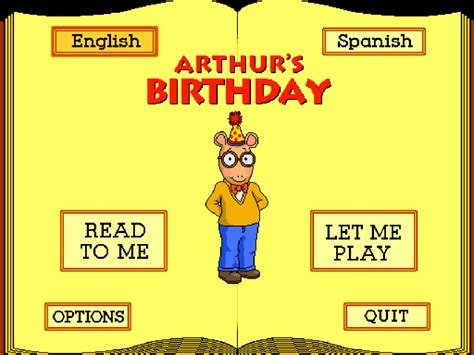
Arthur’s Birthday is an educational game developed by Living Books and published by Brøderbund, based on the Arthur children’s series. Released in 1997 as an updated version of the 1994 original, it features enhanced graphics and audio, along with new mini-games like the Great Gift Mystery and Pin the Tail on the Donkey. Players join Arthur and his friends in a fantasy-themed birthday party adventure, using interactive storybook elements to build reading and writing skills in a whimsical setting.
Gameplay Videos
Where to Buy Arthur’s Birthday
PC
Arthur’s Birthday Free Download
Arthur’s Birthday Guides & Walkthroughs
Arthur’s Birthday: A Definitive Review of a Living Books Landmark
Introduction: The Cake is a Lie (But the Lesson is Real)
In the vast, often-overlooked canon of 1990s educational software, few titles evoke the specific, nostalgic chime of a CD-ROM drive spinning up quite like a Living Books release. Nestled among the towering legacies of The Oregon Trail and Carmen Sandiego lies a quieter, more profound revolution in children’s interactive media: the storybook made tangible. Arthur’s Birthday, in both its 1994 original and its subtly refined 1997 re-release, is not merely a game about a party. It is a masterclass in adaptive design, a time capsule of a pre-internet licensing boom, and a pivotal artifact demonstrating how video games could be harnessed not for points or power-ups, but for empathy, literacy, and emotional regulation. This review will argue that while Arthur’s Birthday is mechanically skeletal by modern standards, its historical significance, meticulous production values, and unwavering focus on its young audience’s developmental needs cement it as a cornerstone of the edutainment genre—a gentle giant whose influence is felt far beyond its modest commercial footprint.
Development History & Context: The Living Books Laboratory
To understand Arthur’s Birthday, one must first understand Living Books. Conceived in the early 1990s by a team that included former Disney animators and child development experts, Living Books was less a game studio and more a digital storytelling workshop. Their proprietary Mohawk engine, first seen with Just Grandma and Me (1991), was revolutionary: it allowed for full-screen, narrated animations controlled by simple mouse clicks, with text highlighted in sync with the voiceover. The goal was not to create a “game” in the traditional sense, but an interactive storybook—a digital page-turner that respected the original picture book’s pacing while adding a layer of discoverable interactivity.
Arthur’s Birthday (1994) arrived at the peak of this formula’s confidence and the peak of the Arthur media frenzy. Marc Brown’s beloved aardvark had transcended his 1976 picture book origins to headline a ratings-dominating PBS television series by 1996. The game, developed under the Living Books banner and published by Brøderbund, was part of a lucrative licensing wave that saw every major children’s character—from The Berenstain Bears to Dr. Seuss—getting a CD-ROM adaptation.
The technological constraints defined the experience. The 1994 version ran at a 512×384 resolution with 11 kHz mono audio—the limits of early CD-ROM audio compression and VGA/SVGA displays. Development was a meticulous dance between hand-drawn animation (digitized from the show’s style) and the Mohawk engine’s scripting limitations. The 1997 Version 2.0, the focus of this review (as cataloged by MobyGames ID 124923), represents a simple but meaningful ” director’s cut.” The resolution was boosted to 640×480, and audio quality improved to 22 kHz, a noticeable fidelity jump for voices and sound effects. The most significant change, however, was design-based: the addition of two mini-games, most notably the “Great Gift Mystery,” which was woven into the narrative flow, requiring the pages themselves to be reworked to accommodate this new interactive layer.
Crucially, V2.0 also marked a strategic pivot in localization. The original 1994 release was fully localized in Latin American Spanish alongside English. The 1997 version dropped this, instead adding French, German, and Castilian Spanish, and implemented a UI that allowed players to switch languages on the fly. This reflects a market shift towards European languages and a move away from the specific Latin American Spanish localization, a quiet but telling business decision from Brøderbund.
Narrative & Thematic Deep Dive: The Conflict of Sharing
At its heart, Arthur’s Birthday is a story about a social-emotional crisis. The plot, directly adapted from Marc Brown’s 1989 book, is deceptively simple: Arthur Read and his friend Muffy Crosswire discover, to their horror, that their birthdays are on the same day. Both have planned separate parties, and their mutual friends are forced to choose. The ensuing drama—the silent treatment, the passive-aggressive notes, the desperate attempts to sway friends—is a flawless microcosm of childhood social dynamics.
The narrative structure is where the Living Books format shines. The story unfolds across a series of fixed flip-screen pages, each a static, richly illustrated scene from Elwood City. The narration, provided by actors capturing the essence of the PBS show’s cast (though not necessarily the original voice actors), is crystal clear and gently paced. The genius lies in the hotspots: virtually every character and key object is clickable. Clicking on Arthur might elicit a sigh; clicking on Muffy’s torn party invitation shows her disappointment. These are not just distractions; they are emotional annotations. They give children agency to explore subtext—the frustration on Brain’s face, the confusion on Buster’s. This transforms passive viewing into active emotional literacy training.
The central theme is conflict resolution through compromise. The climax is not a dramatic showdown, but a quiet, collaborative solution: a joint birthday party. Arthur and Muffy merge their themes (a jungle gym and a fancy dress party) into one grand celebration. This is potent pedagogy. It avoids the “winner-takes-all” narrative, modeling a win-win solution that is both satisfying and realistic within a child’s social sphere. The added “Great Gift Mystery” mini-game in V2.0 extends this theme. Players must help Arthur find a lost gift by interacting with party guests, reinforcing observation, deduction, and polite inquiry—all framed within the story’s urgent context.
The dialogue and character voices are precise. Arthur’s earnestness, Muffy’s initial imperiousness softening into genuine friendship, D.W.’s chaotic energy—all are present and correct. The story never talks down; it presents a relatable problem and lets the child reader/user sit with the discomfort of the conflict before guiding them to the harmonious resolution. It is, in narrative terms, a perfect short story for its target demographic (ages 4-8).
Gameplay Mechanics & Systems: Intentional Minimalism as a Design Strength
Classifying Arthur’s Birthday requires rejecting traditional “game” terminology. There are no points, no lives, no failure states. The core loop is: Navigate page → Listen/Read → Explore Hotspots → Progress. This is a deliberate design choice by Living Books. The “Let Me Play” mode (vs. “Read to Me”) simply grants control over page turning and hotspot activation. The interactivity is low-stakes and consequence-free. You cannot “lose” by clicking in the wrong order; you simply might miss a funny animation or a piece of character-based dialogue.
The two added mini-games in V2.0 are instructive:
1. Pin the Tail on the Donkey: A classic party game rendered in point-and-click form. It is pure, unadulterated play. There is no scoring, just the fun of the act. Its inclusion directly ties the game’s digital experience to a familiar physical party ritual, strengthening the thematic link.
2. The Great Gift Mystery: As integrated, it is a light puzzle-adventure. The player must converse with each party guest (click on them) to gather clues about the gift’s whereabouts. The solution is found by clicking on a specific, non-obvious location. It requires attention to dialogue and spatial awareness but remains trivial. Its purpose is narrative integration: it gives the player an active role in solving a party problem, mirroring Arthur’s own role in resolving the birthday conflict.
The UI/UX is a masterclass in accessibility for children. Text is large, high-contrast, and highlighted word-by-word. Navigation arrows are always visible. The language-switch feature in V2.0 is remarkably seamless for the era. The systemic flaw, if it can be called one, is the utter lack of adaptive challenge or branching narrative. The story is linear and immutable. But for a product designed to foster literacy and social understanding through repetition and exploration, this is not a flaw—it is the point. The value is in the experience, not the outcome.
World-Building, Art & Sound: The Elwood City Aesthetic
Living Books’ signature style was to create a living illustration. The art in Arthur’s Birthday is not pixel art but digitized, watercolor-and-ink artwork directly from the aesthetic of Marc Brown’s books and the PBS show’s early designs. The backgrounds are detailed and cozy—Arthur’s treehouse, the schoolyard, Muffy’s mansion. The character animations are limited but expressive, with key movements (a wave, a shrug, a dance) smoothly looped.
The fixed flip-screen perspective creates a deliberate, reading-like rhythm. You are encouraged to absorb the entire scene before moving on. This pacing is central to the experience, mimicking the act of studying a picture book page.
The sound design underwent its most tangible upgrade in V2.0. The jump from 11 kHz to 22 kHz audio means the narration and character voices are clearer, less tinny. The sound effects—a doorbell, a party horn, the rustle of wrapping paper—gain definition. The background noise adjustments mentioned in the source material (changes in “moments background noise is played”) suggest a fine-tuning of ambient sound to avoid cognitive overload or auditory distraction, a subtle but significant UX improvement for young listeners.
The atmosphere is one of warm, familiar, slightly nostalgic suburban childhood. It is not a fantasy world of dragons but the very real, tangible world of a school party. This groundedness is key to its emotional resonance. The child playing knows this could be their party, their friend conflict. The setting is not an escape; it is a mirror.
Reception & Legacy: The Quiet Giant
By the metrics of mainstream gaming press, Arthur’s Birthday is a ghost. Metacritic lists zero critic reviews for any platform. MobyGames shows a perfect 5.0 average from two player ratings, but with zero written reviews. Its commercial performance is not individually tracked but was certainly dwarfed by gaming titans of 1997. Its legacy is not in sales charts but in cultural osmosis and industry practice.
Within the edutainment sphere of the late 90s, Living Books titles were the gold standard. Reviews from sources like PCMag and MacWorld for the broader Arthur series consistently praised their “charming” execution and educational value, though some, like SuperKids, found activities “tedious and overly repetitious”—a fair critique of the minimal gameplay. The spyware concerns noted in the Wikipedia entry for later Arthur games by The Learning Company (which acquired Brøderbund’s assets) do not directly apply to this Brøderbund-era Living Books title, but they serve as a cautionary footnote about the era’s bundling practices.
Arthur’s Birthday‘s true influence is foundational:
1. It perfected the “clickable storybook” format, directly inspiring countless imitators and establishing a template for interactive children’s media on CD-ROM and, later, app stores.
2. It demonstrated the commercial viability of high-quality licensed educational software, proving that parents would pay for trusted characters paired with legitimate pedagogical design.
3. It prioritized narrative and emotional intelligence over rote learning drills. The “lesson” was social, not academic—a relatively novel concept at the time.
4. Its preservation is critical. The availability of both the 1994 and 1997 versions on the Internet Archive ensures this artifact remains accessible. The 1994 version’s bilingual (English/Spanish) support is a unique historical snapshot, while V2.0’s multi-language UI and integrated mini-game represent the evolutionary peak of the series.
Its reputation has evolved from “a nice kids’ program” to a historical touchstone for scholars of children’s digital media, game studies, and the history of educational technology. It represents the moment when digital media confidently entered the living room as a storytelling medium for the youngest audiences, with respect for the source material and the child’s intelligence.
Conclusion: A Timeless, Time-Bound Artifact
Arthur’s Birthday is not a “great game” by conventional criteria. It has no replay value in the traditional sense, its mechanics are non-existent, and its challenge is nil. To judge it thus is to fundamentally misunderstand its purpose. As a piece of interactive literature, a tool for social-emotional learning, and a pinnacle of 1990s CD-ROM craftsmanship, it is an unqualified success.
The 1997 version, with its cleaner audio, higher resolution, and cleverly integrated mini-game, is the definitive edition. It smooths the technical edges of its predecessor while adding layers of interactivity that serve the story. Its decision to drop Latin American Spanish for European languages is a curious, likely market-driven, step back from the inclusivity of the original.
In the pantheon of video game history, Arthur’s Birthday belongs in the “Important Artifacts” wing, alongside titles like The Oregon Trail and Myst. It did not change the technical face of gaming, but it changed how we think about what games for children can be. It proved that interactivity could be used to foster empathy, that a license could be treated with dignity, and that a simple story about a birthday party could contain a world of social wisdom. Its legacy is every parent who has seen their child quietly absorb a lesson about sharing from an animated aardvark, and every developer who understood that sometimes, the most powerful game mechanic is a well-told story. For this, Arthur’s Birthday earns its place not just in the archives, but in the canon.