
- Release Year: 2001
- Platforms: Windows
- Publisher: Global Software Publishing Ltd., Learning Company, The
- Developer: ImageBuilder Software, Inc.
- Genre: Educational, Reading, writing
- Game Mode: Single-player
- Gameplay: Mini-games, Story Building, Word recognition
- Average Score: 86/100
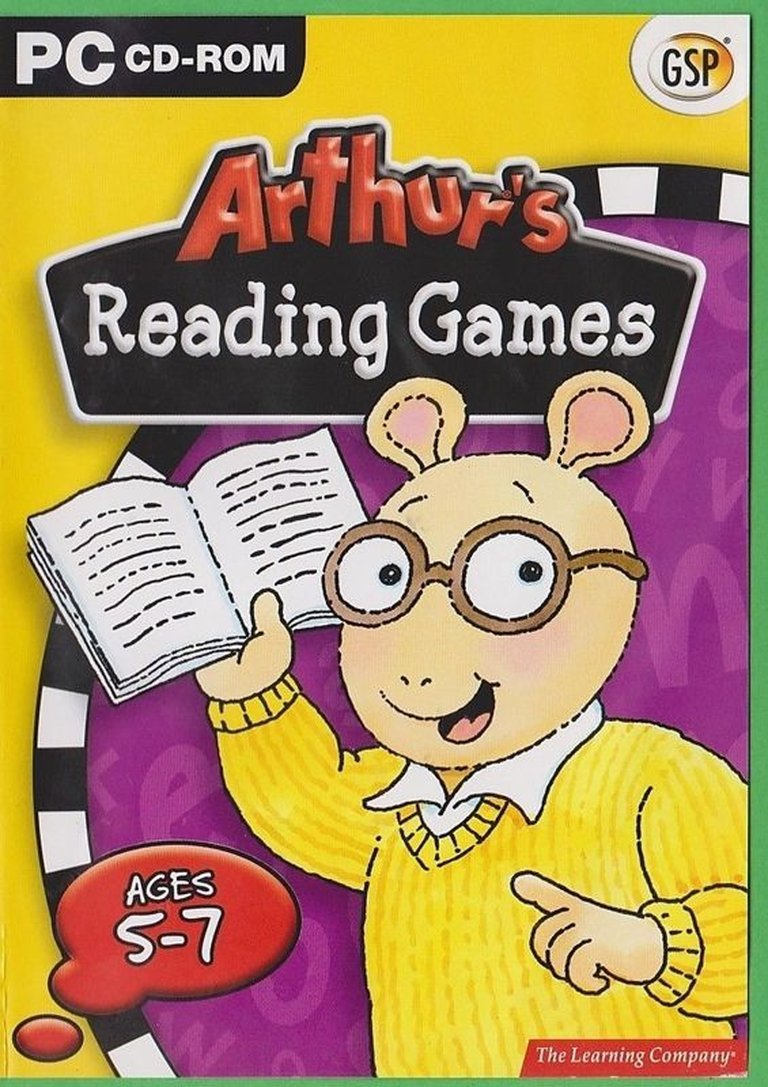
Description
Arthur’s Reading Games is an educational title designed for children aged five to seven, based on Marc Brown’s book Arthur’s Reading Race. The game helps young players develop reading skills through interactive activities, including sentence construction, word recognition, and story building. It features Marc Brown’s interactive story alongside four mini-games: ‘Learn With Arthur,’ a word recognition game, ‘Vowels and Consonants’ with Francine’s Word-O-Matic Machine, and a story-building game where players drag and drop pictures to fill in blanks. The game offers five skill levels and includes music and art options to enhance the learning experience.
Gameplay Videos
Where to Buy Arthur’s Reading Games
PC
Arthur’s Reading Games Free Download
Arthur’s Reading Games Reviews & Reception
gamearchives.net (86/100): Arthur’s Thinking Games is a rare example of educational software that respects its audience, opting for formative assessment, adaptive learning curves, and cognitive scaffolding rather than punitive scoring systems or glitzy animations devoid of substance.
Arthur’s Reading Games: A Masterclass in Edutainment
Introduction
In the annals of educational gaming, few titles have left as indelible a mark as Arthur’s Reading Games. Released in 2001 by The Learning Company and developed by ImageBuilder Software, this title stands as a testament to the power of blending entertainment with education. At a time when edutainment was often dismissed as either too dry or too superficial, Arthur’s Reading Games struck a near-perfect balance, leveraging the beloved Arthur franchise to create an experience that was as engaging as it was instructive. This review will explore the game’s development, narrative depth, gameplay mechanics, and lasting legacy, arguing that it remains one of the most effective and enduring examples of educational software ever created.
Development History & Context
The Studio and Creators’ Vision
Arthur’s Reading Games was developed by ImageBuilder Software, a studio with a strong track record in creating educational titles for children. The game was published by The Learning Company, a powerhouse in the edutainment space during the late 1990s and early 2000s. The Learning Company’s Arthur franchise was part of its broader LearningBuddies line, which aimed to make learning accessible and enjoyable for young children.
The development team behind Arthur’s Reading Games was notably large for children’s software of the era, involving around 90 individuals, including developers, artists, and voice actors. This commitment to quality is evident in the game’s polished presentation and educational depth. The voice cast included talented actors who brought the characters to life with emotional clarity and precision, ensuring that the game felt authentic to the Arthur universe.
Technological Constraints and Innovations
Released in 2001, Arthur’s Reading Games was designed for Windows 95/98 systems, which had limited processing power and memory. Despite these constraints, the game leveraged the CD-ROM medium to deliver high-quality voice acting, animated cutscenes, and rich backdrops. The use of 2D sprites on 3D-rendered backdrops was a clever compromise that balanced visual fidelity with performance, ensuring that the game could run on a wide range of hardware.
However, the game was not without its technical issues. The inclusion of the DSS Agent program, which was labeled as spyware by some critics, raised privacy concerns. Additionally, the game was known to be crash-prone on weaker systems, a common issue for software of that era. These technical limitations, while frustrating, did little to diminish the game’s overall impact.
The Gaming and Educational Landscape
The late 1990s and early 2000s saw a surge in edutainment software, with titles like Mavis Beacon Teaches Typing and Math Blaster defining the genre. However, many of these games were criticized for being overly mechanical and academically rigid. Arthur’s Reading Games, on the other hand, was developed with the input of educators and aligned with core curriculum standards, ensuring that it was both fun and educational.
The partnership between PBS and The Learning Company was a significant factor in the success of the Arthur games. The Arthur television series had already achieved cultural resonance for its emotional literacy and social awareness, and the games leveraged this popularity to create engaging and educational experiences for young players.
Narrative & Thematic Deep Dive
Plot and Characters
Arthur’s Reading Games is structured around a series of mini-games that feature the beloved characters from the Arthur universe. Each mini-game is designed to teach specific skills, such as reading, critical thinking, and problem-solving, while maintaining a narrative wrapper that keeps players engaged.
The game’s narrative revolves around Arthur Read and his friends as they embark on various reading adventures. The interactive story, Arthur’s Reading Race, written by Marc Brown, serves as the centerpiece of the game. In this story, Arthur challenges his sister D.W. to read ten different words, promising her ice cream as a reward. This simple yet effective narrative framework not only engages young players but also reinforces the importance of reading and comprehension.
The characters in Arthur’s Reading Games are drawn directly from the Arthur universe, each bringing their unique personalities and quirks to the gameplay experience. Arthur, the protagonist, is a relatable and likable figure who embodies the spirit of curiosity and learning. D.W., his younger sister, adds a touch of humor and mischief, while friends like Buster, Francine, and Muffy provide additional layers of interaction and engagement. The dialogue is witty and age-appropriate, ensuring that young players remain engaged and entertained throughout their learning journey.
Themes and Educational Content
The overarching theme of Arthur’s Reading Games is that learning is a joyful and playful act. The game positions the brain as a lab, canvas, or strategy map, encouraging players to explore and experiment. Key themes include estimation, pattern recognition, spatial intelligence, and creative confidence.
The game also emphasizes character agency and emotional resonance. Each mini-game embodies a personality trait of the characters, such as Mr. Ratburn’s intellectual rigor or Buster’s curiosity and persistence. The dialogue is scripted to offer hints, encouragement, and sly jokes, creating an emotional investment that keeps players engaged.
Gameplay Mechanics & Systems
Core Gameplay Loops
The gameplay in Arthur’s Reading Games is structured around a series of mini-games, each with its own unique mechanics and educational focus. The game uses a laddered learning design, where each level introduces new mechanics, removes supports, and increases cognitive demand.
For example, in the “Word Recognition” mini-game, players are presented with a grid of words and must find pairs that rhyme. The difficulty scales from simple two-syllable words to more complex multi-syllable words, ensuring that players are always challenged but not overwhelmed. This gradual increase in complexity mimics Vygotsky’s Zone of Proximal Development, ensuring that the game remains accessible yet engaging.
Innovations and Flaws
One of the key innovations of Arthur’s Reading Games is its use of auto-levelling, which dynamically adjusts the difficulty based on the player’s performance. This feature ensures that the game is accessible to a wide range of skill levels and provides a personalized learning experience.
However, the game is not without its flaws. The lack of a save system or profile switching limits long-term use, and the game is known to be crash-prone on weaker systems. Additionally, the inclusion of the DSS Agent program raised privacy concerns, although it was intended for remote updates and analytics.
World-Building, Art & Sound
Visual Direction
The art style of Arthur’s Reading Games is a hybrid of children’s book aesthetics and limited 3D rendering. The characters are designed to match the watercolor, hand-drawn look of the Arthur television series, with expressive faces and exaggerated body language. The environments, such as the Roman Stadium and pyramid, use isometric projections with rendered 3D polygons, creating a “dream logic” world that is familiar, structured, but fantastical.
Sound Design
The soundscape of Arthur’s Reading Games is deliberately designed to focus attention. The voice acting is performed with emotional clarity, crucial for auditory learners. The sound effects are precise and tactile, reinforcing cause-effect relationships. The music is light and cheerful, with bouncy melodies in mini-games and dreamy synths in overworlds, ensuring that the audio experience is engaging but not overwhelming.
Reception & Legacy
Commercial and Critical Reception
Arthur’s Reading Games was a commercial success, ranking highly in software sales and receiving positive reviews from critics. Discovery Education called it “edutainment at its best,” and MacWorld praised its “rewarding, albeit overwhelming, design.” However, the game was not without its critics. SuperKids acknowledged its appeal but noted that “veteran gamers will be unimpressed.”
Privacy Concerns
The inclusion of the DSS Agent program raised privacy concerns, with critics labeling it as spyware. The program was intended for remote updates and analytics, but its background operation and data collection were criticized by child safety groups.
Nostalgia and Rediscovery
Despite these concerns, Arthur’s Reading Games has found a nostalgic following in recent years. The game has been preserved on platforms like the Internet Archive and has been re-released on modern platforms like Steam. User reviews express deep emotional attachment, with many players recalling fond memories of playing the game in their childhood.
Conclusion
Arthur’s Reading Games is not just a relic of the CD-ROM era; it is a pioneering example of educational software that successfully merged fun and learning. Its narrative cohesion, mechanical diversity, pedagogical intentionality, and aesthetic warmth set a benchmark that remains unequaled in commercial educational software. While it suffered from technical limitations and privacy missteps, its core idea—that learning is play, and play teaches—transformed edutainment.
In a world where digital learning is increasingly important, Arthur’s Reading Games offers a counterpoint: cognitive development through structured, playful, human-centered design. It is a must-play title for anyone interested in game-based learning, cognitive science, or the preservation of childhood joy in the digital age. Restored, re-released, and re-evaluated, it earns not just nostalgia, but a permanent place in the video game canon—not as a forgotten title, but as a quiet revolutionary.
Final Verdict:
Arthur’s Reading Games is a timeless artifact of cognitive play. It is a must-play title for anyone interested in game-based learning, cognitive science, or the preservation of childhood joy in the digital age. Its legacy is a testament to the power of educational software that respects its audience and prioritizes fun and learning in equal measure.
Rating: 5/5 – A timeless artifact of cognitive play.
– Historical Significance: ★★★★★
– Replay Value: ★★★★★
– Educational Impact: ★★★★★
– Technical Execution (2001): ★★★★☆
– Legacy in 2025: ★★★★★