
- Release Year: 2006
- Platforms: Windows
- Publisher: Alawar Entertainment, Inc.
- Developer: Brain Storm
- Genre: Puzzle
- Perspective: Top-down
- Game Mode: Single-player
- Gameplay: Combos, Grid-based, Power-ups, Tile matching
- Setting: Egypt, Medieval, Modern
- Average Score: 60/100
Description
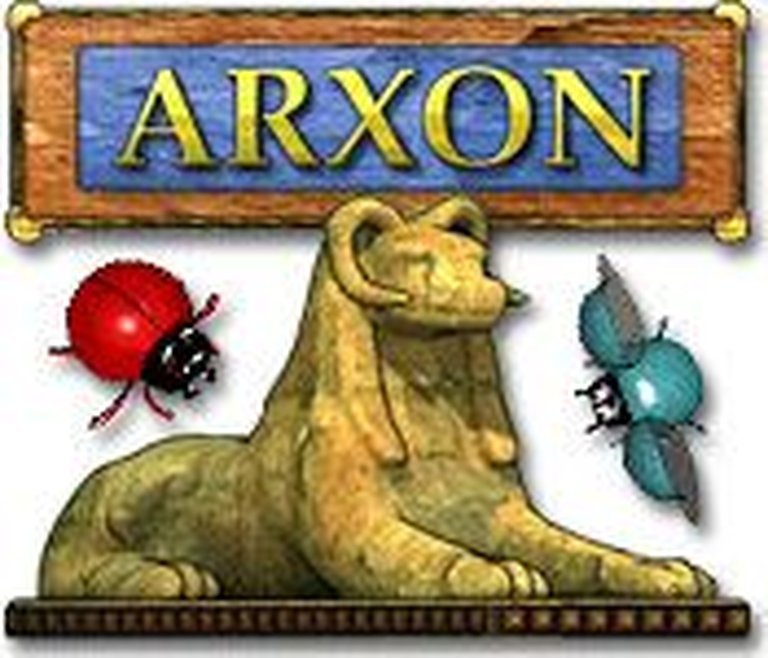
Arxon is a puzzle game with an Egyptian theme where players match colored scarab beetles on a grid. By moving a scarab along the edges and clicking to push it onto the board, entire rows or columns shift to create matches of three or more. The game includes three modes—Adventure (time-limited levels), Endless (no time limit), and Logic (pattern creation)—with combos unlocking bug-themed power-ups for added strategy.
Arxon: A Scarab-Shaped Relic in the Puzzle Game Pantheon
Introduction: A Puzzle Game Buried in the Sands of Time
In the mid-2000s, the casual PC puzzle market was a bustling desert oasis, teeming with match-3 clones, tile-matching experiments, and brain-teasers vying for attention alongside pop-up ads and bundled software. From this crowded landscape emerged Arxon, a 2006 title from developer Brain Storm and publisher Alawar Entertainment that dared to reimagine the core act of matching colored objects. On the surface, it presents a charming, if generic, Egyptian aesthetic and a clever twist on grid-based logic. Yet, beneath its polished scarab motifs lies a game of profound tension—a fascinating, often frustrating, design experiment that crucially misses the mark of accessibility. This review argues that Arxon is a compelling case study in mechanical brilliance undermined by punitive design choices and a profound lack of narrative or atmospheric depth, consigning it to a forgotten footnote rather than a classic. Its legacy is not one of influence, but of a poignant “what if”: what if its unique core mechanic had been paired with a forgiving structure and a world with something to say?
Development History & Context: A Casual Game from a Casual Era
Arxon was developed by Brain Storm, a studio whose history is as obscure as the game itself, with no significant prior or subsequent releases documented in major databases. This anonymity places it firmly within the ecosystem of early-2000s casual game development: small, often Eastern European or Asian studios producing content for the burgeoning shareware and download markets, predominantly picked up by publishers like Alawar Entertainment. Alawar, founded in 1999, was a notable distributor in this space, known for curating a library of visually polished, easily accessible puzzle and hidden-object games for the PC casual audience. The mid-2000s was the golden age of this model, predating the mobile app store explosion. Games were sold as downloadable shareware (as Arxon was, priced at $19.95) or bundled on CD-ROMs at retail. Technologically, the constraints were those of standard PC hardware: a requirement of a PIII-750 processor and 32MB of 3D video RAM, targeting a resolution of 800×600. This was an era of 2D sprite-based art, where visual flair was often achieved through detailed hand-drawn assets rather than complex 3D modeling, a space Arxon occupies comfortably but unremarkably. The gaming landscape was dominated by the colossal shadow of Bejeweled (2000) and its countless imitators, which had established tile-matching as the cornerstone of casual gaming. Arxon‘s attempt to innovate within this saturated genre was both its raison d’être and its greatest challenge.
Narrative & Thematic Deep Dive: An Empty Throne in the Egyptian Court
Herein lies Arxon‘s most significant failing: a catastrophic paucity of narrative and thematic integration. The source material repeatedly references an “Egyptian theme” and a goal to “save an ancient land from destruction” (Games14.com). However, this is presented as a superficial veneer, a skin applied to the mechanics without any meaningful lore, character, or story. There are no cutscenes, no dialogue, no journal entries, and no environmental storytelling to explain why we are moving scarabs. Who are we? What is destroying this land? What is the significance of the scarabs beyond their visual motif? The game provides no answers. This stands in stark contrast to even its contemporaries; Puzzle Quest: Challenge of the Warlords (2007) masterfully wove match-3 combat into an RPG narrative. Arxon offers nothing of the sort. The “Egyptian” setting is reduced to a palette of gold, lapis lazuli, and sandstone, and iconography of scarabs and perhaps hinted pyramid structures in the background. It is a backdrop, not a world. One searches in vain for any cohesive mythology, any hint of the rich history of ancient Egypt beyond the most basic symbols. This lack of lore is not a neutral choice; it is a missed opportunity to elevate the gameplay from a mechanical exercise to an immersive experience. Without a story to contextualize the player’s actions, the act of matching scarabs feels arbitrary and devoid of stakes beyond the timer’s ticking clock.
Gameplay Mechanics & Systems: A Brilliant Core, A Ruthless Execution
The heart of Arxon is its unique, ingenious, and deeply strategic core mechanic. As described on MobyGames: “you move a scarab along the edges of a grid on which the other beetles have been placed. When you click your mouse, it pushes the scarab onto the board and it moves all of the other beetles along that row or column, for one square.” This is not a match-3 game of swapping adjacent tiles; it is a game of spatial prediction and row/column manipulation. The player controls a single, active scarab (often a distinct color or style) that traverses the grid’s perimeter. By selecting a direction to enter, the player initiates a “push” that shifts every beetle in that row or column one space in that direction. The active scarab occupies the vacated space. Matches are formed when three or more beetles of the same color align horizontally or vertically after the shift, at which point they are removed and new beetles fall into place (though the classic “gravity” mechanic is not explicitly detailed, removal followed by refilling is implied).
This system creates a deeply logical, almost chess-like puzzle. Players must foresee the consequences of their push several moves ahead, planning not just for immediate matches but for chain reactions (combos). The combo system is a critical reward: creating sequential matches without interruption generates power-ups in the form of special “bugs.” The LaunchBox description specifies the “Destroyer Bug,” which “wipes out all of the scarabs on the grid with the same color as the one you hit!” This is a potent tool for clearing boards, turning careful planning into explosive payoff.
The game is structured across three distinct modes, as documented across sources:
1. Adventure Mode: The primary campaign with 63 levels. Its defining, and most controversial, feature is a per-level time limit. Here, the GameXtazy critic’s observation becomes devastatingly relevant: “a single instance of letting the timer run out will result in the game being over; you aren’t given multiple chances to try again.” This is a “ruthless” design. There is no gradual failure state or loss of a life; time expiry is an instant, total game-over, forcing a complete restart from the first level. This transforms the game from a logic puzzle to a pressure cooker of speed and precision, punishing hesitation and amplifying the mental load of the core mechanic.
2. Endless Mode: A more forgiving 80-level variant with no time limit, allowing players to strategize without the frantic pressure. This mode is likely where the game’s true puzzle depth reveals itself.
3. Logic Mode: A specialized 10-level set where the objective shifts from clearing the board to “move the beetles to create a pattern.” This suggests a pure, abstract puzzle mode, removing the matching goal entirely and focusing on precise arrangement, showcasing the system’s versatility.
The User Interface (UI) is implied to be simple and mouse-driven, consistent with its shareware casual roots. The “Fixed / flip-screen” perspective (MobyGames) suggests a static grid view, which aids in planning but may feel static.
In essence, the gameplay is a study in contrasts: a mechanically innovative and deeply satisfying puzzle engine shackled to a punishing, outdated arcade-style punishment system in its main mode. The timer in Adventure mode doesn’t add excitement; it adds profound frustration, making the game feel “not as intuitive as most of its contemporaries” (GameXtazy) because the cognitive load of the unique mechanic is doubled by the stress of a relentless countdown.
World-Building, Art & Sound: Gorgeous Ambiance, Hollow Core
The presentation of Arxon is its most consistently praised, yet ultimately superficial, element. Multiple sources describe the art as “gorgeous Egyptian artwork” (Games14.com) and note it’s “not too bad” visually (GameXtazy). The aesthetic is competent and thematically cohesive: a color palette of desert golds, deep blues, and sandy tans; beetle designs that are distinct yet unified by a common style; likely background elements hinting at Egyptian architecture or hieroglyphs. It achieves the primary goal of casual game art: to be pleasant, non-offensive, and thematically identifiable at a glance. However, the critic’s caveat—”not quite eye-catching enough to leave a lasting impression”—is astute. The art serves the gameplay board but lacks the iconic punch of, say, Lumines‘s techno-audio-visual synthesis or Puzzle Quest‘s fantasy character portraits. It is functional theming, not evocative world-building.
The sound design is virtually unmentioned in all sources, a strong indicator of its generic and forgettable nature. One can infer a soundtrack of nomadic flute melodies, xylophone tones, and maybe a deep drumbeat—the standard “exotic” musical shorthand for “Ancient Egypt” in casual games. Without any dynamic audio cues for combos, power-ups, or timer warnings (a critical flaw given the game’s intensity), the soundscape does no work to enhance immersion or provide vital gameplay feedback.
Ultimately, the “Egyptian” setting is an applied skin. The world has no history, no culture, no narrative reason for scarabs to be the central puzzle piece. It is atmosphere divorced from substance, a beautiful, empty tomb.
Reception & Legacy: A Whisper in the Puzzle Boom
Arxon‘s reception was minimal and muted, a clear indicator of its commercial and critical failure to make an impact. The available data is stark:
* Critical Reception: A single critic review on MobyGames from GameXtazy, scoring 60% (3/5). This review succinctly captures the game’s duality: “interesting spin… but not as intuitive… ruthless… not quite eye-catching enough… could’ve been great with a little more attention paid to style. It’s still fun, it’s just not a classic.”
* Player Reception: A mere 1 player rating (3.0/5) on MobyGames, with zero written reviews. The “Collected By” stat shows only 3 players have added it to their collection on that site—a number so low it signifies near-total obscurity.
* Aggregators: Metacritic and OpenCritic have no scores or reviews for the title. It is absent from “best of 2006” lists (like Engadget’s aggregate review roundup), which featured Oblivion on PC and stinkers like Utopia City.
* Commercial Context: Released in October 2006, it competed in a market saturated with established franchises (Bejeweled 2, Zuma, Puzzle Bobble variants) and innovative newcomers (Meteos on DS, Lumines on PSP). Lacking a strong publisher brand (Alawar was not a major name), zero marketing buzz, and a punishing main mode that likely deterred casual players, it vanished without a trace.
Its legacy is virtually non-existent. There is no evidence of influence on subsequent puzzle games. The unique row/column push mechanic is not cited in design post-mortems or seen in later titles. Arxon represents a dead-end branch on the puzzle game evolutionary tree—a fascinating mutation that failed to propagate. Its presence is now primarily archival, a curiosity for historians examining the myriad experiments in the casual puzzle space that did not survive.
Conclusion: The Unfulfilled Promise of the Scarab Grid
Arxon is a game of profound, almost tragic, potential. Its core mechanic—the strategic, predictive pushing of rows and columns—is a brilliant design innovation that offers a fresh, cerebral challenge distinct from the match-3 norm. In its forgiving Endless and Logic modes, it reveals itself as a genuinely engaging, thoughtful puzzle experience. However, this promise is catastrophically undermined by two fatal flaws: the arbitrarily punishing “one-miss-and-you’re-out” timer on its main Adventure path, which transforms intellectual play into anxious, repetitive failure; and the complete absence of narrative or atmospheric depth, which renders its Egyptian theme a hollow aesthetic shell with no emotional or intellectual investment to offer.
In the grand museum of video game history, Arxon does not deserve a prominent wing. It is not a classic, nor an influential failure. It is a forgotten artifact—a well-intentioned but deeply flawed experiment from the casual game gold rush. It serves as a potent lesson: a novel mechanic is not enough. Accessibility, pacing, and a world worth saving are equally, if not more, important. Arxon‘s scarabs may shuffle across the grid with logical elegance, but the game itself remains stuck in the sand, a moderately clever puzzle box whose lock is too frustrating to pick and whose treasure is ultimately empty. Its final verdict is that of the GameXtazy critic, made absolute by the silence of history: It is still fun in its purest form, but it is just not a classic—and it was never given the chance to become one.