
- Release Year: 1996
- Platforms: Windows
- Publisher: ARI Data CD GmbH, Corel Corporation
- Developer: Deep River Publishing
- Genre: Action
- Perspective: 1st-person
- Game Mode: Single-player
- Gameplay: Dynamic terrain, Shooter, Vehicle combat
- Setting: Futuristic, Sci-fi
- Average Score: 44/100
Description
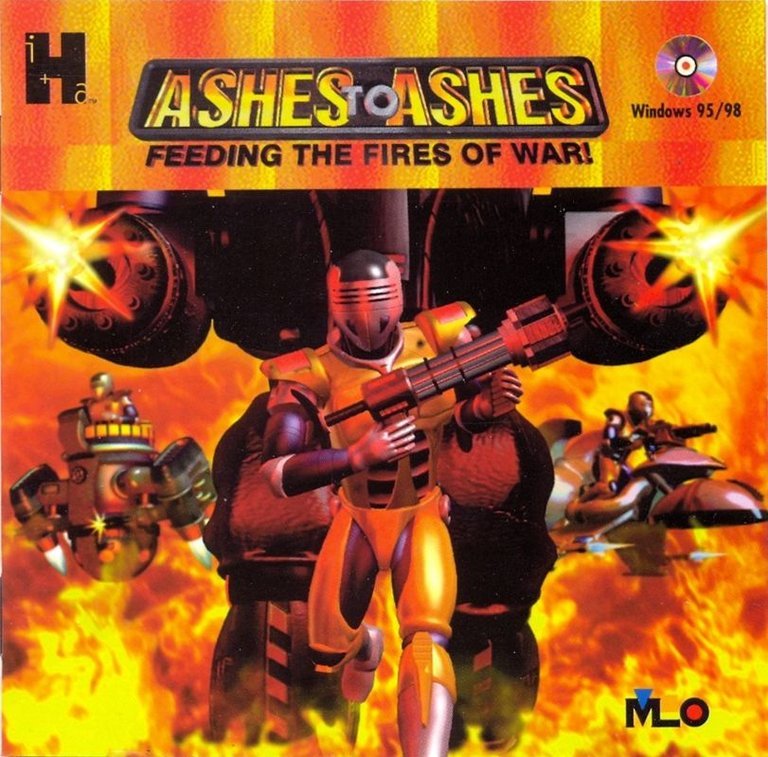
Ashes to Ashes: Feeding the Fires of War! is a first-person shooter set in a futuristic world where chaos reigns, and the player must restore order. Released in 1996, the game features large outdoor environments with dynamic terrain, allowing players to navigate through mountains, cliffs, and buildings. It also includes a variety of vehicles such as turrets, tanks, and mech armors, adding depth to the gameplay. The game uses a 2.5D engine with animated sprites, offering a mix of action and exploration in a sci-fi setting.
Gameplay Videos
Ashes to Ashes: Feeding the Fires of War! Free Download
Ashes to Ashes: Feeding the Fires of War! Patches & Updates
Ashes to Ashes: Feeding the Fires of War! Reviews & Reception
en.wikipedia.org (25/100): A perfect candidate for diminished stardom in the bargain bin.
mobygames.com (25/100): Funny if you want to spend your time in something.
Ashes to Ashes: Feeding the Fires of War! Cheats & Codes
PC
Enter any of the following codes during gameplay for the desired effect.
| Code | Effect |
|---|---|
| destroy | Destroy On/Off |
| godmode | God Mode |
| nolevels | Hide Level Menu Items |
| next | Next Level |
| pause | Pause Actors |
| noammo | Remove All Ammo |
| alllevels | Show All Level Menus |
| credits | Show Credits |
| fps | Show Frame Rate |
Ashes to Ashes: Feeding the Fires of War!: A Retrospective Analysis of a Forgotten FPS
Introduction: The Overlooked Relic of the FPS Boom
In the annals of first-person shooter history, Ashes to Ashes: Feeding the Fires of War! (1996) occupies a peculiar niche—a game that dared to innovate in a genre already dominated by titans like Doom, Duke Nukem 3D, and Quake, yet ultimately faded into obscurity. Developed by the little-known Deep River Publishing and published by Corel Corporation—a company better associated with office software than gaming—Ashes to Ashes emerged during the “second wave” of FPS clones, a period where imitation often overshadowed innovation. However, beneath its unremarkable surface lay a game that experimented with dynamic terrain, vehicle-based combat, and open-air warfare, features that would later become staples in the genre.
This review seeks to dissect Ashes to Ashes in its entirety, exploring its development context, narrative (or lack thereof), gameplay mechanics, and the reasons behind its critical and commercial failure. Was it a bold but flawed pioneer, or merely a forgettable footnote in the evolution of the FPS? By examining its strengths, weaknesses, and historical significance, we can better understand its place in the pantheon of 1990s shooters.
Development History & Context: The Birth of a Misfit
The Studio and the Vision
Deep River Publishing, based in Portland, Maine, was not a household name in the gaming industry. Unlike id Software or 3D Realms, the studio lacked the resources or reputation to compete directly with the giants of the era. Ashes to Ashes was their attempt to carve out a niche in the burgeoning FPS market, leveraging a 2.5D engine that blended sprite-based graphics with pseudo-3D terrain. The game’s development coincided with the transition from Doom-style 2.5D shooters to the fully 3D worlds of Quake, placing it in an awkward middle ground between technological eras.
The game’s premise—a 22nd-century world where global conflicts are resolved through sanctioned battles between professional warriors—was ambitious but underdeveloped. The narrative framing was minimal, serving primarily as a backdrop for the gameplay rather than a driving force. This was not uncommon for FPS games of the time, but Ashes to Ashes took it to an extreme, offering little more than a thin veneer of sci-fi lore to justify its combat arenas.
Technological Constraints and Innovations
The game’s engine, built using the Fastgraph graphics library, was a hybrid of 2.5D and early 3D techniques. While it lacked the true polygonal environments of Quake, it compensated with dynamic terrain modeling, allowing players to traverse rolling hills, valleys, and even lunar landscapes. This was a notable innovation at a time when most FPS games were confined to indoor corridors or flat outdoor maps. The ability to hijack and pilot vehicles—including tanks, assault cycles, and mech suits—added another layer of depth, though the execution was often clunky.
The development team, led by programmer Kenneth Lemieux and artist Andrew Hunter, faced significant challenges. The game’s 2.5D engine struggled with rendering distant objects, leading to pop-in and inconsistent visual fidelity. The sprite-based enemies and environments, while functional, lacked the polish of contemporaries like Duke Nukem 3D. The sound design, handled by Michael McInnis, was similarly uneven, with repetitive audio cues and an oddly eclectic soundtrack that included conga riffs—a choice that baffled critics and players alike.
The Gaming Landscape of 1996
By the time Ashes to Ashes released in late 1996, the FPS genre was in the midst of a seismic shift. Quake, released earlier that year, had set a new standard for 3D graphics and multiplayer gameplay. Duke Nukem 3D had perfected the blend of action, humor, and level design that defined the era. In this context, Ashes to Ashes was a latecomer, arriving when the market was already saturated with similar titles. Its lack of multiplayer support—a feature rapidly becoming essential—further hampered its appeal.
The game’s publisher, Corel Corporation, was primarily known for productivity software like WordPerfect and CorelDRAW. Their foray into gaming was met with skepticism, and Ashes to Ashes did little to dispel the notion that they were out of their depth. The game’s marketing was underwhelming, and it failed to generate significant buzz upon release. Critics and players alike dismissed it as a derivative, if not entirely incompetent, attempt to cash in on the FPS craze.
Narrative & Thematic Deep Dive: A World Without Depth
The Premise: A Thin Sci-Fi Veneer
Ashes to Ashes presents a dystopian 22nd century where global conflicts are resolved through sanctioned battles in open-air arenas. The player assumes the role of a lone gunman tasked with eliminating rogue mercenaries whose erratic behavior threatens the stability of this system. The narrative is delivered through sparse text briefings and the occasional quip from defeated enemies, whose “evil brains” serve as macabre collectibles.
The game’s setting spans eight distinct arenas, each with its own environmental theme: deserts, swamps, lunar landscapes, and more. However, these settings are little more than backdrops for combat, with no meaningful interaction or exploration. The lack of environmental storytelling—a hallmark of games like System Shock or Half-Life—leaves the world feeling hollow and uninspired.
Characters and Dialogue: The Absence of Personality
The player character is a cipher, devoid of personality or motivation beyond the basic objective of “kill everything that moves.” Enemies, too, are faceless foes, distinguished only by their armor types and weaponry. The game’s attempt at humor—such as the “evil brains” taunting the player upon death—falls flat, lacking the wit or charm of Duke Nukem 3D’s one-liners.
The absence of any meaningful character development or narrative progression is a glaring weakness. While many FPS games of the era prioritized gameplay over story, Ashes to Ashes takes this to an extreme, offering no context for the player’s actions beyond the most superficial level. The game’s title, Feeding the Fires of War, hints at a deeper thematic exploration of conflict and militarism, but this potential is squandered in favor of mindless combat.
Themes: War as Sport and the Futility of Violence
Despite its narrative shortcomings, Ashes to Ashes inadvertently touches on themes of war as spectacle and the dehumanization of combat. The premise of professional warriors battling in sanctioned arenas mirrors real-world discussions about the militarization of entertainment and the ethics of conflict. However, the game fails to explore these themes in any meaningful way, reducing them to a backdrop for its gameplay.
The repetitive nature of the combat—endless waves of enemies, minimal objectives, and no narrative payoff—reinforces a sense of futility. The player’s actions feel meaningless, a critique that could be interpreted as intentional but is more likely the result of poor design. The game’s title, Ashes to Ashes, evokes the cyclical nature of violence, but this thematic depth is never realized in the gameplay or storytelling.
Gameplay Mechanics & Systems: Innovation Amidst Repetition
Core Gameplay Loop: Kill, Collect, Repeat
At its heart, Ashes to Ashes is a straightforward run-and-gun shooter. Each level tasks the player with eliminating all enemies and collecting three “evil brains” to progress. There are no puzzles, no complex objectives, and no branching paths—just linear combat in open arenas. This simplicity is both the game’s greatest strength and its most glaring weakness.
The lack of variety in objectives quickly becomes tedious. While the dynamic terrain and vehicle sections provide occasional respite, the core gameplay loop grows repetitive within the first few levels. The absence of multiplayer—a feature that had become a staple of the genre by 1996—further limits the game’s replayability.
Combat and Weaponry: A Mixed Bag
The game’s arsenal is functional but unremarkable. Players can wield a variety of weapons, from standard firearms to futuristic energy guns, but none stand out as particularly innovative or satisfying to use. The enemy AI is equally uninspired, with foes often exhibiting predictable behavior or simply fleeing when the player gets too close.
The vehicle sections are a highlight, offering a welcome change of pace from the on-foot combat. Players can commandeer five types of vehicles, each with unique weapons and movement capabilities:
– Scout Pods: Fast, agile vehicles ideal for traversing rough terrain.
– Falcon Cycles: Motorcycle-like vehicles that excel in open areas.
– Alien Scarabs: Floating, insectoid vehicles with versatile movement.
– Power Suits: Mech-like armors with heavy firepower.
– Roller Tanks: Slow but devastating tanks that can crush infantry.
These vehicles add a layer of tactical depth, allowing players to adapt their strategies to different environments. However, the controls are often unwieldy, and the vehicles themselves can feel underpowered or overly vulnerable.
Level Design: Dynamic Terrain, Static Creativity
The game’s most innovative feature is its dynamic terrain system, which allows players to traverse rolling hills, valleys, and other elevated landscapes. This was a rare feature in 1996, and it gives Ashes to Ashes a sense of openness that many contemporaries lacked. However, the level design fails to capitalize on this innovation, with most arenas feeling empty and underutilized.
The 50 levels are spread across eight distinct environments, but the variation is largely superficial. Each arena introduces minor tweaks to the terrain or enemy types, but the core experience remains the same. The lack of environmental storytelling or interactive elements—such as destructible objects or hidden areas—further diminishes the impact of the dynamic terrain.
UI and Controls: A Clunky Experience
The game’s user interface is functional but dated, with a minimalist HUD that provides basic information like health, ammo, and objectives. The controls, however, are a significant weak point. The mouse and keyboard setup lacks modern conveniences like invertible mouse controls, and the vehicle handling is often imprecise. These issues, combined with the game’s repetitive combat, make for a frustrating experience at times.
World-Building, Art & Sound: A Study in Mediocrity
Visual Design: The Limits of 2.5D
Ashes to Ashes employs a 2.5D engine that blends sprite-based graphics with pseudo-3D terrain. While this approach allows for dynamic landscapes, it also results in visual inconsistencies. Distant objects often pop into view abruptly, and the sprite-based enemies lack the detail and fluidity of polygonal models. The game’s art direction is functional but uninspired, with environments that feel generic and enemies that lack personality.
The game’s color palette is muted, with a focus on earthy tones that blend together in the outdoor arenas. While this creates a cohesive visual style, it also contributes to the game’s lack of visual identity. The vehicle designs are a rare bright spot, with distinct silhouettes and animations that set them apart from the otherwise forgettable visuals.
Sound Design: Repetition and Odd Choices
The audio design in Ashes to Ashes is a mixed bag. The weapon sounds and environmental effects are serviceable, but the enemy voice lines and ambient music grow repetitive quickly. The game’s soundtrack, composed by Michael McInnis, is particularly divisive. While some tracks are well-composed, others—such as the infamous conga riffs—feel tonally inconsistent with the game’s sci-fi setting.
The lack of atmospheric sound design is another missed opportunity. The game’s outdoor arenas could have benefited from ambient noise—wind, distant explosions, or environmental cues—to enhance immersion. Instead, the audio is often sparse and unremarkable, contributing to the game’s overall lack of atmosphere.
Atmosphere: A World Without Soul
The combination of mediocre visuals, repetitive sound design, and minimal narrative results in a game that lacks atmosphere. The outdoor arenas, while technically impressive for their dynamic terrain, feel empty and lifeless. There is no sense of place or purpose, no environmental storytelling to draw the player in. The game’s sci-fi setting is squandered, reduced to a series of generic battlegrounds with little to distinguish them.
Reception & Legacy: The Forgotten Shooter
Critical Reception: A Resounding Thud
Ashes to Ashes was met with near-universal disdain from critics. Reviewers praised its dynamic terrain and vehicle sections but condemned its repetitive gameplay, lack of innovation, and technical shortcomings. The game’s average critic score of 25% on MobyGames reflects its poor reception, with publications like PC Zone and GameStar dismissing it as a forgettable clone.
- GameSpot (50%): “The multiple vehicles and terrain modeling of Ashes to Ashes do energize an otherwise shallow clone with variety and some depth. But at full price… it offers too little, too late for most action gamers.”
- PC Zone (25%): “A particularly sorry-arsed Doom/Quake-style shoot ’em up which makes the least of a not-bad 3D engine to produce a very poor game indeed.”
- GameStar (17%): “Heiße Kämpfe suchte ich in Ashes to Ashes trotz des martialischen Titels vergeblich.” (Translation: “I searched in vain for hot battles in Ashes to Ashes, despite its martial title.”)
Players were slightly more forgiving, with some appreciating the game’s vehicle mechanics and dynamic terrain. However, the lack of multiplayer, repetitive combat, and clunky controls ensured that Ashes to Ashes remained a niche curiosity rather than a beloved classic.
Commercial Performance: A Quick Descent into Obscurity
The game’s commercial performance was equally lackluster. Released in late 1996, it struggled to compete with established titles like Quake and Duke Nukem 3D. Its lack of multiplayer support and underwhelming marketing campaign further hindered its sales. By 1997, Ashes to Ashes had already faded into obscurity, relegated to bargain bins and forgotten by most players.
Legacy: A Footnote in FPS History
Despite its failures, Ashes to Ashes is not without historical significance. Its dynamic terrain and vehicle-based combat were innovative features that would later become staples in games like Halo and Battlefield. However, its poor execution and lack of polish ensured that it would be remembered as a cautionary tale rather than a pioneer.
The game’s legacy is further complicated by its association with Corel Corporation, a company that never established itself as a major player in the gaming industry. Ashes to Ashes remains a curiosity—a game that dared to innovate but ultimately failed to deliver on its potential.
Conclusion: A Flawed but Fascinating Relic
Ashes to Ashes: Feeding the Fires of War! is a game of contradictions. It introduced innovative features like dynamic terrain and vehicle combat but failed to capitalize on them. It dared to experiment in a genre dominated by established titans but lacked the polish and depth to compete. It hinted at thematic depth but squandered it in favor of mindless combat.
In the grand tapestry of FPS history, Ashes to Ashes is a footnote—a forgotten relic of an era when the genre was evolving at a breakneck pace. It is not a great game, nor is it a particularly good one. But it is a fascinating artifact, a reminder of the risks and rewards of innovation in a competitive industry.
For modern players, Ashes to Ashes offers little beyond historical curiosity. Its clunky controls, repetitive gameplay, and lack of multiplayer make it a tough sell even for retro enthusiasts. Yet, for those willing to dig beneath its flaws, there are glimpses of what could have been—a bold, if imperfect, experiment in the evolution of the first-person shooter.
Final Verdict: 4.5/10 – A Flawed Pioneer, Best Left to History
Ashes to Ashes is not a game to be played for enjoyment but studied for its place in the evolution of the FPS genre. It is a cautionary tale of innovation without execution, a reminder that even the boldest ideas can falter without the polish and depth to back them up. For historians and retro gaming enthusiasts, it is a curiosity worth examining. For everyone else, it remains a forgotten relic of a bygone era.