
- Release Year: 2017
- Platforms: PlayStation 4, Stadia, Windows, Xbox One
- Publisher: Ubisoft Entertainment SA
- Developer: Ubisoft Montréal
- Genre: Role-playing (RPG)
- Perspective: Behind view
- Game Mode: Single-player
- Gameplay: Action RPG, Open World, Sandbox, Stealth
- Setting: Egypt (Ancient)
Description
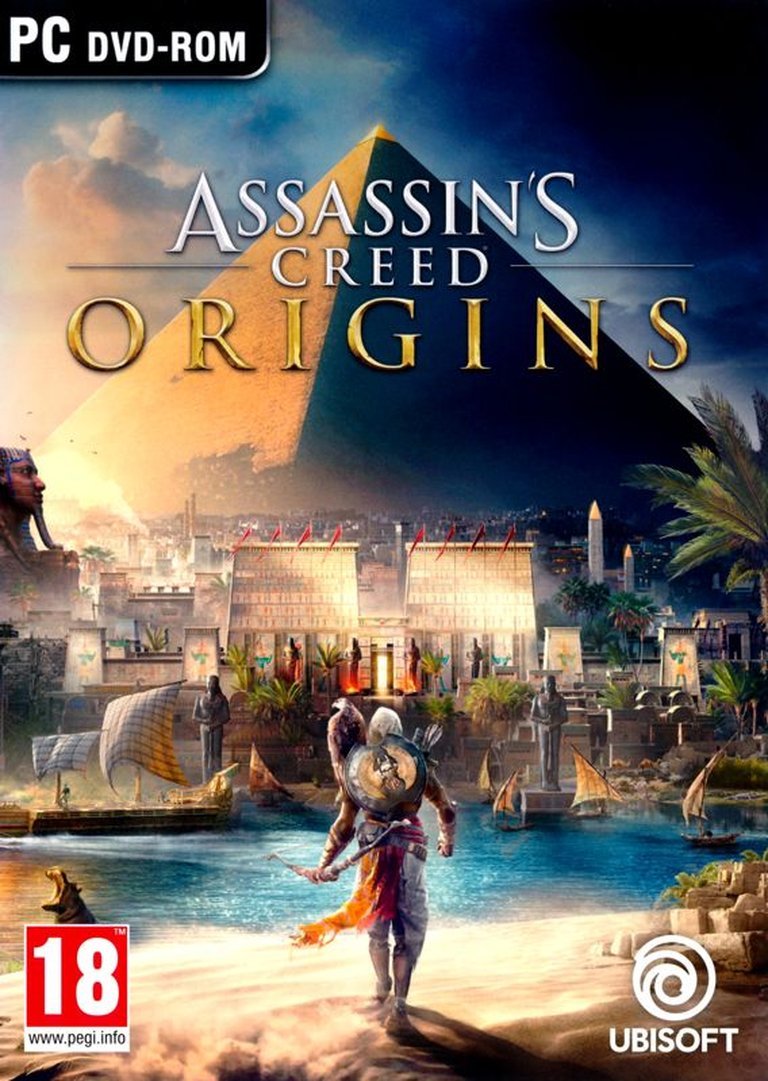
Set in Ancient Egypt during the Ptolemaic period, Assassin’s Creed: Origins is an action RPG that follows Bayek, a Medjay, whose personal journey to protect his family leads to the formation of the Brotherhood of Assassins. Players explore a vast open world blending stealth, combat, and RPG elements while uncovering the origins of the Creed through a rich narrative set against the backdrop of historical landmarks and mythology.
Gameplay Videos
Assassin’s Creed: Origins Free Download
Assassin’s Creed: Origins Cracks & Fixes
Assassin’s Creed: Origins Patches & Updates
Assassin’s Creed: Origins Guides & Walkthroughs
Assassin’s Creed: Origins Reviews & Reception
ign.com : The delightful sense of discovery still hasn’t left me.
gamesradar.com : As beautiful as it is deadly, Origins’ Egyptian playground is finally everything you wanted the Creed to be.
Assassin’s Creed: Origins Cheats & Codes
PC
Go to the Gear tab of the Character pause menu and enter the following commands:
| Code | Effect |
|---|---|
| right mouse button + interact key | Change hair |
| left mouse button + interact key | Change beard |
PlayStation 4
Go to the Gear tab of the Character pause menu and enter the following commands:
| Code | Effect |
|---|---|
| L2 + ∆ | Change hair |
| R2 + ∆ | Change beard |
Xbox One
Go to the Gear tab of the Character pause menu and enter the following commands:
| Code | Effect |
|---|---|
| LT + Y | Change hair |
| RT + Y | Change beard |
Assassin’s Creed: Origins: Review
Introduction
In the pantheon of gaming franchises, Assassin’s Creed has weathered storms of criticism, franchise fatigue, and creative stagnation. After a two-year hiatus following the tepid reception of Syndicate (2015) and the infamous launch of Unity (2014), Ubisoft Montreal delivered Assassin’s Creed: Origins (2017) not merely as another entry but as a transformative rebirth. More than a prequel to the series, Origins reimagined the franchise as a sprawling, RPG-driven epic, diving deep into the origins of the Assassin Brotherhood during Ptolemaic Egypt. This review argues that Origins revitalized the series through its emotional narrative, historically grounded world, and bold gameplay innovations, proving that even a decade-old franchise could find new life through reinvention.
Development History & Context
Ubisoft Montreal’s four-year development cycle for Origins (beginning post-Black Flag) was a deliberate response to the franchise’s existential crisis. Led by directors Jean Guesdon and Ashraf Ismail, a team of nearly 700 collaborators—including studios in Sofia, Singapore, and Bucharest—adopted a “co-development” model unprecedented in the series. This approach allowed each studio to own specific aspects: Sofia crafted intricate tombs, Singapore handled naval segments, and Montreal oversaw core design. The hiatus of 2016 was critical, granting extra polish after Syndicate’s underwhelming sales and Unity’s technical failures.
Technologically, Origins leveraged the AnvilNext 2.0 engine to overcome historical constraints. Previous titles avoided Egypt due to limitations in rendering vast deserts and cities, but by 2017, procedural generation (e.g., SpeedTree for flora) and meticulous handcrafting enabled a seamless world. Ubisoft’s collaboration with Egyptologists ensured authenticity—historian Evelyne Ferron, for instance, corrected depictions of mummification to align with Egyptian sensibilities. This era’s gaming landscape was dominated by open-world RPGs like The Witcher 3 and Horizon: Zero Dawn, pushing Origins to evolve beyond its stealth-action roots.
Narrative & Thematic Deep Dive
Set in 49 BCE, Origins follows Bayek of Siwa, a Medjay (elite protector) whose quest for vengeance after his son Khemu’s murder unravels a conspiracy by the Order of the Ancients—the proto-Templars. The narrative unfolds in two layers: Bayek’s historical journey and Layla Hassan’s modern-day storyline. The former is a masterclass in tragedy and rebirth. Bayek’s grief is visceral—his rage against the masked men who killed Khemu humanizes him, while his wife Aya’s political savvy contrasts his raw emotion. Their partnership culminates in the foundation of the Hidden Ones, whose creed—”Nothing is true; everything is permitted”—emerges organically from their fight against tyranny.
Themes permeate the story: loss as a catalyst for change, free will vs. control (echoed in the Order’s manipulation of Cleopatra and Caesar), and historical cycles where empires rise and fall. Dialogue, penned by Alain Mercieca, avoids franchise clichés, with exchanges like Bayek’s counsel to a grieving father (“Grief is a debt we owe to those we love”) resonating beyond the game. Historical figures—Cleopatra, Caesar, and Pompey—are not cameos but pivotal players, their motivations grounded in political realism. Even the modern framing device, though minimal, cleverly ties into the series’ lore via Layla’s discovery of Bayek’s DNA.
Gameplay Mechanics & Systems
Origins dismantled the series’ formula in favor of RPG depth. Combat received a radical overhaul, replacing “paired animation” systems with a hitbox-based model reminiscent of Dark Souls. Players now dodge, parry, and switch between weapon categories (swords, bows, spears), each with unique traits. Legendary weapons, earned by defeating Phylakes (elite bosses), encourage tactical diversity. Stealth, though viable, is less linear—Senu, Bonelli’s eagle companion, replaces “Eagle Vision,” allowing scouting and marking enemies. Environmental kills (e.g., igniting oil jars) add strategic layers.
Progression embraces RPG mechanics: a tripartite skill tree (Hunter, Warrior, Seer) unlocks abilities like poison darts or adrenaline attacks. Level scaling introduces artificial difficulty, with enemies adapting to Bayek’s power, though this occasionally frustrates. Crafting—using resources from hunting or dismantling gear—adds depth, though loot boxes ( purchasable with in-game currency) feel tacked on. Exploration is rewarded by discovering tombs, solving riddles, and uncovering sync points, which double as fast-travel nodes. The removal of the minimap in favor of a compass fosters organic discovery, though UI clarity occasionally falters.
World-Building, Art & Sound
Origins’ Egypt is a triumph of environmental storytelling. The Nile’s banks, Siwa’s oasis, and Alexandria’s crowded streets are not backdrops but living ecosystems. Ubisoft’s historical consultation ensured landmarks like the Great Sphinx and Library of Alexandria are architecturally accurate, while cities like Memphis reflect their cultural origins. Procedural generation fills deserts with rocks and dunes, yet key locations—tombs, arenas—are handcrafted, ensuring density. Dynamic weather, from sandstorms to mirages, immerses players in the locale’s harshness.
Art direction, helmed by Raphael Lacoste, blends realism with myth. Bayek’s tanned physique and Aya’s regal attire reflect their roles, while enemy designs (e.g., Order members in golden masks) evoke ancient iconography. Lighting during dawn or torch-lit tombs evokes painterly grandeur. Sound design is equally meticulous: Sarah Schachner’s score weaves traditional instruments (oud, flute) with orchestral swells, underscoring both battle and tranquility. Voice acting—particularly Abubakar Salim’s Bayek—breathes life into characters, with Arabic dialogue lending authenticity.
Reception & Legacy
Upon release, Origins earned critical acclaim, with an 87% Metacritic average. Praise centered on its “stunning” world (IGN), “emotional” story (GamesRadar), and “polished” combat (USgamer). Critics lauded the RPG evolution, though some noted pacing issues—VentureBeat criticized repetitive side quests, and PC Gamer bemoaned “padding.” Commercially, it sold over 10 million units, doubling Syndicate’s sales, and topped UK charts. Awards included a Visual Effects Society win for Outstanding Real-Time Project.
Its legacy is transformative. Origins revitalized the franchise, inspiring Odyssey (2018) and Valhalla (2020) to double down on RPG mechanics. The Discovery Tour mode—an educational tool letting players explore Egypt sans combat—was lauded by educators and even exhibited at Montreal’s Pointe-à-Callière Museum. However, its historical accuracy faced scrutiny; the Discovery Tour’s gender-inclusive classrooms sparked debates about revisionism. Despite this, Origins remains a benchmark for open-world design, proving that historical authenticity and accessibility could coexist.
Conclusion
Assassin’s Creed: Origins is not merely a game but a renaissance. By framing the Brotherhood’s birth through Bayek’s personal tragedy, Ubisoft elevated the series beyond stealth tropes into a poignant exploration of loss and legacy. Its RPG systems, world-building, and historical reverence created a blueprint for future entries, even as minor flaws—loot boxes, occasional bugs—marred an otherwise polished experience. For franchise veterans, it was a return to form; for newcomers, a gateway to one of gaming’s richest worlds. Ultimately, Origins stands as a testament to evolution: a rebirth that honored the past while boldly forging a new identity for the future. In the annals of Assassin’s Creed, it is less a chapter than a cornerstone.