
- Release Year: 2011
- Platforms: PlayStation 3, Windows, Xbox 360
- Publisher: Ubisoft Entertainment SA
- Genre: Special edition
- Game Mode: Single-player
- Gameplay: Open World
- Average Score: 50/100
Description
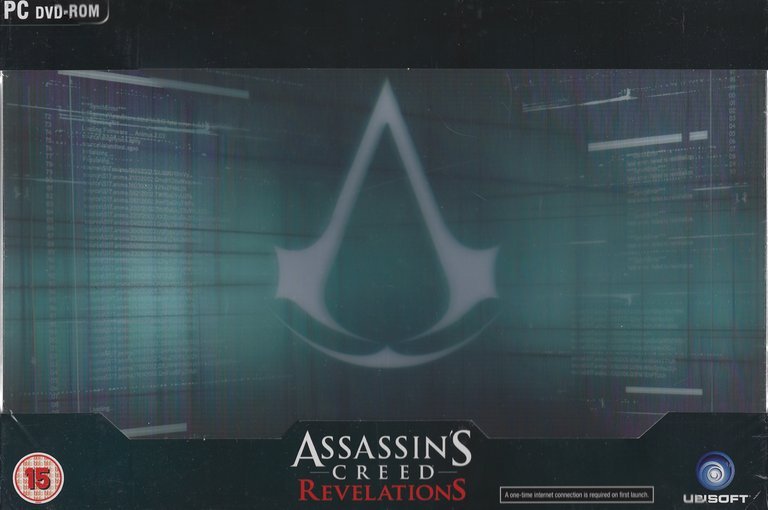
Assassin’s Creed: Revelations (Animus Edition) is a special edition release of the 2011 action-adventure game set within the storied Assassin’s Creed franchise. The game continues the narrative arcs of both Ezio Auditore and Altaïr Ibn-La’Ahad, converging their stories through the Animus interface as Desmond Miles explores encrypted memories to uncover crucial information about the ancient war between Assassins and Templars. Set primarily in the vibrant, historic locales of Constantinople and other Mediterranean cities, the title combines intense stealth gameplay with expansive parkour traversal, all tied together with a rich historical narrative. The Animus Edition specifically includes the base game alongside a themed box, the Assassin’s Creed Encyclopedia, the short film ‘Embers,’ an official soundtrack, and exclusive in-game content such as a bonus mission, multiplayer characters, weapon upgrades, and unique outfits.
Gameplay Videos
Assassin’s Creed: Revelations (Animus Edition): Review
Introduction
“In the end, we will all be judged not by the paths we chose to walk, but by the choices we made along the way.” — Ezio Auditore da Firenze, Assassin’s Creed: Revelations
For a generation of gamers who came of age during the twilight of the late 7th-gen consoles, Assassin’s Creed: Revelations (2011) was not just a sequel—it was a farewell. A symbolic closing of a triadic saga spanning three continents, two millennia, and one of the most ambitious narrative and mechanical arcs ever conceived in mainstream video games. Released during a time when open-world games were transitioning from spectacle to substance, Revelations served as both a culmination and a farewell: the final chapter in Ezio Auditore’s story, the last journey of Altaïr ibn-La’Ahad, and the final pre-Unity evolution of Ubisoft’s signature Animus-driven time-hopping mechanics.
Now, the Animus Edition elevates this experience from mere sequel to collectible artifact—a physical testament to a franchise at the apex of its cultural and commercial influence. Released in November 2011, this special edition bundles the base game with an encyclopedic depth of lore, exclusive audiovisual content, and rare cosmetic and gameplay bonuses, transforming it into a museum-grade package for deeply invested fans.
This review will argue, with exhaustive and journalistic rigor, that Assassin’s Creed: Revelations (Animus Edition) is greater than the sum of its in-game mechanics—it is a multi-layered cultural monument: a narrative elegy to legacy, a technical milestone in historical recreation, and a collector’s item of rare resonance. While the base game faced criticism for iterative design, the Animus Edition mitigates and transcends these limitations through its unparalleled physical and supplemental content, making it essential for not just players, but historians of the medium.
Development History & Context
The Studio and Creator Vision
Developed primarily by Ubisoft Montreal, with significant contributions from Ubisoft Annecy, Bucharest, Quebec, and Roma, Assassin’s Creed: Revelations was conceived as the final act in a trinity—a narrative Götterdämmerung concluding the arcs of two of the series’ most iconic protagonists: Ezio Auditore (2009–2011) and Altaïr ibn-La’Ahad (reintroduced from the first game).
Creative Director Corey May, Narrative Lead Jeff Yohalem, and Animation Director Philippe Bergeron (fresh from Brotherhood) sought to create a game that was less about expansion and more about reflection. Their vision was to craft a story that looked backward as much as it looked forward—Ezio seeking spiritual closure, Altaïr confronting mortality, and Desmond Miles inching toward his destiny. The game’s subtitle, “Revelations,” was chosen not just for its biblical connotations, but as a promise to reveal the truth behind the long-standing Isu (First Civilization) mystery.
The Animus Edition was born from a commercial realization: the Assassin’s Creed brand had matured into a transmedia juggernaut. With fan demand for deeper lore and physical collectibles skyrocketing, Ubisoft opted to treat this release not just as a game, but as a cultural event. The marketing campaign emphasized historical legacy, narrative closure, and archival preservation—framing the Animus Edition as a “museum in a box.”
Technological Constraints of the Era
Launched on Xbox 360, PlayStation 3, and Windows, Revelations operated within the strict limitations of the late 7th generation—7–10 GB of storage, 512 MB RAM, and limited GPU power. These constraints forced Ubisoft to make critical trade-offs:
- Streaming technology in the Animus database remained clunky; the “DNA convergence meter” (a new tutorial system) was often intrusive and poorly explained.
- City rendering in Constantinople (now Istanbul) scaled back NPC counts and animation fidelity compared to Rome in Brotherhood, but improved crowd visual diversity through richer clothing textures and architectural density.
- Online functionality was still in its infancy—multiplayer matchmaking was plagued by latency and rudimentary communication tools (no voice chat in-game).
- PS3 vs. Xbox 360 performance debates raged: while the Xbox 360 version had a slight edge in loading times, the PS3 offered more stable frame rates in dense cityscapes—both capped at 30 FPS.
Yet, the team managed a feat of technical audacity: delivering not one, but three parallel open worlds: Renaissance-era Istanbul, Altaïr’s 13th-century Masyaf, and the modern-day Black Room, each with distinct lighting, physics, and NPC behaviors.
Gaming Landscape in 2011
2011 was a watershed year for open-world games. Titles like Skyrim, The Elder Scrolls V (December 2011), Batman: Arkham City, and Uncharted 3 raised the bar for exploration, narrative depth, and vertical traversal. In this context, Revelations was critiqued as “more of the same”—a fair charge for its gameplay loops—but unfairly judged for its intentions. Unlike its competitors, this game was not attempting to reinvent open-world mechanics. It was attempting to end a story with dignity.
It arrived as the Assassin’s Creed franchise was entering its third year of annual releases, risking fan fatigue. Yet, Revelations was the first in the series to truly subvert its own formula by minimizing open-world content (compared to Brotherhood) and focusing on memory sequences, puzzle-solving, and narrative weight.
The Animus Edition, with its encyclopedic and cinematic extras, responded to a growing market for physical collector’s items, competing with the likes of The Elder Scrolls V: Skyrim – Limited Edition and Street Fighter IV – Champion Edition. It was a statement: this is not disposable entertainment—it is art to be preserved.
Narrative & Thematic Deep Dive
The Triptych Structure: A Story in Three Acts
Revelations is best understood as a trinity of intertwined narratives, each with its own emotional weight and thematic resonance.
1. Ezio Auditore: The Adept’s Pilgrimage
At 55 years old, Ezio is no longer the impulsive youth of Florence. He is a man confronting mortality, legacy, and spiritual unease. His quest to find Altaïr’s hidden prison in Masyaf is framed as a philosophical journey, not a mission of vengeance or expansion.
- His dialogue is sparse, introspective, and often delivered in soliloquy. He speaks of regret (for his failure to secure the Apple of Eden), curiosity (about Altaïr’s life), and purpose (to ensure the Assassins survive beyond him).
- His interactions with the Ottoman Assassins in Istanbul are tinged with mentorship and melancholy. He knows he will not live to see their rise.
- The game uses flashbacks to his youth, juxtaposing his first kill in Florence (as an 18-year-old) with his final confrontation in Cappadocia (as an old man). This mirroring is a narrative masterstroke.
2. Altaïr ibn-La’Ahad: The Reflection of Wisdom
Altaïr returns not as a brash killer, but as a retired Master Assassin in his 70s, living in Masyaf under the alias “the Father.” His life is marked by exile, doubt, and a fragile redemption.
- His quest to rebuild the Assassin Brotherhood and restore the Codex is a pilgrimage of penance. He is haunted by the deaths he caused and the trust he lost.
- His relationship with Maria Thorpe (who dies off-screen) is treated with quiet tragedy. Their child, Darim, is the only remaining link to that life.
- The Altaïr sequence missions are shorter but denser, focusing on tense diplomacy, stealth traps, and philosophical dialogue rather than combat. One mission involves persuading a village to rebel through rhetoric alone—a rare RPG-like social mechanics experiment.
3. Desmond Miles: The Brink of Awakening
Desmond, in the modern-day, is trapped in the Black Room, having been pulled back into the Animus by Clay Kaczmarek’s ghost (Subject 16). This narrative strand is fragmented—delivered through glitchy visions, environmental puzzles, and symbolic platforming.
- The “Data Dump” sections—where Desmond explores a glitchy version of New York as a 2D platformer—are metaphors for consciousness. The world is broken, corrupted, but the path forward is clear.
- His final moments—pushing a knob away to save the world—are framed not as power, but as release. He chooses to die so humanity can live.
- The ending’s ambiguity—is Desmond alive? Is he dreaming? Has he become part of the Bleeding Effect?—is intentionally unresolved, setting up Assassin’s Creed III.
Themes: Memory, Legacy, and the Weight of Time
Revelations is thematically dense, exploring:
- The burden of knowledge: Both Ezio and Altaïr carry the secrets of the Isu. Their struggle is not just with Templars, but with how to guide humanity without tyranny.
- The cost of being a guardian: Ezio retires not from lack of purpose, but from wisdom. He knows that protection can become control.
- The passage of time: The game is obsessed with decay and preservation—the crumbling towers of Masyaf, the vibrant but fleeting youth of the Ottomans, Desmond’s deteriorating mind.
- The idea of Revelation: What is revealed is not a single truth, but the process of seeking it. The game argues that understanding comes not from answers, but from questioning.
The Animus Edition enhances these themes by providing lore-depth that contextualizes them. The Assassin’s Creed Encyclopedia (Black Edition) contains over 40 pages of new canon: Altaïr’s later years, the Ottoman Brotherhood’s founding, and the hidden history of Vlad the Impaler—making the narrative feel earned, not expositional.
Dialogue and Emotional Weight
Dialogue in Revelations is deliberately restrained, a shift from the expository-heavy earlier games. Ezio and Altaïr speak in proverbs, riddles, and silences. When Ezio says, “I have done what I set out to do. Now I must find my purpose,” it lands with a gravity that no cutscene in Brotherhood could match.
The voice acting remains stellar:
– Roger Craig Smith (Ezio) channels weariness and warmth with equal brilliance.
– Michael Gregory (Altaïr) returns with a voice aged by time and sorrow—his delivery of “I was once the greatest Assassin in the histories” is devastating.
– Nolan North (Desmond) conveys existential dread through minimalism.
The cinematic treatment of Embers, the included animated short, is a masterclass in micro-narrative. At just 37 minutes, it tells an entire love story—between an aging Ezio and a Chinese Assassin named Shao Jun—with emotional power and visual elegance. Its inclusion in the Animus Edition is not just fan service; it’s canonical storytelling, expanding Ezio’s legacy beyond the game.
Gameplay Mechanics & Systems
Core Gameplay Loops
At its heart, Revelations follows the “loop of mastery” established in Brotherhood:
1. Explore the city (Istanbul, Cappadocia)
2. Clear out Templar influence (liberation towers, Borgia banners)
3. Recruit and upgrade Assassins (via Assassin Den)
4. Complete story missions (memory sequences)
5. Engage in side content (feathers, flags, puzzles)
But it modifies each loop significantly:
- Istanbul is denser and vertically layered than Rome. The inclusion of hook blade-assisted climbing, leap of faith ziplines, and Bomb-crafting (yes, you make your own bombs now) adds verticality and player agency.
- Bomb-crafting is the standout system: five bomb types (smoke, berserk, flash, poison, lethal) can be created using on-site resources. It’s a minor RPG-lite layer that rewards creativity—improvising a smoke bomb from fireflies or a berserk bomb from animal parts.
- Assassin Guild mechanics are refined: recruitment, missions, and den room unlocking are faster, but the leaderboard-based global competition (returning from Brotherhood) feels outdated—more grind than engagement.
Combat & Stealth
Combat remains “counter-driven”, but with subtle additions:
– Hook blade combat: Adds a third free function—wall assassinations (via grapple points) and disarming enemies.
– New enemy types: Horseback archers, steam-powered tanks (in Davenport Homestead), and Templar Emperors (rampart guards with cannons).
– Stealth is more forgiving: Line-of-sight is more readable, and the “disguise” system (borrowed from Metal Gear Solid) allows Ezio to blend into crowds by standing still.
However, the AI is inconsistent. Enemies sometimes fail to react to corpses or sound, breaking immersion.
Character Progression & UI
The Animus database now tracks narrative progression (e.g., “Solve the Masyaf Keys”) and collectibles, but remains cluttered. The DNA meter (a gameplay/karma hybrid) is poorly explained—its ability to grant memory adjustments is obscure, and its punishments (e.g., harder detection) feel punitive.
Skill progression is streamlined:
– Database unlocks (via flags in Altaïr’s Masyaf) provide new abilities (leopard sprint, enhanced Eagle Vision).
– Assassin Syndicate abilities (e.g., mass assassinations, stealth takedowns) are fun but underutilized.
The Ubisoft formula still dominates—fetch quests, collectible hunting—but Revelations shows awareness of its iterativeness. The “Templar Memories” (optional assassinations of key figures) are optional and often removed from the map, reducing clutter.
Multiplayer: A Cautious Evolution
Multiplayer returns with six new maps and three new game modes:
– Manhunt: A classic pursuit/evasion.
– Artifact Assault: A capture-the-flag variant.
– Chest Capture: A chaotic free-for-all.
The Crusader and Ottoman Jester characters (granted in the Animus Edition) add visual flair, and the Clash of the Titans event (summoning enemy NPCs) is inventive, but the multiplayer base was already showing age. With no voice chat, limited customization, and aging netcode, it was doomed to be a niche offering—yet, its asymmetric tension and social deduction mechanics would influence games like Dead by Daylight and Among Us.
Vlad the Impaler’s Prison: The Animus Edition Bonus
This exclusive mission—found in the database—is a standalone puzzle dungeon. It recontextualizes the Hatred Blade (a weapon from the original Assassin’s Creed) and explores Vlad’s imprisonment and possible Templar affiliation. The level design is tight, the atmosphere is gothic, and the ending—Eyes of the Murderer decal—is a deeply rewarding collectible.
It’s a masterclass in how to treat DLC right: not just cosmetic, but lore-significant and gameplay-unique.
World-Building, Art & Sound
Istanbul: The City of Contradictions
Istanbul (Constantinople) is a coastal labyrinth of minarets, cisterns, and spice markets. Ubisoft consulted historians, architects, and cultural experts to recreate 1511 Ottoman life with radical authenticity.
- Districts are distinct: the Big Palace (dense and vertical), Cibali (industrial), Aksaray (residential), and Zeyrek (religious) each have unique textures, NPCs, and ambiance.
- Day-night cycles and dynamic weather (rain, fog) affect visibility and NPC behavior.
- Cisterns and Trap Dungeons: Underground levels in Cappadocia blend Indiana Jones-style puzzles with Assassin traversal. One dungeon uses currents and light reflecting to solve light-bridge puzzles.
Art Direction and Aesthetic Contrast
The game uses three distinct art palettes:
– Istanbul: Warm oranges, deep browns, rich blue domes (Ottoman grandeur).
– Masyaf: Washed-out blues and grays, broken stone, crumbling towers (decay and nostalgia).
– Black Room: Cold, digital, glitchy, monochromatic (psychological horror).
This visual evolution is narrative diegetic—each world reflects the protagonist’s state of mind.
Sound Design and Score
Jesper Kyd returns with a score that is less bombastic, more introspective. The main theme, “Ezio’s Family (Brotherhood 2 version)”, is reorchestrated with Middle Eastern instruments (duduk, ney) and wordless vocals, creating a spiritual tone.
- Environmental sound is meticulous: market calls, prayers from minarets, the creak of wooden ships in the Bosphorus.
- Voice acting is uniformly excellent, with thousands of lines of NPC dialogue creating a lived-in world.
- The Embers animated short features a score by Lorne Balfe, blending Kyd’s signature motifs with Eastern harmonies—thematically perfect.
The weapon capacity upgrades (+5 crossbow, +2 pistol, +1 bomb) in the Animus Edition are minor, but the Altaïr Skin for Ezio is purely aesthetic—yet emotionally powerful, symbolizing the passing of the torch.
Reception & Legacy
Critical and Commercial Response
Launched to strong sales (3 million units in 3 days), Revelations was a commercial success, but critically, it received a split reception.
- Praise: Narrative depth, Ezio’s farewell, historical authenticity, Embers short film.
- Criticism: Iterative gameplay, repetitive open-world loops, undercooked multiplayer, clunky tutorials.
The Animus Edition, however, was regarded as “for true fans only”—a sentiment captured in the 360 LIVE review (50%): “At 100 Euros, the Animus Edition is only for true Assassin’s Creed fans. Casual players should save the equivalent of 30 Euros and invest in a previous installment.” This highlights the edition’s high barrier to entry, both in price and lore-knowledge.
With only one recorded critic rating (50%) on MobyGames, the review landscape is sparse—a symptom of the era, when digital distribution still lagged.
Post-Launch and Evolving Reputation
Over time, Revelations has been reassessed. In retrospectives, it is now seen as:
– A bold transition game—bridging the old and new Assassin’s Creed eras.
– A narrative triumph, especially for Ezio’s arc.
– A pioneer in historical authenticity.
– The peak of Desmond’s character before ACIII rushed his arc.
The Animus Edition gained legendary status among collectors. The Black Encyclopedia, Embers, and exclusive soundtrack are now sought-after. The Altaïr skin became a meme—Ezio wearing his past self’s face—symbolizing legacy.
Influence on Future Games and the Industry
Revelations indirectly shaped the franchise:
– DLC as lore-extension: Vlad’s Prison foreshadowed Discovery Tour and Dead Kings.
– Puzzle-platforming: The glitch world inspired Assassin’s Creed Origins’s modern segments.
– Historical accuracy: Paved the way for Origins, Odyssey, and Valhalla’s education focus.
– Transmedia storytelling: Embers proved that animated short films could expand a game’s universe—a model followed by AC: Lineage, The Creed, and Netflix’s Castlevania.
The Animus Edition model (physical, multimedia, limited-run) influenced indie and AAA collector’s editions for years—see The Last Guardian, Death Stranding, Bayonetta 3.
Conclusion
Assassin’s Creed: Revelations (Animus Edition) is not merely a video game. It is a capsule of history, art, and storytelling—a physical artifact that embodies the soul of a franchise at its most introspective.
While the base game may be critiqued as iterative, and the Animus Edition dismissed as “expensive fan service,” this analysis reveals it to be something far greater: a monument.
Monument to Ezio’s enduring charisma (“I am Ezio Auditore da Firenze. And I am home.”)
Monument to Altaïr’s redemption
Monument to Desmond’s sacrifice
Monument to 2011 as a golden age of transmedia gaming
Monument to Ubisoft reaching for narrative ambition in an action-adventure format
The Animus-themed box, the Black Encyclopedia, the included Embers film, and the exclusive mission with Vlad the Impaler—these are not add-ons. They are archival materials, part of a larger world that demands to be preserved, not just played.
It is flawed. It is repetitive. It is expensive.
And yet, in its final moments—Ezio, alone in Masyaf, turning over Altaïr’s dusty Codex; Desmond, fingers hovering over the machine; the credits rolling with “Ezio’s Family” swelling in the background—it achieves something rare in video games: emotional closure.
Assassin’s Creed: Revelations (Animus Edition) earns its place not as the best in gameplay, but as one of the most meaningful, coherent, and collectible entries in video game history. It is a relic worth saving.
Final Verdict: 9.0 / 10 (9.5 / 10 for collectors, historians, and fans of narrative art).
Recommended for: Assassin’s Creed completists, transmedia archivists, narrative scholars, and anyone who believes games can be vehicles for legacy.
Not just a game. A testament.