
- Release Year: 1996
- Platforms: DOS, SNES, Windows
- Publisher: Infogrames Europe SA, Infogrames France S.A.S.
- Developer: Bit Managers S.L., Infogrames Europe SA, Infogrames France S.A.S.
- Genre: Action
- Perspective: Side view
- Game Mode: Co-op, Single-player
- Gameplay: Collection, Platform, Sports
- Setting: Ancient Roman
- Average Score: 75/100
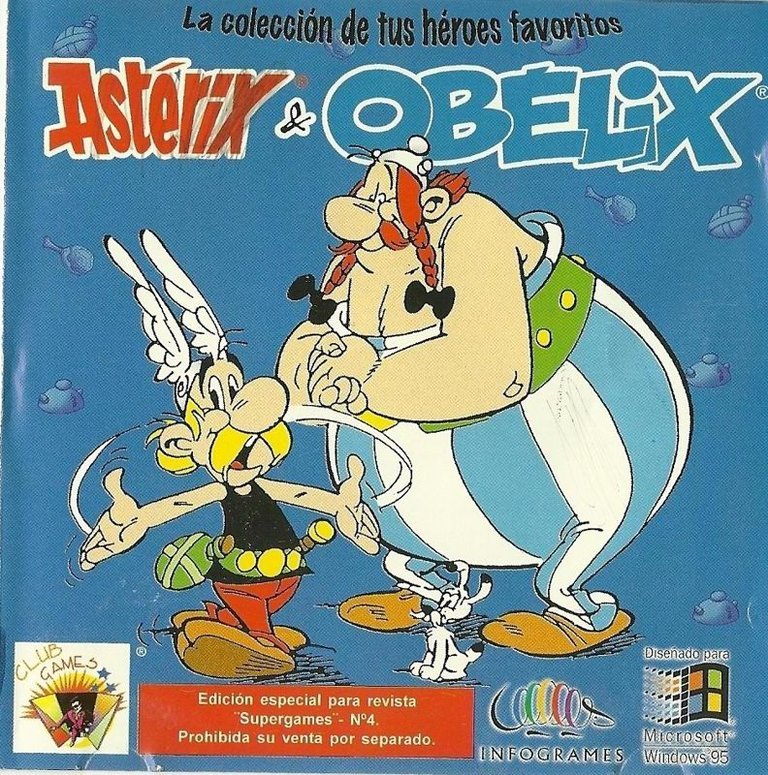
Description
Astérix & Obélix is a side-scrolling platform game set in 50 BC Gaul, where players control the iconic Gaulish heroes—either solo or in cooperative two-player mode—on a quest to retrieve artifacts from various European locations, featuring bonus stages like rugby matches and the Olympic Games that capture the humor and style of the original comics.
Gameplay Videos
Where to Buy Astérix & Obélix
PC
Astérix & Obélix Reviews & Reception
hardcoregaming101.net : It’s actually decent in its own right.
squakenet.com : Gorgeous but dull comic-book adventure.
Astérix & Obélix Cheats & Codes
Super Nintendo (SNES)
Enter Game Genie/Action Replay codes via emulator cheat tab or physical device. Use button sequences at title screen for Level Select. Enter passwords at level select or password screen.
| Code | Effect |
|---|---|
| 82E9-6F64 | Unlimited Energy |
| 82E0-6D04 | Unlimited Lives |
| 2D68-ADAD | Invulnerability |
| A968-AF0D | Invulnerability |
| 6D81-670D | Jump In Midair |
| 6D8D-AF6D | Jump In Midair |
| DD8F-DD67 | Get Items From Anywhere |
| DDAF-D4A7 | Get Items From Anywhere |
| DD2A-6D07 | Get Items From Anywhere |
| 4DCE-D4DD | Hit Enemies From Anywhere |
| DDCE-D40D | Hit Enemies From Anywhere |
| DFCE-D70D | Hit Enemies From Anywhere |
| 6DB5-0D6D | Hit Enemies From Anywhere |
| 7E008C28 | Infinite Health |
| 7E101D09 | Infinite Lives |
| 7E107627 | Infinite Time |
| 7E007DC0 | Moon Jump |
| Left, R, Right, L, X, A | Level Select |
| X, A, B, Y, A, B, Y, X | Level Select |
| Asterix, Obelix, Dog, Old Man | Unlock Level 5 – Switzerland |
| Woman, Viking, Obelix, Dog | Unlock Level 9 – Greece |
| Dog, Woman, Old Man, Viking | Unlock Level 13 – Egypt |
| Woman, Asterix, Dog, Obelix | Unlock Level 17 – Spain |
| dog, girl, wizard, asterix | Unlock Act 3 – London |
| asterix, obelix, dog, wizard | Unlock Act 5 – Swiss Frontier |
| dog, chief, girl, wizard | Unlock Act 7 – The Mountains |
| girl, chief, obelix, dog | Unlock Act 9 – Piraeus |
| girl, dog, chief, wizard | Unlock Act 11 – Olympia |
| dog, girl, wizard, chief | Unlock Act 13 – The Desert |
| asterix, obelix, dog, chief | Unlock Act 15 – The Desert Camp |
| girl, asterix, dog, obelix | Unlock Act 17 – The Pirate Ship |
| girl, chief, dog, obelix | Unlock Act 19 – The Roman Camp |
Astérix & Obélix: A 16-Bit Triumph Marred by Mediocrity
Introduction: The Gaulish Gambit
In the mid-1990s, the European video game landscape was a unique ecosystem. While Nintendo and Sega battled for console supremacy with mascots like Mario and Sonic, a different kind of icon held unbending dominion over the hearts of French and broader European children: a moustached, super-strong Gaul named Astérix and his best friend, the menhir-carrying Obélix. The comics by René Goscinny and Albert Uderzo were not just popular; they were a foundational cultural pillar. Translating this beloved, humor-rich world into a video game was a perilous task—one that had, up to that point, been botched more often than not. Astérix & Obélix (1995/1996), developed by Bit Managers for consoles and Infogrames for PC, represents the most significant and ambitious attempt yet to capture the spirit of the village that defies Rome in a mainstream 16-bit platformer. Its legacy is a fascinating, bifurcated tale: a game lauded for its stunningly authentic comic-book aesthetic, its innovative two-player co-op, and its deep-cut references, yet simultaneously criticized for its repetitive design, frustrating combat, and technical inconsistencies. This title stands as a pivotal, if flawed, monument in the history of licensed games—a project that understood its source material’s soul but struggled to give it a body worthy of the spirit.
Thesis: Astérix & Obélix is a game of profound contrasts. It is a visually sumptuous and mechanically ambitious adaptation that authentically channels the whimsy and world-touring scale of its source comics, yet it is fundamentally held back by a core gameplay loop that grows repetitive, combat that feels unfairly punitive, and development choices that resulted in a notably uneven experience across platforms, ultimately cementing its status as a beloved European cult classic rather than a universally acclaimed masterpiece.
1. Development History & Context: From Coktel’s Ashes to Bit Managers’ Ambition
The path to the 1995 Astérix & Obélix was paved with the failures of earlier, mediocre adaptations. Throughout the late 1980s and early 1990s, the license was deeply entangled with French developer Coktel Vision. Titles like Astérix et la Potion Magique (1986) and Astérix: Le coup du menhir (1989) were plagued by sluggish controls, convoluted design, and a failure to capture the comics’ energetic charm. As Hardcore Gaming 101’s retrospective starkly notes, Coktel’s entries felt “outdated and were plagued with very basic game design flaws,” culminating in a “fitting end” with Le coup du menhir. The license needed a savior, and it found one in two distinct entities: the publisher Infogrames and the Spanish studio Bit Managers.
Infogrames, a French publishing powerhouse, had already dabbled in the franchise with the 1993 Astérix games for NES/SNES/Game Boy (developed by Bit Managers). Those 8/16-bit titles were solid, charming platformers, with the NES version in particular hailed for its incredible soundtrack by Alberto José González. The success and relative competence of those games laid the groundwork for a bigger, grander sequel. The new project, internally, was conceived as a direct adaptation of the classic comic Le Tour de Gaule d’Astérix (Asterix’s Tour of Gaul), where the Gauls race around collecting “souvenirs” from Roman-occupied territories to mock Caesar. This narrative framework was perfect for a video game: a globe-trotting tour of iconic, visually distinct locations.
Bit Managers, the development house given the reins for the SNES and Game Boy versions, was a studio with a growing reputation for competent, faithful licensed work on Nintendo platforms. They had already proven they could handle the Asterix aesthetic on the NES. For the SNES, their task was to scale up that vision—more colors, larger sprites, parallax scrolling, and, crucially, implement a simultaneous two-player co-op mode, a first for a console Asterix game and a direct nod to the arcade beat-’em-up sensibility fans loved. The technological constraints of the SNES were well-understood: Mode 7 was out of the question for a detailed side-scroller, but the system’s rich color palette and DMA-assisted sprite handling allowed for the vibrant, comic-book look the team sought.
Meanwhile, the DOS/Windows versions were outsourced to East Point Software. This decision would have profound implications for the game’s reception on PC. The PC port essentially became a direct, high-resolution port of the SNES version, but with different sound hardware (MIDI instead of the SNES’s sample-based chip) and the potential for mouse control—a clunky addition that did little to improve the core experience. The result was a version that felt like an also-ran, lacking the visual cohesion and musical punch of its console counterpart.
The gaming landscape of 1995-96 was dominated by platformers. Super Mario World and Donkey Kong Country had set极高 standards for fluidity, secrets, and feel. Astérix & Obélix entered this arena not as a innovator, but as a potent licensed contender. Its direct competition wasn’t just other platformers, but other comic-based games. Crucially, Konami’s superb Astérix arcade beat-’em-up (1992) had already demonstrated how to perfectly blend the franchise’s humor and action. Bit Managers’ challenge was to translate that magic into the slower, more precise world of a platformer, and to make the distinction between the tiny, agile Astérix and the large, powerful Obélix meaningful in gameplay, not just in sprite size.
2. Narrative & Thematic Deep Dive: A Tour of Colonial Stereotypes
The game’s narrative is a clever, if broad, amalgamation of several classic album plots, centered on the “Tour de Gaule” concept. Julius Caesar, in a fit of pique over his inability to conquer the Gaulish village, orders a massive wooden palisade built around it. This isn’t to invade, but to isolate—a “soft” siege meant to starve them out by cutting off trade. Astérix and Obélix, after a toast with the magic potion, famously break through the barrier at the start, not to attack Rome directly, but to embark on a sarcastic victory lap. Their mission: to travel to the farthest reaches of the Roman Empire, acquire one “souvenir” from each nation—a symbol of its culture—and mail it back to Caesar. The message is clear: “Your empire is so vast and your control so weak that we, one tiny Gallic village, can travel it unopposed.”
This narrative structure is genius for a video game, providing a built-in level select screen that journeys from the familiar (Gaul, the village and forest) through Britannia (fog, tea, rugby), Helvetia (Swiss Alps, cheese, bank vaults), Graecia (Olympic stadiums, temples), Aegyptus (pyramids, mummies), and Hispania (bull runs, flamenco), before a final assault back through Gaul and into Roma itself. Each location is a direct lift from the comics:
* Britannia’s bonus rugby match is ripped straight from the physical comedy of Asterix in Britain.
* Helvetia’s mountainous terrain and vault infiltrations echo Asterix in Switzerland.
* Graecia’s Olympic mini-games and arena boss fights are pure Asterix at the Olympic Games.
* Aegyptus’s pyramid traps and mummy guardians are from Asterix and Cleopatra.
* Hispania’s bull-running sequences are the climax of Asterix in Spain.
Thematically, the game is a paean to Gallic resilience and cultural superiority through humor and chaos. The Romans are never portrayed as a legitimate military threat; they are bumbling, faceless cannon fodder (with the exception of the occasional centurion boss). The true “villain” is Caesar’s arrogant, bureaucratic imperialism, which the Gauls mock by systematically collecting and mailing back trophies of his provinces. The humor is embedded in the level design: fighting Romans while they sip tea, dodging avalanches caused by stray menhirs, playing Olympic events against心怀不轨的希腊裁判. It’s the comics’ satire of European national stereotypes translated into gameplay mechanics.
However, the game’s narrative execution is thin. Outside the introductory and ending cinematics, there is no story told through dialogue or character interaction within levels. Getafix (Panoramix) appears only in the opening, Vitalstatistix (Abraracourcix) is mentioned, and Dogmatix (Idéfix) is merely a collectible item (bones to summon him for a screen-clearing attack). The rich, character-driven humor of Goscinny and Uderzo is largely absent, replaced by visual gags in the backgrounds and enemy designs. The “souvenir” collection is a score mechanic, not a narrative driver. The anticlimactic final “boss”—finding a sleeping Obélix in the Roman camp—is a famous low point, completely missing the opportunity for a grand, comic-accurate showdown with a character like Brontosaurus (the gladiator trainer) or even a mock-serious confrontation with Caesar, who in the comics often acknowledges the Gauls’ spirit with grudging respect.
3. Gameplay Mechanics & Systems: The Promise and Peril of Duality
Core Loop & Structure:
The game is a side-scrolling platformer with light beat-’em-up elements, structured around 27 main stages (often 2-3 sub-levels per “country”) and 16 bonus mini-games. The objective is simple: reach the exit of each stage, often while collecting a requisite number of “souvenirs” (coins/stars) or finding a key. The stage layouts are large, multi-path, and often confusing, with secret areas behind destructible blocks (marked by a prominent “A”). This open-ended design within a side-scroller is ambitious, but it frequently leads to aimless wandering.
Character Differentiation & The Obélix Problem:
The game’s headline feature is the choice between Astérix and Obélix, with the promise of meaningful differences:
* Astérix: Smaller hitbox, faster movement, higher jumps. His attacks have longer reach (a straight punch vs. Obélix’s wind-up). He can perform a dash and a double jump (in some versions). He is the “skill” character.
* Obélix: Larger hitbox, slower movement, lower jumps. His attacks are more powerful but have shorter reach and slower startup. He is the “power” character.
In theory, this encourages players to choose based on playstyle. In practice, Astérix is almost always superior. His speed and jump height are critical for navigating the game’s many precise platforming sections and dodging enemy projectiles. Obélix’s sluggishness is a death sentence in stages with narrow platforms or fast-moving hazards. The Hardcore Gaming 101 review correctly identifies this as a major flaw: “there very little reason to play as him.” The two-player co-op mode is where the differentiation shines, allowing one player to handle platforming (Astérix) while the other clears enemies (Obélix), but in single-player, the choice is academically interesting but practically effortless.
Combat: A Frustratingly Imbalanced Affair:
Combat is the game’s greatest mechanical weakness. The core attack is a close-range punch. The fatal design flaw is enemy reach versus player reach:
* Enemies (mostly Roman legionaries, pirates, or animals) have a fairly wide attack radius and often attack from a distance with spears, thrown rocks, or fireballs.
* The player must be right next to an enemy to land a hit. Even the “uppercut” move, which provides minimal vertical reach, does not solve this.
* The result is a constant, frustrating trade: you must walk into an enemy’s attack zone, take the first hit (often losing a significant chunk of health), and then land your punch to defeat them. There is no defensive roll, block, or invincibility frame on attack startup. This turns every combat encounter into a health-sapping gamble.
Power-ups help but are inconsistent. The magic potion (or roasted boar for Obélix) provides temporary invincibility (“star power”), allowing you to plow through enemies. However, these are limited resources found in specific blocks or stages, not a reliable tool. The combat is so poorly balanced that many players will simply jump over enemies whenever possible, making the “action” in this “action-platformer” an avoidable nuisance.
Progression & Systems:
Health is a heart-based meter, restored by eating roasted boars scattered throughout levels. Lives are limited (3-5 depending on difficulty). The game uses a password system for saving progress after completing each “country” (a set of levels), a common 16-bit practice but archaic by today’s standards. The 16 mini-games (rugby scrum, Olympic running/jumping, bull dodging) are a double-edged sword. They break up the monotony and are often mechanically distinct, requiring different inputs (e.g., button-mashing for rugby). However, they are also famously repetitive—many use the same punch/jump mechanics of the main game—and feel like padding. Their inclusion is a clear nod to the comic’s episodic, set-piece humor, but they don’t significantly deepen the gameplay.
Interface & Control Quirks:
Control feel varies wildly by platform. The SNES version is notoriously sluggish. There is a noticeable input delay, making precise jumps and timed attacks feel unresponsive. Astérix’s running jump takes too long to accelerate, leading to many falls. The Game Boy version, conversely, is praised for its tighter, more responsive controls. This suggests the SNES port may have been rushed or technically challenged, a devastating flaw for a platformer. The DOS/Windows versions suffer from the same sluggish mechanics as SNES but with the added awkwardness of keyboard controls and a mouse option that offers no meaningful benefit.
4. World-Building, Art & Sound: A Feast for the Eyes and Ears
Visual Fidelity & Art Direction:
This is the game’s undisputed crown jewel. Bit Managers achieved something remarkable: they made a video game that looks like a living Uderzo comic. The sprites are large, colorful, and bursting with personality. Astérix and Obélix are instantly recognizable in their exaggerated proportions and animations. Obélix’s clumsy charges, Astérix’s quick hops, the Roman soldiers’ panicked fleeing—all are animated with a squash-and-stretch fluidity that mimics the original artwork. The backgrounds are lush and varied, perfectly capturing the iconic settings: the misty, cobblestone streets of Londinium; the steep, icy peaks of Helvetia; the sun-bleached, hieroglyphic-covered walls of Egypt; the dusty, arid arenas of Spain.
The attention to comic-book detail is astounding. Destructible blocks have a distinct “cracked” look. The “A” blocks are a playful, fourth-wall-breaking inclusion. Environmental hazards feel like they were lifted from the panels: rolling boulders in pyramids, sliding snow patches, slippery tea-spilled floors in Britain. The art direction is not just a reskin; it’s an hermeneutic translation, converting Uderzo’s linework and color choices into a functional 16-bit tile set. The Game Boy version, while technically more limited, compensates with clever use of dithering and some impressive parallax scrolling in backgrounds, proving the lead development may have been on the handheld.
Sound Design & Musical Score:
The soundtrack, composed by Alberto José González (returning from the 1993 NES/GB Astérix games), is a masterclass in 8/16-bit composition that perfectly encapsulates the franchise’s tone. His style is melodic, upbeat, and infused with folkish motifs that change with the locale—a triumphant, pipe-heavy melody for Gaul, a more solemn, exotic tune for Egypt, a rustic jig for Spain. The themes are catchy, loop seamlessly, and most importantly, sound like Asterix. They carry the same adventurous, slightly silly spirit as the films’ scores by Michel Colombier. The SNES version, while still good, is noted as being “more subdued” than his NES/GB work, likely due to the SNES’s more refined (but sometimes less punchy) sound sample system.
Sound effects are punchy and comedic: the “thwack” of a punch, the clatter of fallen Roman armor, the bubbling of a magic potion, the “boing” of a menhir. They provide crucial audio feedback that the sometimes-loose controls lack. The incorporation of short, sampled voice clips (a robotic “Come on!” from Astérix, a grunt from Obélix) adds charm without being obtrusive. The sound design completes the illusion that you are inside a comic panel.
5. Reception & Legacy: A European Phenomenon, An American Ghost
Critical Reception at Launch:
Reviews in 1995-96 were fiercely divided, often along national lines. French and Spanish magazines were most generous (Superjuegos: 90%, Joypad: 88%), praising the faithful graphics, the innovative co-op, and the sheer volume of content. German publications were more mixed but generally positive (Total!: 80%, Mega Fun: 72%), acknowledging the solid platforming beneath repetitive layers. The most scalding critiques came from harder-core英国 and later French outlets. Computer and Video Games (79%) called it “a good licence and a well-made, albeit unexceptional, game.” Jeuxvideo.com (55%) was brutal: “Décevant… the structure of the stages does not progress… the game manques cruellement d’intérêt. A beautiful package for a very empty game.” Video Games (German, 68%) and MAN!AC (68%) were dismissive, calling it a by-the-numbers platformer relying on the license’s strength. The PC/DOS versions fared worst, with Reset magazine giving them a 6/10, explicitly stating they were “not for 20-something maniacs, but for children.”
The critical schism mirrors the gameplay divide: was it a charming, accessible family game or a repetitive, shallow slog? The answer often depended on the critic’s patience for repetitive combat and their affection for the license.
Commercial Performance & Regional Lock:
The game was a Europe-exclusive phenomenon. It sold well in France, Germany, Spain, and the UK, buoyed by the preposterously popular comics and a savvy marketing tie-in: a box could be redeemed for a free day pass to Parc Astérix, the theme park. This was a marketing masterstroke that directly linked the game to the real-world franchise experience. It was never released in North America. A SNES version was planned for a US release by Electro Brain, but it was cancelled—likely due to the low name recognition of Asterix stateside and the crowded platformer market. This decision cemented the game’s status as a cult object outside of Europe.
Legacy and Historical Position:
Astérix & Obélix occupies a crucial middle chapter in the history of Asterix games. It came after the failed experiments of Coktel Vision and the competent but simple arcade/8-bit titles, and before the 3D-focused XXL series of the 2000s. Its legacy is threefold:
- The High-Water Mark for 2D Asterix: For decades, it was considered the pinnacle of 2D Asterix adaptations. Its combination of co-op, scale, and comic fidelity was unmatched until the more recent, also-flawed Slap Them All! series.
- The Co-op Template: Its simultaneous two-player mode set a template that subsequent games (XXL, Take on Caesar) would emulate. It understood that Astérix and Obélix are a team, and their dynamic is best experienced cooperatively.
- A Lesson in Adaptation Trade-offs: The game demonstrates the core challenge of adapting a narrative-and-character-driven comic: how do you translate satire and wit into interactive systems? Astérix & Obélix translated the settings and aesthetics brilliantly but failed to translate the comedy into mechanics. The humor is in the visuals and level themes, not in the act of punching yet another Roman for the hundredth time.
Its most direct legacy is the 2002 Game Boy Advance compilation Asterix & Obélix: Bash Them All!. This port of the SNES version made a crucial, game-changing alteration: all enemies are defeated in one hit. This single change transforms the game, alleviating the core frustration of the combat system and making it a far more fluid, enjoyable experience. This re-release stands as a tacit admission that the original SNES version’s combat was a misstep.
As of 2025, the original game exists in a preservation limbo. No official digital re-releases exist on modern platforms. Its survival depends on emulation and the collector’s market for rare PAL SNES and Game Boy cartridges. It is remembered with a curious fondness in retro European circles—acknowledged as flawed, but as our flawed, culturally specific masterpiece.
6. Conclusion: The Indomitable Village, The Flawed Game
Astérix & Obélix (1995) is a game that deserves to be remembered, but not blindly revered. It is a monumental technical achievement for its time, a game that genuinely makes you feel like you’ve stepped into a living, breathing Uderzo panel. The world design is a loving, encyclopedic tour of the comics’ greatest hits. The two-player co-op is a revelation, capturing the chaotic teamwork of the Gaulish duo like no game before or since for years. Alberto José González’s soundtrack is one of the finest of the 16-bit era, a perfect melodic companion.
Yet, these triumphs are permanently tethered to a core gameplay experience that is, at best, serviceable and, at worst, actively frustrating. The combat’s fundamental imbalance—requiring the player toabsorb the first hit—is a catastrophic design error for a game this combat-heavy. The sluggish controls on the flagship SNES version hobble the precision platforming. The repetitive structure of 27 nearly identical side-scrolling stages, punctuated by repetitive bonus games, saps the sense of adventure. The narrative is a skeletal framework, missing the soul of Goscinny’s scripts.
Its place in video game history is therefore nuanced. It is not a forgotten classic on par with Super Mario World or Sonic 2. It is, however, the definitive 16-bit attempt to capture the Asterix spirit, a sincere and ambitious effort that succeeded visually and atmospherically but stumbled mechanically. It is a game that captures the look of indomitability but not the feel—the Gauls in the game are powerful, but they feel sluggish and vulnerable, not effortlessly victorious. It is a testament to the power of a beloved license that such a mechanically average game can still be cherished, a nostalgic touchstone for a generation of European gamers who finally saw their comic heroes rendered with such faithfulness, flaws and all. It is the game that proved the Asterix license had video game potential, even if it would take another decade and a shift to 3D for that potential to be fully realized in a critically acclaimed action game. In the pantheon of licensed titles, it is a solid B+—a game whose heart is undeniably in the right place, even if its combat system is stuck in the wrong one.