
- Release Year: 1979
- Platforms: Antstream, Arcade, Atari 2600, Atari 7800, Atari 8-bit, Game Boy, Windows, Xbox 360
- Publisher: Accolade, Inc., Atari Corporation, Atari, Inc., ME-TA Elektronik Endüstri ve Ticaret A.Ş., Microsoft Corporation, Sears, Roebuck and Co., SEGA Enterprises Ltd., Taito Corporation
- Developer: Atari, Inc.
- Genre: Action
- Perspective: Top-down
- Game Mode: Hotseat, Single-player
- Gameplay: Arcade, Shooter, Space flight
- Setting: Futuristic, Sci-fi
Description
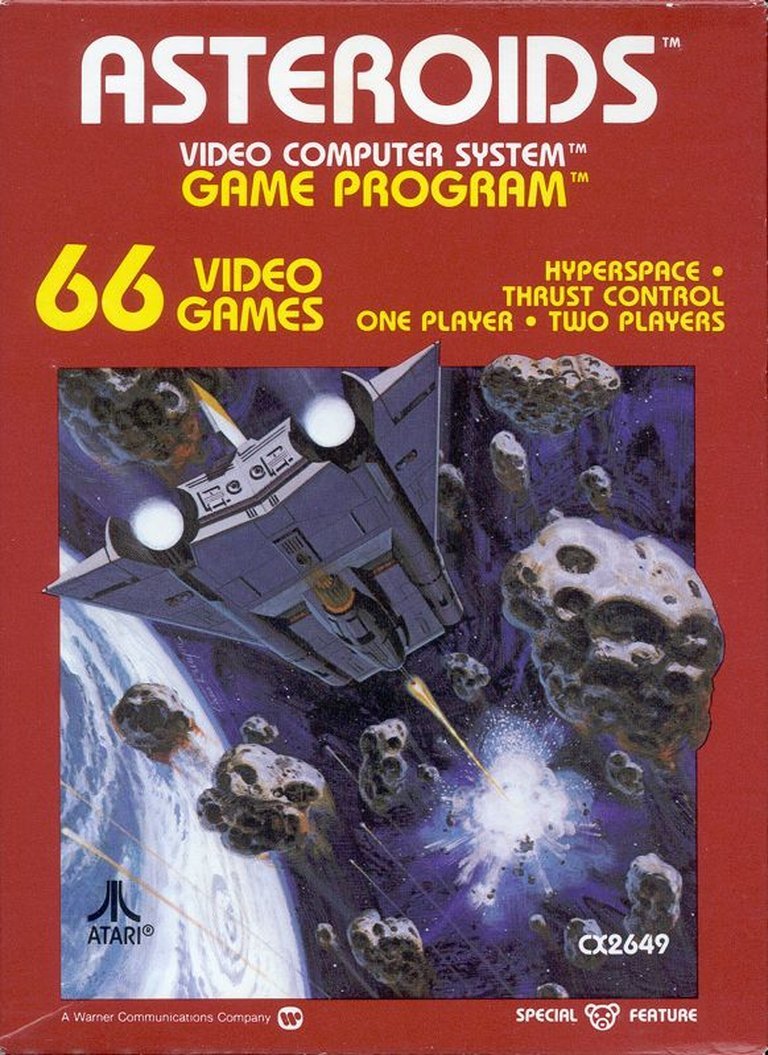
Asteroids is a classic arcade shooter set in a space environment where the player pilots a spaceship through an asteroid field, destroying incoming asteroids with a photon cannon while avoiding collisions and enemy fire from Alien Robot Saucers. Asteroids break into smaller pieces when shot, and the player has three reserve ships, with the option to use hyperspace to evade danger. The game features multiple difficulty levels and gameplay variations, including single and multiplayer modes.
Gameplay Videos
Where to Buy Asteroids
PC
Asteroids Free Download
Asteroids Patches & Updates
Asteroids Mods
Asteroids Guides & Walkthroughs
Asteroids Reviews & Reception
retrogamedeconstructionzone.com : Asteroids is definitely worth a try, especially considering that it presents a challenge of a kind that is hard to come by in modern games.
Asteroids Cheats & Codes
PC
Enter text codes during gameplay or at the main menu. Use level passwords at the password screen.
| Code | Effect |
|---|---|
| issallgood | Grants all power-ups |
| vector | Enables original game mode |
| SPACEVAC | Skip to Level 2 |
| STARSBRN | Skip to Level 3 |
| WORM SIGN | Skip to Level 4 |
| INCOMING | Skip to Level 5 |
PlayStation
Codes are entered at the title screen (hold Select) or while the game is paused.
| Code | Effect |
|---|---|
| Up, X, Down, Triangle, Left, Square, Right, Circle | 99 Lives (in Classic Asteroids mode) |
| Up, Down, Left, Right, Circle, Square, X, Triangle | Add One Life (in Classic Asteroids mode) |
| Triangle, Circle, Circle, Triangle, Square, Circle, Square | Unlock Excalibur Ship |
| Down, Down, Up, Up, Circle, Square, Triangle, Triangle | Invincibility (in Classic Asteroids mode) |
| Square, Triangle, Circle, Triangle, Triangle, Square, Circle | Enable Cheat Mode (Level Select and No Collision) |
| Circle, Circle, Circle, Triangle, Square, Square, Circle | Unlock Classic Asteroids mini-game |
| Hold fire button for 5 seconds then release | Activate Armageddon mode |
Game Boy
Enter codes as passwords or press button sequences on the main menu.
| Code | Effect |
|---|---|
| B, A, A, B, A, B, B, A, B, B, A, B, B | Invincibility |
| QRTREATR | Unlock Classic Asteroids Mini-game |
| CHEATONX | Enable Cheat Mode |
| PROJECTX | Unlock Excalibur Ship |
| XFILESNOW | Unlock Alien Craft |
| SPACEVAC | Skip to Level 2 |
| STARSBRN | Skip to Level 3 |
| WORMSIGN | Skip to Level 4 |
| INCOMING | Skip to Level 5 |
Asteroids: Review
Introduction
In the constellation of arcade classics, few stars shine as brightly or as enduringly as Asteroids. Released by Atari in November 1979, this deceptively simple multidirectional shooter transcended its era to become a cultural touchstone and a technical marvel. It didn’t just displace Taito’s Space Invaders as the king of arcades—it redefined the possibilities of video game design. With its monochrome vector graphics, physics-based inertia, and relentless, escalating challenge, Asteroids distilled the essence of arcade gameplay into a perfect loop of survival and destruction. Yet its legacy extends far beyond its initial success. As the highest-grossing arcade game of 1980, a pioneer of high-score culture, and an enduring muse for generations of developers, Asteroids stands as a testament to the power of minimalist design. This review will dissect its genesis, mechanics, artistic impact, and indelible mark on gaming history, arguing that Asteroids remains not merely a relic but a timeless masterpiece whose innovations continue to resonate in contemporary game design.
Development History & Context
Asteroids emerged from the crucible of Atari’s ambition and the competitive frenzy of the late 1970s arcade scene. Conceived by Lyle Rains, Atari’s Vice President of Engineering, and programmed by Ed Logg—a designer deeply influenced by MIT’s Spacewar!—the project was born from a discarded prototype. Initially part of Atari’s holographic gaming initiative Cosmos (codenamed Planet Grab), Rains proposed a radical shift: instead of claiming planets, players would “smash asteroids—big rocks into small rocks.” Logg, who had played Spacewar! at UC Berkeley, refined this concept, blending the 2D freedom of Spacewar! with the addictive “clear the screen” mechanics of Space Invaders. The duo collaborated with Howard Delman, who repurposed the vector graphics hardware from Atari’s commercially underwhelming Lunar Lander. The resulting QuadraScan system—a high-resolution digital vector generator—allowed for crisp, flicker-free lines that enabled the game’s signature physics. Technological constraints were severe: the arcade cabinet ran on a 6502 processor with just 8KB of ROM (6KB for code, 2KB for graphics), yet Logg’s ingenuity squeezed unprecedented performance from the hardware. Atari’s internal codename, “Champagne Wars,” reflected the developers’ playful mindset, while prototype testing in Sacramento revealed player frustrations with the lack of breaks and request for a joystick (though the final design used buttons). The game’s release coincided with the zenith of the arcade boom, where Space Invaders dominated cabinets worldwide. Asteroids didn’t just compete—it dethroned the incumbent, selling 70,000 units by 1980 and generating $150 million for Atari alone. Its success was so overwhelming that Atari halted Lunar Lander production to prioritize Asteroids, even retrofitting Lunar cabinets with the new game.
Narrative & Thematic Deep Dive
At first glance, Asteroids appears devoid of narrative, a void intentionally left for the player to inhabit. There are no characters, dialogue, or exposition—only a lone triangular ship adrift in an asteroid field, stalked by alien saucers. This minimalism is a profound design choice, transforming the game into a primal allegory of survival. The underlying themes are rooted in chaos versus control: as Paul Schuytema observed in Microsoft Arcade: The Official Strategy Guide, the game taps into a “primitive drive to clean and take control of the environment.” Each shattered asteroid represents a taming of the void, a momentary reclamation of order from the cosmos’ indifference. The player’s ship, with its thrust-based inertia, embodies vulnerability and agency—its momentum a double-edged sword that rewards skill but punishes hesitation. The saucers, meanwhile, introduce an antagonistic force, their erratic firing patterns embodying the unpredictability of hostile environments. Hyperspace, a desperate warp to a random screen location, symbolizes the gamble of relinquishing control in the face of annihilation. Thematically, Asteroids is a meditation on isolation: the player is a solitary pilot against an indifferent universe, a stark contrast to the communal spectacle of Space Invaders. This lack of narrative isn’t a weakness but a strength, allowing players to project their own narratives of heroism onto the minimalist canvas.
Gameplay Mechanics & Systems
The brilliance of Asteroids lies in its deceptively complex mechanics, a masterclass in emergent gameplay. The core loop is a ballet of physics and precision: the player’s ship rotates on a dime, thrusts with momentum-based inertia, and fires forward. Asteroids shatter into smaller pieces when shot, each fragment moving faster and unpredictably—a chain reaction that escalates tension. Small saucers (worth 1,000 points) appear periodically, firing with increasing accuracy as the player’s score rises, while large saucers (200 points) blast randomly. The wrap-around screen mechanic—where objects reappear on the opposite edge—enables strategic flanking and creates an infinite playfield. Hyperspace, borrowed from Spacewar!, adds a high-risk escape route, often resulting in instant death if the ship rematerializes inside an asteroid. The game scales elegantly: levels introduce more asteroids up to a hard cap of 26, while extra lives are awarded every 10,000 points. Critically, Asteroids introduced a high-score system allowing players to enter their initials—a first for video games, fostering competitive culture. Controls were revolutionary for the era: five buttons managed rotation, thrust, fire, and hyperspace, with the 6502 processor mapping inputs directly to memory addresses. The game’s physics, particularly inertia, were groundbreaking. Unlike raster-based contemporaries, vector graphics enabled smooth, angular movement that made momentum feel visceral. This demanded mastery: players had to counter-thrust to stop, anticipate asteroid trajectories, and exploit the lurking exploit (hiding near screen edges to pick off saucers safely)—a flaw later patched by Atari. Variations added depth: Competition mode enabled simultaneous two-player duels with friendly fire, while Team mode disabled it. The Atari 2600 port (1981) introduced 66 variations, including shields and 180-degree flips, and used bank-switching to expand ROM from 4KB to 8KB—a technical feat. Yet the core loop remained unchanged: a relentless cycle of destruction, survival, and escalating pressure.
World-Building, Art & Sound
Asteroids’ setting is a triumph of suggestion over exposition. The monochrome vector graphics create a stark, infinite void—no stars, planets, or backgrounds. The player’s ship, a simple triangle, is rendered with clean, unadorned lines, evoking both fragility and purpose. Asteroids, initially large, jagged polygons, fracture into smaller, sharper shards, their rotation and movement creating a sense of chaotic dynamism. Saucers, with their rounded, asymmetrical designs, introduce an alien threat, their appearance punctuating the asteroid field with menace. The wrap-around screen reinforces the illusion of boundless space, while the lack of color (in the original) focuses attention on movement and shape. Sound design, equally minimalist, was Howard Delman’s handiwork: 13 analog circuits generated iconic effects—the percussive “thump-thump” of thrust, the percussive explosions of shattered asteroids, and the piercing zaps of saucer fire. A “heartbeat” soundtrack accelerates with rising difficulty, syncing with gameplay tension. The absence of musical melodies amplifies the isolation, making each sound cue a lifeline or a death knell. Together, the art and sound forge an atmosphere of existential dread: the player is a tiny speck in a hostile cosmos, where every asteroid fragment and saucer laser could be the end. This synergy of visual and audio feedback made the experience visceral and immersive, proving that minimalism could evoke maximal emotion.
Reception & Legacy
Upon release, Asteroids was an unqualified phenomenon. It displaced Space Invaders atop arcade charts by April 1980 and generated $700 million worldwide by year’s end ($3 billion adjusted for inflation). Operators reported cabinets earning up to $700 weekly, necessitating larger coin boxes. Critics lauded its purity; Electronic Games awarded it an “A” rating, praising its “endless replayability.” Retrospectively, its acclaim has only deepened. Flux ranked it 11th in its 1995 “Top 100 Video Games,” while Next Generation placed it 39th in its “Top 100 Games of All Time” (1996). Eurogamer (2007) declared it “momentous,” noting it proved “great games are great forever.” The Museum of Modern Art inducted it into its game collection in 2013, and the Strong National Museum of Play honored it with a World Video Game Hall of Fame induction in 2024. Its commercial success was mirrored in ports: the Atari 2600 version sold 3 million copies, while adaptations spanned the Atari 8-bit, 7800, Game Boy, and beyond. The game’s influence is incalculable. It directly inspired Eugene Jarvis’s Defender (1980), which expanded on multidirectional movement and physics. Atari’s sequels—Asteroids Deluxe (1981, with shields and rotating asteroids), Space Duel (1982, colored shapes and two-player modes), and Blasteroids (1987, raster graphics and power-ups)—refined the formula but couldn’t surpass the original’s purity. Clones like Mine Storm (Vectrex) and Meteor! (Intellivision) proliferated, while the high-score system became industry standard. Even its flaws were instructive: the lurking exploit prompted Atari to revise its QA processes, a lesson still cited in game design circles. By 2021, Asteroids: Recharged brought the classic to modern consoles, proving its timeless appeal.
Conclusion
Asteroids is more than a game; it is a foundational artifact of video game history. Its genius lies in its economy of design: vector graphics, physics-based inertia, and escalating difficulty coalesced into a perfect, replayable loop. It didn’t just dominate arcades—it redefined what games could be, proving that depth could emerge from simplicity. The game’s legacy is woven into the DNA of the industry: its physics, high-score culture, and multidirectional mechanics are ancestors of everything from Asteroids: Recharged to Geometry Wars. Yet its enduring relevance transcends technical influence. In an era of bloated narratives and complex systems, Asteroids remains a paragon of focused gameplay—a testament to the adage that the best games are often the most distilled. As we navigate modern asteroid fields of microtransactions and live-service games, Asteroids stands as a beacon of purity. It is, in the words of Eurogamer, “a classic that proved great games are great forever.” Its place in history is not just assured; it is essential.