
- Release Year: 2003
- Platforms: Windows
- Genre: Adventure
- Perspective: 3rd-person
- Game Mode: Single-player
- Gameplay: Point-and-click, Puzzle elements
- Setting: Futuristic, Sci-fi
Description
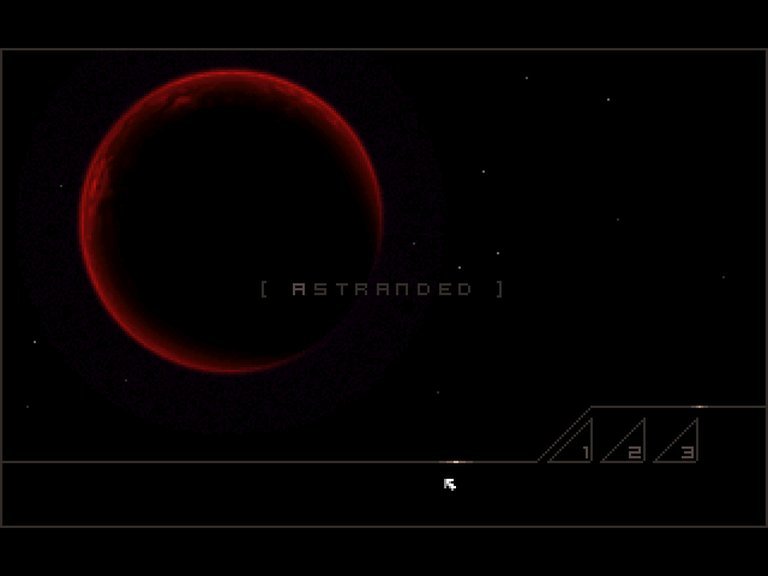
Astranded (Astro-Stranded) is a short sci-fi point-and-click adventure game created for the October 2003 Mags competition. Players assume the role of a female space pilot whose ship is forced to crash-land on an alien planet after an engine failure. The gameplay focuses on puzzle-solving as the protagonist searches for a replacement power cell to repair her spacecraft. The interface features action buttons displayed on a persistent panel occupying a third of the screen, maintaining a 3rd-person perspective throughout the atmospheric, futuristic survival scenario.
Astranded (Astro-Stranded) Free Download
Astranded (Astro-Stranded): Review
Introduction: A Microscopic Titan of Indie Experimentation
In the vast cosmos of video game history, Astranded (Astro-Stranded) exists as a curious artifact—a fleeting spark in the early 2000s indie gaming boom. Developed for the October 2003 Mags competition using Adventure Game Studio (AGS), this freeware sci-fi adventure encapsulates both the ingenuity and limitations of grassroots game development. While overshadowed by contemporaries like Stranded (2003) by Unreal Software, Astranded’s legacy lies in its razor-focused simplicity and inadvertent commentary on player expectations versus artistic intent. This review argues that Astranded is less a game in the traditional sense and more a provocative vignette—a minimalist experiment that continues to polarize retro enthusiasts.
Development History & Context: The AGS Revolution and Indie Constraints
Studio and Vision
Astro-Stranded was crafted by an unknown developer (or team) for the MAGSnets competition, a now-obscure forum event celebrating short-form adventures. Unlike Peter Schauß’s Stranded series—which embraced open-ended survival mechanics—Astranded was designed as a compact narrative experience. Built using Adventure Game Studio (AGS), a democratizing tool for aspiring creators, the game leveraged pre-built assets and scripting to bypass the technical hurdles of early-2000s PC development.
Technological and Cultural Landscape
Released during a transitional era for indie games (2003 saw the rise of Dwarf Fortress and Cave Story), Astranded epitomized the DIY ethos of AGS titles. While AAA studios pursued cinematic storytelling (Half-Life 2), AGS empowered amateurs to prioritize ideas over polish. However, Astranded’s development was likely hamstrung by AGS’s rudimentary engine: its UI consumed a third of the screen, and gameplay depth was sacrificed for brevity. The game’s freeware status and lack of monetization also reflect an era before platforms like Steam democratized distribution.
Narrative & Thematic Deep Dive: Isolation, Illusion, and Anti-Resolution
Plot Mechanics
Players assume the role of a nameless female space pilot whose ship crashes on an alien planet after engine failure. The objective is straightforward: locate a replacement power cell to escape. Dialogue is minimal, and characters are nonexistent beyond the protagonist’s silent determination. The narrative’s brevity (15–30 minutes) serves as both a strength and weakness—compelling in its simplicity but devoid of emotional stakes.
Themes and Subtext
Beneath its skeletal plot lies a subversive commentary on player agency. The infamous ending—where the protagonist transforms into a giant robot before abruptly waking—suggests a Twilight Zone-esque twist: her ordeal was a hallucination or simulation. This meta-narrative critiques adventure-game tropes (e.g., fetch quests as existential loops) and echoes the nihilism of The Stanley Parable years before its time. Themes of futility and isolation permeate, though the execution remains too oblique to resonate deeply.
Gameplay Mechanics & Systems: Minimalism or Abdication?
Core Loop and Interaction
Astranded is a point-and-click adventure stripped to its bones. Players navigate static screens, collecting items (e.g., the power cell) and triggering scripted sequences. The UI—a row of clunky verb buttons (e.g., “Take,” “Use”) across the bottom third of the screen—prioritizes functionality over elegance, evoking early King’s Quest titles but lacking their charm.
Innovations and Flaws
- Puzzle Design: Critically lambasted for its absence of challenge (e.g., solutions involve clicking objects in sequence), the game defies genre conventions. Some argue this “anti-puzzle” approach is a deliberate critique; others see it as unfinished design.
- Player Agency: With no fail states or branching paths, Astranded feels more like an interactive slideshow than a game. Steam reviews lamented the lack of engagement, with one user noting: “If people knew there were no puzzles… they would not feel frustrated looking for them” (Steam, 2024).
- Technical Hurdles: AGS’s limitations manifest in stiff animations and minimal feedback. Mouse interactions lack tactile responsiveness, further distancing players from immersion.
World-Building, Art & Sound: Aesthetic Salvation
Visual Direction
Astranded’s pixel-art aesthetic channels retro sci-fi charm. Crude yet evocative backdrops—a neon-lit cockpit, desolate alien plains—evoke Flash Gordon serials via a 256-color palette. Character sprites are minimally detailed, but the protagonist’s design (a helmeted astronaut) radiates stoic determination. The UI’s intrusive presence, however, undermines the art’s atmosphere.
Sound Design
While no soundtrack is credited, ambient sound effects—hissing steam, distant machinery—create an eerie, desolate mood. The abrupt silence during the robot-transformation scene amplifies its surrealism. Yet, like the gameplay, the audio remains undercooked, relying on stock AGS samples rather than bespoke composition.
Reception & Legacy: A Footnote with Fangs
Initial Reception
Upon release, Astranded garnered little attention. MobyGames lists no critic reviews, and player impressions were sparse until its 2014 archival. Steam user reviews (for a separate but identically named 2025 game) reveal a pattern: players expecting survival-crafting were baffled by its abstract, motionless gameplay (“I thought this would be an island survival game”).
Evolution of Reputation
Today, Astranded is a cult curio among AGS historians and indie archaeologists. Its “so bad it’s profound” aura has inspired ironic retrospectives, while its ending is meme fodder on forums like TV Tropes (“Mind Screw”). Though not directly influential, it presaged arthouse experiments like Dear Esther (2012) in privileging mood over mechanics.
Impact on Industry
Astranded’s true legacy is didactic: it exemplifies how constraints (time, tools, scope) can birth unintended artistry. The game’s failure to meet expectations also underscores the perils of ambiguous marketing—a lesson modern indie devs heeded with tags like “walking simulator.”
Conclusion: A Strange Star in the Indie Firmament
Astro-Stranded is neither masterpiece nor disaster—it is a fossil, preserved in the amber of early-2000s indie ambition. Its janky UI, threadbare narrative, and anti-gameplay frustrate conventional analysis, yet its audacious ending and minimalist ethos demand reconsideration. For historians, it offers a snapshot of AGS’s potential and perils; for players, it remains a Rorschach test of patience and interpretation. In the pantheon of forgotten freeware, Astranded earns its place as a flawed but fascinating relic—a game that dared to ask, “What if the journey was… nothing at all?”
Final Verdict: A 2/5 as a “game,” but a 4/5 as a provocative artifact. Essential for indie scholars; bewildering for everyone else.