
- Release Year: 2006
- Platforms: Windows
- Publisher: RetroSpec
- Developer: RetroSpec
- Genre: Action
- Perspective: Diagonal-down
- Game Mode: Single-player
- Gameplay: Puzzle elements
- Setting: Fantasy
- Average Score: 80/100
Description
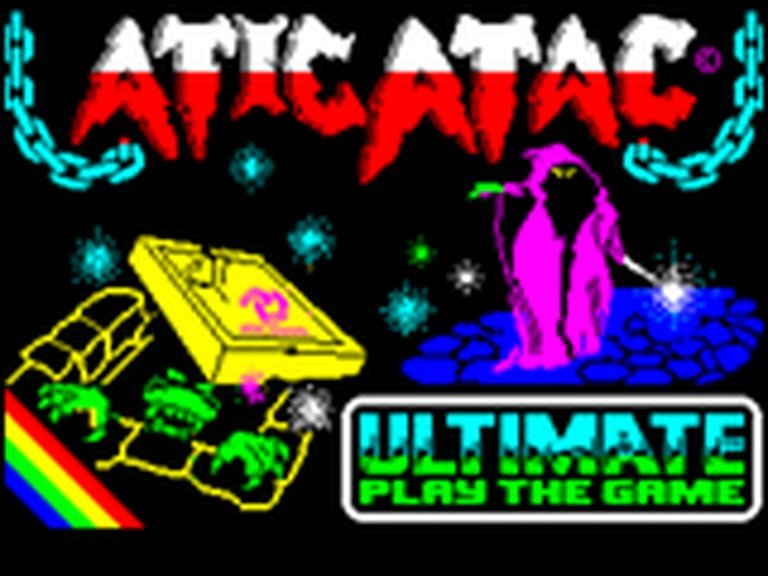
Atic Atac is a fantasy action-adventure remake where players explore a haunted castle to collect the three pieces of the Golden Key of ACG. Choose from a knight, wizard, or serf, each with distinct weapons and routes. Navigate through castle rooms filled with ghosts and supernatural enemies, collect keys and helpful items, and manage your energy represented by a chicken that depletes with hits. Use trapdoors and staircases to traverse multiple floors in this puzzle-filled adventure.
Where to Buy Atic Atac
PC
Atic Atac Reviews & Reception
wizarddojo.com : Despite some genuinely great ideas, however, Atic Atac is nonetheless extremely prototypical, with much of its gameplay feeling shallow and unpolished when compared to adventure games released even just a few short years later.
eurogamer.net (80/100): Atic Atac is a prime example of what passion can do when properly digitised, and marked a crucial nexus for all involved; from the legendary Stamper brothers through renowned publishing house Ultimate Play the Game, to the delighted Spectrum owners who revelled in the light of 8-bit creation.
Atic Atac: Review
Introduction
In the pantheon of 1980s computer gaming, few titles embody the raw, unbridled creativity of the era quite like Atic Atac. Developed by the enigmatic Ultimate Play the Game—the studio that would later evolve into the legendary Rare—this ZX Spectrum masterpiece stands as a landmark in early action-adventure design. More than four decades after its release, Atic Atac remains a hauntingly brilliant relic of a bygone technological era, where ambitious programmers squeezed labyrinthine worlds into 48KB of RAM. This review posits that Atic Atac was not merely a game of its time but a foundational blueprint for hybrid gameplay mechanics, whose influence resonates in everything from Metroidvanias to modern roguelikes. Its genius lies in the seamless fusion of arcade action with adventure-game exploration, wrapped in a gothic atmosphere that still chills. Yet, its archaic design choices and punishing difficulty reveal a product of its era—a testament to both the limitations and boundless potential of 8-bit computing.
Development History & Context
Ultimate Play the Game, founded in 1982 by brothers Tim and Chris Stamper in Ashby-de-la-Zouch, operated with a near-mythological secrecy. Prior to Atic Atac, their portfolio included hits like Jetpac and Lunar Jetman, but the Stampers pushed boundaries by demanding 48KB of RAM—a premium configuration for ZX Spectrum users in 1983. This technological ambition allowed Atic Atac to house an unprecedented 200 interconnected rooms across five castle floors, a scale unthinkable for most contemporary titles.
The Stampers’ development process was grueling and innovative. Tim Stamper handled coding, while Chris Stamper crafted the graphics, their roles separated into “teams” to ensure quality control—a radical approach for small studios. They worked seven-day weeks, recycling core mechanics from earlier games while introducing revolutionary systems like character-specific pathways and dynamic environmental hazards. The gaming landscape of 1983 was dominated by arcade ports and simplistic platformers, making Atic Atac’s immersive, player-driven exploration a revelation. Its release in November 1983 saw it debut at #5 on the MRIB charts, rapidly overtaking competitors like Valhalla to claim the #1 position—a meteoric rise underscored by its ambitious design. The 1985 BBC Micro port further solidified its status, proving the game’s cross-platform viability even amidst the Spectrum’s dominance.
Narrative & Thematic Deep Dive
While Atic Atac eschews overt exposition, its narrative is woven into its very fabric. The player is trapped within a sentient, haunted castle, tasked with reassembling the “Golden Key of ACG” (an acronym for Ultimate’s parent company, Ashby Computers and Graphics) to escape. The castle itself is the antagonist—a malevolent entity where doors slam shut, trapdoors appear unpredictably, and rooms shift layout based on the player’s actions. This lack of direct storytelling mirrors the era’s tendency to let imagination fill gaps, but it also creates profound thematic unease: the castle is a prison of both physical and psychological terror.
The game’s tripartite character selection—Knight, Wizard, and Serf—introduces subtle narrative layers. Each character’s unique weapon (axe, fireball, sword) and secret passages (e.g., the Knight warping through grandfather clocks) imply distinct backstories. The Knight represents chivalric duty, the Wizard esoteric knowledge, and the Serf resourcefulness. This choice isn’t cosmetic; it reframes the castle’s challenges, suggesting the castle adapts to the intruder’s nature. Enemies like Dracula, Frankenstein’s Monster, and Devil Witches evoke classic horror tropes, but their chaotic spawning—governed by the castle’s “will”—subverts expectations, turning the narrative into a cosmic struggle where survival hinges on deciphering a hostile entity’s logic. The absence of dialogue or cutscenes heightens this existential dread, making victory feel less like defeating a villain and more like outsmarting a living labyrinth.
Gameplay Mechanics & Systems
Atic Atac’s core loop is a masterclass in emergent complexity. Players navigate flip-screen rooms, unlocking colored doors with matching keys while battling supernatural foes. The inventory system—limited to three items—forces brutal triage, as red herrings (like useless charms) compete with essentials (keys, food). Health is represented by a roast chicken on the screen’s right, which depletes from combat contact or starvation if the player lingers too long. This dual-threat mechanic—action and resource management—was groundbreaking, demanding strategic retreats to locate sustenance.
Character differentiation defines replayability. The Knight’s axe has longer range, the Wizard’s fireball travels faster, and the Serf’s momentum-based movement allows brief sliding—subtle physics quirks that alter risk calculus. Each character also accesses exclusive shortcuts; the Wizard teleports via bookcases, the Knight through clocks, creating three distinct “mazes” within the castle. Combat is simple yet tense: common enemies (ghosts, spiders) perish on contact, but “special” foes like Dracula require specific items (e.g., a crucifix) to defeat. The game’s most innovative system is the dynamic environment: doors open/close randomly, trapdoors transport players across floors, and stationary fungi drain health—turning navigation into a high-stakes puzzle. Controls, however, show their age. Keyboard mapping (Q/W/E/R for movement, T to fire) is clunky, and joystick response is sluggish, punishing modern players accustomed to fluid inputs.
World-Building, Art & Sound
Atic Atac’s castle is a triumph of 8-bit environmental storytelling. The “splayed” perspective—showing all four walls, floor, and ceiling—creates uncanny 3D depth, with rooms furnished with gothic accoutrements (coffins, suits of armor, bookcases). Each floor has a distinct aesthetic: the attic is cluttered with debris, the cellar features damp stone walls, and the middle levels blend library and dungeon motifs. This verticality—from sun-drenched attic to subterranean crypt—evokes a palpable sense of descent into madness.
Chris Stamper’s graphics are legendary for their detail. Enemies animate fluidly—witches hover on broomsticks, pumpkins float menacingly—while items like keys and food are rendered with playful grotesquerie. The roster of foes mixes mythology (mummies, devils) with surrealism (flying pumpkins), creating a menagerie that feels both cohesive and unhinged. Sound design is equally potent, albeit constrained by hardware limitations. The Currah MicroSpeech synthesizer add-on allowed for voice commands (e.g., “Open sesame!” for doors), adding eerie immersion. Standard sound effects—plink-plonk steps, enemy shrieks—are rudimentary yet effective, while the haunting absence of ambient music amplifies the castle’s oppressive silence. The roast chicken’s visual decay—from plump bird to bare bones—remains one of gaming’s most iconic UI touches, blending humor with high stakes.
Reception & Legacy
Upon release, Atic Atac was hailed as a revelation. Crash awarded it 92%, praising its “marvellous” graphics and “fantastic” details, though lamenting its steep learning curve. Computer and Video Games declared it “the best yet from Ultimate,” while Sinclair User lauded its “superb” depth and graphics. It topped charts, displaced genre titans, and became a cultural touchstone—directly inspiring the CITV game show Knightmare (1987), whose producer Tim Child cited the Spectrum’s ability to render a compelling adventure as a revelation. Critically, it was ranked #79 in Your Sinclair’s “Top 100 Spectrum Games” and #8 by Retro Gamer readers, cementing its cult status.
Its legacy is profound. Atic Atac pioneered the “Metroidvania” template—non-linear exploration, interconnected rooms, and character-driven paths—predating Super Metroid by a decade. Its hybrid arcade-adventure DNA is evident in titles like Sabre Wulf (Ultimate’s follow-up) and modern roguelikes like Dead Cells. The 2015 compilation Rare Replay introduced it to new audiences, while fan remakes (e.g., the 2006 RetroSpec version) keep its spirit alive. Yet, its design limitations—poor controls, lack of mapping—highlight how far game design has evolved. Still, as Eurogamer noted in 2007, it remains “what passion can do when properly digitised,” a time capsule of innovation born from technical constraints.
Conclusion
Atic Atac is a product of its time, yet it transcends its limitations to achieve timeless brilliance. Its gothic atmosphere, labyrinthine design, and hybrid gameplay were revolutionary, setting standards for exploration-based adventures that studios still chase today. While its punishing difficulty and archaic controls may alienate modern players, its core genius lies in how it transforms a haunted castle into a sentient, adaptive antagonist. It is less a game to be “beaten” and more a world to be conquered, its secrets uncovered through trial, error, and memory. As a cornerstone of Ultimate Play the Game’s legacy and a blueprint for future innovations, Atic Atac earns its place among the most influential titles of the 8-bit era. Verdict: a masterpiece of its time, forever haunting the annals of game history.