
- Release Year: 2003
- Platforms: Windows
- Publisher: Isotope244 Graphics LLC
- Developer: Isotope244 Graphics LLC
- Genre: Strategy, Tactics
- Perspective: Side view
- Game Mode: Hotseat, Single-player
- Gameplay: Artillery, Tank combat, Turn-based strategy, Vehicular
- Average Score: 70/100
Description
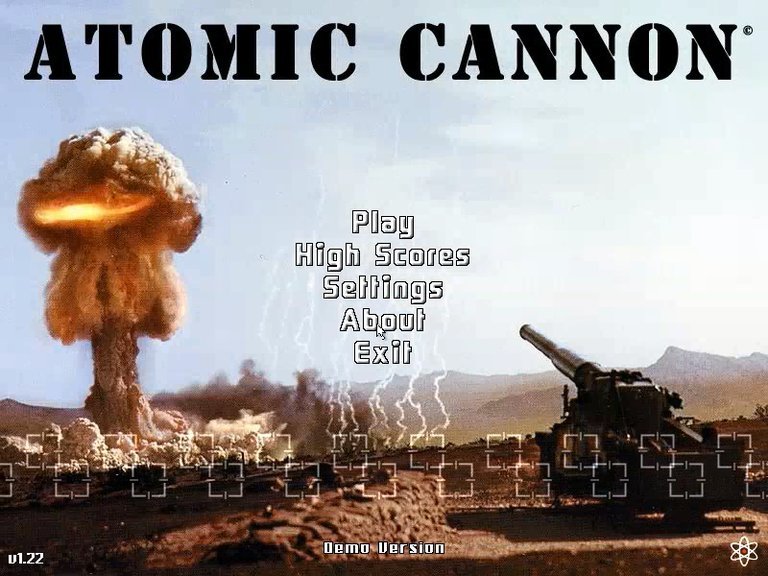
Atomic Cannon is a turn-based artillery strategy game set in destructible 2D battlefields across 25 diverse environments, where players command tanks in side-view combat reminiscent of classics like Scorched Earth. The premise revolves around outmaneuvering and obliterating opponents’ tanks by selecting from 50 weapons, adjusting power and angle for precise shots, and optionally moving positions, all while competing for the highest score in highly customizable matches supporting up to 16 players and multiple tanks per side.
Guides & Walkthroughs
Reviews & Reception
en.wikipedia.org : Infinitely replayable. It’s also exceptionally customizible, and simply fun to boot.
infopackets.com : A franticly fun strategy game with super-cool graphics, sound effects, and dazzling backdrops.
insidemacgames.com (70/100): Features a tremendous variety of options to tweak and tool performance suited for your machine, and has some really nice special effects.
Atomic Cannon: Review
Introduction
In the pantheon of video games, few concepts have endured as stubbornly and joyfully as the artillery duel—a simple yet profoundly satisfying formula where players lob projectiles across a destructible landscape in a bid to obliterate their foes. Born in the text-based simplicity of 1976’s Artillery and popularized through the chaotic brilliance of 1991’s Scorched Earth, this genre has inspired countless iterations, each vying to modernize the core thrill of ballistic strategy without losing its addictive essence. Enter Atomic Cannon (2003), developed by the nimble Isotope244 Graphics LLC, which arrives like a nuclear warhead in the early 2000s indie scene: a shareware gem that polishes the classics with expanded arsenals, customizable chaos, and cross-platform portability. As a historian of gaming’s underbelly, I find Atomic Cannon not just a nostalgic throwback but a testament to how humble mechanics can evolve into endlessly replayable entertainment. My thesis is clear: while it doesn’t reinvent the wheel—or the cannon—Atomic Cannon stands as a definitive, accessible revival of the artillery genre, blending strategic depth with arcade flair to cement its place as a hidden classic for solo strategists and multiplayer skirmishers alike.
Development History & Context
The early 2000s marked a transitional era for PC gaming, sandwiched between the graphical excesses of the late ’90s and the multiplayer boom ushered in by broadband internet. Shareware models still thrived, allowing solo developers and small studios to distribute games via floppy disks, CDs, or emerging online portals, often with limited budgets but boundless creativity. It was in this landscape that Isotope244 Graphics LLC, a modest outfit founded by visionary James Bryant, unleashed Atomic Cannon in 2003 for Windows, with subsequent ports to Mac OS X and Windows Mobile. Bryant, a one-man army in the truest sense, handled nearly every aspect of production: engine programming, design, artwork, sound implementation, and even testing. This solopreneur approach echoes the DIY ethos of earlier shareware hits like Scorched Earth, but Bryant’s technical prowess—leveraging open-source libraries like ZLib for compression, JpegLib for image handling, and FMOD for audio—allowed for smoother, more feature-rich execution on hardware like Windows XP machines.
The game’s vision stemmed directly from the artillery genre’s roots. Inspired by Mike Forman’s 1976 text-mode Artillery and its graphical successors like the Atari 2600’s Artillery Duel (1983), Atomic Cannon aimed to capture the turn-based tension of calculating trajectories amid wind and terrain variables. Bryant’s innovation lay in scalability: building a game that could run on low-end Pocket PCs while scaling to desktop resolutions, a foresight that predated mobile gaming’s explosion. Technological constraints of the time—limited polygons, 2D sprites over 3D models—forced a focus on physics simulation and particle effects rather than spectacle, aligning perfectly with the genre’s side-view perspective. The gaming landscape in 2003 was dominated by real-time strategy behemoths like Warcraft III and emerging MMOs, but Atomic Cannon‘s hot-seat multiplayer and offline focus carved a niche for casual, pick-up-and-play fun. Thanks to collaborators like music composer subatomicglue and shout-outs to industry figures (e.g., Paul Nettle of id Software fame), the project benefited from a supportive indie network, even incorporating U.S. Department of Energy archival footage for authentic “atomic” visuals. Ultimately, Atomic Cannon embodies the era’s indie optimism: a shareware title ($19.95 full version) that punched above its weight, proving small teams could deliver polished entertainment without AAA backing.
Narrative & Thematic Deep Dive
Atomic Cannon eschews the sprawling epics of its contemporaries in favor of a minimalist, arcade-driven structure, where “story” is more pretext than plot. There’s no branching dialogue tree or character arcs; instead, the game opens with a terse backstory evoking a dystopian near-future: amid global chaos sparked by a rogue dictator, world powers clash in inhospitable wastelands too treacherous for human soldiers or aircraft. Enter the Atomic Cannon—a resurrected Cold War relic, outfitted with an arsenal of mass destruction to wage mechanical warfare. Players command these behemoths, dueling for supremacy in a “new world order” where victory hinges on tactical annihilation. This setup nods to historical tensions, drawing from real atomic artillery prototypes developed during the nuclear arms race, complete with credits thanking the U.S. Department of Energy for imagery. Thematically, it’s a meditation on escalation and futility: each nuke or cluster bomb not only scorches the earth but deforms the battlefield, turning neutral terrain into a graveyard of craters and cover, symbolizing how conflict reshapes the world irreparably.
Characters are equally sparse—tanks are customizable with names, colors, and AI personalities (including “talking bots” for humorous quips like taunts or victory boasts), but they lack depth beyond mechanical stats like armor or shields. Dialogue, if it can be called that, emerges in the bots’ lighthearted banter, adding levity to the destruction: a defeated tank might “complain” about bad luck, humanizing the machines without delving into philosophy. Underlying themes amplify the genre’s satirical edge—war as a game of angles and power levels, where wind (a capricious force) mirrors unpredictable geopolitics, and weapons economy rewards aggressive play, critiquing arms races through playful excess. Over 85-100 armaments (from basic shells to MIRV nukes) escalate the absurdity, with radioactive effects imposing damage-over-time, evoking lingering fallout. Yet, for all its thematic nods to scorched-earth warfare, the narrative’s brevity is a strength: it frees players to immerse in emergent stories of rivalries, like outmaneuvering a wind-shifted missile or terraforming a plateau into a trap. In an era of narrative-heavy RPGs, Atomic Cannon‘s “plot” is its absence—a deliberate choice that prioritizes player agency, making every duel feel like a personal saga of boom or bust.
Gameplay Mechanics & Systems
At its core, Atomic Cannon refines the artillery loop into a symphony of precision and pandemonium: turn-based tank combat where each volley demands calculated risk. Players alternate turns on a side-view battlefield, selecting from 50+ weapons (up to 100 in expanded counts) via a intuitive HUD at the screen’s bottom. Core mechanics revolve around three inputs—weapon choice, power (0-100 scale), and angle (typically 0-90 degrees)—fired with a simple button press. Physics simulation, powered by real-time calculations, accounts for gravity, wind (direction and strength customizable per game), and terrain deformation, ensuring shots arc realistically with smoke trails and particle explosions. Movement adds tactical depth: tanks can reposition via a “Move” command, dodging incoming fire or gaining high ground, though this costs turns and exposes vulnerability.
Combat loops build in layers. Weapons range from straightforward artillery shells to exotics like cluster bombs (splitting mid-air), napalm (area-denial fire), or nukes (massive blasts with fallout). Successful hits earn credits for an in-game economy, allowing purchases of upgrades like shields, armor boosts, or rarer munitions— a system that encourages aggressive playstyles while punishing recklessness. Modes vary: round-based (fixed turns, highest score wins) for structured matches, or deathmatch (last tank standing) for frantic elimination. Multiplayer supports up to 16 players (human or CPU) with five tanks each, enabling hot-seat chaos on one machine—no online play, but ideal for LAN parties or family showdowns. AI opponents scale in difficulty, from novice (predictable shots) to expert (adaptive wind compensation), providing solo challenges that feel fair yet unforgiving.
Progression is modular rather than level-based: no persistent campaigns, but endless customization fosters growth. Tweak tank sizes (affecting hitboxes), rounds per match, move limits, or environmental factors like wind frequency. UI is clean but dense—sliders for settings, a mini-map for scrollable fields, and real-time landscape updates via “scorched earth” destruction. Innovations shine in physics fidelity (e.g., refractive wave effects from blasts) and weather reactivity, but flaws emerge in option overload: the menu’s dizzying array can overwhelm newcomers, and balance issues arise with overpowered nukes in early rounds. Still, the loop’s elegance—aim, fire, adapt—makes mastery addictive, blending TBS strategy with arcade immediacy for sessions that stretch from minutes to hours.
World-Building, Art & Sound
Atomic Cannon‘s world is a canvas of controlled apocalypse: 25 diverse environments, from arid deserts and lunar craters to urban ruins and alien vistas, rendered in 2D side-view with fixed or scrollable layouts. These aren’t immersive simulations but procedural battlegrounds—randomly generated formations (flatlands, hills, gullies, plateaus, slopes) that deform in real-time as weapons gouge craters or erect dirt barriers. This dynamic terraforming is the game’s secret sauce, turning static maps into evolving arenas where a well-placed bomb creates cover or exposes flanks, fostering strategic world-building through destruction. Atmosphere evokes a post-apocalyptic standoff, with “radioactive” zones pulsing with green haze and lingering damage, enhancing the thematic weight of nuclear escalation.
Visually, the art direction prioritizes function over flash: flatly drawn tanks and landscapes use shaded sprites and particle effects for impact, like graded missile plumes or nifty explosion shards. It’s effective for the era—crisp on Windows XP, portable to mobiles—but lacks spectacle; no 3D flair, just solid 2D that evokes Scorched Earth‘s charm without dazzling. Customizable elements (tank colors, fonts) add personality, and alternate “war-game” modes toggle retro aesthetics for nostalgia buffs.
Sound design amplifies the mayhem: FMOD integration delivers ultra-crisp effects—booming cannons, whistling shells, shattering earth—that sync perfectly with visuals, heightening tension during wind-affected arcs. Six professional tracks by subatomicglue (totaling 20 minutes) lean into retro-’80s arcade synths, looping energetic beats for duels, though reviewers decry them as grating after prolonged play. Options to mute or swap help, but the audio’s strength lies in immersion: talking bots inject humor with quips, while weather whooshes and fallout ticks build dread. Collectively, these elements craft an experience of visceral, tactile warfare—deafening blasts in barren worlds that make every hit feel consequential.
Reception & Legacy
Upon release, Atomic Cannon flew under mainstream radar, a shareware obscurity in a year dominated by Half-Life 2 and World of Warcraft. Critical reception was sparse but glowing in niche outlets: Macworld awarded 3.5/5 mice in 2006, lauding its “tremendous variety of options” and “nifty particle effects” while critiquing the “irritating” soundtrack and option bloat. Brighthand hailed it as “infinitely replayable” and “exceptionally customizable,” emphasizing “quality graphics” and “immense challenge” for Pocket PC ports. Smartphone Magazine crowned the mobile version Best Shooting Game in its 2005 awards, praising “realistic graphics,” 85+ weapons, and “superior effects” across 25 deformable landscapes. No MobyScore exists due to limited user reviews, but player anecdotes (e.g., GOG forums) recall it as a XP-era multiplayer staple, evoking fond memories of friend-gathered sessions.
Commercially, as shareware, it succeeded modestly—cross-platform availability (Windows, Mac, mobiles) broadened reach, with a tiny install size aiding portability. Reputation has evolved positively in retro circles: preserved on platforms like Lutris and wishlist-dreamed on GOG, it’s valued for democratizing artillery fun amid rising online multiplayer. Influence-wise, Atomic Cannon perpetuated the genre’s lineage, inspiring mobile artillery clones and emphasizing customization in indies like Pocket Tanks. It subtly shaped shareware’s endurance, proving solo devs could compete via polish and accessibility. In industry terms, it bridges DOS relics to modern ports, reminding us that timeless mechanics outlast trends—its legacy as a “welcome update” to classics endures for strategy enthusiasts seeking unpretentious destruction.
Conclusion
Atomic Cannon distills the artillery genre’s enduring appeal into a compact, explosive package: masterful mechanics that reward cunning over reflexes, a destructible world that turns chaos into strategy, and boundless customization that ensures no two duels feel alike. James Bryant’s solo triumph revitalizes forebears like Scorched Earth with modern touches—particle flair, economic depth, cross-platform grace—while its thematic undercurrents add wry commentary to the pixelated blasts. Flaws like overwhelming options and dated tunes aside, it captures the joy of emergent warfare, from solo AI skirmishes to hot-seat hilarity.
In video game history, Atomic Cannon earns a definitive spot as an indie exemplar of genre fidelity—a 8/10 scorcher for fans of turn-based tactics, and a must-preserve artifact of early-2000s shareware ingenuity. Fire when ready; this cannon’s legacy still packs a punch.