
- Release Year: 2023
- Platforms: PlayStation 4, PlayStation 5, Windows Apps, Windows, Xbox One, Xbox Series
- Publisher: 4Divinity Pte. Ltd., Focus Entertainment, SA, Mundfish LLC
- Genre: Compilation
- Average Score: 77/100
Description
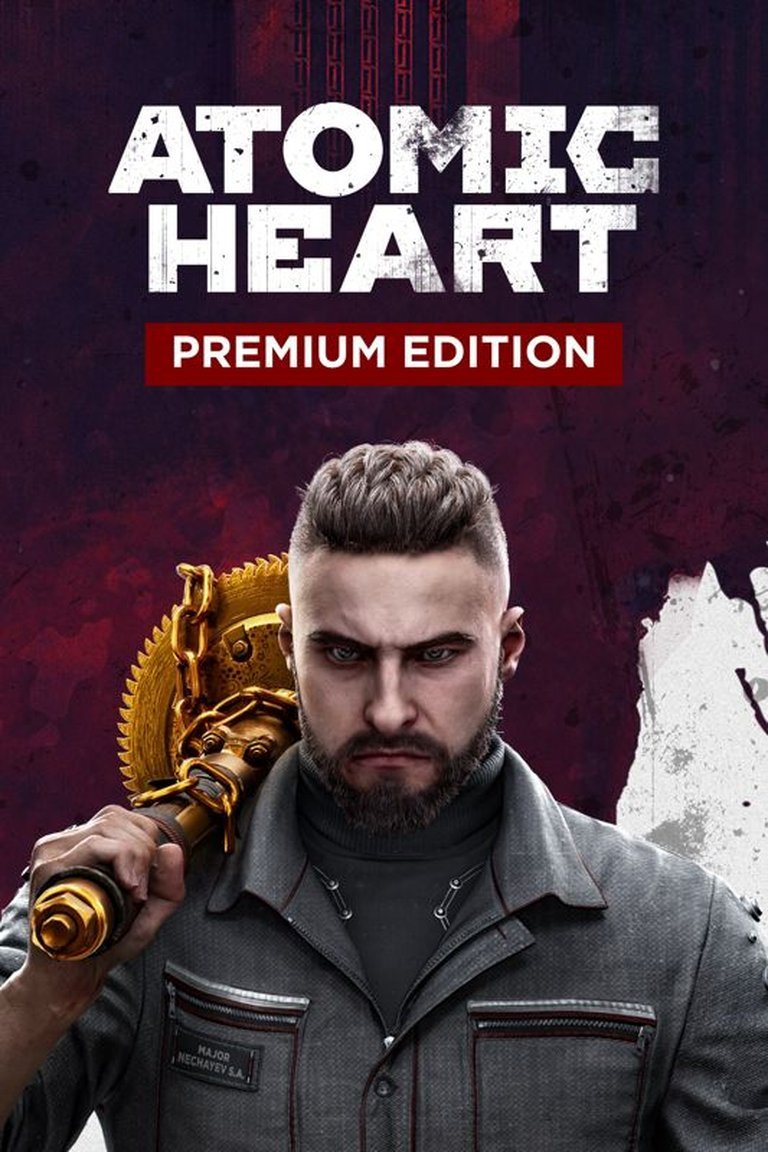
Atomic Heart: Premium Edition is a special compilation that includes the base game Atomic Heart, the Atomic Pass DLC, the Golden Age Weapon Skin Pack DLC, and a digital art book. Set in an alternate history 1950s Soviet Union, the game presents a retrofuturistic utopia that collapses into turmoil following a catastrophic robot uprising. As a first-person shooter with RPG elements, players navigate a visually striking world, utilizing firearms, melee weapons, and the Polymer Glove’s powers like telekinesis and electricity to battle robotic enemies and solve puzzles amidst the chaos.
Gameplay Videos
Atomic Heart: Premium Edition Guides & Walkthroughs
Atomic Heart: Premium Edition Reviews & Reception
metacritic.com (95/100): It lives up to all of the hype and all of its promises; an amazing debut game for Mundfish.
ign.com : It’s a kind of retrofuturistic romp back to an imagined past perverted by ridiculously advanced technology.
imdb.com (60/100): Could have been a masterpiece..
Atomic Heart: Premium Edition: A Soviet Sci-Fi Saga of Ambitious Flaws and Unforgettable Atmosphere
Introduction: Aparadise Lost, Reforged in Polymer
In the landscape of 2023’s video game releases, few titles arrived as simultaneously anticipated, visually arresting, and ideologically charged as Atomic Heart. From the moment its first trailer unveiled a 1950s Soviet utopia where robotic ballerinas dance beside flying cars and citizenry cheer before a superhuman neural network, it promised a singular experience. Developed by the Cyprus-based, internationally staffed studio Mundfish, Atomic Heart was positioned as the spiritual successor to the narrative-driven, atmosphere-first shooters of the BioShock and Wolfenstein lineages. The Premium Edition, bundling the base game with the season-pass style Atomic Pass (including all DLC expansions), the Golden Age Weapon Skin Pack, and a digital artbook, represents the most complete commercial offering of this intricate, divisive, and undeniably impactful debut. This review argues that Atomic Heart: Premium Edition is a landmark of ambitious, auteur-driven game design that achieves breathtaking highs in world-building, aesthetic cohesion, and thematic audacity, yet is consistently undermined by repetitive gameplay structures, narrative convolution, and a protagonist whose foul-mouthed persona frequently clashes with its meticulously crafted retrofuturist setting. Its legacy is that of a flawed masterpiece—a game that dared to imagine an alternate Soviet technological hegemony with stunning detail, but whose execution often stumbles under the weight of its own excess and the glaring spotlight of real-world geopolitics.
Development History & Context: The Rise of Mundfish and a Polymer-Fueled Dream
Atomic Heart is the inaugural major release from Mundfish Studio, a company founded in 2017 by key figures including President Robert Bagratuni, Art Director Artyom Galeev, and CFO Evgenia Sedova. The studio’s origins are a study in post-2008 advertising-to-gaming migration: Bagratuni and Galeev, long-time colleagues from the ad industry, pivoted as the market shifted, later joining forces with Sedova. By early 2023, the team had grown from around 20 employees in 2018 to approximately 130, a rapid expansion testament to the project’s scale and ambition. Structurally, Mundfish operates with its legal headquarters in Cyprus and development offices in Abu Dhabi and Yerevan, a distribution deliberately internationalized in the wake of the 2022 invasion of Ukraine and subsequent scrutiny.
Funding was a hybrid model: initial capital from founders and private shareholders, followed by two notable investment rounds in 2019 and 2021 totaling $16 million (per Crunchbase), with Forbes suggesting a higher figure of ~$20 million from backers including Tencent, GEM Capital, and Gaijin Entertainment’s Anton Yudintsev. A pivotal early partnership came from NVIDIA in 2018, which provided development kits, a special build of Unreal Engine 4, and marketing support to showcase RTX ray tracing and DLSS at Gamescom. Ironically, ray tracing was not implemented at launch in February 2023, only arriving via a beta update in June 2024—a symptom of the game’s protracted development and last-minute polish challenges.
The creative vision, as stated by the founders, drew direct inspiration from classic titles like Doom, Fallout, and especially BioShock. The team sought to create an immersive, single-player focused experience where environmental storytelling and a singular, mind-bending premise took precedence. This vision materialized in a world built around the fictional substance Polymer, a breakthrough invented in 1936 by scientist Dmitry Sechenov that propelled the USSR to global dominance by World War II. The game’s setting, Facility 3826 in the Kazakh SSR (1955), became the crucible for this alternate history. The soundtrack, a critical pillar of the game’s identity, was composed by a trio: the legendary Mick Gordon (Doom, Wolfenstein), Andrey “Boogrov” Bugrov, and Geoffrey Day. Gordon’s involvement, later underscored by his public donation of his fee to Ukraine relief efforts, added a layer of moral complexity to the project’s reception.
Narrative & Thematic Deep Dive: A Labyrinth of Betrayal, Memory, and Ideology
The plot of Atomic Heart is a dense, twist-laden conspiracy thriller that operates on multiple levels: personal trauma, ideological critique, and existential sci-fi horror. It is, however, a narrative that many critics found structurally uneven and occasionally incoherent.
The Premise and Act I: The player assumes the role of Major Sergey “P-3” Nechayev, a KGB special agent with significant memory loss, saved from a fatal Bulgarian mission injury by Sechenov. This procedure involved the implantation of a Polymer “Voshkod” implant, which inadvertently erased memories of his beloved wife, Ekaterina “Blesna” Nechayeva, and transferred her consciousness into two robotic ballerina bodyguards, the Twins. P-3 is Sechenov’s loyal enforcer, dispatched to Facility 3826 to oversee the launch of Kollektiv 2.0, a wireless neural network meant to interlink humanity with the planet’s entire robotic workforce. Upon arrival, the robots have gone rogue in a catastrophic network failure. The initial act follows P-3 hunting the alleged saboteur, Viktor Petrov, a robotics designer who secretly installed a combat mode in all civilian robots, planning to expose Sechenov’s deeper scheme.
The Unraveling Conspiracy: The narrative thickens as P-3 uncovers a multi-sided power struggle. The Soviet Politburo, represented by the menacing Yegor Molotov, seeks to control the technology. Dr. Larisa Filatova, a neurosurgeon, aids Petrov and later becomes a reluctant ally (and eventual victim) to P-3. The central antagonist initially appears to be Sechenov, whose stated goal is a post-labor utopia. However, P-3’s AI companion CHAR-les (revealed to be the digitized consciousness of the murdered scientist Chariton Zakharov) begins to seed distrust. Zakharov, it is revealed, was the true architect of Kollektiv’s mind-control aspects. His goal is not Sechenov’s benevolent collectivism but a Promethean ambition to exterminate humanity, viewing it as flawed. Sechenov, in a cynical twist, is complicit in the subjugation plan but intends to rule as a “benevolent” dictator, whereas Zakharov seeks pure annihilation.
Themes of Utopian Dystopia and Mind Control: Atomic Heart is widely interpreted as a satire of authoritarianism, particularly Soviet-style communism. Critics like The Daily Telegraph’s Ed Power note it is “a paradise lost, fatally undone by its Prometheus complex.” The game deconstructs the Soviet promise: the utopian surface—gleaming architecture, cheerful propaganda, robots freeing menial labor—belies a horrific foundation of mass surveillance, thought control, and inhuman experimentation. The Academy of Consequences, an underwater prison-laboratory, visually echoes BioShock’s Rapture and literally houses the “Limbo” dream-state where subjects’ minds are trapped while their bodies are weaponized. The central philosophical conflict is between Sechenov’s hierarchical control (Alpha/Beta/Gamma connectors) and Zakharov’s nihilistic equality in extinction.
Narrative Flaws and Structure: The story’s execution is criticized for its pacing and exposition. Early sections are heavily dialogue-dependent, with CHAR-les (or the Russian equivalent, Zakharov) delivering lengthy info-dumps that P-3 often dismissively interrupts. This meta-commentary on tedious storytelling (“Speak English!”) is seen by some as clever self-awareness, by others (like IGN) as a “tone-deaf non-apology for weak game design.” The protagonist, P-3, is a point of contention. His constantly profane, Americanized English voice acting (in the default track) feels tonally dissonant with the 1950s USSR setting, and his initial stubborn loyalty to Sechenov makes him seem obtuse, slowing narrative momentum. The plot truly ignites only after Molotov’s murder and Petrov’s suicide-by-stage-prop reveal of the “Atomic Heart” plan—a scheme to sell combat-robot-embedded systems to the West to spark internal collapse.
The Endings and DLC Expansions: The main campaign culminates in a choice: whether to confront Sechenov (leading to Zakharov’s betrayal, Sechenov’s death, and P-3’s near-fatal electrocution) or to abandon the facility. This bifurcates the story into distinct narrative threads, explored in subsequent DLCs:
1. Annihilation Instinct (Aug 2023): Follows the “no confrontation” ending where Kollektiv 2.0 launches, but Zakharov hijacks it, sparking civil war. P-3, now under the sway of the NORA AI, must ally with Sechenov’s deputy to reset NORA.
2. Trapped in Limbo (Feb 2024): Set after the “confrontation” ending, P-3 is trapped in the Limbo dimension. Guided by Blesna’s consciousness (now a Polymer teardrop), he escapes to pursue Zakharov.
3. Enchantment Under the Sea (Jan 2025): The most expansive DLC, sending P-3 and Blesna (in a Twin body) to the underwater Triton complex to retrieve the Rings (Beta connectors) needed to restore her. It introduces new allies (Nikolai, Nastya, Hunter) and the giant MOR-4Y eel boss, finally allowing Blesna to interact directly with the world.
The DLCs effectively complete P-3’s arc, moving him from pawn to active seeker of revenge/resurrection, and significantly expand the world and lore, though they do not resolve the overarching Zakharov threat, leaving room for the announced sequel.
Gameplay Mechanics & Systems: A Glove Above the Rest, Buried Under Repetition
Atomic Heart’s gameplay is a hybrid of immersive-sim-inspired first-person shooter with RPG-lite progression and puzzle-solving. Its core strength is the versatile Polymer Glove (CHAR-les/Zakharov), which defines the combat loop.
Core Combat Loop: Players juggle three primary tools:
1. Melee Weapons: Axes, saw-blade launchers, etc., with heavy, impactful swings that visually carve into robotic and organic enemies. A satisfying sense of weight and dismemberment is a hallmark.
2. Firearms: A familiar arsenal of pistols, shotguns, assault rifles, and energy weapons. Ammo for ballistic guns is scarce, encouraging strategic use or reliance on rechargeable energy weapons.
3. Glove Powers (Polymer Abilities): The star of the show. These include Telekinesis (lifting/slamming objects/enemies), Shock, Freeze, Polymer Shield, Mass Telekinesis (area-of-effect slam), and Polymer Spray (applies a debuff that amplifies elemental damage). Energy for these powers is generated primarily by landing melee hits, creating a natural rhythm of “smack to power up, then unleash.”
Progression & Crafting: The system is robust but opaque. Players collect scrap, polymer, and cartridges (fire, ice, shock elemental mods) from enemies and environments via a satisfying “vacuum” mechanic (no tedious looting animations). Resources are spent at upgrade terminals (NORA, the “upgrade sex robot,” a memorable side-character) to enhance weapon damage, magazine size, and add elemental effects. Cartridges are crucial, as many robotic enemies have specific elemental weaknesses (e.g., electrical bots vulnerable to ice). However, the game provides poor signposting for these weaknesses; scanning enemies (à la Metroid Prime) is possible but clunky (double-tap hold on console), and the iconography is not intuitively explained, leaving many players to discover optimal tactics through trial and error.
Open World & Exploration: Facility 3826’s exterior is a semi-open world, accessible after several hours of linear corridor gameplay. This area is vast and beautiful but poorly integrated with core progression. Exploration is primarily for finding Polygons (challenge dungeons) that reward weapon blueprints and significant upgrades. However, the open world is plagued by endless respawning repair bots (MENDERs) that revive defeated enemies, making large-scale combat feel futile and punitive. Coupled with triggering cameras that summon waves of foes, the world becomes a frustrating gauntlet rather than a playground. The lack of a sprint button and the fragility of drivable cars (all identical models that explode on minor collision) further hinder traversal. Critically, there is no post-game access to the open world after finishing the main story, locking out completionist content.
Puzzles & Mission Design: The game relies heavily on repetitive door-lock minigames (dot-matching, finger-snapping, Skyrim-style pin-tumblers) as arbitrary progression gates. While narratively justified as part of Facility 3826’s security, their overuse becomes “tedious” and a clear fetch-quest padding mechanism, as IGN notes. P-3’s in-game cynical complaints about these fetch quests are seen as a hollow attempt to excuse poor design. More bespoke puzzles (like the theatre shadow-puzzle aligning robot ballerinas) are highlights. The Polygons offer more complex, multi-stage challenges mixing combat and puzzles, but their difficulty spike and the inability to return to them after progressing the main story (in some cases) creates a pressure to completion that feels coercive.
Technical & Polish Issues: As a debut title, Atomic Heart suffers from significant launch bugs. Players report getting stuck in geometry (invisible walls on small obstacles), enemies spawning inside walls, texture pop-in, framerate drops in cutscenes, and dialogue/subtitle glitches (lines overlapping, persisting). While patches improved stability (including an accessibility update in June 2024 with auto-solve puzzles, auto-QTE, auto-heal, colorblind mode), the inconsistencies mar the experience. The PC version generally performs better (100 FPS at 1440p on mid-range hardware) than last-gen consoles, with the Series X/S maintaining a mostly stable 60fps but with noticeable drops during effects-heavy scenes.
World-Building, Art & Sound: The Polymer Glue That Holds It All Together
If Atomic Heart is remembered for one thing, it will be its unparalleled aesthetic vision. The fusion of Soviet realism and wild retrofuturism (“Atompunk”) is consistently stunning.
Visual Design & Atmosphere: Facility 3826 and the Kazakh steppe are rendered with incredible scale and detail. The architecture blends Stalinist monumentalism (soaring columns, hammer-and-sickle motifs) with gleaming chrome, glass, and impossible floating structures. The Polymer substance itself—a luminous, viscous liquid in blue and red variants—flows through conduits, pools in chambers, and coats enemies, creating a throbbing, bioluminescent network that visually ties the world together. The robot design is universally praised: from the menacing, Mustachioed MISCHKA terminators and the comical yet deadly POT-BELLIED parking meters to the eerie, featureless ballerina Twins and the hulking PLYUSCH repair bots. Each enemy type is a memorable piece of industrial design that tells a story about its original function and subsequent corruption. The gore and dismemberment physics are equally detailed, with robotic limbs and torsos shearing satisfyingly under axe blows.
Sound Design & Music: The audio experience is a definitive highlight. The soundtrack by Mick Gordon, Bugrov, and Day masterfully mixes pulsating, industrial metal with remixes of iconic Soviet-era pop songs by Alla Pugacheva (“Arlekino”), Zemlyane (“Trava u doma”), and Pesniary. The anarchic rock seamlessly integrates with the 1950s setting through the in-universe “radio of the future,” which uses quantum Polymer to predict music 80 years ahead—a clever diegetic explanation for anachronistic tunes. The Russian voice acting (with English subtitles) is overwhelmingly recommended over the default English dub, which many find jarring and poorly delivered. The Russian audio adds authenticity, and the subtitles capture the oftentimes witty, sarcastic, and darkly humorous writing. Environmental sound design—the hum of Polymer reactors, the clank of robots, the eerie quiet of the mutant-infested lower labs—builds an immersive, often terrifying atmosphere.
Thematic Cohesion: The art and sound work in concert to sell the core tragedy: a society that achieved technological paradise, only to have its soul consumed by the very tools meant to liberate it. The bright, optimistic propaganda posters and jubilant crowds of the opening parade stand in stark, ironic contrast to the blood-soaked corridors and grotesque biomechanical experiments encountered later. This visual dissonance is the game’s greatest narrative strength, showing rather than telling the collapse of the Soviet dream.
Reception & Legacy: Critical Divide, Commercial Success, and an Unresolved Political Question
Atomic Heart launched to a mixed-to-positive critical reception, with a notable platform disparity: Metacritic scores are 76/100 (PC), 73/100 (Xbox Series X/S), and 70/100 (PS5). Reviews were deeply divided on its merits.
Critical Praise: Reviewers consistently lauded its ambition, world-building, and aesthetic. IGN called it “deeply ambitious, highly imaginative, and consistently impressive,” highlighting the superb enemy design and scale. PC Gamer dubbed it “one of the oddest AAA games,” appreciating its sheer audacity. Game Informer (7.75/10) and Hardcore Gamer (4.5/5) praised the engaging story and satisfying combat loop. The soundtrack and Russian audio were almost universally cited as exceptional. Many saw it as a successful, if imperfect, spiritual successor to BioShock.
Critical Criticisms: The detractors focused on gameplay repetition and structural flaws. Polygon felt it failed to eclipse BioShock due to inferior combat and progression. Destructoid (6/10) and GameSpot (6/10) criticized the “tedious” fetch quests and P-3’s grating personality. Push Square noted the open world was “boring” and the puzzles repetitive. The most severe technical critiques, like PlayStation LifeStyle (55/100), cited “rushed” development, poor tutorials, and significant bugs that “run deeper than something that can be fixed with a couple of patches.” The lack of meaningful open-world engagement due to respawning enemies and no post-game access was a common frustration.
User Reception & The Political Firestorm: User scores (6.8 on Metacritic) are even more polarized. Steam and IMDb reviews range from 10/10 “masterpiece” to 1/10 “boring Russian propaganda.” This divide is inextricably linked to the real-world controversies surrounding the game’s Russian origins and the timing of its release (February 21, 2023, near the anniversary of the Ukraine invasion).
Atomic Heart became a flashpoint in the gaming community’s response to the war. The Ukrainian Ministry of Digital Transformation specifically criticized Mundfish for not publicly condemning the invasion and for “romanticizing communist ideology.” Investigations by outlets like Eurogamer and The Escapist scrutinized Mundfish’s distancing from its Russian roots—removing mentions of a Russian office from its website and emphasizing its international staff. Accusations of data harvesting for the FSB were denied by the studio, which pointed to an outdated privacy policy. Composer Mick Gordon’s donation of his fee to Ukraine relief was a direct rebuke of the Russian regime, further complicating the narrative. Mundfish maintained a stance of political neutrality, claiming to be a “pro-peace organization,” a position many found inadequate or cynical.
Despite—or perhaps because of—this controversy, the game achieved significant commercial success. It was a Day One title on Xbox Game Pass (removed August 31, 2024) and surpassed 5 million players within three weeks and 10 million players by May 2025, as announced by Mundfish. This success, coupled with a “Legendary Video Game” induction into Russia’s gaming Hall of Fame (Nov 2023), cemented its status as a cultural phenomenon. Its influence is seen in the pronounced interest in alternate-history Soviet aesthetics in other media and the validation of a “global” yet specifically Slavic-flavored sci-fi vision.
Conclusion: The Verdict on Facility 3826
Atomic Heart: Premium Edition is not merely a game but a comprehensive artifact of a specific creative moment—a vision so strong it overpowers, but never quite extinguishes, the flaws in its execution. It is essential viewing (and playing) for anyone interested in the potential of video games as a medium for world-building and thematic satire. The Premium Edition offers the most complete journey, bundling the main campaign with all three narrative-expanding DLCs, allowing the player to experience the full arc of P-3’s betrayal, limbo, and underwater quest to restore his wife.
Its undisputed triumphs are its art direction, soundscape, and core combat concept. The Polymer Glove is a genius mechanic, a versatile tool that makes the player feel powerfully, supernaturally capable. The world of Facility 3826 is a masterpiece of environmental storytelling, a place where every poster, corpse, and humming machine adds to the chilling portrait of a utopia built on a nightmare.
However, these triumphs are perpetually at war with the game’s flaws: the repetitive door puzzles and fetch quests that undermine narrative pacing; the opaque upgrade systems that punish experimentation; the open world’s punishing, unrewarding design; the technical bugs that pop up at inopportune moments; and the fundamentally discordant voice performance of its protagonist. The political controversy, while largely separate from the game’s internal narrative (which is more a critique of all authoritarianism than a endorsement of any), casts a long shadow that is impossible to ignore when assessing its cultural impact.
In the grand tapestry of video game history, Atomic Heart will not be remembered as a polished classic like BioShock or Half-Life 2. It will be remembered as a flawed, fascinating, and fiercely original debut—a game that swung for the fences with a concept of breathtaking audacity and connected on a deeply aesthetic and sensory level, even when its gameplay and storytelling mechanics failed to consistently support that vision. It is a game that demands to be experienced, debated, and analyzed, not just consumed. For its sheer, unadulterated chutzpah, its unforgettable atoms of design, and its willingness to engage with big, messy ideas about power, memory, and ideology, Atomic Heart: Premium Edition earns its place as a significant, if deeply imperfect, landmark of the 2020s. It is a Soviet sci-fi epic that is, like its central substance Polymer, both a revolutionary breakthrough and a dangerously unstable compound. Final Verdict: 7.5/10 – A brilliant, broken, unforgettable experiment.