
- Release Year: 2018
- Platforms: Windows
- Publisher: DEVGRU-P
- Developer: Curse Box Studios
- Genre: Adventure
- Perspective: 1st-person
- Game Mode: Single-player
- Gameplay: Dating simulation, Multiple endings, Visual novel
- Setting: Contemporary
- Average Score: 90/100
- Adult Content: Yes
Description
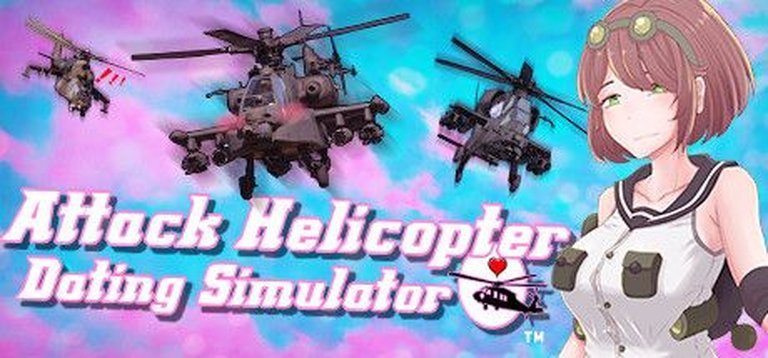
Attack Helicopter Dating Simulator is a satirical comedy visual novel and dating simulator where players take on the role of an anthropomorphic attack helicopter navigating romantic relationships with other helicopters in a military-themed world. Inspired by the infamous ‘I Sexually Identify as an Attack Helicopter’ internet meme, the game blends absurd humor, romance, and multiple endings in a first-person adventure, offering a unique and irreverent take on the dating sim genre.
Gameplay Videos
Where to Buy Attack Helicopter Dating Simulator
PC
Attack Helicopter Dating Simulator Guides & Walkthroughs
Attack Helicopter Dating Simulator Reviews & Reception
store.steampowered.com (90/100): A comedy dating sim visual novel where you play as an attack helicopter and romance other anthropomorphic helicopters in a satirical, military-themed world.
steambase.io (91/100): Attack Helicopter Dating Simulator has earned a Player Score of 91 / 100.
Attack Helicopter Dating Simulator: A Satirical Masterpiece or a Meme Gone Too Far?
Introduction: The Birth of a Cultural Phenomenon
In the vast, often bizarre landscape of indie gaming, few titles have managed to carve out a niche as uniquely absurd—and yet, oddly compelling—as Attack Helicopter Dating Simulator (AHDS). Released in 2018 by Uruguayan studio Curse Box Studios, this visual novel/dating simulator hybrid is a deliberate, unapologetic dive into the surreal, blending internet meme culture, satirical military themes, and a premise so outrageous it could only thrive in the modern era of gaming. At its core, AHDS is a game about playing as an attack helicopter who identifies as such, navigating the complexities of romance, warfare, and existential dread—all while delivering “democracy” via hellfire missiles.
But beneath its layers of irony and absurdity lies a game that is both a product of its time and a commentary on it. AHDS is not just a joke; it’s a meta-joke, a game that understands its own ridiculousness and leans into it with gleeful abandon. It’s a title that challenges players to engage with its premise on multiple levels: as a parody of dating simulators, as a satire of military propaganda, and as a reflection of the internet’s obsession with memes and identity politics.
This review will dissect AHDS in exhaustive detail, exploring its development history, narrative depth, gameplay mechanics, artistic choices, and cultural impact. By the end, we’ll determine whether it’s a fleeting meme turned into a game or a legitimate, if unconventional, contribution to the visual novel genre.
Development History & Context: From Meme to Game
The Studio Behind the Madness
Curse Box Studios, a small Uruguayan indie team, is no stranger to controversial or unconventional projects. Before AHDS, they were known for titles like Panzermadels: Tank Dating Simulator and Stay! Stay! Democratic People’s Republic of Korea!, games that similarly blend humor, satire, and niche appeal. Their work often walks the line between offensive and hilarious, catering to an audience that appreciates dark comedy and absurdity.
The studio’s lead, Pablo Cidade (credited as Neo), served as both the writer and game designer for AHDS. His vision was clear: take one of the internet’s most infamous copypastas—the “I Sexually Identify as an Attack Helicopter” meme—and transform it into a playable experience. The meme itself, which originated as a parody of transgender identities, was already a lightning rod for controversy. By adapting it into a game, Curse Box Studios didn’t just embrace the controversy; they weaponized it, turning it into a vehicle for satire.
Technological Constraints and Design Choices
AHDS was built using Ren’Py, a popular engine for visual novels, which allowed the team to focus on writing and art rather than complex programming. The game’s minimal system requirements (it can run on a machine with just 1GB of RAM) reflect its simplicity, but this simplicity is part of its charm. The developers didn’t need cutting-edge graphics or mechanics to sell their vision; the premise alone was enough.
The game’s art style is a mix of anime/manga aesthetics and military-themed designs, with character sprites that are intentionally exaggerated and cartoonish. The sound design, featuring music from Benjamin Tissot (bensound.com) and sound effects from freesound.org, leans into the game’s satirical tone, with tracks that feel like they were lifted straight from a 1980s action movie.
The Gaming Landscape in 2018
AHDS arrived at a time when the indie gaming scene was flourishing, with titles like Doki Doki Literature Club! and Undertale proving that unconventional narratives and meta-commentary could resonate with audiences. The visual novel genre, in particular, was experiencing a renaissance, with developers experimenting with themes ranging from psychological horror to romance.
However, AHDS stood out by embracing the internet’s love of memes and absurdity. Games like Goat Simulator and Surgeon Simulator had already shown that players were hungry for experiences that didn’t take themselves too seriously. AHDS took this a step further by tying its humor to a specific, controversial meme, ensuring that it would either be loved or loathed—with little room for indifference.
Narrative & Thematic Deep Dive: Satire, Romance, and Warfare
The Premise: A Helicopter’s Love Life
The game’s story is deceptively simple: you play as an attack helicopter who identifies as such, navigating the dual responsibilities of military service and romantic entanglements. Your daily routine includes “morning maintenance,” “aerial attack runs,” and “delivering hellfire missiles on noncombatants for democracy.” But, as the game reminds you, “it is a visual novel after all,” so the real focus is on dating other anthropomorphic helicopters.
The narrative is structured as a branching visual novel, with multiple routes and eleven endings (though the game jokingly assures you that you “probably don’t die” in most of them). The writing is sharp, self-aware, and dripping with satire. The game doesn’t just mock dating simulators; it mocks military propaganda, internet culture, and even the player’s expectations.
Characters and Dialogue: Absurdity as a Narrative Tool
The cast of AHDS is a roster of anthropomorphic helicopters, each with their own personalities and quirks. From the stoic Apache to the flirtatious Kiowa, the characters are designed to be both ridiculous and oddly endearing. The dialogue is filled with military jargon, meme references, and over-the-top romantic tropes, creating a tone that oscillates between parody and genuine charm.
One of the game’s most interesting narrative choices is its dual focus on romance and warfare. The player is constantly reminded of their dual role as both a lover and a weapon of war. This juxtaposition is played for laughs, but it also serves as a satirical commentary on militarism and identity. The game doesn’t shy away from dark humor, often making jokes about “delivering democracy” via airstrikes or the absurdity of anthropomorphic military hardware engaging in romantic relationships.
Themes: Identity, Satire, and the Absurd
At its core, AHDS is a game about identity—both in the literal sense (you are a helicopter who identifies as such) and in the broader cultural sense. The game’s premise is a direct reference to the “attack helicopter” meme, which was originally used to mock transgender individuals. By adopting this meme as its central conceit, AHDS recontextualizes it, turning it into a vehicle for satire rather than bigotry.
The game’s humor is layered:
1. Surface-Level Absurdity: The idea of dating helicopters is inherently ridiculous, and the game leans into this with over-the-top dialogue and scenarios.
2. Military Satire: The game mocks military propaganda, portraying warfare as a series of absurd, almost mundane tasks (“delivering democracy” via missiles).
3. Meta-Commentary: AHDS is aware of its own ridiculousness and frequently breaks the fourth wall, acknowledging that the player is engaging with a joke.
This layered approach ensures that the game’s humor doesn’t grow stale. Even when the jokes are crude or offensive, they’re delivered with such self-awareness that it’s hard to take them seriously—which, of course, is the point.
Gameplay Mechanics & Systems: Dating, Combat, and Choices
Core Gameplay Loop: A Visual Novel with a Twist
AHDS is, at its heart, a visual novel, meaning that the majority of gameplay revolves around reading dialogue, making choices, and navigating branching paths. However, the game distinguishes itself with a few unique mechanics:
- Multiple Endings: With eleven possible endings, AHDS encourages replayability. Each ending is tied to different romantic routes or narrative outcomes, ranging from wholesome to absurdly dark.
- Rock-Paper-Scissors Combat: In a bizarre but fitting twist, the game includes turn-based combat in the form of Rock-Paper-Scissors battles. These sequences are framed as “aerial strafing maneuvers” and are as ridiculous as they sound. The combat is simple but serves as a humorous break from the visual novel format.
- Cheat Codes and Modifiers: A later update introduced cheat codes that alter the game’s mechanics, adding new dialogue, scenarios, and even “immortality” (though the developers jokingly note that this hasn’t been tested in real life).
UI and Progression: Simple but Effective
The game’s user interface is straightforward, with a radar-like HUD that indicates nearby helicopters and a choice menu that separates itself from the default Ren’Py aesthetic. The UI is functional but also contributes to the game’s satirical tone, with exaggerated military-themed elements.
Character progression is tied to romantic routes, with each helicopter offering a different narrative path. The game doesn’t feature traditional “stats” or “leveling,” but the choices you make influence which endings you unlock. The lack of traditional gameplay mechanics is intentional; AHDS is more about the experience than the challenge.
Innovations and Flaws
AHDS’s greatest innovation is its commitment to absurdity. The game doesn’t try to be anything other than what it is: a joke taken to its logical extreme. However, this also leads to some of its flaws:
– Short Playtime: Most players complete the game in 2-3 hours, which can feel brief for a visual novel.
– Technical Issues: Some players have reported bugs, missing images, and grammar errors, which detract from the experience.
– Limited Replay Value: While the multiple endings encourage replayability, the core narrative doesn’t change drastically between routes.
Despite these flaws, the game’s writing and humor carry it. The developers clearly prioritized satire and comedy over polish, and for the most part, it works.
World-Building, Art & Sound: Crafting a Satirical Universe
Setting and Atmosphere: A Military-Themed Dating Sim
AHDS takes place in a satirical military world, where anthropomorphic helicopters live alongside humans (or at least, human-like characters). The setting is intentionally vague, allowing the game to focus on its absurd premise rather than world-building. The atmosphere is a mix of military propaganda and romantic comedy, creating a tone that is both darkly humorous and oddly charming.
Visual Design: Anime Meets Military Hardware
The game’s art style is a fusion of anime/manga aesthetics and military-themed designs. The character sprites are exaggerated and cartoonish, with helicopters that somehow manage to be both menacing and cute. The backgrounds are simple but effective, often depicting military bases, battlefields, or romantic settings (because nothing says romance like a missile silo).
The animation and particles, handled by Lucia Riccitelli, add a layer of polish to the game’s visuals. While not groundbreaking, the art style fits the game’s tone perfectly, reinforcing its satirical and absurd nature.
Sound Design: A Soundtrack for Absurdity
The game’s soundtrack, composed by Benjamin Tissot (bensound.com), is a mix of upbeat, synth-heavy tracks that feel like they were lifted from an 80s action movie. The music is intentionally cheesy, matching the game’s over-the-top tone. Sound effects, sourced from freesound.org, include explosions, helicopter noises, and romantic flourishes, all of which contribute to the game’s unique atmosphere.
The voice acting (limited to certain scenes, such as the Rock-Paper-Scissors combat) is similarly exaggerated, adding to the game’s comedic value.
Reception & Legacy: A Game That Divides and Delights
Critical and Commercial Reception
AHDS was met with a mixed but generally positive reception. On Steam, it holds a “Very Positive” rating (90% positive from 151 reviews), with players praising its humor, writing, and unique premise. However, it also faced criticism for its short length, technical issues, and reliance on meme culture.
Critically, the game received little mainstream attention, likely due to its niche appeal and controversial premise. Metacritic, for example, has no critic reviews listed, suggesting that major outlets either ignored it or deemed it unworthy of serious analysis.
Cultural Impact and Legacy
Despite its lack of mainstream recognition, AHDS has developed a cult following. Its satirical take on meme culture and military themes resonated with a specific audience, and its self-aware humor has kept it relevant years after its release.
The game’s legacy is tied to its unapologetic absurdity. It’s a title that embodies the spirit of indie gaming: weird, experimental, and unconcerned with appealing to everyone. In this sense, AHDS is a success—it knows its audience and delivers exactly what they want.
Influence on Subsequent Games
AHDS hasn’t spawned a wave of imitators, but it has contributed to the growing trend of meme-based games. Titles like Putin Dating Simulator and My Dream Sport Dating Simulator (also by Curse Box Studios) follow a similar formula, blending absurd premises with visual novel mechanics.
More broadly, AHDS is part of a larger movement in indie gaming that embraces satire, irony, and meta-commentary. Games like Doki Doki Literature Club! and The Stanley Parable have shown that players are hungry for experiences that challenge expectations and subvert genres. AHDS takes this a step further by weaponizing absurdity, proving that even the most ridiculous premise can be compelling if executed with confidence.
Conclusion: A Meme Turned Masterpiece
Attack Helicopter Dating Simulator is a game that shouldn’t work—and yet, it does. It’s a satirical masterpiece, a meme turned into a playable experience, and a testament to the power of absurdity in gaming. It’s not a game for everyone, but for those who appreciate its brand of humor, it’s an unforgettable experience.
The game’s greatest strength is its commitment to its premise. It doesn’t try to be anything other than what it is: a joke taken to its logical extreme. The writing is sharp, the humor is relentless, and the satire is razor-edged. Even when it stumbles (with technical issues or repetitive gameplay), its charm and audacity carry it through.
In the grand tapestry of video game history, AHDS is a footnote—a bizarre, hilarious, and ultimately minor entry in the visual novel genre. But it’s also a cultural artifact, a game that captures the spirit of internet humor and indie gaming’s willingness to take risks. For that alone, it deserves recognition.
Final Verdict: 8/10 – A Satirical Triumph
Attack Helicopter Dating Simulator is not a perfect game, but it’s a perfect execution of its vision. It’s funny, absurd, and unapologetically itself. If you’re a fan of dark humor, meme culture, or visual novels that defy expectations, this is a must-play. Just don’t expect it to change your life—unless, of course, you’ve always dreamed of dating a helicopter.
Pros:
– Hilarious, self-aware writing
– Unique and absurd premise
– Multiple endings encourage replayability
– Sharp satire of military and meme culture
Cons:
– Short playtime (2-3 hours)
– Technical issues and grammar errors
– Limited appeal outside its niche audience
Final Thought:
Attack Helicopter Dating Simulator is the gaming equivalent of a dadaist art piece—it’s not supposed to make sense, but it’s impossible to look away. Play it, laugh at it, and then ask yourself: Why did I just spend two hours romancing a helicopter? The answer, of course, is because the internet made you do it.