
- Release Year: 2019
- Platforms: Nintendo Switch, PlayStation 4, PlayStation 5, Windows, Xbox One, Xbox Series
- Publisher: Curve Digital Publishing Limited
- Developer: Denki Ltd.
- Genre: Automation, Simulation
- Perspective: Diagonal-down
- Game Mode: Single-player
- Gameplay: Automation, City management, construction simulation, Fishing
- Setting: Fantasy
- Average Score: 78/100
Description
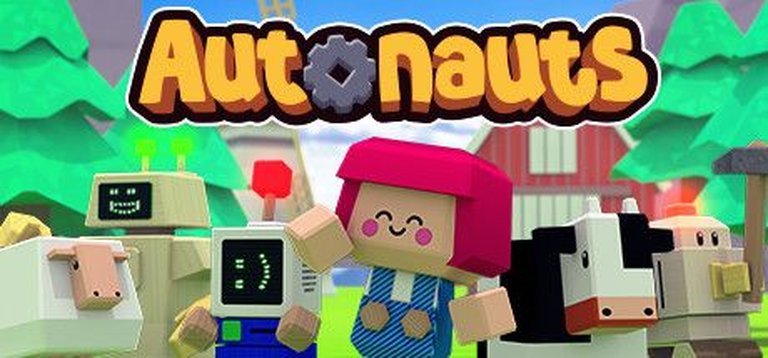
Autonauts is a charming colony-building simulation set in a vibrant fantasy world, where players crash-land on an uninhabited planet and must program adorable robots known as Autonauts to automate essential tasks like farming, crafting, and construction. Through an intuitive point-and-select interface with real-time pacing and a diagonal-down perspective, you teach your robotic workforce to sustain and entertain a growing population of droids-turned-colonists, evolving from basic survival to a thriving, inventive settlement filled with complex automation challenges.
Gameplay Videos
Where to Buy Autonauts
Autonauts Free Download
Crack, Patches & Mods
Guides & Walkthroughs
Reviews & Reception
metacritic.com (80/100): Autonauts is a fantastic little base-builder that gives players the chance to build and program their own robots.
opencritic.com (76/100): Autonauts is a colourful, creative and energetic game of automation and colonisation, whose cute facade is home to some truly engaging coding that never gets too complex.
gamingonpc.com : Autonauts is a quite joyous game most of the time.
Autonauts: Review
Introduction
Imagine crash-landing on a barren alien world, armed not with lasers or survival kits, but with a knack for coding and a dream of turning desolation into a bustling robotic utopia. This is the whimsical premise of Autonauts, a 2019 indie gem that invites players to colonize procedurally generated planets through the power of automation. As a game that echoes the pioneering spirit of early simulation titles like The Settlers or SimCity while injecting modern programming education into the mix, Autonauts stands as a testament to the indie scene’s ability to innovate without the baggage of blockbuster expectations. Developed by the Scottish studio Denki, it launched quietly amid a wave of colony sims but has since carved out a niche for its accessible yet deep mechanics. My thesis: Autonauts is a masterful fusion of creative coding, resource management, and serene world-building that not only educates on automation principles but also delivers profound satisfaction in watching your digital dreams self-sustain, cementing its place as an underappreciated cornerstone of the automation genre.
Development History & Context
Denki Ltd., the Edinburgh-based developer behind Autonauts, has a storied history in the British gaming landscape, tracing its roots back to the 1990s when co-founder Gary Penn contributed to classics like Lemmings and early Grand Theft Auto titles at DMA Design (now Rockstar North). Founded in 2000, Denki specialized in mobile and educational games, honing a philosophy of “playful programming” that emphasizes intuitive mechanics over complexity. Autonauts emerged from this ethos, initially prototyped on itch.io around 2017 as a crowdfunding experiment—though the campaign was unsuccessful, it garnered enough buzz for publisher Curve Digital (known for Bomber Crew and Human: Fall Flat) to step in.
The game’s development was bootstrapped, leveraging Unity’s 2018 engine to keep costs low amid the indie crunch of the late 2010s. Technological constraints were minimal; Unity allowed for procedural planet generation and real-time simulation without the need for massive teams or budgets. However, Penn’s vision was ambitious: blending Factorio-style automation with Pikmin-esque resource chaining and Animal Crossing‘s relaxing vibe, all wrapped in a visual programming language inspired by MIT’s Scratch. This era’s gaming landscape was dominated by survival sims like Oxygen Not Included and Subnautica, where harsh environments demanded constant vigilance. Autonauts bucked this trend, opting for a threat-free sandbox that prioritized experimentation over peril, reflecting a post-No Man’s Sky skepticism toward procedural hype. Released on October 17, 2019, for PC via Steam, it was positioned as “Phase 1,” signaling ongoing support—post-launch updates like the “Fully Automated” patch in 2022 added settlement modes and bot refinements. Console ports followed in 2022 for PlayStation 4/5, Xbox One/Series, and Nintendo Switch, adapting controls for controllers while preserving the mouse-driven precision of PC play. In a market flooded with live-service giants, Autonauts exemplified indie’s strength: iterative, community-driven evolution without aggressive monetization.
Narrative & Thematic Deep Dive
Autonauts eschews traditional storytelling for a procedural narrative driven by player agency, unfolding like a silent symphony of progress rather than a scripted epic. There’s no overwrought plot or villainous arc; instead, you embody the titular Autonaut, a robotic pioneer guided by Otto-0, a sassy AI companion whose dialogue serves as tutorial narration. Otto-0’s quips—”Don’t forget to hydrate your bots… oh wait, they don’t need water”—infuse humor into the otherwise minimalist script, drawing from sci-fi tropes like Isaac Asimov’s robot laws but subverting them with whimsy.
The “plot” progresses through a campaign of quests, from rudimentary resource gathering to enlightening colonists into transcendence. Characters are archetypal: workerbots as tireless drones, colonists as dependent humanoids birthed from food-seed incubators, and wildlife like leeches or berry bushes as passive ecosystem elements. No deep backstories here—colonists are blank slates, their “personalities” emergent from needs like food, shelter, and leisure. Dialogue is sparse, limited to Otto-0’s instructional banter and bot status reports, but it’s punchy and thematic, emphasizing themes of creation and dependency.
Underneath the cute facade lies a profound exploration of automation’s double-edged sword. Themes of recursive creation shine through: you build bots that build more bots, mirroring real-world AI anxieties but framed optimistically. Colonists, raised by robots (Raised by Robots trope), produce “Wuv” (a happiness metric) to unlock tech, critiquing human reliance on machines while celebrating symbiosis. There’s subtle environmental commentary—chopping forests for planks evokes colonial exploitation, yet replanting mechanics encourage sustainability. Forced transformations via the Ziggurat wonder (turning folk into birds) nods to Creating Life and ethical dilemmas in god-like simulation. Overall, the narrative is thematic poetry: a meditation on enlightenment through labor, where progress isn’t conquest but harmony, making Autonauts a quiet philosopher in the sim genre.
Gameplay Mechanics & Systems
At its core, Autonauts revolves around a satisfying loop of harvest, automate, expand, delivered in real-time with diagonal-down perspective and point-and-select interface. Starting with manual twig-and-stone collection, players craft blueprints for bots, then program them via a drag-and-drop visual language akin to Scratch—record actions (e.g., chop tree, carry log), add loops/conditions (if inventory full, return to storage), and define search radii. This Programming Game mechanic is innovative, scaling from toddler-simple (plant seeds) to complex (multi-bot assembly lines for medicines), teaching logic without code syntax.
No combat exists—it’s pure simulation, focusing on city-building and automation. Core loops include resource chains: trees to logs to planks to poles to pegs, escalating to fishing, farming, tailoring, and power generation via windmills or steam engines. Character progression ties to a tech tree unlocked by quests and “Wuv” from happy colonists, who require bot-managed needs (food via cooking stations, housing, clothing). Bots upgrade modularly—swap heads for better memory, drives for speed—enabling uninterrupted workflows, a flawlessly executed Easily Detachable Robot Parts system.
UI is clean but occasionally cluttered; the bot editor shines with copy-paste programs via the Central Computer wonder, but early tutorials can feel hand-holdy, and console ports sacrifice precision for controller-friendly menus. Innovations abound: procedural planets ensure replayability, animal husbandry adds depth (pen animals for wool/leather), and late-game power networks (belts, axles) evoke Factorio without its intensity. Flaws include repetitive mid-game scaling—expanding economies can devolve into “sleur” (Dutch for tedium, as one critic noted)—and occasional bot pathing glitches, like infinite loops producing idle robot queues. Yet, the sandbox freedom, with no permadeath or timers, fosters experimentation; Free Play mode lets you ignore campaigns for pure creativity. Pacing evolves from tedious manual labor to exhilarating autonomy, where watching your empire hum is the ultimate reward.
World-Building, Art & Sound
Autonauts‘ world is a vibrant, low-poly paradise: procedurally generated planets burst with candy-colored biomes—lush forests, swampy leech pools, berry-dotted plains—framed by a free-roaming camera that scales from intimate bot close-ups to sprawling colonies. Setting is a mundane sci-fi fantasy, uninhabited yet teeming with harvestable life; no aliens or cataclysms, just endless potential for transformation. Atmosphere is relentlessly optimistic—sunny days, no weather hazards—evoking a therapeutic escape, where building a metropolis feels like gardening a digital Eden.
Visual direction employs a consistent, bright palette of primaries against low-poly models, reminiscent of LEGO bricks or Minecraft‘s charm but polished with Unity’s sheen. Bots’ steampunk flair (gears, puffs of steam) contrasts colonists’ humanoid simplicity, while wonders like the Stone Circle (a fast-forward UI enabler) add mystical flair. This stylization enhances accessibility—resources pop visually, preventing clutter—and contributes to immersion by making failure (e.g., a bot jam) endearing rather than frustrating.
Sound design amplifies the relaxation: a gentle, orchestral soundtrack with flute and string motifs echoes Animal Crossing‘s whimsy, looping calmly without intrusion. Ambient effects—chopping thwacks, bot whirs, colonist hums—build a soothing ASMR-like symphony, with no bombast or alerts to shatter the zen. Together, these elements craft an experience of quiet empowerment: the world feels alive yet malleable, turning automation into meditative artistry.
Reception & Legacy
Upon its 2019 PC launch, Autonauts earned solid critical acclaim, averaging 80 on Metacritic and 76 on OpenCritic from 17 reviews, with Steam users at 90% positive (over 1,900 reviews). Critics praised its inventive programming—Video Chums called it “satisfying and open-ended” (84/100), while VGC hailed its “astonishingly complex” depth (80/100). The Guardian (4/5) lauded its “playful, welcoming” charm, and outlets like GameSpace (8.5/10) highlighted bot-building’s hours-long appeal. Commercially, it sold steadily on Steam ($19.99, often discounted to $7.99), amassing 89 collections on MobyGames and spawning a 2022 sequel, Autonauts vs. Piratebots, which added combat.
Player reception was mixed initially—some decried early tedium (Pure Nintendo: 8/10, “tedious at first, then fun”)—but post-updates like “Industrial Revolution” (steam power) and “Fully Automated” (settlement mode) boosted longevity, evolving its rep from niche sim to enduring favorite. On consoles, 2022 ports scored well (e.g., Video Chums 84% on Switch), though UI tweaks drew minor gripes.
Legacy-wise, Autonauts influenced the automation wave, inspiring hybrids like The Colonists (2018) and Techtonica (upcoming), while its educational programming democratized coding in games, akin to Human Resource Machine. In industry terms, it proved small teams (185 credits, mostly indie talent) could rival AAA sims, paving for post-Factorio indies. Though not revolutionary like Dwarf Fortress, its influence lingers in relaxing, bot-driven sims, ensuring a cult following among automation enthusiasts.
Conclusion
Autonauts weaves a tapestry of innovation, from its Scratch-like programming to serene colony sim loops, transforming potential drudgery into joyous creation. While pacing hiccups and sparse narrative keep it from perfection, its flaws are mere specks in a low-poly masterpiece of accessibility and depth. As a historian, I place it firmly in video game canon: a bridge between educational tools and immersive sims, influencing a generation of automated dreams. Verdict: Essential for sim fans—8.5/10, a timeless indie triumph that proves automation isn’t just efficient; it’s enchanting.