
- Release Year: 2014
- Platforms: Windows
- Publisher: ak tronic Software & Services GmbH
- Genre: Compilation
Description
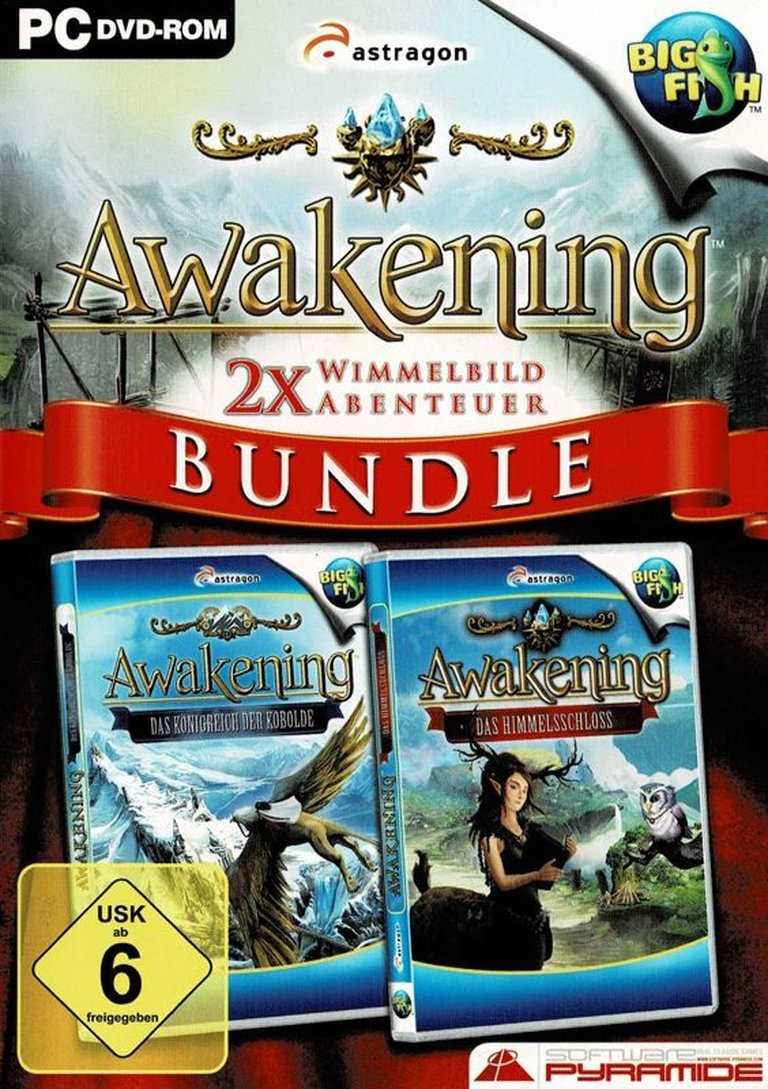
The Awakening Bundle compiles two hidden object puzzle adventure games set in a light fantasy realm. Players follow Princess Sophia as she awakens from a century-long slumber to find her missing family, navigate enchanted landscapes, and solve intricate puzzles while battling dark forces and magical creatures across the Goblin Kingdom and Skyward Castle.
Awakening Bundle: Review
Introduction
In the golden age of casual gaming, few franchises achieved the sustained success and cultural footprint of the Awakening series. Released in 2014 by ak tronic Software & Services GmbH, the Awakening Bundle serves as a curated anthology of two pivotal installments: Awakening: The Goblin Kingdom (2011) and Awakening: The Skyward Castle (2012). As the second compilation in the series, it captures the saga of Princess Sophia at its narrative zenith—where fairy-tale fantasy meets intricate puzzle design. For over a decade, Boomzap Entertainment’s flagship series has enchanted millions (17+ downloads by 2014) with its lush, hand-painted worlds and accessible yet intellectually demanding gameplay. This bundle is more than a mere repackage; it is a testament to a genre-defining franchise that redefined hidden object puzzle adventures (HOPA) through masterful storytelling, mechanical innovation, and emotional resonance. This review deconstructs why these two games remain cornerstones of the series, exploring their legacy within the broader landscape of casual gaming history.
Development History & Context
The Awakening series emerged from the fertile soil of the 2010s casual gaming boom, a period dominated by digital storefronts like Big Fish Games. Developed by Boomzap Entertainment—a Southeast Asian studio founded in 2005 by Christopher Natsuume (ex-Crytek) and Allan Simonsen—the games were born from a dual vision: to create immersive narrative experiences accessible to non-traditional gamers while pushing the boundaries of HOPA mechanics. Boomzap’s remote, agile development model allowed rapid iteration, with art director Michael Gonzales pioneering the series’ signature hand-painted aesthetic in early prototypes.
The Goblin Kingdom (2011) arrived as the series’ critical and commercial turning point. Its simultaneous PC/Mac release (a first for Boomzap) reflected publisher Big Fish Games’ strategy of cross-platform ubiquity, capitalizing on the franchise’s rising popularity. By 2012, The Skyward Castle refined this formula, leveraging lessons learned from its predecessor to elevate production values—most notably through expanded voice acting and cinematic cutscenes. Technologically, the games operated within the constraints of casual gaming: minimalist hardware demands, modular asset design for portability, and digital-first distribution. The bundle itself, released in 2014, coincided with the series’ peak influence, packaged for audiences seeking the definitive mid-saga experience before the narrative concluded with 2014’s The Golden Age and The Redleaf Forest. This context reveals a studio skillfully navigating the casual gaming ecosystem—one that prioritized narrative depth over graphical fidelity, ensuring broad accessibility without sacrificing ambition.
Narrative & Thematic Deep Dive
The bundle’s two games form an uninterrupted chapter in Princess Sophia’s epic quest, evolving from a personal mission into a world-spanning odyssey. The Goblin Kingdom opens with Sophia venturing into the eponymous realm to seek counsel from its wise king, only to be ensnared in a political conspiracy. Dark forces have imprisoned the monarch, framing Sophia for treason and igniting tensions between humans and goblins. The narrative pivots on themes of allyship and prejudice: Sophia must navigate mistrust, uncovering that the true enemy is the shadowy Dreadmyre, whose curse threatens to engulf both races. The goblin characters—initially antagonistic—reveal nuanced motivations, challenging simplistic notions of good versus evil. Sophia’s growth here is pivotal; she transitions from a sheltered princess to a diplomat, using wit over combat to forge alliances.
The Skyward Castle elevates the stakes, shifting to vertical realms as Sophia ascends a floating citadel to rescue her cursed people. Guided by a wounded winged unicorn, she confronts aerial perils—storm clouds, basilisks, and treacherous winds—symbolizing the fragility of hope. The narrative explores sacrifice and resilience: Sophia repairs the unicorn’s wing, embodying reciprocity with nature, while the castle’s multi-level design mirrors her ascent from despair to leadership. Themes of restoration deepen, as human survivors represent the remnants of a fallen society. Both installments interweave fairy-tale whimsy with darker undertones—Dreadmyre’s looming threat underscores the cost of complacency. Sophia’s arc, from amnesiac exile to queen, forms the emotional core, supported by Mira’s humorous-yet-wiseful narration and the Fairy Queen’s cryptic guidance. The bundle’s interconnected storytelling exemplifies the series’ strength: episodic yet cohesive, with each puzzle propelling the next revelation.
Gameplay Mechanics & Systems
The Awakening Bundle showcases the series’ evolution from hidden object scavenging to intricate, multi-layered gameplay. The Goblin Kingdom introduces narrative-driven puzzles, reducing traditional list-based scenes in favor of context-sensitive challenges. Players manipulate goblin artifacts—like assembling fragmented runes or solving match-3 sequences to bypass guards—emphasizing environmental interaction. A standout innovation is the alliance-building system, where dialogue choices and item trades with goblin factions unlock pathways, integrating role-playing elements into the HOPA framework. Hints via Mira’s journal recharge after use, maintaining challenge accessibility.
The Skyward Castle elevates verticality with flight-based mechanics. Sophia’s unicorn becomes a gameplay linchpin: its wing repairs unlock aerial navigation, while aerial battles against basilisks require strategic positioning. Morphing objects—subtly shifting within scenes—reward meticulous observation, a mechanic refined from prior entries. Collector’s Editions (included in the bundle) add bonus chapters, concept art, and replayable puzzles, enhancing value for completionists. UI design remains intuitive, with point-and-click simplicity masking complexity: inventory puzzles demand logical deduction (e.g., combining a rope and stick to craft an oar), while multi-step sequences—like disarming a mechanical dragon—showcase the series’ signature blend of creativity and clarity. Both games excel in pacing, avoiding backtracking through linear chapter structures, though The Skyward Castle’s aerial exploration introduces a welcome sense of scale.
World-Building, Art & Sound
Boomzap’s artistry defines the bundle’s immersive appeal. The Goblin Kingdom’s subterranean lairs and snow-peaked mountains evoke a tactile, earthy magic—crystalline caves and goblin totems rendered in warm, earthy tones. Contrast this with The Skyward Castle’s ethereal realms: cloud forests and floating spires dissolve into pastel skies, where iridescent unicorns and stormy vistas create a dreamscape. These environments aren’t backdrops; they’re narrative devices. The castle’s decaying architecture reflects Sophia’s hope, while goblin graffiti in The Goblin Kingdom hints at societal strife. Character designs—Sophia’s adaptable gowns, Mira’s mischievous glow—blend fantasy with functionality, ensuring visibility in cluttered scenes.
Sound design amplifies this atmosphere. The Skyward Castle features full voice acting for cutscenes, with Sophia’s resolve and Mira’s wit conveyed through nuanced performances. Musical scores shift from the Goblin Kingdom’s tribal drums to the castle’s harp-driven melodies, reinforcing emotional beats. Environmental sounds—dripping caverns, gusting winds—ground fantastical elements in realism. The bundle’s art direction, a fusion of hand-painted textures and stylized lighting, established a benchmark for HOPA aesthetics, proving that accessibility need not sacrifice beauty.
Reception & Legacy
Upon release, The Goblin Kingdom was hailed as a genre landmark. It topped Big Fish Games’ charts for 42 days and clinched JayIsGames’ “Best Hidden Object Game of 2011,” praised for its “magical enchanted ride” and puzzle variety. Critics lauded its narrative depth, with Gamezebo noting it was “an instant recommendation” that “reinvigorated” the genre. The Skyward Castle followed as a “capstone,” earning acclaim from CasualGameGuides for its “beautiful story” and JayIsGames for being “one of the best adventure hybrids.” Commercially, the bundle capitalized on the series’ 17-million-download momentum, cementing Boomzap’s reputation in casual gaming.
Historically, the bundle epitomizes the Awakening series’ influence. It popularized HOPA’s hybridization with RPG elements and episodic storytelling, inspiring titles like Mortimer Beckett and Nightfall Mysteries. Its fairy-tale aesthetic influenced art direction in mobile casual games, while its emphasis on character-driven narratives elevated the genre beyond mere object-hunting. Though the bundle itself received limited standalone reviews, its constituent games remain touchstones in the series’ legacy—a legacy preserved through remasters and Steam re-releases, ensuring Sophia’s story endures for new audiences.
Conclusion
The Awakening Bundle is more than a compilation; it is a curated masterclass in narrative-driven puzzle design. The Goblin Kingdom and The Skyward Castle represent the series at its apex—where thematic depth, mechanical innovation, and artistic cohesion converge. Sophia’s journey, from political intrigue in goblin realms to aerial heroics, exemplifies the franchise’s ability to blend fairy-tale wonder with mature storytelling. While the bundle lacks the first game’s introduction or the series’ finale, it captures the saga’s emotional and creative core. For HOPA enthusiasts, it is an essential artifact—a testament to Boomzap’s vision that casual gaming could be both accessible and profound. In the pantheon of adventure games, the Awakening Bundle stands as a luminous, enduring jewel.