
- Release Year: 1998
- Platforms: Macintosh, Windows 16-bit, Windows
- Publisher: Humongous Entertainment, Inc., Playground Productions LLC
- Developer: Humongous Entertainment, Inc.
- Genre: Action, Sports
- Perspective: Top-down
- Game Mode: Single-player
- Gameplay: Custom teams, Fouls, Hat tricks, Penalty kicks, Power-ups, Practice mode, Stamina management, Substitutions, Team selection
- Setting: Backyard
- Average Score: 100/100
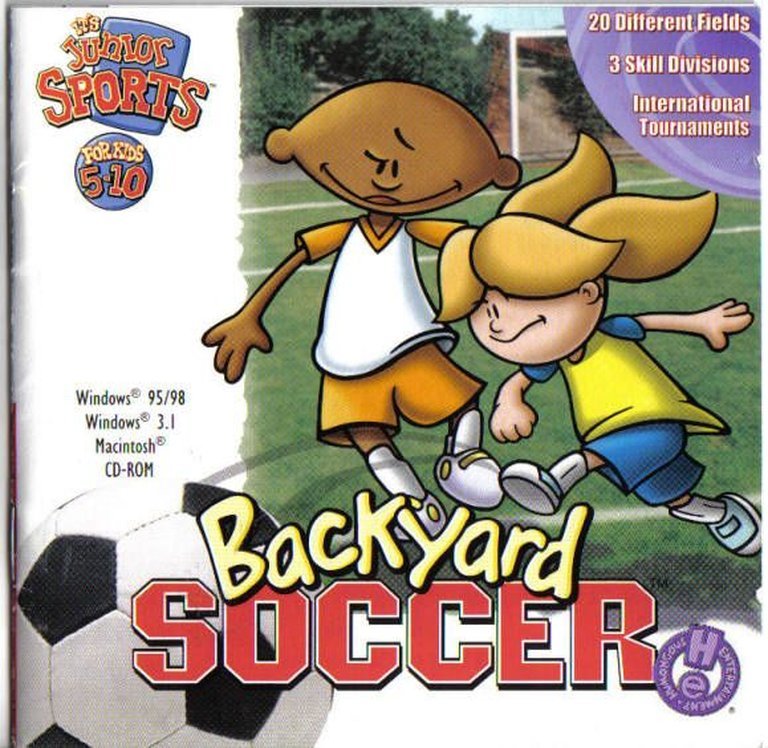
Description
Backyard Soccer is the first game in the Backyard Sports Soccer series, where players build teams from 30 unique kids with individual stats to compete in casual backyard soccer matches. It features simple arcade-style gameplay with modes like Single games and Season play, a practice mode for penalties and kicking, and includes all standard soccer rules such as fouls and hat tricks, all wrapped in a charming, kid-oriented aesthetic.
Gameplay Videos
Where to Buy Backyard Soccer
Backyard Soccer Free Download
Backyard Soccer Guides & Walkthroughs
Backyard Soccer Reviews & Reception
cbr.com : It brings the same fun it had when it first came out in 1998.
rectifygaming.com (100/100): Backyard Soccer ’98 on Steam proves that sometimes, less is more.
hammerdownsportsblog.wordpress.com : Overall, I would highly recommend Backyard Soccer 98.
Backyard Soccer Cheats & Codes
PC
Put the ball out of bounds, then press Shift + Enter + Tab.
| Code | Effect |
|---|---|
| Shift + Enter + Tab | Win All Levels |
PlayStation 1 (PS1)
| Code | Effect |
|---|---|
| 300BD428 00?? | Home Team Score Modifier |
| 300BDA84 00?? | Away Team Score Modifier |
| 800540F4 00?? | Goals Score Modifier |
| 300BD442 00FF 300BD43E 0001 | Home Team Always Has Twister |
| 300BD442 00FF 300BD43E 0002 | Home Team Always Has Underground |
| 300BD442 00FF 300BD43E 0003 | Home Team Always Has Bowling Ball |
| 300BD442 00FF 300BD43E 0004 | Home Team Always Has Cannonball |
| 300BDA9E 00FF 300BDA9A 0001 | Away Team Always Has Twister |
| 300BDA9E 00FF 300BDA9A 0002 | Away Team Always Has Underground |
| 300BDA9E 00FF 300BDA9A 0003 | Away Team Always Has Bowling Ball |
| 300BDA9E 00FF 300BDA9A 0004 | Away Team Always Has Cannonball |
Backyard Soccer (1998): A Cult Classic Built on Shaky Foundations
Introduction: The Unlikely Pitch
Launched in 1998 by Humongous Entertainment, Backyard Soccer arrived not as a pioneer of simulation, but as a purveyor of pure, unadulterated playground fantasy. It captured the essence of neighborhood soccer—chaotic, inclusive, and fueled by imagination—and packaged it into a digital experience for children aged 6 to 12. As the second entry in the groundbreaking Backyard Sports series following Backyard Baseball, it inherited a charming cast of kid athletes but faced the monumental task of translating the fluid, physical sport of soccer into a point-and-click computer game. Its legacy is a paradox: a title often criticized for its baffling core mechanics and unreliable AI, yet one that achieved massive commercial success, spawned sequels, and cemented characters like Pablo Sanchez into the pantheon of 90s gaming icons. This review argues that Backyard Soccer is a fascinating historical artifact—a game whose fundamental design is fundamentally flawed yet whose surrounding artistry, character, and cultural impact created a beloved, enduring franchise. Its true genius lies not in its on-field action, but in its successful evocation of backyard spirit, a feat that ultimately overshadowed its clumsy gameplay.
Development History & Context: From SCUMM to Backyard
Backyard Soccer was developed by Humongous Entertainment, a studio founded in 1992 and already renowned for its “Junior Adventure” edutainment series (Putt-Putt, Freddi Fish). The project was led by producer D.J. Mattern, with key design contributions from Rhett Mathis, Nick Mirkovich, and Eric Gross—a team of about 60 credited personnel. The development represented a significant pivot: adapting the studio’s proprietary SCUMM engine, originally built for point-and-click adventure games, to a real-time sports simulation. This was a technological constraint that defined the game’s identity. The team’s vision, as documented in post-mortems and interviews, was to create a soccer game that mirrored informal, diverse neighborhood play. They drew inspiration from films like The Bad News Bears and comics like Peanuts, aiming for a tone of whimsical, kid-led chaos rather than professional realism. The goal was accessibility for young players, incorporating simplified 6-on-6 rules, cartoonish exaggeration, and a roster of children that reflected real-world diversity without tokenism. This commitment to “kids’ quirks and kids’ humor” was paramount, leading to hundreds of thousands of hand-drawn animation frames and a soundtrack of playful, whimsical tunes.
The gaming landscape of 1998 was dominated by increasingly realistic sports simulations (EA’s FIFA, Madden) and arcade-style alternatives (NBA Jam). Humongous carved a unique niche: the Backyard series was explicitly non-violent, family-friendly, and aimed at fostering an interest in sports through fun, not fidelity. Following the modest initial performance of Backyard Baseball in 1997, co-founder Ron Gilbert’s insistence on continuing the series paid off with Backyard Soccer, which became a commercial turning point, eventually making the Backyard Sports franchise Humongous’s biggest cash cow with over 15 million units sold by the mid-2000s.
Narrative & Thematic Deep Dive: The Backyard Bunch as Protagonists
Backyard Soccer possesses no traditional narrative or plot. Instead, its “story” is emergent, built entirely on the charisma of its 30 iconic “Backyard Kids.” Each character is a protagonist, defined by a vividly written biographical card, unique statistical attributes (Speed, Passing, Shooting, Defense, Goalkeeping), and distinct voice lines. This roster is a masterclass in economical character design, where a few sentences and visual cues convey a complete personality. For instance, the wheelchair-using Kenny Kawaguchi’s biography credits his ballet classes for his surprising goaltending prowess, framing his ability not as a limitation but as a specific, earned skill. The themes are explicitly inclusive and empowering: soccer is for everyone, regardless of size, gender, or ability. The game’s universe is a persistent, optimistic backyard where rivalries are good-natured and commentary is cheeky rather than hostile.
The dialogue, delivered by a cast of voice actors including Jen Taylor (as the peppy commentator Sunny Day) and Dolores Rogers (as the dryly humorous British Earl Grey), reinforces this tone. Sunny and Earl provide a running, comedic commentary filled with puns, kid-friendly jokes, and stereotyping so gentle it becomes affectionate (Earl’s love of tea, the foreign teams in the end-game tournament with names like “The Wiener Schnitzel Squad”). The narrative experience is about assembling a team that feels personally meaningful, reading the bios, and imagining the dynamics between these kids. Pablo Sanchez emerges as the unlikely legend—a small, hyper-competent child whose stat sheet in Backyard Baseball was so dominant it became community folklore. His slightly toned-down but still exceptional skills in Soccer only deepened his mythos. The game’s thematic core is not about winning a trophy, but about the joy of selection, the fantasy of leading a ragtag group of friends to glory, and the laughter provoked by the kids’ antics and the commentator’s banter.
Gameplay Mechanics & Systems: A Beautiful Mess at the Core
This is where Backyard Soccer divides players. Its foundational mechanic is the “ball ownership” system, a radical departure from direct control that proves its fatal flaw. The game internally assigns the ball to one player at a time. Only that “owner” can dribble or kick. Teammates can only interact by receiving a pass, while opponents must “steal” to become the new owner. The player issues commands via mouse clicks, but the action is context-sensitive and inverted based on possession:
* Left-Click (on ball): If you own it, dribble toward it. If opponent owns it, tell your closest player to keep distance/defend.
* Right-Click (on ball): If you own it, kick/pass. If opponent owns it, tell your closest player to steal.
This system creates a cascade of problems. First, ambiguity of ownership is rampant. When the ball is loose near your player, the game may arbitrarily switch ownership to a farther opponent, causing your player to retreat when you intended to dribble. Second, transferring ownership mid-dribble is impossibly clunky. A trailing, faster player cannot simply take the ball; the dribbler must first pass, introducing a delay and leaving you vulnerable. Third, shot opportunities are fraught. To score, you must first steal (right-click), then aim and shoot (right-click on goal). The delay between stealing and shooting, combined with multiple opponents swarming, turns scoring into a frantic, often failed, button-mashing exercise where the AI frequently outperforms the player by always knowing the correct command.
The AI is schizophrenic. Offensively, it is passive and stupid, making pointless passes and failing to capitalize on breakaways because its decision-making is as confused as the player’s. Defensively, it is easily beaten by a single fast player with the ball, as additional defenders rarely join the chase. Goalkeeper AI is particularly poor, often standing idle. This results in a bizarre difficulty curve: games are trivially easy on lower difficulties due to the AI’s incompetence, and only become a challenge in the end-game “Astonishingly Shiny Cup” when opponents have maxed stats that allow them to outrun your players, effectively brute-forcing past the AI’s tactical ineptitude.
The stamina system is the one glimmer of strategic depth. All six field players (plus two substitutes) tire over time, significantly reducing speed. With no stamina meter, players must visually judge a player’s fatigue by their running speed, creating tense substitution decisions. However, this is undermined by the core control chaos. Power-ups ( Bowling Ball, Cannonball, etc.) are earned on performance (seemingly after shots) and automatically trigger on next goal attempt. They are a minor, often forgettable, arcade layer with minimal strategic impact. The game is also plagued by notable bugs: physics glitches (ball teleporting over goal), goalies locking up with the ball, and occasional crashes in League Play.
League Play is the centerpiece and shows more ambition. It features a 3-division (B, A, Premier) promotion/relegation system with 14-game seasons. Mid-season, top-four teams enter the “Off-The-Wall Indoor Invitational,” a 3-match tournament on enclosed fields that increases chaos. Winning the Premier Division unlocks the international “Astonishingly Shiny Cup.” While this structure adds variety and long-term goals missing from Backyard Baseball, it is exhausted by the sheer volume of matches and the soul-crushing repetition of the flawed core gameplay. The other modes—Pick-Up Game, Friendly Match, Penalty Kick Practice (vs. Mr. Clanky), and Spectator—offer welcome variety but cannot escape the underlying control and AI issues.
World-Building, Art & Sound: The Charm Offensive
Where gameplay falters, presentation triumphs. The visual art style is identical to Backyard Baseball: colorful, hand-drawn, and bursting with personality. The 30 Backyard Kids are exquisitely designed, with exaggerated features and animations that communicate their stats (the lanky runner, the stocky defender). Their on-field movements—from triumphant celebrations to clumsy stumbles—are full of caricatured charm. The 20 unique fields—from grassy parks to urban streets to the indoor walled court—are creatively themed, though they lack the surface-type variety (grass, dirt, sand) that would meaningfully affect physics. The distant, cinematic camera angle, while functional, often makes the detailed character sprites appear small, a step back from the closer views in Baseball.
The sound design is a highlight. The soundtrack, largely recycled from Backyard Baseball, consists of peppy, unobtrusive tunes. The true star is the commentary. Sunny Day and Earl Grey have a delightful, if uneven, chemistry. Sunny is energetic and pun-heavy, while Earl provides dry, stereotypically British sotto voce remarks. Their lines are triggered by in-game events and rarely repeat in the same match. However, the player review correctly notes that Earl lacks the memorable zaniness of Backyard Baseball‘s Vinnie the Gooch. The character-specific goal-scoring themes are a beloved touch, allowing players to hear most of the roster’s musical motifs during play—a clever way to reinforce personality. Audio bugs occasionally cut these themes short.
Reception & Legacy: From Critical Pans to Nostalgic Canon
Original Reception (1998-2001): Critics were mixed, averaging 81% but with a stark divide. Reviews praised the charming presentation, character depth, and accessibility for children. Mac Gamer (90%) and FamilyPC (86%) highlighted its suitability for young audiences. However, gameplay criticisms were severe and consistent. The All Game Guide and macHOME (both 60%) explicitly cited the “frustrations of playing with a mouse” and “clunky point-and-click controls.” The PlayStation port (2001) was panned (PSX Nation: 49/100) for being even more simplistic and unengaging. Player sentiment, reflected in the MobyGames average of 2.8/5, echoed these concerns, focusing on the confusing ownership system and repetitive play. Commercially, it succeeded in the edutainment and children’s software markets, buoyed by the franchise’s growing reputation and the charismatic cast.
Remaster Reception (2024-Present): The tide turned dramatically with the 2024 Backyard Soccer ’98 remaster by Mega Cat Studios/Playground Productions. On Steam, it holds a “Very Positive” rating (96% of 202 reviews). Modern critics and nostalgic fans celebrated the preservation of the original’s “lighthearted charm” and “playful spirit,” with Rectify Gaming awarding a perfect 10/10 and CBR an 8/10. The updates—modern system compatibility, Steam achievements, and controller support—were seen as respectful and necessary. The core gameplay flaws are now often reframed as “quirky” or “part of the charm” by those with fond memories, while new players are encouraged to persevere past the learning curve. The remaster’s success has reignited the entire franchise, leading to a “Retro Collection” bundle and announcements for new titles and an animated special in 2026.
Series Legacy & Cultural Impact: Backyard Soccer’s true legacy is as the cornerstone of a franchise that redefined children’s sports games. It directly spawned two sequels: MLS Edition (2000) and 2004 (2003), which controversially introduced professional athletes (MLS players, USWNT stars like Brandi Chastain) as kid versions, shifting the tone but maintaining core gameplay. The series’ emphasis on inclusive representation—a balanced, diverse roster of children with varied abilities and backgrounds—was groundbreaking for its time and set a precedent for equitable character design in youth-oriented media. Culturally, it became a touchstone of late-90s/early-2000s childhood for millions, with Pablo Sanchez ascending to a meme-worthy legend. The 2024 revival proved this nostalgia is potent, fueling online communities, merchandise, and media coverage. It stands as a testament to the idea that a game’s emotional resonance and aesthetic personality can outweigh significant mechanical shortcomings in the public memory.
Conclusion: The Flawed Gem on the Shelf
Backyard Soccer (1998) is an enigma. Judged purely on its sport simulation merits, it is a failure. Its ball ownership system is a convoluted, opaque nightmare that robs the player of direct agency and creates a constant cognitive dissonance between intention and outcome. The AI is laughably inept, turning matches into predictable, un-demanding Steam-rolls until a stat-check final boss. The stamina system hints at depth but is crippled by a missing UI element. The bugs are infamous.
Yet, to dismiss it entirely is to ignore what it successfully built. It is not a soccer game in the traditional sense; it is a toy. It is a collector’s set of delightful, personality-filled characters, housed in a vibrant, cheerful world with fantastic sound design and a compelling fantasy of season-long management. The thrill of drafting your dream team, reading the bios, hearing Earl Grey’s dry commentary, and winning the “Astonishingly Shiny Cup” is real—it’s just that the actual playing is often a frustrating, illogical hurdle to get there.
Its historical importance is twofold. First, it exemplifies a specific era of “edutainment” and children’s software, where accessibility and thematic charm were prioritized over simulation fidelity. Second, and more enduringly, it proved that a game’s identity could be forged on the strength of its cast and world, not just its mechanics. The Backyard Sports franchise survived because kids identified with the Backyard Kids, not because the baseball or soccer was perfect. Backyard Soccer is the awkward, passionate, deeply flawed older sibling of a family of classics. It is not a game to be studied for its technical brilliance, but one to be remembered for its audacious heart, its unforgettable characters, and its role in creating a universe where every child could see themselves as a champion. In the museum of video game history, its place is secure not in the “Masterpieces” wing, but in the beloved, well-worn “Childhood Favorites” exhibit—a flawed gem that caught the light in just the right way.