
- Release Year: 1999
- Platforms: Windows
- Publisher: Interplay Productions, Inc.
- Developer: BioWare Corporation
- Genre: Role-playing (RPG)
- Perspective: Isometric
- Game Mode: Single-player
- Setting: Fantasy
- Average Score: 73/100
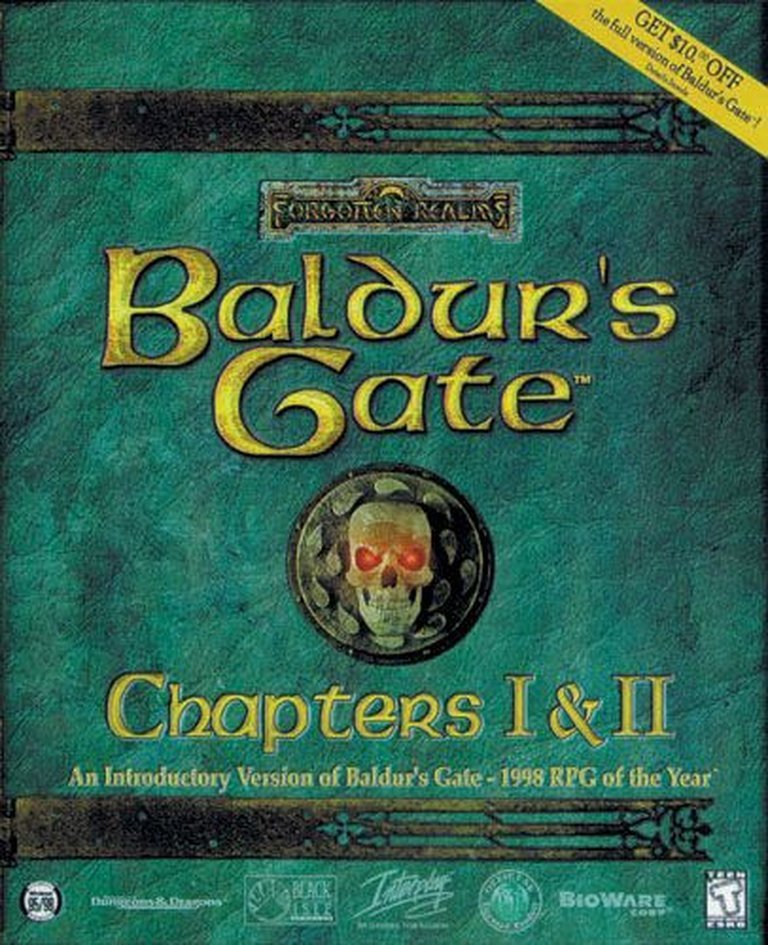
Description
Baldur’s Gate Chapters I & II is a partial release of the seminal 1998 role-playing game developed by BioWare, offering only the first two chapters of the full adventure. Based on Advanced Dungeons & Dragons 2nd Edition rules, players create a custom protagonist who explores the Forgotten Realms’ Sword Coast alongside recruitable companions. Through its iconic Infinity Engine, the game blends real-time with pause combat, party management, and intricate quests against the backdrop of a high-fantasy narrative. This version provides an introductory experience to the robust CRPG that revitalized the genre, featuring isometric visuals, rich dialogue, and tactical gameplay within a licensed Dungeons & Dragons setting.
Baldur’s Gate Chapters I & II Cracks & Fixes
Baldur’s Gate Chapters I & II Patches & Updates
Baldur’s Gate Chapters I & II Mods
Baldur’s Gate Chapters I & II Guides & Walkthroughs
Baldur’s Gate Chapters I & II Reviews & Reception
gamefaqs.gamespot.com (90/100): Baldur’s gate is a very great game to play. A must be for the rpg fans that are out there.
mobygames.com (74/100): We don’t have any critic reviews for Windows.
vgtimes.com (55/100): Baldur’s Gate Chapters 1 & 2 is an isometric role-playing game with a dash of fantasy from the masters at BioWare Corporation.
Baldur’s Gate Chapters I & II Cheats & Codes
PC
Enable cheat mode by adding ‘Cheats=1’ under [Game Options] in Baldur.ini. In-game, press Ctrl+Tab to open the console. For cheat keys, first enable via ‘CLUAConsole:EnableCheatKeys()’.
| Code | Effect |
|---|---|
| Cheats:Midas(); | Add 500 gold to inventory |
| Cheats:CriticalItems(); | Obtain all main quest items |
| Cheats:DrizztDefends(); | Spawns friendly Drizzt |
| Cheats:DrizztAttacks(); | Spawns hostile Drizzt |
| Cheats:TheGreatGonzo(); | Summon 10 friendly berserk chickens |
| Cheats:CowKill(); | Creates Cow Kill spell if a cow is nearby |
| Cheats:FirstAid(); | Adds Scroll Of Stone To Flesh, 5 Potions Of Healing, and 5 Antidotes |
| Cheats:Hans(); | Teleports party to an open location if stuck |
| Cheats:ExploreArea(); | Fully reveals current map |
| CLUAConsole:SetCurrentXP(“[number]”) | Sets XP of selected character to specified number |
| CLUAConsole:CreateCreature(“[name]”) | Spawns specified NPC or creature (e.g., ‘Drizzt’, ‘Angelo’) |
| CLUAConsole:CreateItem(“[item]”) | Creates specified item (e.g., ‘AMUL01’ for Necklace of Missiles) |
| CLUAConsole:AddGold(“[number]”) | Adds specified gold amount |
| CLUAConsole:EnableCheatKeys() | Enables cheat key combinations below |
| Ctrl+J | Teleport to cursor location |
| Ctrl+Y | Kills targeted creature |
| Ctrl+R | Fully heals targeted creature |
Baldur’s Gate Chapters I & II: Review
Baldur’s Gate Chapters I & II, released in 1999, is a seminal work in the realm of role-playing video games. Developed by BioWare and published by Interplay Productions, this game is a truncated version of the original Baldur’s Gate, containing only the first two chapters of the full game. Despite its abbreviated nature, it offers a rich and immersive experience that has left an indelible mark on the genre. This review will delve into the development history, narrative, gameplay mechanics, world-building, and the enduring legacy of Baldur’s Gate Chapters I & II.
Development History & Context
Studio and Creators’ Vision
BioWare, a Canadian game developer, was founded in 1995 by Ray Muzyka, Greg Zeschuk, Trent Oster, his brother Brent, Zeschuk’s cousin Marcel, and Augustine Yip. The studio’s vision was to create a game that combined deep storytelling with innovative gameplay mechanics. Baldur’s Gate was their first major project, and it was clear from the outset that they aimed to push the boundaries of what role-playing games could achieve.
Technological Constraints of the Era
The game was developed using the Infinity Engine, a proprietary engine created by BioWare. This engine allowed for pre-rendered isometric graphics, which were cutting-edge at the time. The use of Lua as the primary scripting language enabled complex interactions and dynamic gameplay. The technological constraints of the era meant that the game had to be optimized for the hardware available at the time, leading to a focus on efficient coding and resource management.
Gaming Landscape
The late 1990s saw a resurgence of interest in role-playing games, with titles like Diablo and Ultima series paving the way. Baldur’s Gate stood out by offering a more traditional RPG experience, with a focus on storytelling, character development, and strategic combat. The game’s use of the Advanced Dungeons & Dragons (AD&D) 2nd edition rules provided a familiar framework for fans of the tabletop game, while its innovative mechanics and engaging narrative set it apart from other titles in the genre.
Narrative & Thematic Deep Dive
Plot
Baldur’s Gate Chapters I & II follows the journey of Gorion’s Ward, a young orphan raised in the fortified library-monastery of Candlekeep. After a mysterious armored figure kills Gorion, the protagonist embarks on a quest to uncover the truth behind his foster father’s murder and the iron crisis plaguing the region. The story is rich with political intrigue, moral dilemmas, and epic battles, all set against the backdrop of the Sword Coast.
Characters
The game features a diverse cast of characters, each with their own unique personalities and backstories. From the loyal and naive Imoen to the enigmatic and powerful Sarevok, the characters in Baldur’s Gate are memorable and well-developed. The player’s choices throughout the game can significantly impact the story and the relationships between characters, adding a layer of depth and replayability.
Dialogue and Themes
The dialogue in Baldur’s Gate is extensive and context-dependent, allowing for a high degree of player agency. The game explores themes of identity, destiny, and the consequences of one’s actions. The narrative is deeply rooted in the Forgotten Realms lore, but it also stands on its own as a compelling story.
Gameplay Mechanics & Systems
Core Gameplay Loops
Baldur’s Gate Chapters I & II features a real-time combat system with a pausable option, allowing players to strategize and issue commands to their party members. The game’s user interface is intuitive, with action bars surrounding the main screen for easy access to character stats, inventories, and spells. The inventory system is robust, with weight limits and equipment restrictions based on character class and strength.
Combat
Combat in Baldur’s Gate is tactical and engaging. Players can control up to six party members, each with their own unique abilities and skills. The pausable real-time system allows for precise control over the action, making battles both challenging and rewarding. The game’s AI is sophisticated, with enemies that react realistically to the player’s actions.
Character Progression
Character progression is a key aspect of the game. Players can create their own character or import one from a previous playthrough. The game features a deep and complex character progression system, with multiple classes, races, and alignments to choose from. As characters gain experience and level up, they can acquire new abilities, spells, and equipment, allowing for a high degree of customization.
UI and Innovative Systems
The game’s user interface is well-designed, with a focus on usability and accessibility. The inventory system, for example, is intuitive and easy to navigate, with clear indicators of weight limits and equipment restrictions. The game also features a reputation system, which tracks the player’s moral actions and affects how they are perceived by other characters in the game.
World-Building, Art & Sound
Setting and Atmosphere
Baldur’s Gate is set in the Sword Coast region of the Forgotten Realms, a high fantasy campaign setting. The game’s world is vast and immersive, with a diverse range of environments, from bustling cities to treacherous dungeons. The art direction is consistent with the Forgotten Realms lore, with detailed and evocative backgrounds and character designs.
Visual Direction
The game’s visuals are impressive for the time, with pre-rendered isometric graphics that create a sense of depth and immersion. The character sprites are well-designed, with a high degree of detail and animation. The game’s use of color and lighting is effective, creating a mood that ranges from dark and foreboding to bright and hopeful.
Sound Design
The sound design in Baldur’s Gate is top-notch, with a memorable soundtrack and high-quality voice acting. The game’s use of sound effects is subtle but effective, enhancing the immersion and atmosphere. The voice acting is particularly noteworthy, with performances that bring the characters to life and add depth to the narrative.
Reception & Legacy
Critical and Commercial Reception
Baldur’s Gate Chapters I & II received critical acclaim upon its release, with praise for its deep storytelling, complex characters, and innovative gameplay mechanics. The game won numerous awards, including the Origins Award for Best Role Playing Game Computer Game of 1998. Commercially, the game was a success, selling over 2 million copies by 2008.
Influence on Subsequent Games and the Industry
Baldur’s Gate Chapters I & II had a significant impact on the role-playing game genre. Its use of pausable real-time combat, deep character progression, and immersive world-building set a new standard for RPGs. The game’s success revitalized the genre, inspiring a new wave of RPGs that focused on storytelling and player agency. Its influence can still be seen in modern RPGs, with many games citing Baldur’s Gate as a major inspiration.
Conclusion
Baldur’s Gate Chapters I & II is a masterpiece of role-playing game design. Its rich narrative, complex characters, and innovative gameplay mechanics make it a standout title in the genre. The game’s enduring legacy is a testament to its quality and impact, and it continues to be celebrated by fans and critics alike. Whether you’re a veteran RPG player or a newcomer to the genre, Baldur’s Gate Chapters I & II is a must-play experience. Its place in video game history is secure, and its influence can still be felt in the games of today.