
- Release Year: 2012
- Platforms: Android, iPad, iPhone, Linux, Macintosh, Windows
- Publisher: Beamdog
- Developer: Overhaul Games
- Genre: RPG
- Perspective: Isometric
- Game Mode: Online Co-op, Single-player
- Gameplay: Arena combat, Character Creation, Downloadable content, Modding, NPC interaction
- Setting: Fantasy, Underdark
- Average Score: 85/100
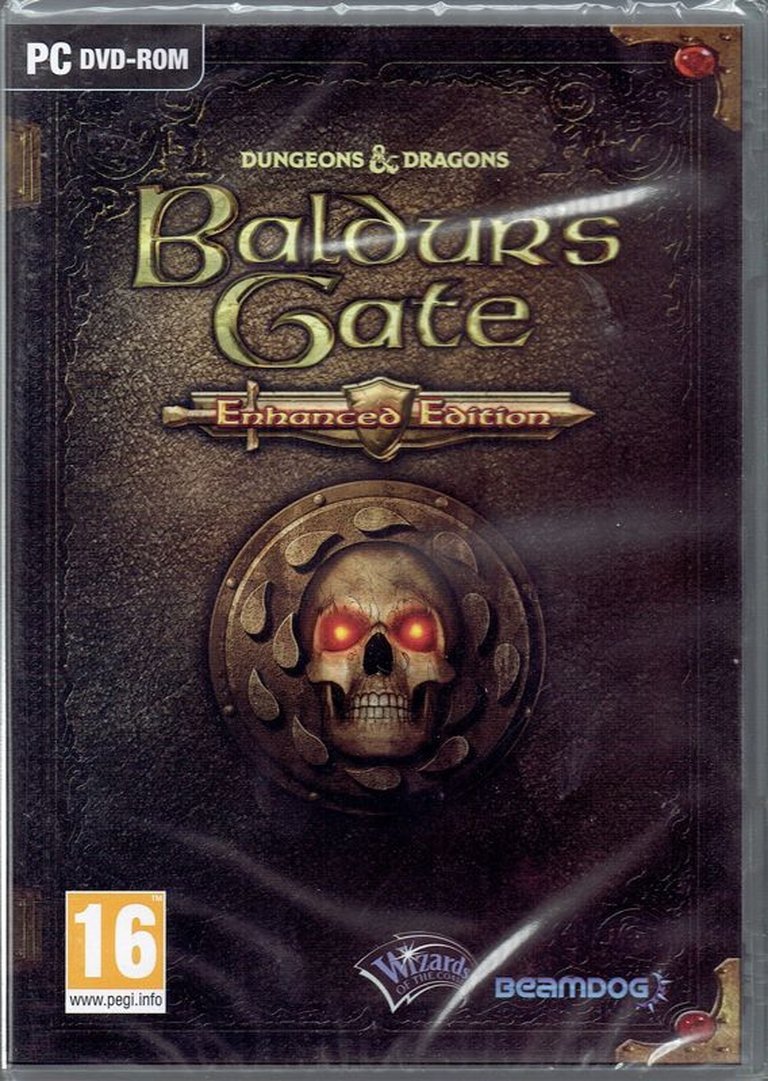
Description
Baldur’s Gate: Enhanced Edition is a remastered classic RPG that combines the original Baldur’s Gate and its expansion Tales of the Sword Coast, set in the fantasy realm of the Forgotten Realms. It features cross-platform multiplayer, enhanced visuals, new party members like Neera and Rasaad, the arena-based Black Pits adventure, and improvements from the sequel including new classes and kits. Players navigate a rich narrative of battles, choices, and exploration in the Underdark while experiencing over 400 upgrades to the original experience.
Gameplay Videos
Where to Buy Baldur’s Gate: Enhanced Edition
Baldur’s Gate: Enhanced Edition Free Download
Baldur’s Gate: Enhanced Edition Cracks & Fixes
Baldur’s Gate: Enhanced Edition Mods
Baldur’s Gate: Enhanced Edition Guides & Walkthroughs
Baldur’s Gate: Enhanced Edition Reviews & Reception
metacritic.com (78/100): A solid re-release of a classic plus some nice new frills, but not without its problems.
ign.com : This is still the Baldur’s Gate I knew and loved
howlongtobeat.com : Highly recommended, but not for everybody.
Baldur’s Gate: Enhanced Edition Cheats & Codes
PC
Enable Debug Mode by editing the `baldur.ini` file located in `Documents/Baldur’s Gate – Enhanced Edition`. Add the line `’Program Options’,’Debug Mode’,’1’`. In-game, press `CTRL+SPACE` to open the console. During character creation, press `CTRL+8` to max out stats.
| Code | Effect |
|---|---|
| C:CreateItem(‘SHLD20’) | Creates a specified item (e.g., Kiel’s Buckler) |
| Ctrl+Q | Unnamed cheat key |
| Ctrl+J | Unnamed cheat key |
| X | Show [x,y] coordinates of the mouse |
| CLUAConsole:ExploreArea() | Sets the current area to fully explored |
| CLUAConsole:SetCurrentXP(“[Number]”) | Assigns experience points to the selected character |
| CLUAConsole:AddGold(“[Number]”) | Adds gold to the party |
| CLUAConsole:CreateItem(“[Item name]”) | Creates a specified item in the leader’s inventory |
| CLUAConsole:CreateItem(“[item]”, [number]) | Creates a specified item with a set number of charges or stacks |
| CLUAConsole:CreateCreature(“[CRE FILE]”) | Spawns a specified creature |
| CLUAConsole:MoveToArea(“[Area Name]”) | Moves selected characters to a specified area |
Baldur’s Gate: Enhanced Edition: Review
Introduction
In the pantheon of computer role-playing games (CRPGs), Baldur’s Gate stands as a colossus. Its 1998 release revolutionized the genre with its deep storytelling, complex party dynamics, and masterful fusion of Dungeons & Dragons mechanics with real-time-with-pause combat. Yet, time can tarnish even the most brilliant legacies, leaving classics locked behind archaic interfaces and technical limitations. Enter Baldur’s Gate: Enhanced Edition (2012), a bold remaster by Overhaul Games (a division of Beamdog) that promised to reintroduce this masterpiece to a new generation while honoring its legacy. This review dissects the Enhanced Edition not merely as a technical update, but as a cultural artifact—a bridge between the golden age of CRPGs and the modern era. While it succeeds in making the game accessible and adding intriguing new layers, it also reveals the fragility of retro classics when subjected to contemporary expectations. The question remains: does this “enhancement” elevate the original, or does it merely polish a diamond already perfectly cut?
Development History & Context
The genesis of Baldur’s Gate: Enhanced Edition is a story of ambition tempered by pragmatism. Developed by Overhaul Games—a studio founded by BioWare veterans including Trent Oster—the project emerged from a 14-month negotiation between Beamdog, Atari (the rights-holder), and Wizards of the Coast (D&D’s licensor). Beamdog secured the Infinity Engine license and leveraged their nostalgia-driven mandate to “revive the classic RPG” (Kotaku, 2012). The original Baldur’s Gate was a product of its time: built on BioWare’s innovative isometric Infinity Engine, it pushed the boundaries of 1998 hardware with its pre-rendered sprites and fluid, tactical combat.
The Enhanced Edition’s vision was radical yet constrained. Beamdog aimed to modernize without reinventing. Key goals included cross-platform play (PC, Mac, iOS, Android, Linux), higher resolutions, widescreen support, and the integration of Baldur’s Gate II’s class kits and subraces. New content was planned to justify the $20 price point, including the standalone arena adventure The Black Pits and four recruitable NPCs (Rasaad, Neera, Dorn, and later Baeloth). Developer Trent Oster famously quipped that the original Baldur’s Gate was “the perfect game for the touch interface—released a decade early,” highlighting the team’s dual mission: preserve the original’s soul while embracing contemporary platforms (Empire, 2012).
Technological hurdles abounded. Console versions (PS3, Xbox 360) were scrapped due to prohibitive UI redesign costs and controller incompatibility. Delays pushed the release from September to November 2012, attributed to localization across 16 languages and last-minute bug fixes. The result was a game that, while technically robust, bore the scars of compromise—a testament to the delicate act of resurrecting a beloved classic.
Narrative & Thematic Deep Dive
At its core, the Enhanced Edition retains the original Baldur’s Gate’s narrative masterpiece: the player’s journey as a Bhaalspawn—offspring of the murdered god of murder—unraveling a conspiracy to plunge the Sword Coast into war. The plot, a masterclass in political intrigue and moral ambiguity, remains intact. Sarevok’s rise as a charismatic, nihilistic villain, Gorion’s sacrifice, and the iron crisis’ true origins still resonate with power. The Enhanced Edition amplifies this with subtle refinements, such as expanded voice acting for NPCs like the haughty wizard Edwin Odesseiron, whose comic relief and unsettling complexity (including a gender-swap subplot) endure as one of gaming’s finest character arcs (MacCallum-Stewart, 2016).
New content enriches, yet occasionally disrupts, the original’s tapestry. The Black Pits, a gladiatorial arena in the Underdark, introduces Baeloth the Entertainer—a drow sorcerer—and his imprisoned fighters. Its “choose your party” structure echoes Icewind Dale, offering bite-sized combat challenges but little narrative weight. More substantial are the new companions:
– Rasaad yn Bashir: A monk grappling with his past, his questline explores themes of redemption and faith in Faerûn’s chaotic pantheon.
– Neera: A wild mage whose unpredictable magic and personal vendetta against a Red Wizard add levity and danger.
– Dorn II-Khan: A blackguard who subverts the “evil companion” trope, questioning the nature of tyranny.
These characters, penned by senior D&D writer Dave Gross, integrate seamlessly, offering new quests and areas that expand the Sword Coast’s lore. Yet, their inclusion highlights a thematic tension: the original’s focus on emergent storytelling—where player choices shaped relationships—clashes with the Enhanced Edition’s more scripted approach. As Eurogader noted (2012), the game’s “antiquated framework” demands patience, rewarding those who invest in its world-building while potentially alienating players accustomed to modern RPG hand-holding.
Gameplay Mechanics & Systems
The Enhanced Edition’s gameplay is a study in contrasts: its core mechanics remain timeless, but its modernization reveals both brilliance and brittleness. At its heart is the Infinity Engine’s pausable real-time combat, a system still revered for its tactical depth. Positioning, spell sequencing, and party synergy are paramount—whether facing gibberling hordes or a lich’s devastating spells. The Enhanced Edition preserves this while importing BGII innovations: five new class kits (e.g., Dwarven Defender, Sun Soul Monk), subraces, and a raised level cap, offering build diversity without breaking balance.
New features attempt to bridge the gap between past and present. Cross-platform multiplayer allows PC and iPad players to unite, a technical feat that fosters community. The Black Pits arena mode provides distilled combat challenges, rewarding strategic mastery. Two difficulty modes—Story Mode (ironically easy, with party immortality) and Legacy of Bhaal (a punishing, permadeath-inspired mode)—cater to diverse skill levels. The revamped UI, with resizable text and a journal overlay, improves clarity, though pathfinding glitches persist—a relic of the original’s AI that frustrates even veterans (MobyGames player review, 2023).
Yet, the Enhanced Edition stumbles in execution. Inventory management remains clunky; selecting a full party defaults the leader to loot pickup, forcing manual character toggling. Movement speed feels glacial until haste spells are acquired, and late-game gold bloat (players can accumulate 100,000+ gold) highlights the XP cap’s failure to scale rewards. As one critic lamented, the game “punishes dabblers” (Touch Arcade, 2013), demanding a commitment few modern titles require. These flaws underscore a deeper truth: Baldur’s Gate’s brilliance lies in its systems, not its user-friendliness.
World-Building, Art & Sound
The Enhanced Edition excels in translating Baldur’s Gate’s atmospheric world into a modern medium. The Forgotten Realms remains a character unto itself: the cobblestone streets of Baldur’s Gate, the shadowed forests of Nashkel, and the gothic spires of Candlekeep are rendered with hand-drawn charm. Nat Jones’ new cinematics replace the original’s CGI, trading digital polish for a painterly warmth that evokes classic fantasy art. Higher resolutions and widescreen support breathe life into environments, though purists may mourn the loss of the original’s pixelated grit.
Sound design fares better. Inon Zur’s original score is augmented by Sam Hulick’s ethereal additions, underscoring moments of tension and tranquility. Voice acting—particularly for returning NPCs like Jaheira and Minsc—brings Banter, jokes, and pathos to life. Minsc’s rallying cry, “Go for the eyes, Boo!” transcends meme status, embodying the game’s blend of humor and heroism. The mobile version’s touch controls and zoom gestures are ingenious, allowing players to “playbook” combat as Trent Oster envisioned, though touchscreen precision can falter in cramped spaces. Ultimately, the Enhanced Edition’s art and sound honor the original’s spirit: a world that feels lived-in, dangerous, and endlessly explorable.
Reception & Legacy
The Enhanced Edition’s reception mirrors its dual nature: a critical darling for its preservation, a lightning rod for its compromises. On Metacritic, it scored 78/100 (PC) and 73/100 (iOS), with praise for its “truly enhanced” presentation (Shacknews, 2012) and “worthwhile content” (IGN, 2012). Critics lauded cross-platform support and the new NPCs, yet noted lingering bugs and a steep learning curve. GameBanshee typified the dissent, arguing that the original—with its free modding community—remained superior, calling the Enhanced Edition “a compilation of mods sold at a premium.”
Commercially, the game thrived, selling over a million copies by 2015 (Edmonton Journal, 2015). Its legacy extends far beyond sales: it revitalized demand for classic CRPGs, prompting Enhanced Editions of BGII, Icewind Dale, and Planescape: Torment. Beamdog’s follow-up, Siege of Dragonspear (2016), added 30 hours of content, bridging BG and BGII—though its divisive writing sparked debate. Most significantly, the project’s success paved the way for Larian Studios’ Baldur’s Gate 3 (2023), which inherited the Enhanced Edition’s torch of blending D&D mechanics with cinematic storytelling. As PC Gamer noted (2019), the Enhanced Edition “proved that old games could find new audiences,” ensuring the Bhaalspawn saga’s legacy endured.
Conclusion
Baldur’s Gate: Enhanced Edition is a paradox: a game both greater and lesser than its progenitor. It succeeds brilliantly as a gateway, introducing new players to a genre-defining masterpiece with modern amenities and fresh content. Rasaad’s redemption, Neera’s chaos, and the Black Pits’ gladiatorial thrills enrich the original’s tapestry without defiling it. Yet, its flaws—pathfinding woes, inventory quirks, and a price point that felt steep to veterans—remind us that some classics resist easy modernization.
Verdict: The Enhanced Edition is indispensable. For newcomers, it is the definitive way to experience Baldur’s Gate’s unparalleled storytelling and tactical depth. For veterans, it is a convenient, if imperfect, return to the Sword Coast. In the end, its true legacy lies not in what it changed, but in what it preserved: the magic of a world where every choice, every spell, every conversation with Minsc and Boo feels like the beginning of a legend. As the game itself might say: “It is a tale told by an idiot, full of sound and fury, signifying everything.” And in this Enhanced Edition, that fury burns brighter than ever.