
- Release Year: 2002
- Platforms: Windows
- Publisher: Archgames Inc.
- Developer: Archgames Inc.
- Genre: Action, Arcade
- Perspective: Top-down
- Game Mode: Single-player
- Gameplay: Brick destruction, Level rotation, Moving units, Power-ups
- Setting: Abstract
- Average Score: 80/100
Description
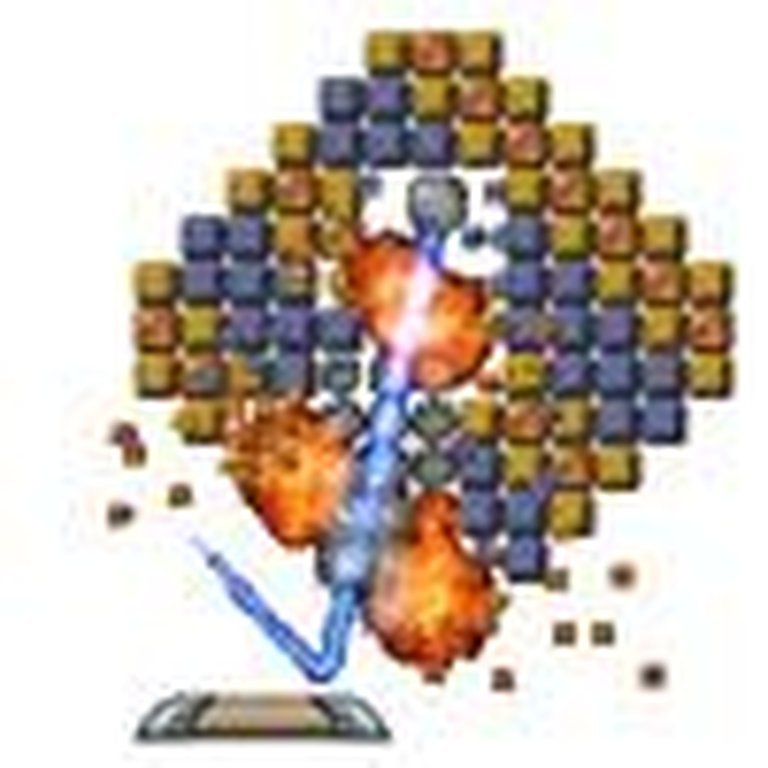
Ball Attack is a fresh take on the classic Arkanoid/Breakout genre, blending fast-paced brick-breaking action with innovative mechanics. Players navigate through dynamic levels filled with hundreds of bricks, moving obstacles, and rotating layouts, all while utilizing a variety of unique power-ups and weapons to clear massive clusters in seconds. The game stands out with its 16-bit graphics, translucency effects, and particle systems, delivering vivid visuals that complement its challenging and inventive gameplay. With a mix of agility and strategy, Ball Attack offers a revitalized experience for fans of the brick-breaker genre.
Ball Attack Free Download
PC
Ball Attack Reviews & Reception
mobygames.com (80/100): A number of unique elements that never before appeared in such games give Ball Attack absolutely fresh look and feel.
retro-replay.com : Ball Attack takes the classic Arkanoid/Breakout formula and injects it with a thrilling dose of creativity.
Ball Attack Cheats & Codes
PC
Enter one of the following codes during game play to activate the corresponding cheat function. Note: You must re-enter the code during every level to have it available in that level.
| Code | Effect |
|---|---|
| [F3] | Big ball |
| [F4] | Big paddle |
Ball Attack: A Deep Dive into the Arkanoid/Breakout Renaissance
Introduction: The Legacy of a Forgotten Gem
In the vast pantheon of video game history, few genres have endured as persistently—or as quietly—as the Arkanoid/Breakout clone. Born from Atari’s Breakout (1976) and refined by Taito’s Arkanoid (1986), the “ball-and-bricks” formula became a staple of arcade cabinets, home computers, and eventually, digital distribution. Yet, by the early 2000s, the genre had largely faded into obscurity, overshadowed by the rise of 3D graphics, first-person shooters, and open-world epics.
Enter Ball Attack (2002), a title that dared to breathe new life into a dying breed. Developed by the obscure Russian studio Archgames Inc., this Windows-exclusive arcade game didn’t just iterate on the Breakout formula—it reinvented it. With its relentless pace, inventive power-ups, and dynamic level designs, Ball Attack stood as a defiant testament to the enduring appeal of simple, skill-based gameplay in an era increasingly dominated by complexity.
This review seeks to unpack Ball Attack’s place in gaming history, dissecting its mechanics, aesthetics, and legacy. Was it a fleeting curiosity, or a hidden masterpiece? And why, despite its critical acclaim, did it fade into obscurity? To answer these questions, we must first understand the world that birthed it.
Development History & Context: A Russian Revival in the Post-Arcade Era
The Studio: Archgames Inc. – A Mystery Wrapped in Pixels
Little is known about Archgames Inc., the Moscow-based developer behind Ball Attack. The studio’s digital footprint is minimal, with only a handful of titles to its name, including Deadhunt (a first-person shooter) and Star Fighters (a space combat game). What is clear, however, is that Ball Attack was a passion project—a labor of love from a small team determined to push the boundaries of a genre that had long been dismissed as “retro” or “casual.”
The core team consisted of:
– Igor Garanin (Programming, Level Design)
– Eugene Petukhov (Design, Graphics, Sound Effects)
– Eugene Kuzmin & Vitaly Kozlov (Additional Level Design)
Their collective vision? To create an Arkanoid game that wasn’t just more of the same, but a reimagining—one that retained the core appeal of brick-breaking while introducing mechanics that demanded both reflexes and strategy.
The Gaming Landscape of 2002: A Genre on Life Support
By the time Ball Attack launched on November 30, 2002, the Breakout clone was a relic of a bygone era. The late ’90s and early 2000s were dominated by:
– 3D platformers (Super Mario 64, Crash Bandicoot)
– First-person shooters (Half-Life, Halo: Combat Evolved)
– Open-world sandboxes (Grand Theft Auto III)
– Real-time strategy (Warcraft III, Age of Empires II)
The arcade-style “ball-and-paddle” game had no place in this new world—or so it seemed. Yet, Ball Attack arrived at a curious juncture:
– The indie revolution was still years away (2002 predated Braid, Super Meat Boy, and the Steam Greenlight era).
– Digital distribution was in its infancy (Steam launched in 2003; Ball Attack was a download-only title).
– Nostalgia gaming wasn’t yet a market force (retro revivals like Shovel Knight and Stardew Valley were over a decade away).
In this environment, Ball Attack was an anomaly—a game that refused to conform to trends, instead doubling down on pure, unadulterated arcade action.
Technological Constraints & Innovations
Developed for Windows 98/ME/XP, Ball Attack was built with the limitations of early-2000s PC hardware in mind:
– 16-bit graphics with translucency effects (a rarity for Breakout clones at the time).
– A particle system for explosive brick-destruction effects.
– Dynamic level transformations (rotating stages, moving obstacles).
Yet, despite these technical flourishes, the game’s visuals were deliberately minimalist—a choice that would later divide critics. As GameXtazy noted in 2006:
“Ball Attack’s one downside is its graphics, which are crisp and professional, but draw from a limited number of colors and lack attractive backgrounds.”
This aesthetic decision wasn’t laziness—it was philosophical. Ball Attack prioritized gameplay clarity over visual spectacle, ensuring that the player’s focus remained on the ball, paddle, and bricks—nothing more.
Narrative & Thematic Deep Dive: The Art of Minimalist Storytelling
Plot? What Plot?
Ball Attack has no story. No cutscenes, no dialogue, no lore. You are a paddle. There is a ball. There are bricks. Destroy them all.
In an era where games like Metal Gear Solid 2 and Final Fantasy X were pushing cinematic storytelling, Ball Attack’s refusal to engage in narrative was radical. It was a game that trusted the player to find meaning in pure interaction—a philosophy reminiscent of Tetris or Pac-Man.
Themes: Destruction as Catharsis
While Ball Attack lacks explicit themes, its gameplay loop speaks volumes:
– Repetition as meditation – The rhythmic back-and-forth of the paddle, the hypnotic trajectory of the ball.
– Controlled chaos – The satisfaction of clearing hundreds of bricks in minutes, only to face an even greater challenge.
– Power fantasy – The game’s over-the-top power-ups (more on these later) turn the player into an agent of mass destruction.
In this sense, Ball Attack is a metaphor for mastery—a game that rewards precision, patience, and adaptability in equal measure.
Gameplay Mechanics & Systems: Deconstructing the Breakout Formula
Core Gameplay Loop: Familiar, Yet Fresh
At its heart, Ball Attack follows the Breakout template:
1. Bounce a ball with a paddle.
2. Destroy bricks by hitting them.
3. Avoid losing the ball (lives are limited).
4. Clear the level to progress.
But where Ball Attack innovates is in its execution:
– Hundreds of bricks per level (unlike Arkanoid’s sparse layouts).
– Moving obstacles that force the player to adapt mid-level.
– Rotating stages that defy spatial logic (imagine playing Breakout on a merry-go-round).
Power-Ups: From Helpful to Game-Breaking
Ball Attack’s 25+ power-ups are where the game truly shines. Unlike Arkanoid’s predictable buffs (longer paddle, multi-ball), Ball Attack introduces chaotic, unpredictable modifiers:
– Bonus Generator – Spawns additional power-ups mid-level.
– Penalty Items – Temporary debuffs (shrinking paddle, slower ball).
– “Turn the whole massive of bricks to dust” – A screen-clearing nuke that rewards risk-taking.
This risk-reward system ensures that no two playthroughs are alike. Do you play it safe, or gamble on a high-risk power-up that could either save your run or doom you instantly?
Level Design: A Masterclass in Pacing
With over 180 levels (including expansions), Ball Attack avoids the repetition pitfall that plagues many Breakout clones. The game’s stages are divided into three difficulty modes, each introducing new mechanics:
– Easy – Standard brick layouts, minimal movement.
– Normal – Introduces moving obstacles and rotating stages.
– Hard – Brutal speed, unpredictable brick patterns, and limited power-ups.
The progression curve is steep but fair—a testament to the designers’ understanding of arcade difficulty.
Flaws: The Price of Innovation
While Ball Attack excels in mechanical depth, it stumbles in accessibility:
– No tutorial – New players are thrown into the fray with no guidance.
– Unforgiving difficulty spikes – Some levels feel designed for masochists.
– Limited visual feedback – The minimalist art style sometimes makes it hard to distinguish power-ups mid-game.
These issues don’t ruin the experience, but they limit the game’s appeal to hardcore arcade fans.
World-Building, Art & Sound: The Aesthetics of Destruction
Visual Design: Functional Minimalism
Ball Attack’s 16-bit graphics are deliberately sparse:
– No elaborate backgrounds (just gradients or simple patterns).
– Bricks are small but numerous, creating a dense, overwhelming visual field.
– Translucency effects make power-ups pop against the chaos.
This less-is-more approach ensures that the gameplay remains the star. However, it also makes the game feel dated compared to contemporaries like Cave Story (2004) or Ikaruga (2001).
Sound Design: The Rhythm of Destruction
Eugene Petukhov’s sound effects are simple but effective:
– Ball bounces have a satisfying “click” (reminiscent of Pong).
– Brick destruction is accompanied by a crunchy, explosive sound.
– Power-up activation triggers a distinctive “ding” (a Pavlovian reward for the player).
The lack of music is a bold choice—one that heightens focus but may leave some players wanting more.
Reception & Legacy: A Cult Classic in the Making?
Critical Reception: Praise from the Niche
Ball Attack received two professional reviews, both scoring it 80%:
– GameXtazy (2006) – “If you’ve grown tired of Breakout games, Ball Attack just might revive your passion.”
– Game Tunnel (2003) – “Any Arkanoid die-hard will really enjoy Ball Attack… a hallmark in the genre.”
Players, however, were more divided, giving it a 3.1/5 on MobyGames. The chief complaints?
– “Too hard for casual players.”
– “Graphics feel outdated.”
– “Lacks the polish of modern arcade games.”
Yet, for those who stuck with it, Ball Attack was addictive—a hidden gem in the sea of early-2000s shareware.
Legacy: The Last Great Breakout Clone?
Ball Attack arrived at the tail end of the Breakout revival:
– Before it (1990s): Arkanoid clones (DX-Ball, Breakout 2000).
– After it (2010s+): Indie revivals (Peggle, Lumines).
In many ways, Ball Attack was the final evolution of the classic formula before the genre faded into obscurity. Its influence can be seen in:
– Modern “bullet heaven” games (Geometry Wars) – Which share Ball Attack’s chaotic, high-score-chasing DNA.
– Roguelike brick-breakers (Brick Breaker Hero) – Which borrow its procedural level design ideas.
Yet, unlike Tetris or Pac-Man, Ball Attack never achieved mainstream recognition. It remains a cult favorite—a game that true arcade enthusiasts cherish, but that most gamers have never heard of.
Conclusion: A Masterpiece of Its Kind, Lost to Time
Ball Attack is not a perfect game. Its steep difficulty, minimalist presentation, and lack of modern polish will turn away many players. But for those who embrace its chaos, it offers one of the most satisfying Breakout experiences ever made.
In an era where games were bigger, louder, and more cinematic, Ball Attack dared to be small, focused, and pure. It didn’t need a story. It didn’t need 3D graphics. It didn’t even need music. All it needed was a ball, a paddle, and a player willing to rise to the challenge.
Final Verdict: 8.5/10 – A Flawed but Brilliant Swansong for the Breakout Genre
Ball Attack may not have changed gaming history, but it perfected a formula that had been stagnant for decades. For that alone, it deserves to be remembered, revisited, and celebrated.
Where to Play Today?
– Archive.org (Free shareware version: Ball Attack 1.09)
– Abandonware sites (Full version may require hunting)
If you’ve ever loved Breakout, Arkanoid, or pure, unfiltered arcade action, do yourself a favor—give Ball Attack a shot. You might just find that the best games don’t need stories. Sometimes, all they need is a ball, a wall, and the will to destroy.