
- Release Year: 2024
- Platforms: Nintendo Switch, PlayStation 4, PlayStation 5, Windows, Xbox One, Xbox Series
- Publisher: Outright Games Ltd.
- Developer: Casual Brothers Ltd., Xaloc Studios S.L.
- Genre: Action
- Perspective: 3rd-person
- Game Mode: Co-op
- Gameplay: Mini-games, Puzzle elements
- Average Score: 80/100
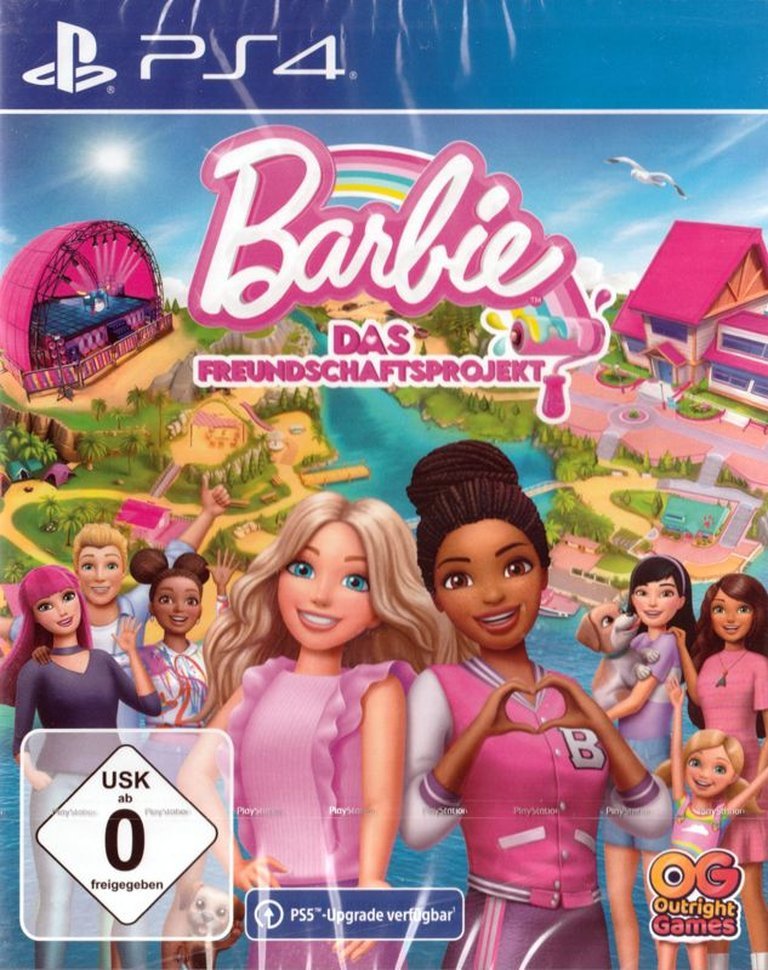
Description
Barbie: Project Friendship is an action-oriented game designed for young children, where players join Barbie in a heartwarming project to restore and foster friendships through a variety of mini-games and puzzle challenges. Set in bright, interactive environments, the game supports single-player or cooperative split-screen play for up to two players, emphasizing feel-good activities and teamwork across platforms like Windows, PlayStation, Xbox, and Nintendo Switch.
Gameplay Videos
Where to Buy Barbie: Project Friendship
PC
Barbie: Project Friendship Guides & Walkthroughs
Barbie: Project Friendship Reviews & Reception
metacritic.com (80/100): Barbie Project Friendship is an excellent example of a game for kids: it’s well-presented, engaging to play and offers a wealth of activities to complete.
roundtablecoop.com : Overall, Barbie Project Friendship is a fun and engaging adventure game for younger gamers.
parentingpatch.com : The sentiment among parents is very positive about Barbie: Project Friendship.
moviesgamesandtech.com : Barbie Project Friendship is sickly sweet.
Barbie: Project Friendship Cheats & Codes
Nintendo Switch
| Code | Effect |
|---|---|
| 0451 | Unlocks or activates the ice cream machine |
Barbie: Project Friendship: Review – A Glamorous, Heartfelt Footnote in Gaming’s Most Iconic Franchise
Introduction: More Than Just a Dollhouse
In the sprawling, often contradictory, and frequently misunderstood history of licensed video games, few franchises carry as much cultural weight—and as many preconceived notions—as Barbie. From the infamous 1991 NES title derided for its clunky controls to the surprisingly sophisticated 1996 Barbie Fashion Designer that subtly introduced a generation to the PC, the Barbie game lineage is a fascinating microcosm of the industry’s relationship with “girls’ games.” Against this backdrop, and coinciding with the 65th anniversary of the doll and the cultural zenith of the Barbie film, arrives Barbie: Project Friendship. Developed by Xaloc Studios S.L. and Casual Brothers Ltd., and published by the family-game specialist Outright Games, this 2024 multi-platform release is not a radical reinvention. Instead, it is a deliberate, polished, and earnest crystallization of modern,values-driven children’s entertainment. This review argues that Barbie: Project Friendship is a significant, if modest, milestone: it represents the successful translation of Barbie’s core ethos—creativity, friendship, and limitless possibility—into a competent, contemporary co-op adventure, setting a new benchmark for what a licensed “toyetic” game can be in the 2020s. It is less a landmark and more a perfectly executed blueprint.
Development History & Context: Building on a Legacy of Learning
The development of Barbie: Project Friendship is a story of strategic partnership and learned experience. The publisher, Outright Games, has built a reputation on licensed family titles (Teenage Mutant Ninja Turtles: Mutants Unleashed, Bratz: Flaunt Your Fashion), understanding that success lies in accessibility and charm over complexity. Here, they collaborated with two studios: Xaloc Studios S.L., a Spanish developer with a portfolio including Barbie Horse Trails (2025) and Monster High: Skulltimate Secrets, and Casual Brothers Ltd., suggesting a split in development focus, possibly between core adventure and mini-game systems.
The game’s context is twofold. First, it follows a decade-plus drought of major Barbie console games, the last being the 2015 Barbie and Her Sisters: Puppy Rescue. The intervening years saw Barbie’s digital presence largely on mobile and web platforms (like the now-sunset BarbieGirls.com), making this a return to living rooms and handhelds. Second, and more importantly, it emerges in the shadow of Greta Gerwig’s 2023 film, which revitalized the brand’s cultural relevance and explicitly tied Barbie’s identity to empowerment and community. The developers, led by Lead Producer Ester Zanón Fernández, were acutely aware of this. As stated in the ComingSoon interview, the goal was “variety” and a “balance narrative with minigames and activities,” moving beyond the simple platformers or dress-up apps of yesteryear.
Technologically, the game runs on the Unity engine—a workhorse for accessible, cross-platform development. This choice reflects the need to deploy seamlessly across Nintendo Switch, PlayStation 4/5, Xbox One/Series, and PC (Steam/Microsoft Store) without demanding cutting-edge hardware. The visual style directly mimics the “world” established by the Barbie Dreamhouse Adventures and Barbie A Touch of Magic Netflix series, a sleek, bright, CGI-animated aesthetic. This was no accident; the game was “created with the support of television series head writer Ann Austin” and features the “original English voice cast from the series.” This deep integration with the canonical TV world was crucial for legitimacy with the target audience and marks a maturation of licensed game development, where transmedia synergy is paramount.
Narrative & Thematic Deep Dive: Saving Malibu Waves, One Smile at a Time
The plot of Barbie: Project Friendship is a masterclass in straightforward, goal-oriented storytelling designed for a young audience. The MacGuffin is the Malibu Waves Community Center, a beloved local hub that has fallen into disrepair and faces permanent closure. The conflict is not a villain but entropy and neglect. Protagonists are the dual Barbies—Barbie “Malibu” Roberts and Barbie “Brooklyn” Roberts—who galvanize their extensive friend and family network (Ken, Teresa, Nikki, Skipper, Stacie, Chelsea, and Daisy) into action.
The narrative is delivered through a mix of in-engine cutscenes, extensive text-message-style dialogue, and simple character interactions. Reviews noted “lengthy dialogue sections” that can test the patience of adults but serve a vital function for children: they clearly, repetitively, and kindly state objectives, reinforce the theme of teamwork, and model positive social communication. There is no ambiguity, no moral grey area. The story’s progression is tied directly to the restoration of six specific zones: the Pet Salon, Campsite, Crafting Studio, Tech Lab, Skate Park, and Amphitheatre. Each transformation is a discrete narrative beat, providing a constant sense of accomplishment.
Thematically, the game is a concentrated dose of Barbie’s modern brand identity. Community is the central pillar. As Producer Ester Zanón stated, the collaborative spirit of “working together… on restoring a cultural place for the surrounding community” was “crucial.” This isn’t just about fixing things; it’s about civic responsibility and collective joy. Creativity is equally emphasized, not as a vague concept but as a tangible gameplay loop: unlocking outfits, decorating spaces, and choosing how to tackle each mini-game. Friendship is operationalized through the mandatory or optional two-player local co-op, which the developers called “crucial” for the experience. The message is explicit and uncynical: problems are solved, and joy is multiplied, through teamwork. This thematic clarity is both its greatest strength for its audience and the source of its perceived “sickly sweet” nature for older critics.
Gameplay Mechanics & Systems: A Salad of Mini-Games with a Co-Op Dressing
Gameplay in Barbie: Project Friendship is structured as a loosely connected hub-world adventure. The player explores the isometric, diagonal-down view of the Malibu Waves Community Center grounds, accepting quests from NPCs that funnel into specific “activity zones.” The core loop is: Receive Task → Navigate to Zone → Complete Mini-Game/Objective → Earn “Community Points” & Rewards → Unlock Next Area/Upgrade.
The mini-game variety is the game’s most touted feature, and it delivers a wide, if shallow, spectrum:
* Simulation/Time Management: Making ice cream with Ken (evoking Overcooked’s frantic coordination), caring for pets at the salon.
* Rhythm/Action: A guitar-based performance mini-game with “Fortnite Festival vibes.”
* Sports: A tennis minigame compared to Mario Party’s Swing Kings.
* Customization/Vehicle: Scooter customization with Nikki, skateboarding challenges.
* Puzzle/Fetch Quests: Repairing bicycles, finding items, powering up equipment.
* Renovation/Decorating: Using points to paint walls, buy furniture, and transform the six spaces.
The progression system is twofold. “Community Points” are the primary currency, earned by completing tasks and used to purchase cosmetic unlocks (outfits for Barbie) and decorative upgrades for the center. This creates a satisfying, visible feedback loop where your actions directly beautify the world. Character progression is non-existent in a traditional RPG sense; power comes from familiarity with mini-game mechanics and the simple joy of completion.
The co-op system is the game’s defining mechanical feature. It is strictly local split-screen, a deliberate choice to encourage shared physical space play. In mini-games, tasks are often divided (one player serves ice cream, the other adds toppings) or made easier with a second pair of hands. This is not a complex synergy system but a direct reinforcement of the narrative theme: “You can do it alone, but it’s more fun together.” The AI partner for solo players was noted as functional but clearly designed as a placeholder for a human.
Flaws are intrinsically tied to its simplicity. The navigation can become tedious; the isometric perspective sometimes obscures paths, leading to aimless wandering as players search for NPCs or item spawn points. The lack of a sprint button, repeatedly cited by adult reviewers, makes traversal feel slow and passive. The tutorialization is thorough to a fault, with dialogue and instructions that cannot be skipped, a necessary evil for young players but a major pain point for anyone else. The UI/UX is clean and icon-driven, prioritizing clarity over style.
World-Building, Art & Sound: A Sun-Drenched, Plastic-Fantastic Paradise
The world of Barbie: Project Friendship is Malibu, California, rendered in a bright, saturated, cel-shaded style that perfectly matches the current Barbie TV series. The environment is a pastel dream: impossibly blue skies, pink and teal buildings, lush green lawns, and an ocean that shimmers with a single shade of turquoise. The art direction is 100% committed to the brand’s identity. There is no grit, no decay that isn’t instantly fixable with a coat of paint. The “rundown” community center is less a haunted ruin and more a project waiting for a fresh coat of “Malibu Pink.”
Character models are recognizable and expressive within the limited range of the style. They animate with energetic, sometimes exaggerated, movements that sell the “fun” mood. However, some critics noted a lack of polish—minor clipping, simplified textures, and repetitive animations (like the weary sigh before every task). This is a budget-conscious production, and while it never looks “bad,” it lacks the see-it-and-believe-it detail of top-tier children’s media like a Pixar film.
The sound design and voice acting are a divide. The voice cast is the genuine article from the TV show, lending crucial authenticity. The dialogue is bubbly and clear. The background music is an endless cascade of upbeat, acoustic-guitar-driven pop tracks that are undeniably cheerful. However, the repetition of vocal sound bites (the aforementioned sighs, cheers, and “Let’s go!”) was criticized as grating—“nails down a chalkboard,” in one review. This is a common pitfall in games with limited voice budgets; the intent is positive reinforcement, but the effect can be artificial and annoying to adult ears.
The atmosphere, therefore, is one of relentless, manufactured positivity. It is a safe, sunny, conflict-free space where every problem has a cheerful solution and every friend is eager to help. For its target audience, this is the entire point: a world without threats, where agency is always positive and friendly.
Reception & Legacy: A Clear Success in Its Lane, A Curiosity Outside It
Critically, Barbie: Project Friendship was received with qualified praise, reflected in its consistent 76% aggregate score on MobyGames. The consensus is remarkably uniform:
* Strengths: Exceptionally well-suited for its young target audience (ages 3-8, PEGI 3/ESRB E). Vibrant, faithful art style. Simple, intuitive controls. Wholesome, unambiguous themes of cooperation and creativity. The co-op mode is a highlight. No microtransactions or violent content—a major plus for parents.
* Weaknesses: Extremely repetitive and simplistic for anyone over 10. Slow pacing (due to dialogue and walk speed). Lack of depth or substantial replay value beyond collecting cosmetics. Some visual and audio polish issues. Fetch quest design is basic.
Commercially, specific sales figures are unavailable, but its simultaneous release on all major platforms (including a physical retail version) and continued presence suggest it met its modest commercial goals. Its true metric of success is likely engagement with its core demographic, a segment whose playtime is often not tracked by traditional metrics.
Its legacy within the Barbie game canon is one of confident execution. It stands in stark contrast to the janky platforming of Barbie Explorer (2001) or the niche PC focus of Barbie Fashion Designer (1996). It is the first modern Barbie game to fully embrace the current CGI series aesthetic, co-op as a central pillar, and a structured “quest + mini-game” format. It does not have the historical impact of Fashion Designer, but it is arguably the most polished and conceptually sound mainstream Barbie game of the 21st century.
For the broader industry, it is a noteworthy case study in successful, uncynical family gaming. Outright Games has found a formula: take a beloved IP, understand its core emotional appeal (here: friendship/creativity), and build a game around simple, repeatable activities that embody that appeal. It avoids the twin pitfalls of being too much like a mobile game (it’s a full console/PC release) and being too complex (it’s always accessible). It also proves that a game can be explicitly “for girls” without being condescending or boring; its mechanics are gender-neutral, its appeal is rooted in the IP’s established charm.
Conclusion: A Perfectly Good Game for Exactly Who It’s For
Barbie: Project Friendship is not a hidden masterpiece destined for retrospective reappraisal. It will not appear on “Top 100 Games of All Time” lists. Judged by the standards of Elden Ring or Baldur’s Gate 3, it is a trivial, repetitive, simplistic experience. To judge it thus is to completely miss the point.
Evaluated on its own terms—as a vehicle for positive social values, creative expression, and simple co-operative fun for children aged 4-10—it is an unqualified success. It delivers a lengthy (6-9 hour main+side content) adventure with unwavering tonal consistency. Its mini-games provide enough variety to stave off boredom, its reward loops are immediate and satisfying, and its commitment to local co-op is a cherishable anachronism in an online-first era. It is a safe, happy, well-made product that understands its audience and respects their intelligence enough to be clear, not condescending.
In the grand tapestry of video game history, Barbie: Project Friendship is a small, brightly colored thread. But it is a tightly woven one. It signifies a maturation of licensed children’s gaming, where brand synergy is used to enhance—not cheapen—the experience. It stands as a testament to the idea that “games for kids” can be, and should be, good games. For a child who loves Barbie, this is not just a game; it’s a chance to step into her world, help her friends, and learn that the most powerful tool isn’t a magic wand or a glamorous outfit, but teamwork. In an industry often obsessed with darkness and complexity, that is a message—and a game—worth celebrating.
Final Verdict: 7.5/10 – A charming, flawlesslytargeted, and mechanically sound adventure that perfectly captures the spirit of its license for its intended audience. Its value is entirely dependent on the player’s age and affinity for the Barbie brand, within which it is an excellent and heartfelt experience.