
- Release Year: 2005
- Platforms: Windows
- Publisher: Freeware / Free-to-play / Public Domain
- Developer: Bill Dwyer
- Genre: Driving, Racing, Strategy, Tactics
- Perspective: 3rd-person (Other)
- Game Mode: Single-player
- Gameplay: Gravity manipulation, Maze navigation, Puzzle-solving
- Setting: Abstract, Surreal
- Average Score: 62/100
Description
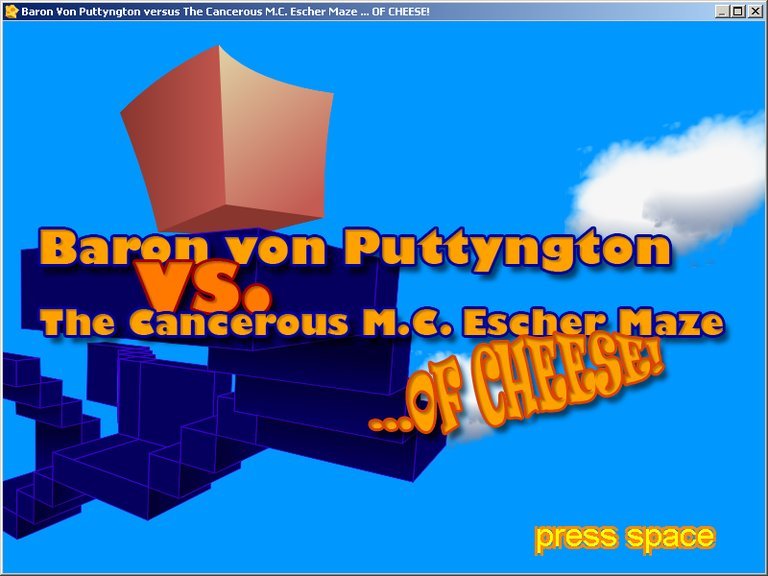
In ‘Baron von Puttyngton versus the Cancerous M.C. Escher Maze of Cheese’, players take on the role of the heroic Baron von Puttyngton, a jiggling gelatin cube, tasked with neutralizing sprawling, cancerous mazes made of cheese that defy conventional 2D layouts. The game features a unique 3rd-person perspective where the Baron can alter gravity to navigate the ever-expanding, Escher-like structures, turning walls into floors to touch and turn each segment blue before they spread further. With meditative pacing and surreal, gravity-defying mechanics, the game blends strategy and racing elements in a whimsical, free-to-play experience.
Baron von Puttyngton versus the Cancerous M.C. Escher Maze of Cheese Reviews & Reception
mobygames.com (70/100): A unique and challenging maze game with gravity-defying mechanics.
retro-replay.com : A gravity-defying maze-runner that guarantees hours of head-spinning fun.
vgtimes.com (55/100): A third-person strategy game with average ratings across all categories.
aquarionics.com : The worlds most insane game, very cool.
Baron von Puttyngton versus the Cancerous M.C. Escher Maze of Cheese: A Surreal Masterpiece of Spatial Puzzles
Introduction: A Cube of Gelatin Against the Cheese Apocalypse
Few games dare to blend the absurd with the profound as seamlessly as Baron von Puttyngton versus the Cancerous M.C. Escher Maze of Cheese. Released in December 2005 as a student project from Stanford University’s CS 248 course, this game is a fever dream of geometry, gravity, and dairy-based existentialism. At its core, it is a puzzle-platformer where players control a sentient, jiggling cube of gelatin—Baron von Puttyngton—as he battles against ever-expanding, cancerous cheese mazes suspended in the sky. The premise is as ridiculous as it is brilliant: a surreal fusion of M.C. Escher’s impossible architectures, a tongue-in-cheek narrative about “cancerous” cheese, and a gravity-defying gameplay loop that challenges spatial reasoning in ways few games have attempted.
This review will dissect Baron von Puttyngton in exhaustive detail, exploring its development history, narrative quirks, gameplay mechanics, artistic vision, and lasting legacy. While it may not be a household name, the game’s audacity and innovation make it a fascinating artifact of early 2000s indie experimentation. Its second-place finish in Stanford’s competition—behind only Deadly Soccer Ball—speaks to its technical and creative merits, even if its reception has been niche. By the end of this analysis, we will argue that Baron von Puttyngton is not just a quirky relic but a bold, underappreciated experiment in game design that deserves recognition for its ingenuity.
Development History & Context: A Stanford Experiment in Chaos
The Birth of a Cheese Nightmare
Baron von Puttyngton versus the Cancerous M.C. Escher Maze of Cheese was created by Bill Dwyer as his final project for CS 248: Introduction to Computer Graphics at Stanford University in the autumn of 2005. The course, taught by professors including Pat Hanrahan (a pioneer in computer graphics and later a Turing Award winner), challenged students to develop a 3D video game as a capstone project. To incentivize creativity, the course organizers turned the assignment into a public competition, complete with a panel of expert judges and enticing prizes.
The stakes were high:
– First place won a trip to Siggraph 2006, the premier computer graphics conference.
– Second place (awarded to Baron von Puttyngton) earned a dinner for two at Il Fornaio, a high-end Italian restaurant in Palo Alto.
– A “Wackiest, Most Creative” prize, donated by Microsoft, awarded an Xbox 360 to the team behind Labyrin3D.
Dwyer’s game stood out for its whimsical premise, technical polish, and innovative gravity mechanics, securing it the runner-up position. The competition’s lineup was diverse, featuring everything from Deadly Soccer Ball (a cosmic, missile-shooting soccer game) to War of the Penguins (a jetpack-fueled penguin shooter). Yet, Baron von Puttyngton’s blend of Escherian geometry, cheese-based horror, and gelatinous heroism made it a memorable entry.
Technological Constraints and Innovations
Developed in 2005, Baron von Puttyngton was constrained by the technological limitations of its era. The game was built using OpenGL and C++, standard tools for graphics programming at the time. Key technical challenges included:
– Procedural Maze Generation: The cheese mazes dynamically sprout new segments, requiring efficient collision detection and real-time geometry updates.
– Gravity Manipulation: The game’s defining mechanic—rotating the gravity vector—demanded precise physics calculations to ensure the Baron’s movement felt responsive yet disorienting.
– Minimalist Aesthetics: The visuals eschewed complex textures in favor of clean, geometric forms, a necessity given the hardware limitations of mid-2000s PCs.
Despite these constraints, Dwyer’s implementation was flawlessly executed. The game runs smoothly even on modern systems, a testament to its optimized codebase. The absence of a traditional “game over” state (players have endless lives) and the infinite progression of maze complexity reflect a design philosophy focused on player experimentation rather than punitive difficulty.
The Gaming Landscape of 2005
To understand Baron von Puttyngton’s place in history, it’s essential to contextualize the gaming environment of 2005. This was the year:
– Indie games were on the cusp of a revolution, with titles like Braid (2008) and World of Goo (2008) still years away. The indie scene was dominated by shareware, freeware, and student projects, often distributed via forums and niche websites.
– Puzzle-platformers were evolving beyond Super Mario clones, with games like Portal (2007) and Echochrome (2008) soon to redefine the genre. Baron von Puttyngton’s gravity mechanics foreshadowed these innovations.
– Surreal, experimental games were gaining traction, thanks to titles like Psychonauts (2005) and Killer7 (2005). Baron von Puttyngton fit neatly into this trend, offering a playful, abstract experience that defied conventional storytelling.
The game’s freeware distribution model (it remains available for free download) ensured it reached a small but dedicated audience. While it lacked the marketing muscle of commercial titles, its word-of-mouth appeal—fueled by its absurd premise and polished execution—helped it carve out a cult following.
Narrative & Thematic Deep Dive: Cheese, Cancer, and Cosmic Absurdity
The Premise: A Geometrical Fugue
Baron von Puttyngton’s narrative is deliberately minimalist, yet its premise is packed with surreal charm. The game’s opening text sets the stage:
“For reasons we won’t go into here, a series of mazes are growing, like cancerous tumors, in the middle of calm skies… and yes, they are made of cheese.”
This single sentence encapsulates the game’s tone: a blend of whimsy, existential dread, and geometric absurdity. The mazes are not merely obstacles; they are living, spreading entities, described as “cancerous” to emphasize their uncontrolled, malignant growth. The choice of cheese as the primary material is equally significant—it’s a mundane, comedic substance elevated to cosmic importance, turning the game into a dairy-based apocalypse.
The Protagonist: A Jiggling Cube of Destiny
The player assumes the role of Baron von Puttyngton, a “dashing cube of jiggling gelatin”. The Baron is a silent protagonist, devoid of traditional character development, yet his physicality makes him endearing. His wobbly, translucent form reacts dynamically to movement, jiggling with each jump and gravity shift. This visual feedback reinforces the game’s playful tone while grounding the player in the Baron’s gelatinous reality.
The game’s description hints at a backstory—the Baron was once a “mere lab experiment” before embracing his destiny as a cheese-maze neutralizer. While this lore is never explored in-depth, it adds a layer of tragic heroism to the protagonist. He is not just a cube; he is a reluctant savior, battling an endless tide of dairy-based chaos.
Themes: Control, Chaos, and the Illusion of Order
Beneath its absurd surface, Baron von Puttyngton grapples with profound themes:
1. The Illusion of Control: The mazes grow faster than the player can neutralize them, creating a Sisyphean struggle. No matter how skilled the player becomes, the cheese always spreads, mirroring real-world struggles against entropy.
2. Perception and Reality: The Escherian mechanics—where walls become floors and gravity is fluid—challenge the player’s spatial reasoning. The game forces players to reorient their understanding of “down,” a metaphor for the subjectivity of reality.
3. Absurdism: The game’s premise is inherently ridiculous, yet it is treated with deadpan seriousness. This juxtaposition creates a comic existentialism, where the player’s efforts are both meaningful and futile.
Dialogue and Tone: A Masterclass in Minimalism
Baron von Puttyngton features no spoken dialogue and minimal text. The few lines that exist are dry, humorous, and self-aware:
– “Over the vertex?” (a playful jab at the game’s lack of traditional perspective)
– “Controls so subtle you’ll figure out why you turned the way you did next week.” (a meta-commentary on the learning curve)
This economy of language ensures the game’s tone remains consistent and immersive. The absence of over-explanation allows players to interpret the narrative through gameplay, reinforcing the abstract, dreamlike quality of the experience.
Gameplay Mechanics & Systems: Gravity, Gelatin, and Geometric Mayhem
Core Gameplay Loop: Touch, Turn, Repeat
At its heart, Baron von Puttyngton is a puzzle-platformer with a twist. The objective is simple:
1. Navigate a floating cheese maze.
2. Touch every segment to turn it from yellow (cancerous) to blue (neutralized).
3. Outpace the maze’s growth before it becomes unmanageable.
The devil is in the details. The mazes are non-Euclidean, defying traditional 2D layouts. Walls sprout in all directions, often leaving the player suspended over an endless void. To traverse these structures, the Baron can:
– Jump (a modest, gelatinous hop).
– Rotate gravity (redefining “down” relative to the Baron’s facing direction).
This gravity manipulation is the game’s defining mechanic. Pressing a button flips the world, turning walls into floors and ceilings into walkable surfaces. The effect is disorienting yet exhilarating, forcing players to rethink spatial relationships on the fly.
Controls: Precision in a Wobbly World
The controls are deceptively simple:
– Arrow keys or WASD for movement.
– Mouse to adjust the camera.
– Spacebar to jump.
– A key (or similar) to rotate gravity.
Despite this simplicity, mastering the Baron’s movement is no small feat. The gelatinous physics introduce a slight delay in momentum, making precise platforming a trial-and-error affair. The game’s description jokes that the controls are “so subtle you’ll figure out why you turned the way you did next week,” a self-aware nod to the learning curve.
Progression and Difficulty: A Spiral of Complexity
Baron von Puttyngton features no traditional “levels” in the conventional sense. Instead, the mazes evolve dynamically:
– Early stages introduce basic geometric shapes (cubes, ramps).
– Later stages incorporate spirals, branching paths, and vertical towers.
– The spawn rate of new cheese segments increases, ratcheting up the pressure.
The game never ends—there is no final boss, no credits roll. Instead, players are locked in an endless cycle of escalation, pushing their spatial reasoning to the limit. This design choice reinforces the game’s thematic focus on futility and perseverance.
Innovative Systems: What Works (and What Doesn’t)
Strengths:
– Gravity Mechanics: The ability to reorient gravity is brilliantly implemented, offering a fresh twist on platforming.
– Procedural Growth: The dynamic maze expansion keeps players on their toes, ensuring no two playthroughs are identical.
– Endless Lives: The lack of punishment for failure encourages experimentation, making the game accessible yet challenging.
Flaws:
– Lack of Checkpoints: In longer sessions, the absence of save points can feel tedious, especially as mazes grow more complex.
– Limited Feedback: The minimalist UI (no health bar, no score display) can make progress feel abstract and intangible.
– Repetitive Loop: While the core mechanics are solid, the lack of narrative or mechanical evolution may cause fatigue over time.
UI and HUD: Less Is More (Sometimes Too Much)
The game’s UI is virtually nonexistent:
– No health meter (the Baron is invincible).
– No score counter (progress is measured by maze completion).
– No minimap (navigation is purely spatial).
This minimalist approach keeps the focus on gameplay and immersion, but it also lacks feedback for players who crave tangible progression. A simple percentage counter (e.g., “75% of maze neutralized”) would have added much-needed clarity.
World-Building, Art & Sound: A Surrealist’s Playground
Setting: The Sky as a Canvas
Baron von Puttyngton takes place in an endless sky, where floating cheese mazes defy the laws of physics. The absence of ground creates a sense of vertigo, reinforcing the dreamlike, disorienting atmosphere. The mazes themselves are geometric marvels, evoking M.C. Escher’s impossible staircases and Penrose triangles.
The cheese aesthetic is both comedic and unsettling:
– Golden-yellow segments represent cancerous growth.
– Blue segments signify neutralized cheese.
– The textures range from smooth cheddar to porous Swiss, adding visual variety.
Visual Design: Minimalism with a Twist
The game’s art style is a masterclass in restraint:
– Clean, geometric shapes dominate the environment.
– Subtle lighting effects cast dynamic shadows as gravity shifts.
– The Baron’s gelatinous form is translucent and wobbly, providing visual feedback for movement.
The color palette is warm and inviting, with golden cheese contrasting against azure skies. This vibrant contrast ensures the game never feels dull, even during prolonged sessions.
Sound Design: The Symphony of Cheese
The audio design is understated but effective:
– Light, bouncy sound effects accompany segment touches.
– A subtle rumble plays when the maze expands.
– Ambient wind noises enhance the sense of height and openness.
The lack of music is a deliberate choice, ensuring the sound effects remain clear and immersive. This minimalist approach aligns with the game’s overall aesthetic, prioritizing gameplay clarity over auditory spectacle.
Reception & Legacy: A Cult Classic in the Making
Critical Reception: A Niche Gem
Baron von Puttyngton received little mainstream attention upon release, but its cult following has grown over time. On MobyGames, it holds a 3.5/5 rating (based on a single user review), while Retro Replay and Aquarionics have praised its innovative mechanics and surreal charm.
Ars Technica’s Ben Kuchera called it “the best of the lot” in Stanford’s competition, highlighting its addictive gravity mechanics. Meanwhile, Kotaku featured it in a roundup of bizarre indie games, cementing its reputation as a quirky, underrated gem.
Commercial Performance: Freeware Forever
As a freeware title, Baron von Puttyngton was never commercialized. Its distribution was limited to Stanford’s website and niche gaming forums, ensuring it remained a hidden treasure for adventurous players. Despite this, its legacy endures through:
– Word-of-mouth recommendations.
– Retro gaming communities (e.g., Retro Replay).
– Academic interest (as a case study in experimental game design).
Influence on Later Games
While Baron von Puttyngton did not directly inspire major commercial titles, its gravity mechanics and procedural maze design foreshadowed later innovations:
– Portal (2007): Shared a focus on spatial reorientation.
– Echochrome (2008): Explored Escherian perspectives in puzzle design.
– Super Mario Galaxy (2007): Popularized gravity-shifting platforming.
In this sense, Baron von Puttyngton was ahead of its time, experimenting with ideas that would later define a generation of puzzle-platformers.
Conclusion: A Gelatinous Triumph of Absurdity and Innovation
Baron von Puttyngton versus the Cancerous M.C. Escher Maze of Cheese is a rare gem—a game that defies convention while delivering rock-solid mechanics. Its surreal premise, innovative gravity system, and minimalist aesthetics make it a standout experiment in indie game design. While it may lack the polish or narrative depth of commercial titles, its bold creativity and addictive gameplay loop ensure it remains a cult classic worth revisiting.
Final Verdict: 8.5/10 – A Surreal Masterpiece
– Gameplay: 9/10 (Innovative, challenging, and endlessly replayable).
– Art & Sound: 8/10 (Minimalist yet effective, with a striking visual identity).
– Narrative: 7/10 (Absurd but charming, though lightweight).
– Legacy: 9/10 (Ahead of its time, influencing later puzzle-platformers).
Baron von Puttyngton is not for everyone—its steep learning curve and abstract design may alienate casual players. However, for those willing to embrace its gelatinous madness, it offers a one-of-a-kind experience that challenges, delights, and disorients in equal measure. Don your finest monocle, adjust your gravity, and dive into the cheese apocalypse—you won’t find another game quite like it.
Download Link: Stanford CS 248 Competition Page (Free, legal download available).