
- Release Year: 2011
- Platforms: Browser, iPad, iPhone, Linux, Macintosh, Nintendo Switch, PlayStation 4, PS Vita, Windows, Xbox 360, Xbox One
- Publisher: Supergiant Games, Inc., Warner Bros. Interactive Entertainment Inc.
- Developer: Supergiant Games, Inc.
- Genre: Role-playing (RPG)
- Perspective: Diagonal-down
- Game Mode: Single-player
- Gameplay: Action RPG
- Setting: Fantasy, Post-apocalyptic
- Average Score: 89/100
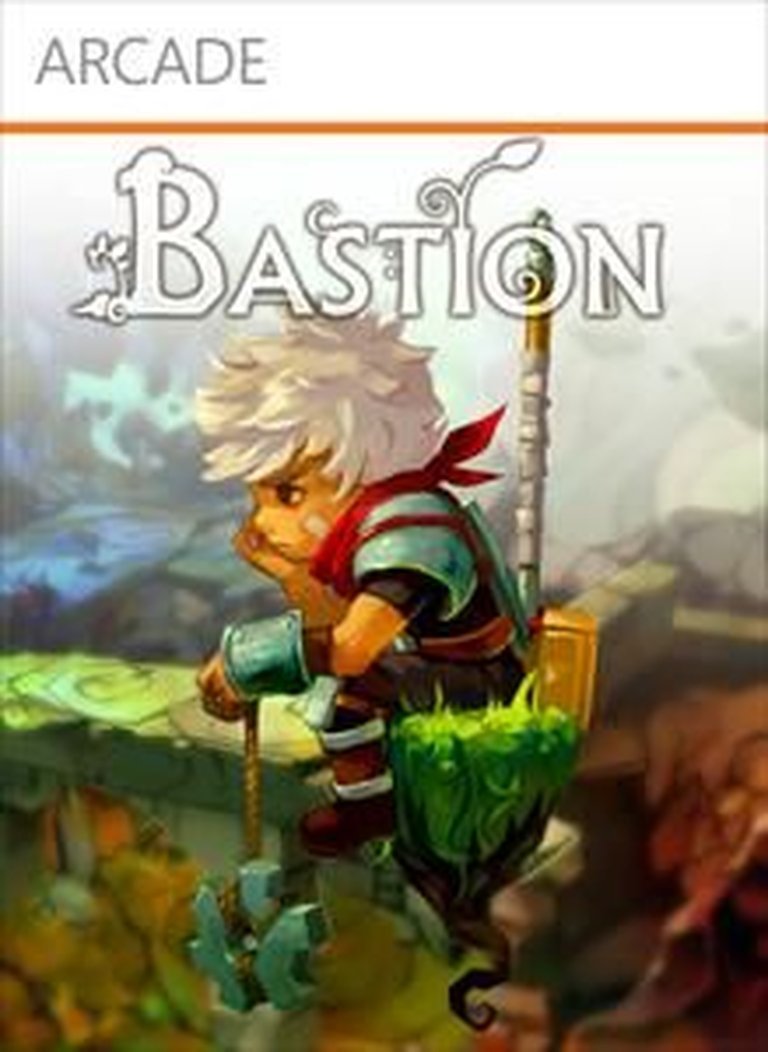
Description
Bastion is an isometric action RPG set in the post-apocalyptic fantasy world of Caelondia, destroyed by the ‘Calamity’. Players control ‘The Kid’, a silent protagonist, who, guided by the narrator Rucks, must rebuild the Bastion and uncover the world’s secrets using a variety of weapons and skills while navigating dynamic narration that responds to player actions.
Gameplay Videos
Where to Buy Bastion
Bastion Free Download
Bastion Cracks & Fixes
Bastion Patches & Updates
Bastion Mods
Bastion Guides & Walkthroughs
Bastion Reviews & Reception
metacritic.com (86/100): Bastion is something special, clearly made with love and oodles of talent.
ign.com (90/100): Bastion is one of the best downloadable games this year, but I didn’t believe it right away.
pcgamer.com (92/100): Bastion is special. The soundtrack is phenomenal, the world is breathtaking, and the narration is a brilliant new idea for gaming.
opencritic.com (88/100): Bastion is a wonderfully diverse game that offers up a great deal of flexibility in how you approach its many challenges.
Bastion: A Timeless Indie Masterpiece
In the summer of 2011, a small team of seven developers in San Jose and New York City unleashed a game that would redefine what independent video games could achieve. Bastion, Supergiant Games’ debut title, arrived not with bombastic marketing or a triple-A budget, but with something far more valuable: an unwavering creative vision that permeated every aspect of the experience.
Development History & Context
The story of Bastion‘s creation is as compelling as the game itself. Amir Rao and Gavin Simon, former Electronic Arts developers who had worked on Command & Conquer 3 and Red Alert 3, left their corporate positions to pursue something more personal. They founded Supergiant Games in September 2009 with a simple yet ambitious goal: create a game that felt handcrafted from beginning to end.
The team operated on a bootstrap budget, funding development themselves over nearly two years. Most of the seven-person crew worked from a house in San Jose, while composer Darren Korb recorded music and narration in his New York City apartment closet. This intimate development environment fostered the kind of creative cohesion rarely seen in larger productions.
Their timing was fortuitous. The Xbox Live Arcade was experiencing a renaissance of quality downloadable titles, with games like Limbo and Braid proving that digital distribution could support artistically ambitious projects. When Supergiant debuted Bastion at the September 2010 Penny Arcade Expo, the response was immediate and enthusiastic. Warner Bros. Interactive Entertainment signed on as publisher shortly after, providing the certification support needed for Xbox Live release without compromising the game’s indie spirit.
Narrative & Thematic Deep Dive
Bastion‘s story unfolds in the aftermath of the Calamity, a catastrophic event that shattered the world of Caelondia into floating fragments. You play as “the Kid,” a silent protagonist who awakens amid the ruins and journeys to the Bastion—a safe haven where survivors were meant to gather in times of crisis.
What elevates this post-apocalyptic setup beyond cliché is the game’s masterful narrative delivery. Rucks, the game’s narrator voiced by Logan Cunningham, doesn’t merely comment on events—he shapes them. His gravelly, world-weary voice provides exposition, character development, and real-time reactions to the player’s actions. When you fall off a ledge, he notes it. When you struggle with a new weapon, he observes. When you triumph, he acknowledges it. This dynamic narration creates an intimacy between player and story that few games achieve.
The narrative complexity deepens as you encounter other survivors: Zia, an Ura girl raised in Caelondia, and Zulf, an Ura ambassador. Their presence reveals the game’s true thematic core—the tragic consequences of cultural division and the cyclical nature of violence. The Calamity wasn’t merely an accident; it was the result of centuries of tension between Caelondia and the Ura, culminating in the Mancers’ plan to build a weapon capable of wiping out their enemies entirely.
Venn, Zia’s father and a brilliant Ura scientist, becomes the story’s tragic fulcrum. Pressured to complete the weapon that would destroy his own people, he instead sabotaged it to backfire on Caelondia. His final whispered words to Zia—”Hurry home to the den and lock yourself in”—carry devastating weight when you discover his journal later in the game.
The narrative’s sophistication lies in its refusal to offer easy answers. When you finally reach the Bastion with all the necessary shards, Rucks presents two choices: use the Bastion to rewind time and potentially prevent the Calamity, or evacuate the survivors to start anew. Neither option guarantees a better future. The Restoration Protocol might simply create another loop, while the Evacuation Protocol abandons the world that was. This ambiguity transforms Bastion from a simple hero’s journey into a meditation on responsibility, consequence, and the impossibility of truly escaping the past.
Gameplay Mechanics & Systems
At its core, Bastion is an action RPG with deliberately streamlined systems. The Kid wields two weapons at a time, selected from an arsenal that grows throughout the game. This limitation forces tactical consideration rather than mindless weapon switching. Each weapon feels distinct—the powerful but slow War Machete, the rapid-fire Dueling Pistols, the area-control Galleon Mortar—and mastering their individual quirks becomes essential for survival.
The game’s combat strikes a balance between accessibility and depth. Basic attacks are straightforward, but the system rewards skillful play through shield blocking, dodge rolling, and special attacks powered by black tonics. The difficulty can be customized through the Shrine, where players can invoke idols of the gods to make enemies stronger in exchange for increased experience and currency. This risk-reward system allows players to tailor the challenge to their preference.
Weapon upgrades occur at the Forge, where collected materials improve specific attributes. While not as deep as some RPG systems, the upgrade paths provide meaningful choices that complement different playstyles. The Proving Grounds offer weapon-specific challenges that test mastery, rewarding players with valuable materials and providing a welcome change of pace from regular combat.
The Bastion itself serves as both narrative hub and progression system. Each Core collected allows construction of a new building: the Distillery for passive bonuses, the Arsenal for weapon management, the Forge for upgrades, the Memorial for challenges, the Lost-and-Found for purchasing materials, and the Shrine for difficulty modifiers. This structure creates a satisfying loop of exploration, combat, and character development.
However, the game isn’t without mechanical frustrations. The isometric perspective, while visually striking, occasionally creates depth perception issues that lead to unintended falls. The constant influx of new weapons, while thematically appropriate for a scavenger in a ruined world, can prevent players from settling into comfortable loadouts. Some challenge courses feel more punishing than rewarding, particularly those requiring pixel-perfect precision.
World-Building, Art & Sound
Bastion‘s visual aesthetic represents one of indie gaming’s most distinctive achievements. Jen Zee’s hand-painted environments create a world that feels simultaneously devastated and beautiful. The floating islands don’t merely serve as level geometry—they’re characters in their own right, each with personality and history. The Sundown Path’s golden light, the Hanging Gardens’ overgrown splendor, the Tazal Terminals’ harsh beauty—every location tells a story through environmental design alone.
The game’s color palette deserves special mention. Rather than the desaturated browns typical of post-apocalyptic settings, Bastion embraces vibrant hues that underscore the tragedy of what’s been lost. The contrast between the world’s former glory and its current state creates emotional resonance that pure destruction never could.
Darren Korb’s soundtrack transcends typical video game music, functioning as both accompaniment and narrative device. The “acoustic frontier trip-hop” style—a fusion of frontier folk, electronic beats, and orchestral elements—creates an auditory landscape as unique as the visual one. Songs like “Build That Wall,” “Mother, I’m Here,” and “Setting Sail, Coming Home” feature lyrics that advance the story and deepen character relationships. Korb’s decision to record everything in his apartment closet, including over three thousand lines of narration, demonstrates the kind of resourceful creativity that defines the entire project.
The sound design complements the visual and musical elements perfectly. Environmental audio—the creak of floating islands forming beneath your feet, the distant cries of unseen creatures, the satisfying clang of weapon impacts—creates an immersive soundscape that draws players deeper into the world.
Reception & Legacy
Upon release, Bastion became an immediate critical darling. Review aggregator Metacritic shows scores of 86/100 for both Xbox 360 and PC versions, with similar high marks across all platforms. Critics universally praised the game’s art direction, narration, and music, though opinions on gameplay depth were more varied.
The game’s commercial success exceeded expectations for an indie title. It sold over 500,000 copies in 2011 alone, with 200,000 of those on Xbox Live Arcade. By January 2015, total sales surpassed three million across all platforms. This financial success proved that artistic ambition and commercial viability weren’t mutually exclusive in the indie space.
Bastion‘s influence extends far beyond sales figures. The game’s narration system inspired countless imitators, though few matched its seamless integration and emotional impact. Supergiant Games’ subsequent titles—Transistor, Pyre, and Hades—all bear the creative DNA established by Bastion, refining and expanding upon its narrative techniques and artistic sensibilities.
The game’s success also helped legitimize the Summer of Arcade promotion on Xbox Live, demonstrating that digital distribution could support experiences as polished and meaningful as retail releases. For many players, Bastion represented their first exposure to the creative potential of indie games, serving as a gateway to the broader independent development scene.
Perhaps most significantly, Bastion proved that a small team with a clear vision could compete with industry giants. In an era when game development budgets were ballooning into the tens of millions, Bastion showed that seven people working with passion and purpose could create something that resonated with millions of players worldwide.
Conclusion
A decade after its release, Bastion remains a landmark achievement in video game storytelling and design. Its influence can be seen in countless subsequent titles, yet few have managed to capture the same magical combination of narrative sophistication, artistic beauty, and mechanical elegance.
The game’s enduring appeal lies in its refusal to compromise. Every element—from the floating level design to the dynamic narration to the acoustic frontier soundtrack—serves the central vision of creating an intimate, handcrafted experience. In an industry increasingly dominated by live-service models and microtransactions, Bastion stands as a reminder of what games can achieve when creative vision takes precedence over commercial formula.
For players who haven’t experienced it, Bastion offers a masterclass in how video games can tell stories that are uniquely suited to the medium. For developers, it provides a blueprint for how small teams can create work that resonates far beyond their size. And for the medium as a whole, it represents a pivotal moment when independent games proved they could not only compete with mainstream titles but often surpass them in artistic ambition and execution.
Bastion isn’t merely a great indie game—it’s a great game, period. Its legacy continues to inspire new generations of developers and players, ensuring that the Kid’s journey through the ruins of Caelondia will be remembered long after the Calamity has faded from memory.