
- Release Year: 2004
- Platforms: Windows
- Publisher: Russobit-M, ValuSoft, Inc.
- Developer: Zono, Inc.
- Genre: Strategy, Tactics
- Perspective: Isometric
- Game Mode: Single-player
- Gameplay: Base building, Real-time combat, Resource Management, Spell casting
- Setting: Greek mythology, Historical events
- Average Score: 85/100
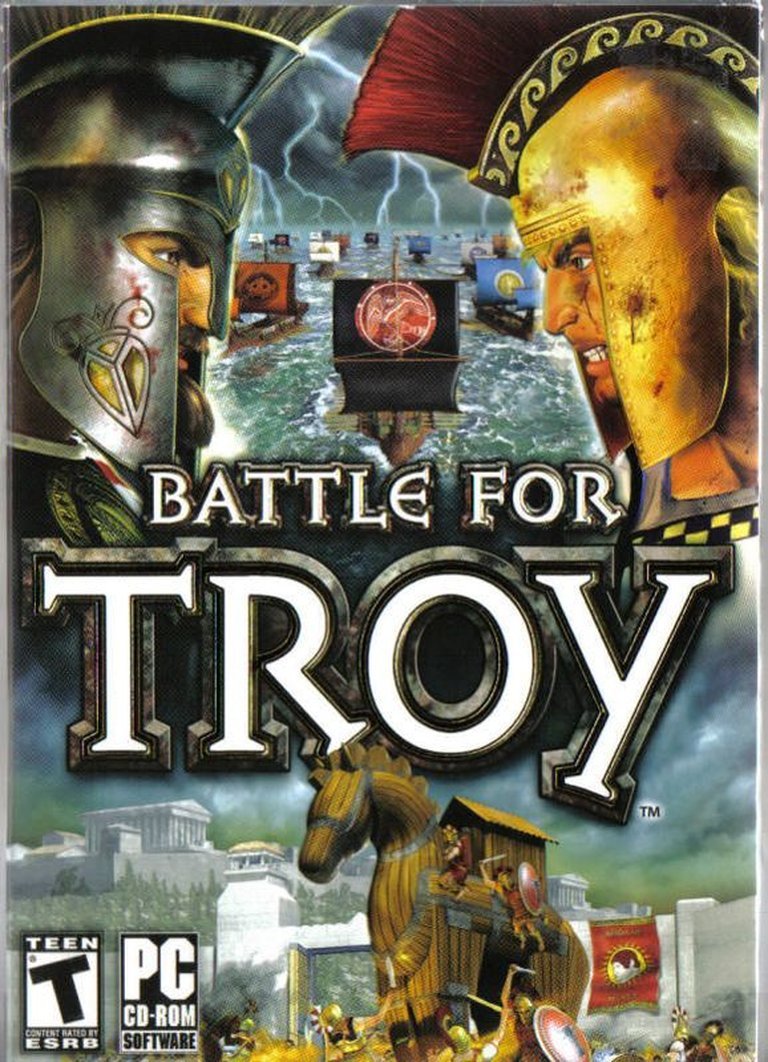
Description
Battle for Troy is a real-time strategy game set during the Trojan War as depicted in Homer’s epic poems, where players can command either the Greek alliance led by the Spartans in offensive maneuvers or the Trojans in defending their city walls, across eight campaign missions per side with nine unit types, gathering gold by destroying enemies and unleashing supernatural god spells in an isometric historical setting.
Gameplay Videos
Battle for Troy Free Download
Battle for Troy Cracks & Fixes
Battle for Troy Reviews & Reception
worthplaying.com : The biggest problem, though, is the sheer stupidity of your units.
gamewatcher.com : It’s just too bad that it wasn’t executed as well as it could be.
gamespot.com (85/100): Quite simple and straightforward game, great for passing the time.
Battle for Troy Cheats & Codes
PC
Press keys or type while in the game.
| Code | Effect |
|---|---|
| Ctrl + F6 | Reveals the whole map and allows building anywhere |
| bestarmy | Grants 20 archers, 20 swordsmen, 20 spearmen, 25 healers |
Battle for Troy: Review
Introduction
In the annals of video game history, few tales have inspired as many epics as Homer’s Iliad—a saga of divine wrath, heroic valor, and the cataclysmic clash between Greeks and Trojans over the abducted Helen of Sparta. Released in 2004 amid a golden age of real-time strategy (RTS) giants like Warcraft III: Reign of the Frozen Throne and Age of Mythology, Battle for Troy dared to transplant this mythic conflict into isometric 3D battlefields. Developed by the obscure Zono, Inc. and published as a $19.99 budget title by ValuSoft, it promised players the chance to command either King Menelaus’s vengeful Greek alliance in offensive sieges or defend Troy’s fabled walls as Paris’s forces. Yet, for all its Homeric ambition, the game stumbles as a simplistic Warcraft clone hampered by technical woes and design myopia. This review argues that Battle for Troy endures not as a masterpiece, but as a poignant artifact of early-2000s budget gaming: a flawed yet evocative snapshot of an untapped mythological niche, redeemable today only through nostalgic abandonware tinkering.
Development History & Context
Zono, Inc., a diminutive studio with just 17 credited contributors on the Windows release, crafted Battle for Troy in the shadow of RTS titans. Lead Programmer Richard Campomanes anchored the engine efforts, supported by David Eaton III on core programming, Jeff Fort on tools, and Rob Smith on extras. Jason Hough served as Lead Designer, while Hunter Luisi handled level design and even penned the script (per IMDb credits). Environmental art came from Todd Pickens and Tony Hsu, with Brian Collins modeling and animating units. Music by David Schmidt and production oversight by Michael Arkin rounded out a lean team, many of whom had prior ties to ValuSoft’s historical lineup like The History Channel: Alamo – Fight for Independence and Crusades – Quest for Power. Special thanks went to figures like Peter Green and William Novak, hinting at external consultations.
Launched March 5, 2004 (U.S.), as a CD-ROM title rated Teen for violence, it arrived in a post-Warcraft III landscape dominated by polished 3D RTS with hero units, campaigns, and multiplayer. ValuSoft’s budget model—eschewing lavish marketing for value pricing—positioned it against flashier peers like Empire Earth or Rise of Nations. Technological constraints were evident: a custom isometric engine struggled with pathfinding and AI on era hardware (Pentium III minimum, 128MB RAM), yielding playable but unoptimized performance. Modern players report 5-15 FPS stuttering on Windows 10/11, fixable via controller plugins or widescreen/FOV mods (e.g., ModDB’s 2025 patch). No patches materialized post-launch, typical for defunct Zono (abandonware status confirmed on MyAbandonware). In context, it rode the 2004 Troy film hype but predated deeper mythological RTS like Imperiums: Troy (2020), marking it as a pioneering, if primitive, Homeric experiment.
Narrative & Thematic Deep Dive
Battle for Troy faithfully echoes Homer’s Iliad, framing the Trojan War as a divine-tinged grudge match: Paris abducts Helen, enraging Menelaus and sparking a Greek armada’s siege. Players choose sides—Greeks for aggressive assaults or Trojans for desperate defenses—across dual eight-mission campaigns. Greek scenarios emphasize offensive maneuvers like beachheads and city breaches; Trojans focus on fortification, culminating in the iconic wooden horse ploy (per ad blurbs). Missions blend historical beats (e.g., wall defenses, hero duels) with supernatural “god spells,” invoking Zeus’s bolts or Poseidon’s quakes for Iliad-style intervention.
Characters are archetypal: Menelaus as the betrayed king, Paris as the seductive prince, heroes like Achilles proxies as tougher units. Dialogue is sparse—gruff voice-overs like war cries (“To battle!”)—lacking Warcraft‘s flavorful cinematics. Themes probe hubris (hybris), honor (timē), and fate (moira): gold-hoarding evokes plunder-driven warfare, while persistent units across missions nod to epic persistence (survivors gain XP). Yet, shallowness undermines depth—no branching narratives, no Helen subplot agency, just objective checklists (“capture villages, slay foes”). Reviews decry it as “eintöniges” (monotonous, per PC Action), a “kastrierten WarCraft-Klon” (castrated clone, 4Players). Analytically, it romanticizes Bronze Age brutality sans nuance—Greeks as “bloodthirsty,” Trojans noble—but god spells inject mythic flair, elevating rote plots into fleeting Homeric reverie.
Gameplay Mechanics & Systems
At its core, Battle for Troy is stripped-down RTS: erect barracks/tents (just three building types), muster nine units (spearmen, swordsmen, archers, cavalry, healers, skeletons, Cyclopes, heroes), and clash in real-time. Innovation shines in resource economy—solely gold, harvested by slaying foes or seizing villages for trickle income, bypassing lumber/gold farms. God spells add tactical bursts (e.g., summons), heroes level up, and units persist inter-mission for progression. UI is isometric-standard: mouse-scroll zoom (impressively close-up), group hotkeys, but no rotations or formations.
Flaws abound. Units path like drunks—overshooting waypoints, scattering wildly, ignoring micro (WorthPlaying: “stand still until ready to swing”). AI is “stupide” (4Players): foes ignore threats, allies phantom-chase. No mid-mission saves (Jeuxvideo.com: “scandale”), no multiplayer, rigid campaigns (8 missions/side, 7-8 hours total). Combat devolves to zerg rushes: mass-produce, overwhelm. Level editor exists (per Gamicus, ValuSoft archives), but scripting’s limited. Modern fixes (controller for FPS, widescreen) revive it, yet core loops feel “simpliziten Massenkeilereien” (simplistic brawls). Verdict: accessible for newbies (“Einsteiger,” PC Action), punishing for veterans.
World-Building, Art & Sound
The Bronze Age Aegean comes alive in isometric vistas: sun-baked plains, rocky ruins, sandy shores, towering Trojan walls. Environments blend grassy fields, villages (key for gold), and mythic flourishes like cyclopean lairs. Art direction impresses for budget fare—crisp textures, detailed models (zoom reveals musculature, flowing capes), fluid animations (clangs, stabs). Brian Collins’s work shines; villages bustle authentically. Yet, repetition reigns: “starres Gelände” (rigid terrain, 4Players), plain grass/rocks.
Sound design fits: David Schmidt’s score pulses with martial drums, lyres evoking Homeric hymns—repetitive but atmospheric. SFX deliver visceral clashes (swords ring, arrows whistle), voice-overs cornily epic (“For Troy!”). War cries amuse (GameSpot user: “extremely funny”), but lack variety. Collectively, they forge immersion: visuals pull you into sieges, audio underscores fury, crafting a gritty, if unpolished, mythic haze.
Reception & Legacy
Launch reception was tepid: MobyGames aggregates 46% critics (7 reviews)—GameWatcher/Strategy Informer (58%: “excellent concept, doesn’t work”), PC Action (56%: “for Einsteiger”), down to Jeuxvideo.com (15%: “à la poubelle”). WorthPlaying (50%): “average… might be better off picking up something else.” PC Gamer (12/100): “buggy clunker.” Players averaged 3.6/5 (4 ratings), praising simplicity (GameSpot: 8.5/10 as “nice, simple game”). No Metacritic aggregate; IMDb’s 7.4/10 skews from tiny sample.
Commercially, it flopped—budget obscurity, no patches, Zono defunct. Legacy: abandonware darling (MyAbandonware downloads, Archive.org ISO), with ModDB widescreen/FOV fixes (2025) and controller FPS hacks breathing life. Influences negligible—pioneered Trojan RTS pre-Imperiums: Troy—but exemplifies 2000s budget pitfalls: ambition sans polish. Cult status flickers in forums (ModDB spam on mods), preserved as MobyGames #8,552 Windows rank.
Conclusion
Battle for Troy tantalizes with Homeric fire—gold-plunder economy, dual campaigns, god-spell spectacle—but crumbles under idiotic AI, unformative troops, no saves/multiplayer, and budget brevity. Zono’s earnest team delivered visual/s sonic competence, but execution evokes a “gut gemeinten Modifikation” (well-meant mod). In history’s canon, it’s no Age of Mythology, but a quirky relic: playable via tweaks, ideal for Trojan War completists craving Spartan simplicity. Verdict: 5.5/10—a forgotten budget skirmish, historically curious yet gameplay forgettable, warranting emulation for mythology buffs only. Its place? A cautionary footnote in RTS evolution, whispering “what if” amid 2004’s giants.