
- Release Year: 2019
- Platforms: Nintendo Switch, PlayStation 4, Windows
- Publisher: EuroVideo Medien GmbH, Wild River GmbH
- Developer: THREAKS GmbH
- Genre: Action
- Perspective: Top-down
- Game Mode: Co-op, Single-player
- Gameplay: Roguelike, Shooter
- Setting: Fantasy, Futuristic, Sci-fi
- Average Score: 72/100
Description
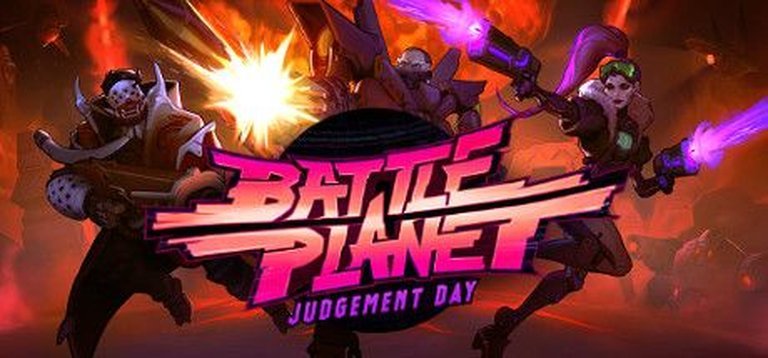
Battle Planet: Judgement Day is a sci-fi/fantasy roguelike shooter set across small, rotating alien planets infested with insectoid enemies. Players engage in fast-paced top-down combat, utilizing bombs, jump fields, and strategic movement to survive procedurally generated challenges. With its 2D scrolling fixed-screen perspective and roguelike progression, the game offers cooperative play for 1-2 players locally, blending arcade action with light tactical elements in a futuristic setting.
Gameplay Videos
Where to Buy Battle Planet: Judgement Day
Battle Planet: Judgement Day Cracks & Fixes
Battle Planet: Judgement Day Reviews & Reception
steambase.io (88/100): A triumphant return to form for the series.
metacritic.com (70/100): Battle Planet: Judgement Day is a shooter that’s best played in short bursts with a friend in tow.
butwhytho.net : A deeper appreciation of the game’s tactical demands is required for success.
indiegamereviewer.com (60/100): Battle Planet is a fun, action-packed shooter that provides its own take on the Rogue-like.
Battle Planet: Judgement Day: Review
A Frenetic but Flawed Rogue-Lite Odyssey
Introduction
In the saturated cosmos of indie rogue-lites, Battle Planet: Judgement Day (2019) emerges as a top-down, twin-stick shooter that promises chaotic freedom but often orbits the gravitational pull of mediocrity. Developed by German studio THREAKS GmbH and published by Wild River Games, this sci-fi escapade pits players as fugitive convicts battling across procedurally generated planets. While its kinetic action and striking art direction offer fleeting adrenaline, the game’s repetitive design and derivative systems prevent it from reaching the stratospheric heights of its inspirations. This review interrogates whether Judgement Day carves a niche in rogue-lite history or crumbles under the weight of its own unfulfilled ambitions.
Development History & Context
Studio Vision & Technological Constraints
THREAKS GmbH, a Hamburg-based studio known for Beatbuddy: Tale of the Guardians (2013), sought to blend arcade intensity with rogue-lite progression in Battle Planet: Judgement Day. Built on Unity, the game aimed to modernize the top-down shooter genre pioneered by titles like Smash TV and Geometry Wars, while incorporating planetary rotation mechanics reminiscent of Super Mario Galaxy. Released in October 2019, it entered a market dominated by polished indie darlings like Dead Cells and Hades—a landscape where innovation was paramount.
THREAKS cited inspirations ranging from Nuclear Throne to Alienation, aiming to capture their “hard to beat” ethos. However, budgetary constraints led to recycled enemy assets, limited voice acting, and a small team (37 credited contributors, with Sebastian Bulas handling multiple roles). The studio’s ambition to support Tilt Five AR glasses post-launch hinted at experimental aspirations, yet this feature failed to resonate widely.
Narrative & Thematic Deep Dive
A Thin Veneer of Story
Battle Planet: Judgement Day frames its carnage with a wafer-thin premise: three “most wanted” criminals (Jet, Maya, and Duke) escape a prison ship crash, battling aliens, police, and military forces across fractal planets to avoid execution. Narration is minimal, relegated to hammy one-liners (“Make them pay!”) and tutorial quips that critics universally panned as “cringe” (IndieGameReviewer). Characters lack backstory or motivation, serving as interchangeable avatars for destruction.
Themes of Survival & Repetition
Thematically, the game mirrors its rogue-lite loop: a Sisyphean struggle against overwhelming forces. Yet, unlike Hades’ nuanced exploration of cyclical torment, Judgement Day reduces its narrative to a blunt instrument. The title itself—Judgement Day—hints at apocalyptic stakes, but these remain unexplored, leaving players with a hollow power fantasy devoid of emotional resonance.
Gameplay Mechanics & Systems
Core Loop: Rotational Combat & Perilous Progression
Gameplay unfolds across spherical mini-planets, with players navigating 360-degree environments using twin-stick controls. Each planet hosts four enemy waves followed by a boss, culminating in a shop to purchase upgrades (health, weapon capacity) or perks (explosive dashes, bubble shields). Runs are punctuated by permadeath, with permanent unlocks (new characters, weapon variants) incentivizing repetition.
Innovations & Shortcomings
– Planetary Dynamics: Rotating terrain adds verticality and tactical positioning, forcing players to evade lava pools and use “jump fields” to traverse gaps.
– Co-op Chaos: Local split-screen multiplayer injects frenetic camaraderie, though screen clutter often overwhelms (ButWhyTho).
– Flawed Systems: Critics lambasted the “uninspired” upgrade tree (mostly stat boosts) and repetitive mission types (IndieGameReviewer). Enemy variety is sparse—shielded troopers, insect swarms, and bullet-sponge bosses recycle ad nauseam. Weapon balancing also falters; shotguns feel underpowered, while homing missiles trivialize fights.
UI & Accessibility
The HUD is functional but cluttered, with cooldown meters and ammo counters jostling for space. Keyboard/mouse controls are poorly optimized, favoring gamepads—a design oversight noted by Steam reviewers.
World-Building, Art & Sound
Aesthetic Virtue vs. Environmental Monotony
Art director Max Schulz delivers a vibrant, cartoonish vision: neon-drenched planets, chunky pixel-art explosions, and grotesque aliens channeling Borderlands’ irreverence. Each biome—toxic jungles, lava-scarred wastelands—boasts unique visual flair, though procedural generation limits their memorability.
Sound Design: A Dual-Edged Sword
Garry Schyman (BioShock, Middle-earth: Shadow of Mordor) crafts a pulsating electronic-orchestral score that elevates combat tension. Conversely, sound effects—punctuated by generic gunfire and screeching foes—wear thin, while voice acting veers into “aggressive it hurts” territory (IndieGameReviewer).
Reception & Legacy
Critical Divide & Commercial Obscurity
Judgement Day garnered mixed reviews:
– Praise: “Fun in short bursts” (ButWhyTho), “solid co-op” (GameSpace), and “nostalgic visuals” (Honey’s Anime).
– Criticism: “Monotonous” (4Players.de), “repetitive level design” (IndieGameReviewer), and “lack of originality” (GameRevolution).
Scores averaged 61-70% (Metacritic), with Steam user reviews settling at “Very Positive” (88/100) post-discount pricing—a testament to its value proposition at under $5.
Industry Impact
The game failed to chart new territory, overshadowed by contemporaries like Risk of Rain 2 (2019). Its sole legacy lies in demonstrating indie studios’ struggles to innovate within crowded genres. Post-launch updates (Tilt Five AR support, bug fixes) sustained a niche audience but couldn’t revive its commercial momentum.
Conclusion
Battle Planet: Judgement Day is a conflicted artifact—a twin-stick shooter with moments of delirious fun, shackled by repetition and unfulfilled potential. Its planetary combat and Schyman score shine brightly, yet these are eclipsed by derivative systems and a dearth of narrative ambition. For rogue-lite devotees seeking couch co-op mayhem, it’s a serviceable diversion; for the genre at large, it’s a footnote rather than a revolution. In the annals of video game history, Judgement Day orbits as a middling celestial body—visible, but far from stellar.
Final Verdict: 6.5/10 – A flawed but occasionally exhilarating romp best enjoyed in fleeting, explosive sessions.