
- Release Year: 2008
- Platforms: Wii, Windows
- Publisher: 1C Company, Destineer, Teyon S.A., UIG Entertainment GmbH
- Developer: Destan Entertainment
- Genre: Action
- Perspective: Behind view
- Setting: Futuristic, Sci-fi
- Average Score: 20/100
Description
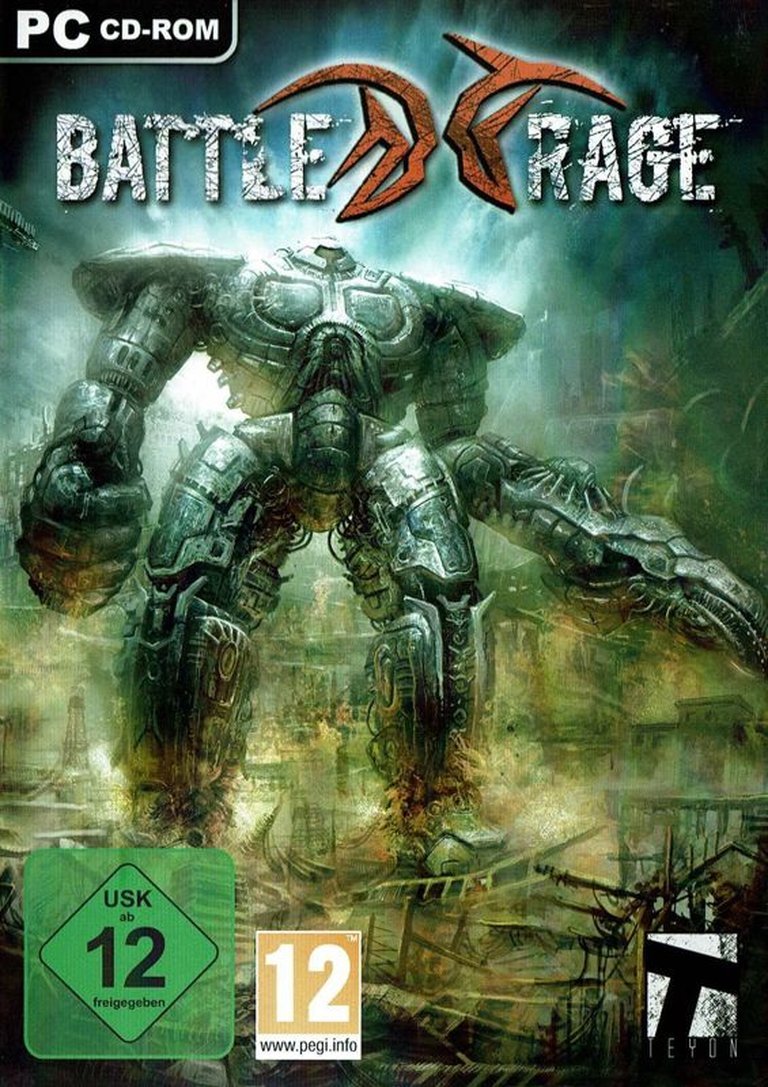
Battle Rage is a sci-fi action game set in the ruins of a shattered futuristic world where players pilot and customize massive mecha robots. With a choice of 20 weapons, special attacks like Poison or Vampire, and a Power Triangle balancing speed, power, and armor, gamers battle across 10 destructible arenas in single-player arcade modes with distinct character storylines or frantic multiplayer matches.
Battle Rage Reviews & Reception
ign.com (20/100): Worst. Giant robot game. Ever.
ign.com (20/100): Worst. Giant robot game. Ever.
Battle Rage Cheats & Codes
Battle Rage: The Robot Wars (PC)
Press t then type ammo to get free ammo.
| Code | Effect |
|---|---|
| ammo | Grants free ammo for range and add-ons; press E to use add-on ammo. |
Battle Rage (Nintendo Wii)
Codes work only with a softmodded Wii running Gecko OS or compatible homebrew application.
| Code | Effect |
|---|---|
| C202830C 00000004 821EFFF8 2C100000 4182000C D01E0078 48000008 D03E0078 60000000 00000000 |
Infinite LIFE (1P) |
| 0412618C 60000000 | Infinite Ammo (all) |
| 28418F3A 00002000 C210CF7C 00000006 2C000003 4182000C D01F0064 4800001C 2C090000 4182000C D01F0064 4800000C 3E404150 925F0064 60000000 00000000 E0000000 80008000 28418F3A 00000000 0410CF7C D01F0064 E0000000 80008000 |
Moon Jump (1P) (Z Button) |
Battle Rage: A Forgotten Titan’s Stumble in the Mech Combat Arena
1. Introduction: The Ghost in the Machine
In the crowded necropolis of video game history, few titles fade with the quiet efficiency of Battle Rage. Released in 2008 for Windows and later ported to the Wii as Battle Rage: Mech Conflict, this third-person mech combat game from Polish developer Destan Entertainment represents a fascinating “what if.” Conceived at a time when the market for giant robot brawlers was niche but passionate, Battle Rage arrived with a promising core concept—customizable mechs, a strategic “Power Triangle,” and frantic arena combat—yet it crashed against the shores of reception with a profound silence, punctuated by a single, scathing critique that has come to define its legacy. This review will dissect Battle Rage not as a mere failure, but as a case study in ambition thwarted by technical execution, narrative vacuity, and unfortunate timing. Its true significance lies in its stark contrast to the juggernaut that shares its name, and what its obscurity reveals about the perils of developing a competent but unremarkable game in a genre dominated by giants.
2. Development History & Context: Poland’s Niche Pursuit
Studio & Vision: Battle Rage was developed by Destan Entertainment, a Polish studio with a portfolio largely consisting of smaller-scale action and puzzle games for PC and handhelds (notably working on titles like Indianapolis 500: Evolution). Led by figures like producer and engine programmer Michał Tatka, the team tackled a project that was, for them, a significant swing into a more complex 3D action genre. Their vision, as outlined in the official ad blurbs, was clear: a customizable mech fighter focused on “frantic multiplayer” and a deep single-player “Arcade mode” with separate storylines for eight characters. The goal was to blend the tactical loadout choices of a shooter with the visceral, up-close combat of a beat-’em-up.
Technological Constraints & Era: The mid-to-late 2000s were a transitional period. The seventh console generation was in full swing (Xbox 360, PS3, Wii), but PC development was still navigating the tail end of the DirectX 9 era. Battle Rage’s Windows version, distributed on a single CD-ROM, immediately signals its modest technical scope compared to the multi-disc, high-fidelity titles of the time. The game’s architecture, built by a small team (20 credited), likely prioritized accessible, fast-paced gameplay over cutting-edge graphics or complex physics. The 2008-2009 release window placed it between the celebrated Armored Core series and the upcoming, highly anticipated Rage from id Software—a naming coincidence that would prove catastrophic for its discoverability.
Gaming Landscape: The mech genre was, and remains, a cult favorite. From the simulation-heavy Mech Warrior to the action-oriented Armored Core, the space was dominated by established, deep franchises. Battle Rage entered as a blunt instrument: an arena brawler with a “behind-the-view” perspective, reminiscent more of Power Stone or Rune than Mech Warrior. Its primary competition on the Wii, a console with a massive casual audience but a dearth of serious mech games, was virtually non-existent. Yet, this also meant it had no built-in audience. It was a game searching for a niche that might not have existed.
3. Narrative & Thematic Deep Dive: An Echo in an Empty Wasteland
The official description offers the only canonical narrative framework: “In the Ruins of a Shattered World…” We are told to “Complete a separate storyline for each of the eight characters in Arcade mode.” However, the source material provides zero concrete details about these characters, their motivations, or the world’s history. The credits list “Story” under Przemyslaw Zapala and Artur Gocyk, but no script excerpts, dialogue samples, or lore documents are available in the provided sources.
This narrative vacuum is itself a critical fact. Unlike the post-apocalyptic Rage (2011), which built a world around the asteroid Apophis and the Eden Project’s Arks, Battle Rage’s setting is a pure abstraction. The “ruins” are merely arenas—10 maps with “destructible physical objects.” There is no environmental storytelling, no audio logs, no NPCs to converse with. The themes are implied solely through mechanics: the “Power Triangle” (Speed, Power, Armor) suggests a thematic core of resource trade-offs and strategic sacrifice. The ability to equip “special attacks like Poison or Vampire” hints at a world of cybernetic enhancement or bio-mechanical horror, but it is never contextualized.
The eight robots are not characters but classes or chassis, each with “unique abilities.” The absence of narrative is so total that it becomes the narrative’s defining feature. This is a world stripped of all context, a pure gladiatorial pit. The thematic depth is thus measured solely in gameplay balance, not in any lore about corporate warlords, mutated wastelanders, or fallen civilizations. It is a pure combat sport, and the story is the player’s own progression through unlockables.
4. Gameplay Mechanics & Systems: The Power Triangle and the Void
Battle Rage’s mechanical heart is its customization and combat loop, which shows flashes of clever design buried under a layer of jank.
Core Loop & Combat: Players select a robot chassis (8 total) and enter an arena-based battle. The combat is a hybrid: ranged (from a pool of 20 weapons, equipping up to three at a time, presumably two ranged and one melee) and melee beat-’em-up attacks. The “Power Triangle” is the central strategic device. At the cost of one stat, you can boost another: maximize Speed for mobility, Power for damage, or Armor for survivability. This creates meaningful pre-match builds—a fast, fragile “glass cannon” or a slow, tanky bruiser.
Innovative/Flawed Systems:
* The “Rage” & “Rush” Modes: These special states, along with attacks like “Push” and “Stun,” provide temporal power spikes. “Rage” likely involves a damage boost, while “Rush” may grant speed—classic mechanics, but their implementation is undocumented.
* Special Attacks (Poison, Vampire): These add a layer of status-effect strategy. “Vampire” suggests life-steal, creating a sustain mechanic that contrasts with pure burst damage.
* Arena Design: 10 maps with destructible objects offer tactical environmental interaction, a rarity in simple arena fighters.
* Major Flaws (Per IGN & User Reports): Craig Harris’s review title, “Worst. Giant robot game. ever.”, singles out control issues. The Wii version, in particular, suffered from unresponsive or imprecise controls—a death sentence for a game requiring precise movement and aiming. The PC version’s reported adware/virus issues (from engine.exe) from cracked releases, while not the developers’ fault, created a lasting black mark on its reputation and playability. The game’s fundamental architecture, from a small studio, likely lacked the polish and tightness of its contemporaries.
UI & Progression: The interface for managing the Power Triangle and weapon loadouts is presumably straightforward but unremarkable. Progression is arcade-based: “unlock many new, powerful robots” by completing character storylines. The depth here is purely combinatorial (chassis + weapon loadout + Power Triangle build), with no skill tree or RPG stat growth outside the pre-match triangle.
5. World-Building, Art & Sound: Functional, But Forgotten
Visual Direction & Setting: With no screenshots or video from the provided sources showing in-game footage beyond promotional renders, we rely on descriptions. The setting is generic “sci-fi/futuristic” ruins. The eight robots are the only visual antagonists or protagonists. The art style is not described, but given the era and platform (Wii), it was almost certainly low-polygon, with simple textures and unremarkable effects. The “destructible physical objects” were likely a headline feature that looked impressive on paper but was technically basic (breakable barrels, walls). There is no evidence of a cohesive artistic vision; the world is a pure, empty sandbox for combat.
Sound Design: The credits list composers “Patryk Gęgniewicz (‘Revisq’)”, “Fractal Chaos”, and “Michal Wasilewski”, and SFX by Dariusz Ziȩtara. This suggests an electronic, industrial soundtrack fitting for mech combat—aggressive, driving, and atmospheric. However, without auditory samples, its effectiveness is pure speculation. In games of this caliber, sound is often functional rather than memorable: weapon reports, robotic footfalls, and impact noises. The lack of narrative voice acting is a given.
Atmosphere Contribution: The atmosphere is entirely derived from the music and the claustrophobic tension of arena combat. Without any environmental narrative or character, the “ruins” are just geometry. The game’s atmosphere is one of sterile competition, not post-apocalyptic dread or sci-fi wonder.
6. Reception & Legacy: Buried by a Bigger Rage
Critical & Commercial Reception at Launch: Battle Rage exists in a state of near-total historical oblivion. MobyGames shows it collected by only 6 players and has no critic or user reviews. The single major critic review is IGN’s Craig Harris, who excoriated the Wii version as “Worst. Giant robot game. ever.” This review, with its visceral disdain, is the de facto historical record. Commercial sales figures are non-existent in the sources, but its rapid appearance on abandonware sites (My Abandonware, Internet Archive) and its publisher list (1C Company, Teyon S.A., UIG Entertainment GmbH) suggest it was a minor commercial release that quickly depreciated.
Evolution of Reputation: Its reputation has not evolved so much as * fossilized. It is a footnote, often confused with id Software’s *Rage (2011). On abandonware sites, it’s noted for its technical issues (the adware/virus problem in cracked versions) and lack of community. The few user comments on My Abandonware focus on troubleshooting installation and executable problems, not on nostalgia for its gameplay.
Influence on the Industry & Subsequent Games: Battle Rage had no discernible influence. It was not innovative enough to be copied, nor popular enough to be remembered. Its primary historical role is as a cautionary tale about:
1. Brand Confusion: Releasing a game titled Battle Rage in the shadow of id’s Rage (announced in 2007, released 2011) was a marketing catastrophe. Search results, player memory, and even scholarly discussion are perpetually polluted.
2. Polish vs. Polish: It highlights the gap between a competent Eastern European studio trying to break into a complex genre and the established Western developers with deeper resources. The “Power Triangle” is a smart idea that needed more iterative design and polish to shine.
3. The Importance of “Juice”: The game lacked the “game feel”—the tight controls, satisfying feedback, and visual特效—that elevates a functional game to a compelling one. IGN’s review suggests the core shooting and movement felt “off,” a critical flaw in an action title.
7. Conclusion: The Unremarkable Giant
Battle Rage is not a “bad” game in the fascinating, broken sense of E.T. the Extra-Terrestrial or Big Rigs. It is a profoundly average game, executed with a level of technical roughness that tipped it into negative territory for critics like Harris. Its concept—the Power Triangle, the hybrid combat, the unlockable mechs—was logically sound and would have been a solid foundation for a tighter, more polished $15 digital title. Instead, it arrived as a full-priced retail product on Wii and PC, looking and playing like a budget title, with a narrative shell so thin it was nonexistent.
Its place in video game history is that of a ghost. It is a game remembered only in the context of its infinitely more famous namesake, a cautionary footnote about branding, and a data point for studies of Eastern European game development in the late 2000s. For the historian, it is valuable as evidence of the countless competent, unremarkable games that filled store shelves in the medium’s growth years, only to vanish without a trace. It represents the vast, silent majority of games that fail to capture the imagination, not through spectacular failure, but through a complete absence of distinctive character. To play Battle Rage today is not to experience a lost classic, but to witness the quiet death of a mech that never truly lived.
Final Verdict: ⭐⭐☆☆☆ (2/5) – A technically flawed and narratively vacant arena mech fighter, whose primary historical value is as a case study in branding misadventure and the perils of releasing an unpolished product into a crowded market.