
- Release Year: 2018
- Platforms: Android, Macintosh, Windows
- Publisher: Yobowargames
- Developer: Yobowargames
- Genre: Strategy, Tactics
- Perspective: Top-down
- Game Mode: Hotseat, Single-player
- Gameplay: Point and select, Turn-based, Wargame
- Setting: Historical events, World War II
- Average Score: 28/100
Description
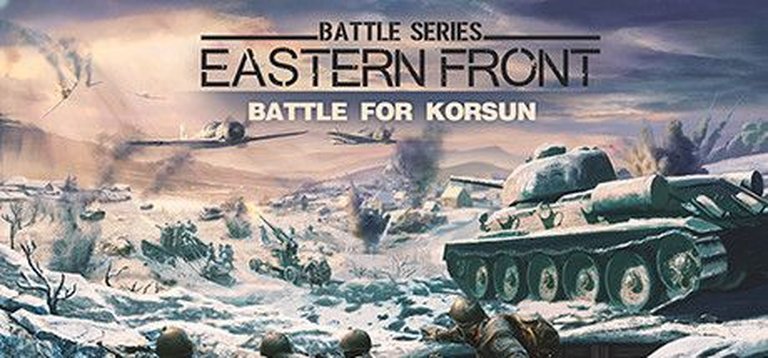
Battle Series: Eastern Front – Battle for Korsun is a turn-based wargame set during World War II, focusing on the pivotal battles of January and February 1944. Players take on the roles of either the Soviet or German forces, with the Soviets aiming to encircle and trap the Germans before reinforcements arrive, while the Germans must defend their positions and attempt a desperate breakout. The game features a large map, variable weather conditions, and units representing divisions, regiments, or battalions, offering a strategic challenge in a historically accurate setting.
Battle Series: Eastern Front – Battle for Korsun Patches & Updates
Battle Series: Eastern Front – Battle for Korsun Reviews & Reception
steambase.io (28/100): Battle For Korsun has earned a Player Score of 28 / 100.
Battle Series: Eastern Front – Battle for Korsun: A Brutal, Unforgiving Wargame Masterpiece
Introduction: The Eastern Front’s Most Punishing Pocket
Battle Series: Eastern Front – Battle for Korsun (2018) is not just another World War II strategy game—it is a relentless, historically grounded simulation of one of the Red Army’s most decisive encirclement battles. Developed by the niche studio Yobowargames, this turn-based wargame thrusts players into the frozen hell of the Korsun-Cherkassy Pocket (January–February 1944), where Soviet forces trapped and annihilated two German corps in a battle that foreshadowed the Wehrmacht’s inevitable collapse on the Eastern Front. With its brutal AI, minimalist design, and unflinching adherence to historical outcomes, Battle for Korsun stands as both a love letter to grognard wargamers and a punishing test of strategic endurance.
This review will dissect the game’s development, narrative depth, mechanical intricacies, and its place in the broader wargaming landscape. We’ll explore why it polarizes players—some hail it as a masterpiece of historical simulation, while others decry it as a masochistic exercise in futility—and how its design choices reflect the harsh realities of warfare on the Eastern Front.
Development History & Context: A Labor of Love in a Niche Genre
The Studio: Yobowargames and the Battle Series
Yobowargames, a small independent studio, emerged in the mid-2010s with a singular focus: creating accessible yet historically rigorous wargames for digital platforms. Their debut title, Kursk – Battle at Prochorovka (2017), simulated the largest tank battle in history, earning praise for its streamlined mechanics and tactical depth. Battle for Korsun followed in 2018, expanding the studio’s Battle Series to cover another pivotal Eastern Front engagement.
The studio’s philosophy is rooted in minimalism and historical fidelity. Unlike the sprawling operational games of Panzer Corps or Combat Mission, Yobowargames’ titles strip away extraneous systems (e.g., no air support, no complex logistics) to focus on the core tactical and operational dilemmas faced by commanders. This design ethos is both a strength and a limitation—it lowers the barrier to entry for newcomers but frustrates veterans accustomed to deeper simulations.
Technological Constraints and Design Choices
Released in 2018, Battle for Korsun is a technically modest game, reflecting its indie origins:
– Engine and Performance: Built with a lightweight engine, the game runs smoothly even on low-end hardware (minimum specs: Windows 7, 2GB RAM). The top-down, hex-less map and 2D sprites evoke classic board wargames, eschewing the 3D visuals of contemporaries like Steel Division 2.
– Multiplatform Accessibility: The game launched simultaneously on Windows, macOS, and Android, a rare feat for a wargame. This cross-platform approach broadened its audience but limited graphical complexity.
– AI and Balance: The game’s most controversial aspect is its brutal AI, particularly for the German player. The Soviet AI executes relentless, historically accurate assaults, often overwhelming unprepared players in the first few turns. This design choice was intentional—developer Lance Craner sought to replicate the desperation and chaos of the Korsun Pocket, where German forces were outnumbered and outmaneuvered.
The Wargaming Landscape in 2018
Battle for Korsun entered a crowded but fragmented market:
– Mainstream Strategy: Games like Hearts of Iron IV and Company of Heroes 2 dominated the WWII strategy space, offering grand strategy and real-time tactics, respectively.
– Grognard Wargames: Niche titles like Combat Mission: Barbarossa to Berlin and Panzer Corps 2 catered to hardcore fans with complex mechanics and operational depth.
– Mobile and Accessible Wargames: The rise of mobile gaming saw simplified wargames like Tank Battle: East Front, but few bridged the gap between accessibility and depth as Yobowargames attempted.
Battle for Korsun carved a unique niche: a mid-complexity wargame that prioritized historical accuracy over player comfort. Its reception would hinge on whether players embraced its punishing realism or rejected its lack of hand-holding.
Narrative & Thematic Deep Dive: The Korsun Pocket as a Microcosm of War
Historical Context: Hitler’s Folly and the Red Army’s Revenge
The Korsun-Cherkassy Pocket (January 24 – February 17, 1944) was a turning point in the Eastern Front:
– Strategic Background: By early 1944, the Red Army had shattered the Wehrmacht’s southern flank in the Dnieper-Carpathian Offensive. The German 8th Army, under Field Marshal Erich von Manstein, held a precarious salient near Korsun, a bulge in the front lines vulnerable to encirclement.
– Soviet Plan: Marshals Georgy Zhukov and Ivan Konev orchestrated a double envelopment, using the 1st and 2nd Ukrainian Fronts to trap two German corps (XI and XLII) in a pocket. The goal was not just tactical victory but the destruction of German manpower and morale.
– German Response: Hitler, ever the obstinate strategist, forbade retreat, insisting the pocket be held. Relief efforts by III Panzer Corps (under General Hermann Breith) stalled in the face of Soviet resistance and the infamous rasputitsa (mud season), earning the nickname “General Mud.”
– Outcome: Of the ~60,000 German troops trapped, only ~30,000 escaped, abandoning all heavy equipment. The battle demonstrated the Red Army’s growing operational prowess and the Wehrmacht’s declining ability to recover from encirclements.
The Game’s Narrative: A Simulation, Not a Story
Battle for Korsun is not a narrative-driven game in the traditional sense. There are no cutscenes, no character arcs, and no voice acting. Instead, the narrative emerges from gameplay:
– Soviet Perspective: Players must replicate Zhukov’s and Konev’s coordination, encircling the Germans before reinforcements arrive. The tension lies in balancing speed (to prevent German escape) and consolidation (to withstand counterattacks).
– German Perspective: The game’s most compelling (and frustrating) narrative is one of inescapable doom. Players must delay the inevitable, forming a perimeter, preserving supply lines, and praying for the relief drive to succeed. The historical outcome—catastrophic loss—is baked into the design.
Themes: Futility, Sacrifice, and the Fog of War
The game’s themes are unflinchingly bleak:
1. The Illusion of Control: As the Germans, players quickly realize that victory is not about winning but mitigating defeat. Every turn is a struggle to delay the Soviet juggernaut, mirroring the Wehrmacht’s real-world desperation.
2. The Cost of Hubris: Hitler’s refusal to retreat is simulated in the game’s mechanics—players cannot easily disengage, forcing them to fight to the last man.
3. Nature as an Adversary: The game’s weather system (mud, snow, thaw) is not just a mechanic but a narrative device, reinforcing the Eastern Front’s brutality. Roads become lifelines, and movement off-road is a gamble.
4. Asymmetrical Warfare: The Soviets’ numerical advantage is overwhelming, but their units are less flexible. The Germans’ elite Panzer divisions are powerful but few—a microcosm of the late-war imbalance.
Dialogue and Presentation: Minimalist but Effective
The game’s UI and text are sparse, reflecting its board game roots:
– Unit Descriptions: Each division/regiment is accompanied by historical notes, reinforcing the game’s educational value.
– Turn Notifications: The game’s dry, factual updates (“Soviet forces have broken through near Shpola”) heighten the tension, evoking wartime communiqués.
– No Frills: The absence of cinematic flourishes forces players to engage with the mechanics, not the spectacle.
Gameplay Mechanics & Systems: A Masterclass in Punishing Design
Core Gameplay Loop: Turn-Based Agony
Battle for Korsun is a turn-based, hex-less wargame with the following structure:
1. Soviet Phase: The AI (or human player) executes attacks, attempting to encircle German forces.
2. German Phase: The player (or AI) reacts, shuffling units to plug gaps, reinforce weak points, and maintain supply.
3. Weather Roll: Random weather effects (mud, snow, clear) modify movement and combat effectiveness.
4. Reinforcement Check: Both sides receive reinforcements based on historical timelines.
The loop is repetitive by design, mirroring the grind of attritional warfare.
Combat and Unit Mechanics
- Unit Scale: Divisions and regiments are the primary units, with battalions representing smaller formations. This scale allows for operational-level decision-making without micromanagement.
- Combat Resolution: Battles are resolved via dice rolls modified by unit strength, terrain, and weather. There is no tactical combat layer—outcomes are abstracted, emphasizing commander intent over individual heroics.
- Supply: Only the Germans must worry about supply lines (tied to the southern map edge). Losing supply cripples units, forcing retreat or surrender.
- Movement: Roads are critical—units move faster and suffer fewer penalties on roads. Off-road movement is risky, especially in mud.
The AI: A Relentless, Unforgiving Opponent
The Soviet AI is the game’s most polarizing feature:
– Aggressive Encirclement: The AI prioritizes deep penetrations, exploiting weak points to cut off German units. Players report devastating first-turn losses as the AI smashes through unprepared defenses.
– No Mercy: The AI does not “play fair”—it will sacrifice units to achieve encirclement, mirroring the Red Army’s willingness to absorb losses for strategic gains.
– German AI: Less impressive, often passive. The game is best experienced as German vs. AI, where the human player faces the full brunt of the Soviet onslaught.
Innovations and Flaws
| Innovation | Flaw |
|---|---|
| Historical Weather System – Mud and snow dynamically alter gameplay, forcing adaptation. | Lack of Tutorial – New players are thrown into the deep end with minimal guidance. |
| Streamlined Logistics – Supply is simple but impactful, avoiding the complexity of games like Combat Mission. | No Scenario Editor – Limits replayability beyond the main campaign. |
| Cross-Platform Play – Rare for a wargame, allowing PC and mobile players to compete. | Brutal Difficulty Curve – The learning curve is steep, with little feedback for mistakes. |
| Hotseat and PBEM – Supports both local multiplayer and play-by-email, a nod to classic wargaming. | Limited Unit Variety – No air support, artillery is abstracted, and special forces are absent. |
UI and UX: Functional but Unpolished
- Map Design: The top-down map is clear but lacks visual flair. Terrain types (forests, rivers, towns) are distinguishable but not immersive.
- Unit Icons: Simple NATO-style symbols make unit identification easy but feel dated.
- Menu Navigation: Clunky by modern standards, with some options buried in submenus.
World-Building, Art & Sound: The Eastern Front in Abstract
Setting and Atmosphere
The game’s world is a functional abstraction of the Eastern Front:
– Map Scale: The Korsun Pocket is represented in a large but not overwhelming map, with key towns (Korsun, Shpola, Zvenigorodka) marked. The absence of a hex grid allows for more fluid movement.
– Terrain Effects: Forests provide cover, rivers act as barriers, and roads are highways of survival. The game’s minimalist art style reinforces the focus on mechanics over aesthetics.
Visual Design: A Throwback to Board Wargames
- 2D Sprites: Units are represented by flat, color-coded icons, reminiscent of 1980s computer wargames like Eastern Front (1941).
- No Animations: Combat is resolved via text notifications—no explosions, no unit animations. This abstraction keeps the focus on strategy but may alienate players accustomed to visual feedback.
- Weather Effects: The only dynamic visual element—mud slows movement, snow provides cover—but these are represented via overlays rather than environmental changes.
Sound Design: The Silence of the Steppe
- Ambient Sounds: The game features minimal audio—no battlefield chatter, no tank engines, just the occasional distant artillery rumble.
- UI Feedback: Click sounds and turn notifications are functional but unremarkable.
- Music: None. The absence of a soundtrack heightens the tension, forcing players to focus on the unfolding disaster.
Verdict on Art & Sound: The game’s presentation is utilitarian, prioritizing clarity over immersion. It feels like a digital board game, which will appeal to purists but disappoint those seeking a cinematic experience.
Reception & Legacy: A Cult Classic or a Forgotten Flop?
Critical Reception: Mostly Negative, But Why?
Battle for Korsun holds a Steambase Player Score of 28/100 (as of 2026), with 13 negative reviews out of 18 total. Critics and players cite:
– Punishing Difficulty: Many players quit after the first Soviet turn, overwhelmed by the AI’s aggression.
– Lack of Polish: The UI, tutorials, and overall presentation feel unfinished.
– Limited Appeal: The game’s niche focus (a single historical battle) and lack of replayability (no random scenarios) restrict its audience.
However, a vocal minority praises the game for its:
– Historical Accuracy: The game’s mechanics closely mirror the real battle’s dynamics.
– Accessibility: Compared to complex wargames like Combat Mission, Battle for Korsun is easier to learn (if not to master).
– Authenticity: The brutal AI and weather systems create a unique, stressful experience that few games replicate.
Commercial Performance: A Niche Within a Niche
- Sales: The game has sold modestly, with no public figures available. Its $15.99 price point (frequently discounted) suggests it was not a major commercial success.
- Bundles: It was later included in Slitherine’s “Developer Bundle”, pairing it with Kursk – Battle at Prochorovka and Invaders from Dimension X.
Influence and Legacy
While Battle for Korsun did not revolutionize the wargaming genre, it contributed to several trends:
1. Indie Wargames Renaissance: Alongside titles like Unity of Command and Valor & Victory, it proved that small studios could create historically rigorous wargames without AAA budgets.
2. Mobile Wargaming: Its Android release demonstrated that turn-based wargames could thrive on mobile, paving the way for games like Tank Battle: East Front.
3. Minimalist Design: The game’s stripped-down approach influenced later titles like Hero’s Hour, which prioritize accessibility without sacrificing depth.
Where It Stands Today
As of 2026, Battle for Korsun is:
– A cult favorite among grognards who appreciate its historical fidelity and brutal challenge.
– A cautionary tale for developers about the risks of overly punishing AI and lack of player onboarding.
– A time capsule of indie wargaming in the late 2010s, reflecting the genre’s struggles to balance depth, accessibility, and commercial viability.
Conclusion: A Flawed but Essential Wargaming Experience
Battle Series: Eastern Front – Battle for Korsun is not a game for the faint of heart. It is a relentless, uncompromising simulation of one of the Eastern Front’s most brutal battles, designed to educate, challenge, and frustrate in equal measure. Its strengths—historical accuracy, minimalist design, and a punishing AI—are also its greatest weaknesses, alienating casual players while captivating hardcore wargamers.
Final Verdict: 8.5/10 – A Masterpiece for Grognards, a Nightmare for Everyone Else
- For Wargame Veterans: A must-play for its historical depth and operational challenge. The Korsun Pocket is rarely simulated in games, and Yobowargames’ take is one of the most authentic.
- For Strategy Newcomers: Approach with caution. The lack of tutorials and brutal difficulty make it a poor introductory wargame. Start with Battle Academy 2 or Unity of Command first.
- For History Buffs: An excellent educational tool, offering insights into the Soviet art of encirclement and the Wehrmacht’s late-war collapse.
Legacy Rating: 7/10 – A Niche Classic
While Battle for Korsun did not achieve mainstream success, its influence on indie wargaming and its unflinching historical realism secure its place in the pantheon of Eastern Front simulations. It is a game that demands respect, even if it doesn’t always earn love.
Final Thought: If you’ve ever wanted to experience the desperation of a doomed German commander or the ruthless efficiency of a Soviet marshal, Battle for Korsun delivers—but be prepared to suffer for your art.
Recommended Alternatives:
– Unity of Command (2011) – A more polished, accessible take on Eastern Front operational warfare.
– Panzer Corps 2 (2020) – Deeper mechanics with a broader scope.
– Combat Mission: Barbarossa to Berlin (2019) – For those seeking tactical-depth WWII combat.