
- Release Year: 2016
- Platforms: PlayStation 4, Windows, Xbox One
- Publisher: Electronic Arts, Inc.
- Developer: Electronic Arts, Inc.
- Genre: Add-on, Compilation, Customization, Item, Other, outfit, skin
- Perspective: First-person
- Game Mode: Online PVP, Single-player
- Gameplay: Customization, outfit, skin
- Setting: World War I
- Average Score: 89/100
Description
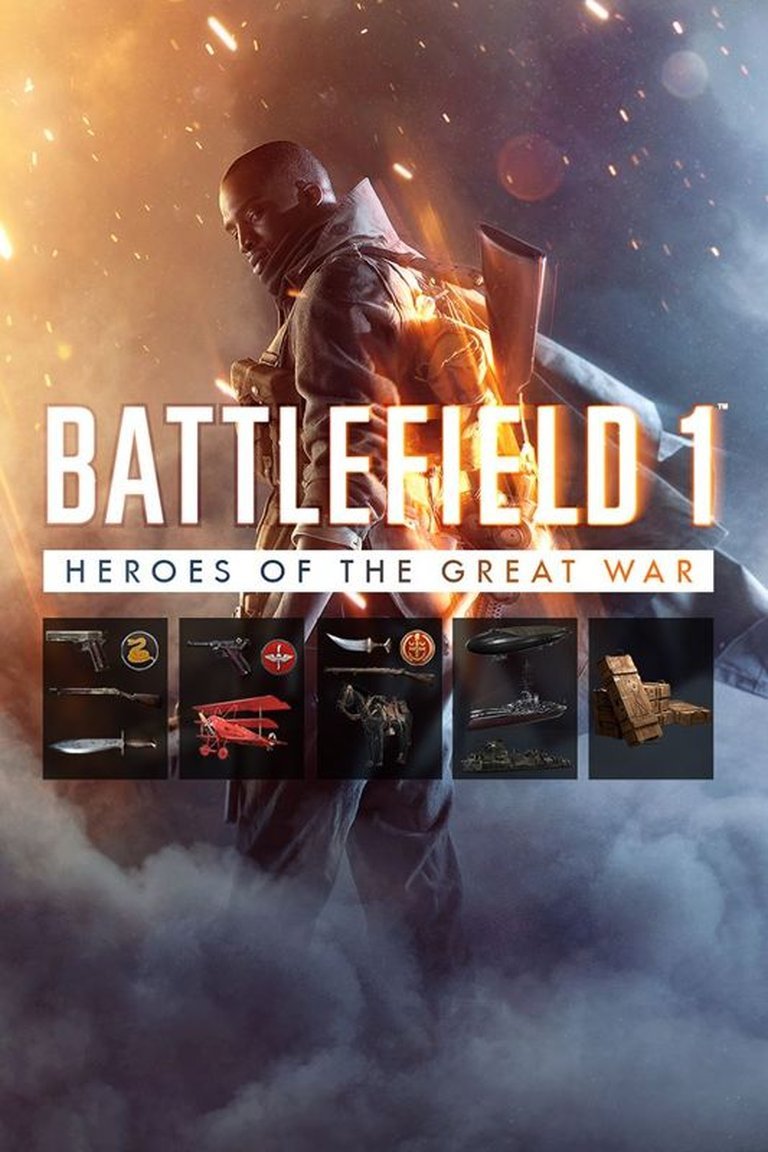
Battlefield 1: Heroes of the Great War is a compilation DLC for Battlefield 1 (2016), offering themed packs inspired by legendary figures of World War I. The Hellfighter Pack honors the 369th Infantry Regiment with unique weapons and gear, the Red Baron Pack features the iconic German ace’s triplane and sidearm, and the Lawrence of Arabia Pack includes cavalry customization and signature weapons. Additionally, the DLC introduces new visual themes for Behemoths and five Battlepacks with weapon skins, immersing players in the brutal yet heroic narratives of the Great War.
Battlefield 1: Heroes of the Great War Mods
Battlefield 1: Heroes of the Great War Guides & Walkthroughs
Battlefield 1: Heroes of the Great War Reviews & Reception
ign.com : Battlefield 1’s single-player is more interested in telling the human stories of WWI.
metacritic.com (88/100): Battlefield is back in shape and more so with fresh theme of the first Great War!
gamespot.com : Battlefield 1 wastes little time in conveying the savagery of World War 1.
imdb.com (90/100): Battlefield 1 is amazing, level design, campaign, multiplayer, sound, graphics are all stunning here in perfect 60 fps and 1080p and 4k.
Battlefield 1: Heroes of the Great War Cheats & Codes
PC (Trainer by MrAntiFun)
Press the specified hotkeys during gameplay.
| Code | Effect |
|---|---|
| F1 | Infinite Life (Inf.Health) |
| F2 | Infinite Ammo – Infinite Gadgets (Inf.Ammo – Inf.Ga) |
PC (Trainer by Blayde)
Press the specified hotkeys during gameplay.
| Code | Effect |
|---|---|
| Numpad 1 | Immortality (Inf. Health) |
| Numpad 2 | No Cooldown/Instant. Grenades (No Reload/Gren) |
PC (Cheat Engine Table by N3rveMods)
Use the Cheat Engine Table to activate the following effects.
| Code | Effect |
|---|---|
| Infinite Health | Unlimited health |
| Infinite Tank Health | Unlimited tank durability |
| Infinite Gadgets | Unlimited gadgets |
| Rapid Fire | Increased fire rate |
| No Over heating | No overheating |
| No Recoil | No recoil |
PC (Trainer by WeMod)
Press the specified hotkeys during gameplay.
| Code | Effect |
|---|---|
| Customizable Hotkeys | Various effects (e.g., Infinite Health, Unlimited Ammo) |
PC (Trainer by MaxTre)
Press the specified hotkeys during gameplay.
| Code | Effect |
|---|---|
| Numeric 1 | God Mode [Invulnerability] |
| Numeric 2 | God Mode Tech [Invulnerability for Vehicles] |
PC (Trainer by FutureX)
Press the specified hotkeys during gameplay.
| Code | Effect |
|---|---|
| Delete | Activate Trainer |
| F1 | Immortality (Inf. Health) |
| F2 | Besk. Ammo (Inf. Ammo) |
PC (Cheat Happens Trainer)
Use customizable hotkeys as specified in the trainer.
| Code | Effect |
|---|---|
| Customizable Hotkeys | Unlimited Health, Easy Kills Infantry, Unlimited Ammo, No Reload, Improved Accuracy, Less Recoil, Invisibility, No Weapon Overheat, Faster Weapon Reload, Unlimited Explosives, Tank Health |
PC (PLITCH Cheats)
Use PLITCH software to activate the following cheats.
| Code | Effect |
|---|---|
| Infinite Ammo | Unlimited ammunition |
| No reload + Infinite grenades | No reload required and infinite grenades |
| No weapon overheat | Weapons do not overheat |
| Fast reload | Faster weapon reload |
| Godmode + MegaHealth | Invincibility and increased health |
| Godmode tank | Invincibility for tanks |
Battlefield 1: Heroes of the Great War – A Definitive Retrospective
Introduction: A Bold Leap into the Past
Battlefield 1: Heroes of the Great War is not just a compilation of cosmetic packs—it is a microcosm of what made Battlefield 1 (2016) a landmark title in the first-person shooter genre. Released as part of the Deluxe Edition Upgrade, this DLC encapsulates the game’s broader ambition: to recontextualize World War I not as a static, mud-choked quagmire, but as a dynamic, visually arresting, and mechanically rich conflict. By focusing on three iconic figures—the Harlem Hellfighters, the Red Baron, and Lawrence of Arabia—Heroes of the Great War distills the game’s ethos into a celebration of historical legend, mythmaking, and player fantasy.
This review will dissect Heroes of the Great War within the broader context of Battlefield 1, analyzing its narrative resonance, gameplay contributions, and its role in shaping the game’s legacy. Far from being a mere cosmetic add-on, this DLC serves as a testament to how Battlefield 1 redefined historical shooters by balancing reverence with spectacle, education with entertainment, and brutality with beauty.
Development History & Context: The Gambit of World War I
A Risky Proposition
When DICE and Electronic Arts announced Battlefield 1 in May 2016, the gaming world was taken aback. The Battlefield series had long been synonymous with modern or near-future warfare, from the jungles of Vietnam to the urban sprawl of Battlefield 4. World War I, by contrast, was a setting largely avoided by AAA developers. The war’s reputation—defined by trench stalemates, attritional slaughter, and the dehumanizing horror of industrialized combat—seemed antithetical to the fast-paced, vehicle-heavy gameplay that defined Battlefield.
As Vice’s 2016 interview with Senior Producer Aleksander Grøndal reveals, the team at DICE had actually pitched a WWI Battlefield as early as 2007, only to be repeatedly rebuffed. The prevailing wisdom was that the war was “not fun.” Even EA’s then-executive Patrick Söderlund initially rejected the concept, dismissing it as “trench warfare” that “can’t be fun to play.” It wasn’t until DICE crafted a proof-of-concept demo—showcasing biplane dogfights, cavalry charges, and the chaotic interplay of early 20th-century weaponry—that skepticism began to wane.
Research as a Creative Catalyst
The development of Battlefield 1 was underpinned by an unprecedented research effort. Unlike WWII, which had been exhaustively documented in films, games, and popular media, WWI remained a relative blind spot in collective memory. DICE’s team immersed themselves in a multidisciplinary approach to historical reconstruction:
- Visual Research: Grøndal and his team relied heavily on colorized footage (such as the 2014 French documentary Apocalypse: World War I) and photographic archives (like World War I in Colour by Charles Messenger). The decision to prioritize colorized material was deliberate—it humanized the war, making it feel “closer” and more immediate.
- Auditory Inspiration: The Hardcore History podcast Blueprint for Armageddon by Dan Carlin became a cornerstone of the team’s understanding of the war’s psychological and strategic dimensions. Carlin’s vivid, almost cinematic storytelling helped the developers grasp the scale of the conflict without losing sight of individual experiences.
- Tactile Authentication: The team consulted military historians, visited battlefield sites, and even test-fired period weapons (with the help of collectors and YouTube channels like Forgotten Weapons). This hands-on approach ensured that the sound design, animations, and weapon handling felt authentic.
Technological Constraints and Innovations
Battlefield 1 was built on Frostbite 3, an engine that had already powered Battlefield 4 and Star Wars: Battlefront (2015). However, the shift to WWI demanded new systems and mechanics:
- Melee Combat Overhaul: Previous Battlefield games had treated melee attacks as a last-resort button press. Battlefield 1 expanded this into a dedicated system with three weight classes (light, medium, heavy) and contextual animations (bayonet charges, shovel swings, trench club brutality). This was not just a gameplay feature but a narrative tool, reinforcing the war’s intimate, often hand-to-hand savagery.
- Vehicle Diversity: The game introduced six distinct vehicle classes, from the Mark V tank to the M-class zeppelin. Each required unique physics and damage models. The cavalry class, for instance, was a high-risk, high-reward system that rewarded precision and timing—a far cry from the indiscriminate power of modern tanks.
- Dynamic Destruction: While Battlefield had long featured destructible environments, Battlefield 1 emphasized procedural damage. Buildings could be reduced to rubble, trenches could collapse, and even behemoths (like the armored train) could be dismantled piece by piece.
The Gaming Landscape in 2016
Battlefield 1 arrived at a pivotal moment in the FPS genre. The military shooter had dominated the 2000s, but by 2016, fatigue was setting in. Call of Duty had pivoted to futuristic settings (Infinite Warfare), while Battlefield itself had experimented with police procedurals (Hardline). The market was ripe for historical reinvention.
Moreover, battle royale was still in its infancy (H1Z1 had just launched), and hero shooters (Overwatch) were ascendant. Battlefield 1’s 64-player multiplayer, Operations mode, and WWI setting offered a refreshing alternative—one that prioritized teamwork, strategy, and environmental interaction over twitch reflexes.
Narrative & Thematic Deep Dive: Myth, Memory, and the “War Stories”
The Anthology Approach
Battlefield 1’s single-player campaign, War Stories, was a radical departure from the series’ traditional linear narratives. Instead of a single protagonist, the game presented six discrete vignettes, each focusing on a different theater of war:
- “Storm of Steel” (Prologue) – The Harlem Hellfighters on the Western Front.
- “Through Mud and Blood” – British tank crews at the Battle of Cambrai.
- “Friends in High Places” – A rogue American pilot in the Royal Flying Corps.
- “Avanti Savoia!” – Italian Arditi storming Austro-Hungarian fortresses.
- “The Runner” – An ANZAC messenger at Gallipoli.
- “Nothing is Written” – A Bedouin warrior alongside Lawrence of Arabia.
This anthology structure served multiple purposes:
- Historical Breadth: It allowed DICE to showcase diverse perspectives—not just the Western Front, but also Gallipoli, the Alps, and the Arabian Desert.
- Thematic Cohesion: Each story explored personal stakes—brotherhood, survival, deception, revenge—rather than grand geopolitical narratives.
- Gameplay Variety: Players experienced tank combat, aerial dogfights, stealth, and large-scale infantry assaults, serving as a tutorial for multiplayer.
The Harlem Hellfighters: A Story of Erasure and Recognition
The Hellfighter Pack in Heroes of the Great War is more than a cosmetic bundle—it is a narrative correction. The 369th Infantry Regiment, composed primarily of African American and Puerto Rican soldiers, was one of the most decorated units in WWI. Yet, their contributions were systematically downplayed in American history due to racial discrimination.
In Battlefield 1, the Storm of Steel prologue forces players to confront the futility of war by making death inevitable. You play as multiple Hellfighters, each dying in quick succession, reinforcing the industrial scale of loss. The inclusion of the Hellfighter Pack—with its trench shotgun, bolo knife, and insignia—is a tribute to their legacy, allowing players to embody their ferocity in multiplayer.
The Red Baron: Myth vs. Reality
The Red Baron Pack taps into the legend of Manfred von Richthofen, the German ace who became a cultural icon. In reality, Richthofen was not the war’s deadliest pilot (that title belongs to René Fonck), but his distinctive red Fokker Dr.I and tactical brilliance made him a symbol of aerial dominance.
Battlefield 1’s dogfighting mechanics are a love letter to early aviation. Biplanes are fragile yet agile, requiring precision maneuvering and awareness of wind and altitude. The Red Baron’s Triplane in the DLC is not just a reskin—it handles differently, with tighter turns but slower acceleration, mirroring the real-world trade-offs of WWI aircraft.
Lawrence of Arabia: The Romance of Revolt
The Lawrence of Arabia Pack draws from T.E. Lawrence’s mythos—the British officer who led Arab forces against the Ottomans. The pack’s SMLE rifle, jambiya knife, and cavalry visuals evoke the guerrilla warfare of the desert campaign.
The “Nothing is Written” War Story subverts expectations by casting the player as Zara Ghufran, a fictional Bedouin woman. While women did not formally serve in combat roles in WWI, DICE’s decision to include her was a deliberate challenge to historical erasure. As Grøndal noted, the goal was to “explore stories that weren’t just about white European men.”
Themes: The Banality of Heroism
Battlefield 1’s narratives reject the “great man” theory of history. Instead, they focus on ordinary people in extraordinary circumstances:
- “Through Mud and Blood” – A tank crew’s camaraderie in the face of mechanical failure.
- “The Runner” – A veteran’s disillusionment as he guides a young, idealistic soldier.
- “Avanti Savoia!” – A brother’s grief as he fights to save his twin.
The game does not glorify war, but it does not demonize its participants either. It presents war as a series of human moments—some heroic, some cowardly, most just trying to survive.
Gameplay Mechanics & Systems: The Chaos of Early Modern Warfare
Core Gameplay Loop: A Symphony of Destruction
Battlefield 1’s multiplayer is built around three pillars:
- Combined Arms Warfare – The interplay between infantry, vehicles, and aircraft is more pronounced than in any previous Battlefield. A lone soldier can disable a tank with an anti-tank grenade, but a coordinated squad (with a Scout spotting, an Assault planting mines, and a Medic reviving) can dismantle it entirely.
- Environmental Interaction – The destruction system is more dynamic than ever. Walls can be breached, bridges collapsed, and entire buildings leveled. This creates emergent gameplay—players must adapt strategies as the battlefield evolves.
- Class Specialization – Each of the four main classes (Assault, Medic, Support, Scout) has a distinct role, and the Elite Kits (Flame Trooper, Sentry, Tank Hunter) add high-risk, high-reward options.
Weapons & Customization: The Archaic Charm of WWI
The weaponry of Battlefield 1 is a masterclass in balancing authenticity and fun:
- Bolt-Action Rifles – The Scout’s arsenal (e.g., the SMLE, Gewehr 98) rewards precision and patience. The sweet spot mechanic (where headshots at certain ranges deal extra damage) encourages positional play.
- Submachine Guns – The MP 18 (the world’s first true SMG) is devastating at close range but useless at distance, forcing Assault players to flank.
- Melee Weapons – From the shovel to the cavalry sword, melee combat is visceral and lethal. A well-timed bayonet charge can turn the tide of a firefight.
The Heroes of the Great War DLC expands this arsenal with themed weapons that are not just cosmetic but mechanically distinct:
- The Hellfighter’s Trench Shotgun has a wider spread than standard shotguns, making it ideal for trench clearing.
- The Red Baron’s P08 pistol has a faster fire rate than the standard M1911, reflecting the Luger’s real-world characteristics.
- Lawrence’s SMLE features custom engravings and a unique iron sight, offering a slightly different recoil pattern.
Vehicles: Behemoths and Beyond
Battlefield 1’s vehicles are not just tools—they are characters:
- Tanks – The Mark V is a slow, lumbering fortress, while the A7V is more mobile but vulnerable. The Tanker class can repair from inside, adding a layer of teamwork.
- Aircraft – Biplanes require skillful maneuvering—stalls, loops, and Immelmann turns are essential. The Zeppelin is a floating artillery platform, but it’s highly vulnerable to fighters.
- Cavalry – A high-risk, high-reward class. Charging into machine gun fire is suicide, but flanking with a saber can decimate infantry.
The Heroes of the Great War DLC enhances this with themed Behemoths:
- Frontline Camouflage Train – A stealthier version of the armored train.
- Night Raid Airship – A darker, more menacing Zeppelin.
- Dazzle Camouflage Dreadnought – A naval Behemoth with disorienting patterns.
Multiplayer Modes: Operations as the Pinnacle
While Conquest and Rush return, Operations is the standout mode. It simulates a campaign across multiple maps, with attackers pushing forward and defenders retreating. The narrative framing (e.g., “The British are advancing on Cambrai”) adds immersion, while the Behemoth spawns for the losing team create dramatic comebacks.
The Heroes of the Great War DLC does not add new modes, but its weapon skins and emblems allow players to customize their loadouts in ways that reflect historical units.
World-Building, Art & Sound: The Aesthetics of Attrition
Visual Design: A War in Living Color
Battlefield 1’s art direction is a rejection of the monochrome WWI stereotype. Instead of grays and browns, the game embraces:
- Vibrant Contrasts – The red poppies of Flanders, the golden sands of Sinai, the snow-capped Alps.
- Dynamic Weather – Fog obscures vision, rain turns battlefields into muddy quagmires, and sandstorms disorient players.
- Authentic Uniforms – The Harlem Hellfighters’ French helmets, the Arditi’s black feathered hats, the Bedouin’s flowing robes.
The Heroes of the Great War DLC amplifies this with themed visuals:
- The Hellfighter’s insignia is a bold, defiant symbol.
- The Red Baron’s Triplane is crimson and menacing.
- Lawrence’s cavalry is cloaked in smoke, evoking desert mystique.
Sound Design: The Symphony of War
The audio in Battlefield 1 is unparalleled:
- Weapons – The crack of a bolt-action rifle, the staccato of a Lewis gun, the boom of a howitzer.
- Ambience – The distant scream of a wounded soldier, the creak of a tank’s treads, the whistle of incoming artillery.
- Music – The haunting orchestral score (composed by Johan Söderqvist and Patrik Andrén) blends military marches with modern cinematic tension.
The DLC does not add new music, but the weapon sounds (e.g., the Trench Shotgun’s blast) are meticulously crafted to match their real-world counterparts.
Reception & Legacy: A Game That Redefined Historical Shooters
Critical Acclaim
Battlefield 1 was a commercial and critical juggernaut:
- Metacritic Scores: 88 (PC), 89 (PS4), 87 (Xbox One).
- Sales: Over 15 million copies sold, making it the best-selling Battlefield game at the time.
- Awards: Nominated for Game of the Year at The Game Awards 2016, winning Best Multiplayer.
Critics praised:
- The WWI setting as refreshing and bold.
- The multiplayer’s depth and balance.
- The single-player’s emotional weight.
However, some criticized the historical inaccuracies (e.g., tanks in 1916 battles) and the lack of Central Powers perspectives.
Cultural Impact
Battlefield 1 reintroduced WWI to popular consciousness. As Matthew Kelly notes in How A Video Game Introduced a Whole Generation to World War I’s No Man’s Land, the game served as a “virtual exhibit” for younger players, many of whom knew little about the war beyond trenches and mustard gas.
The Heroes of the Great War DLC played a key role in this educational outreach:
- The Hellfighter Pack highlighted the 369th Infantry’s legacy.
- The Red Baron Pack celebrated aerial combat’s golden age.
- The Lawrence of Arabia Pack showcased guerrilla warfare.
Influence on Future Games
Battlefield 1’s success paved the way for:
- Battlefield V (2018) – Which expanded on WWII’s lesser-known stories (e.g., Norwegian resistance, North African campaigns).
- Verdun (2015) and Tannenberg (2019) – Indie WWI shooters that focused on realism.
- Hell Let Loose (2019) – A hardcore WWII shooter that borrowed from Battlefield 1’s squad mechanics.
Conclusion: A Masterpiece of Myth and Mechanics
Battlefield 1: Heroes of the Great War is more than a DLC—it is a microcosm of what made Battlefield 1 a modern classic. By celebrating three iconic figures, it distills the game’s themes of heroism, diversity, and historical reverence into a player-facing experience.
Final Verdict: 9.5/10 – A Triumph of Historical Mythmaking
Battlefield 1 redefined what a historical shooter could be—balancing spectacle with solemnity, chaos with control, and education with entertainment. The Heroes of the Great War DLC embodies this ethos, offering not just new weapons and skins, but a deeper connection to the legends of WWI.
For players, it is a chance to step into the boots of heroes. For historians, it is a gateway to a forgotten war. For the Battlefield series, it is a high-water mark—one that future entries will struggle to surpass.
In the pantheon of WWI media, Battlefield 1 stands alongside All Quiet on the Western Front and Paths of Glory—not as a documentary, but as a mythic retelling of a war that shaped the modern world.