
- Release Year: 2011
- Platforms: PlayStation 3, Windows, Xbox 360
- Publisher: ak tronic Software & Services GmbH, Electronic Arts, Inc.
- Developer: EA Digital Illusions CE AB
- Genre: Action
- Perspective: 1st-person
- Game Mode: Co-op, Online PVP, Single-player
- Gameplay: Quick Time Events (QTEs), Shooter, Vehicular
- Setting: Contemporary, War
- Average Score: 89/100
Description
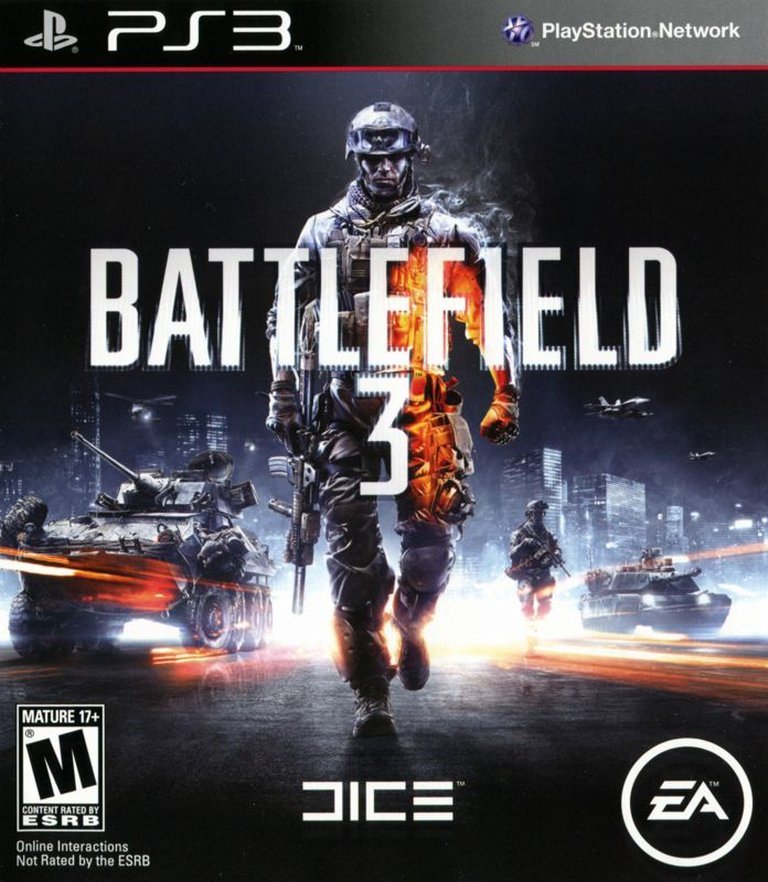
Battlefield 3 is a first-person shooter set in a near-future 2014, where players assume the role of Staff Sergeant Henry Blackburn and his squad as they battle the PLR, a terrorist organization threatening global security with chemical and nuclear weapons. The game features a disjointed single-player campaign with flashbacks, alongside a robust multiplayer mode offering class-based combat, vehicular warfare, and large-scale battles across various modes like Conquest and Rush. Powered by the Frostbite 2 engine, it emphasizes teamwork, destructible environments, and a cooperative mode, while introducing the Battlelog system for tracking stats and managing platoons.
Gameplay Videos
Where to Buy Battlefield 3
PC
Battlefield 3 Free Download
Battlefield 3 Cracks & Fixes
Battlefield 3 Mods
Battlefield 3 Guides & Walkthroughs
Battlefield 3 Reviews & Reception
metacritic.com (89/100): A triumphant return to form for the series.
ign.com : Battlefield 3 delivers scorching multiplayer, fitting of its decade-long pedigree of famously expansive big-team battles, but stumbles over a generic single-player campaign that feels like a different game.
monstercritic.com (89/100): BF3 is an absolutely massive experience, but it’s the explosive multiplayer mode that makes this the must-have FPS of the year.
Battlefield 3: A Defining Moment in First-Person Shooters
Introduction
Battlefield 3 (BF3) is more than just a game—it’s a landmark in the evolution of first-person shooters (FPS). Released in 2011 by DICE and published by Electronic Arts, BF3 arrived at a pivotal moment in gaming history, when the rivalry between Battlefield and Call of Duty was at its peak. With its groundbreaking Frostbite 2 engine, expansive multiplayer battles, and a renewed focus on realism, BF3 didn’t just raise the bar—it redefined what players expected from a modern military shooter.
This review will dissect BF3’s development, narrative, gameplay, and legacy, exploring why it remains one of the most influential titles in the genre. From its controversial single-player campaign to its revolutionary multiplayer suite, BF3 is a study in ambition, innovation, and the occasional misstep.
Development History & Context
The Studio and Vision
DICE (Digital Illusions Creative Entertainment) had already established itself as a leader in large-scale multiplayer shooters with Battlefield 1942 and Battlefield 2. However, the studio’s Bad Company sub-series (2008, 2010) had shifted focus toward a more arcade-like, console-friendly experience. With Battlefield 3, DICE sought to return to the franchise’s roots—delivering a hardcore, team-based shooter with unparalleled scale and realism.
The game’s development began in 2009, shortly after the release of Battlefield 1943. Initially, the PC was the lead platform, but midway through development, the focus shifted to consoles, a decision that would later draw criticism from PC purists. Despite this, DICE remained committed to pushing technological boundaries, leveraging the Frostbite 2 engine to create one of the most visually impressive games of its time.
Technological Constraints and Innovations
BF3’s Frostbite 2 engine was a marvel of its era, introducing Destruction 3.0, which allowed for unprecedented environmental degradation. Buildings could collapse realistically, debris would scatter dynamically, and even small objects like fences and walls could be destroyed. The engine also supported dense urban environments, a first for the series, and featured advanced lighting and particle effects that brought battlefields to life.
However, the engine’s demands were steep. The PC version required DirectX 10 or 11, effectively locking out Windows XP users—a controversial move at the time. Consoles, meanwhile, faced limitations: the Xbox 360 version shipped on two discs due to size constraints, and both console versions capped multiplayer at 24 players (compared to the PC’s 64), leading to smaller, less expansive maps.
The Gaming Landscape in 2011
BF3 launched into a fiercely competitive market. Call of Duty: Modern Warfare 3 was looming on the horizon, and the Battlefield franchise needed a standout title to challenge Activision’s juggernaut. EA’s marketing campaign was aggressive, with the company spending over $100 million to position BF3 as the superior alternative to Call of Duty. The rivalry was palpable, with EA executives openly declaring BF3 “flat out superior” to its competitor.
The game’s beta, released in September 2011, generated massive hype. Players were treated to a taste of the Frostbite 2 engine’s capabilities, and the response was overwhelmingly positive. However, the beta also revealed some of the game’s early flaws, including balance issues and server instability—problems that would persist at launch.
Narrative & Thematic Deep Dive
Plot Overview
BF3’s single-player campaign is a disjointed, flashback-driven narrative that follows Staff Sergeant Henry Blackburn, a U.S. Marine interrogated about his knowledge of a terrorist attack on New York City. The story unfolds through Blackburn’s recollections, jumping between different time periods and perspectives, including those of Dimitri “Dima” Mayakovsky, a Russian GRU operative.
The plot revolves around the People’s Liberation and Resistance (PLR), a terrorist organization led by Faruk Al-Bashir and the shadowy Solomon, who seek to detonate nuclear devices in Paris and New York. Blackburn and Dima’s paths intersect as they uncover Solomon’s plan, leading to a climactic showdown in the streets of Manhattan.
Characters and Dialogue
BF3’s characters are serviceable but lack depth. Blackburn is a generic protagonist, while Dima’s portrayal as a hardened Russian operative adds some intrigue. The villain, Solomon, is underdeveloped, serving more as a plot device than a compelling antagonist. The dialogue is functional, with occasional moments of tension, but it rarely rises above the standard military shooter fare.
The campaign’s structure is its biggest weakness. The nonlinear storytelling, while ambitious, often feels confusing and disjointed. Players are thrust from one set piece to another with little context, making it difficult to invest in the narrative. Quick-time events (QTEs) are overused, disrupting the flow of gameplay and reducing the player’s agency.
Themes: War, Betrayal, and Geopolitical Tension
BF3’s themes are familiar but executed with a degree of realism that sets it apart from contemporaries like Call of Duty. The game explores the fog of war, where alliances shift, and trust is a liability. Blackburn’s interrogation frames the story as a tale of betrayal and misinformation, with both the U.S. and Russian governments manipulating events to their advantage.
The game also touches on the human cost of war, particularly in the aftermath of the Paris nuclear detonation, where Dima and his squad suffer from radiation poisoning. These moments are brief but effective, grounding the otherwise over-the-top action in a semblance of realism.
Missions and Gameplay Variety
The campaign attempts to offer variety, with missions ranging from tank battles in the Iranian desert to aerial dogfights over Tehran. However, the execution is uneven. Some sequences, like the F/A-18 gunner segment, are thrilling, while others, such as the on-rails turret sections, feel dated and restrictive.
The game’s linear design is a stark contrast to the open-ended multiplayer, and the lack of player freedom is a missed opportunity. While the campaign is visually impressive, it ultimately feels like a secondary experience—a necessary evil to justify the game’s $60 price tag.
Gameplay Mechanics & Systems
Core Gameplay Loop
BF3’s multiplayer is where the game truly shines. The core gameplay loop revolves around team-based combat, with an emphasis on combined arms warfare. Players choose from four classes—Assault, Engineer, Support, and Recon—each with unique roles and loadouts. Success in BF3 hinges on teamwork, with players relying on each other for ammunition, healing, vehicle repairs, and reconnaissance.
The game’s conquest mode is the quintessential Battlefield experience, tasking teams with capturing and holding control points while depleting the enemy’s tickets. Rush mode, meanwhile, is a more linear, objective-based affair, with attackers pushing forward to destroy M-COM stations. Other modes, like Team Deathmatch and Squad Rush, offer faster-paced alternatives, though they lack the strategic depth of Conquest.
Combat and Weapon Mechanics
BF3’s gunplay is precise and weighty, with each weapon feeling distinct. The suppression mechanic is a standout feature, blurring the vision and reducing the accuracy of players under heavy fire—a realistic touch that encourages tactical play. The prone position, absent in the Bad Company games, returns, adding another layer of strategy to engagements.
Vehicles are a cornerstone of the Battlefield experience, and BF3 delivers in spades. Tanks, helicopters, and jets are all pilotable, with each requiring a different skill set. The engineer class is essential for vehicle combat, equipped with repair tools and anti-tank weaponry. The recon class, meanwhile, can deploy spawn beacons and motion sensors, making them invaluable for squad coordination.
Progression and Customization
BF3’s progression system is deep and rewarding. Players earn experience points (XP) for kills, objectives, and team actions, unlocking new weapons, attachments, and gadgets. The unlock tree is extensive, with each weapon featuring its own progression path. For example, the M16A3 assault rifle can be customized with various scopes, grips, and barrels, allowing players to tailor their loadouts to their playstyle.
The Battlelog system, a web-based social platform, tracks player statistics, allows for platoon creation, and even serves as the game’s launcher on PC. While innovative, Battlelog was initially plagued by bugs and usability issues, frustrating players who preferred a traditional in-game menu.
User Interface and HUD
BF3’s HUD is clean and functional, providing essential information without overwhelming the player. The minimap is a critical tool, displaying enemy positions (when spotted) and objective markers. The 3D spotting system, where players can mark enemies for their team, is a double-edged sword—useful for coordination but often exploited to create an unfair advantage.
The kill cam, a staple of modern shooters, is present but less intrusive than in Call of Duty. Instead of a cinematic replay, BF3 offers a brief, first-person perspective of the killer’s view, reinforcing the game’s focus on realism.
Innovations and Flaws
BF3 introduced several innovations that would become staples of the franchise:
– Destruction 3.0: The ability to level buildings and terrain added a dynamic element to battles, forcing players to adapt their strategies on the fly.
– Suppression Mechanic: A realistic touch that punished reckless play and rewarded teamwork.
– Battlelog Integration: A bold experiment in social gaming, though its execution was flawed.
However, the game was not without its flaws:
– Netcode Issues: Lag and hit detection problems plagued the multiplayer at launch, leading to frustration among competitive players.
– Class Imbalance: The recon class was often criticized for being overpowered, with snipers dominating long-range engagements.
– Map Design: Some maps, like Operation Metro, devolved into choke-point massacres, while others, like Caspian Border, were praised for their balance and scale.
World-Building, Art & Sound
Setting and Atmosphere
BF3’s campaign spans multiple locations, from the war-torn streets of Tehran to the bustling metropolis of Paris. Each environment is meticulously crafted, with a level of detail that was unprecedented in 2011. The Frostbite 2 engine renders everything from crumbling buildings to dust storms with stunning realism, immersing players in the chaos of war.
The multiplayer maps are equally impressive, with Caspian Border standing out as a masterclass in level design. The map’s vast open spaces, dense urban areas, and strategic choke points create a dynamic battlefield where every match feels unique. Other standout maps include Operation Firestorm, a desert oil field ripe for tank battles, and Grand Bazaar, a tight, infantry-focused arena.
Visual Direction
BF3’s visuals were a revelation in 2011. The Frostbite 2 engine’s dynamic lighting and particle effects brought battlefields to life, with explosions casting realistic shadows and debris scattering in believable ways. The game’s color palette is muted and realistic, eschewing the oversaturated hues of competitors like Call of Duty.
Character models are detailed, with animations that convey weight and impact. Soldiers stumble when shot, vehicles deform when damaged, and environmental destruction is both visually spectacular and tactically significant. The attention to detail extends to small touches, like the way dust kicks up as a tank rolls through a desert or the way glass shatters when a bullet strikes a window.
Sound Design
BF3’s audio design is a masterclass in immersion. The gunfire is punchy and distinct, with each weapon having a unique acoustic signature. The explosions are deafening, and the ambient sounds—from distant artillery to the chatter of teammates—create a living, breathing world.
The voice acting is solid, though not exceptional. The musical score, composed by Johan Skugge and Jukka Rintamäki, is understated but effective, heightening tension during key moments without overpowering the action.
Reception & Legacy
Critical and Commercial Reception
BF3 was met with widespread acclaim upon release, earning an 86% average critic score on MobyGames and an 89/100 on Metacritic for the PC version. Critics praised the game’s multiplayer depth, visual fidelity, and scale, though the single-player campaign was widely criticized for its linearity and lack of innovation.
IGN awarded the game a 9/10, calling it “an unforgettable, world-class multiplayer suite.” GameSpot gave it an 8.5/10, highlighting the “deep multiplayer mode” and “great variety of vehicles.” However, Eurogamer was more measured, scoring it 8/10 and noting that while the multiplayer was “brilliant,” the single-player was “crappy.”
Commercially, BF3 was a juggernaut. It sold 5 million copies in its first week, becoming EA’s fastest-selling game at the time. By 2012, it had moved 15 million units, proving that Battlefield could compete with Call of Duty in the mainstream market.
Awards and Accolades
BF3 received numerous awards, including:
– Best Shooter (2011) – IGN People’s Choice Award
– Best Multiplayer Game (2011) – IGN People’s Choice Award
– Outstanding Achievement in Sound Design – 15th Annual Interactive Achievement Awards
The game’s Frostbite 2 engine was particularly lauded, winning Best Graphics of the Year from 4Players and Best Sound in 2011 from PC Games (Germany).
Controversies
BF3 was not without its controversies:
– PlayStation 3 Exclusive Content: Sony initially promised a free copy of Battlefield 1943 with PS3 pre-orders, but this was later replaced with timed-exclusive DLC, leading to a lawsuit from disappointed gamers. EA eventually relented, offering the game for free.
– PETA Criticism: The game’s rat-stabbing QTE drew ire from People for the Ethical Treatment of Animals (PETA), who condemned it as “sadistic.”
– Iranian Ban: The game was banned in Iran due to its depiction of the country and its nuclear ambitions, with authorities cracking down on pirated copies.
Legacy and Influence
BF3’s influence on the FPS genre cannot be overstated. It redefined large-scale multiplayer combat, proving that 64-player battles could be both chaotic and balanced. The Frostbite engine became a cornerstone of EA’s portfolio, powering subsequent Battlefield titles, Star Wars Battlefront, and even FIFA.
The game’s class-based system and vehicle combat set a new standard for team-based shooters, influencing titles like Planetside 2 and Hell Let Loose. The destruction mechanics, while not perfected, laid the groundwork for future innovations in environmental interaction.
However, BF3’s legacy is also one of unfulfilled potential. The single-player campaign, while visually impressive, was a missed opportunity to deliver a narrative on par with the multiplayer’s depth. The Battlelog system, though innovative, was ultimately abandoned in favor of more traditional menus in later entries.
Conclusion: A Flawed Masterpiece
Battlefield 3 is a game of contradictions—a technical marvel with a forgettable campaign, a multiplayer masterpiece with persistent balance issues, and a groundbreaking experience that nonetheless left room for improvement. It is, in many ways, the quintessential Battlefield game: ambitious, flawed, and utterly unforgettable.
For all its shortcomings, BF3 remains one of the most important shooters of the 2010s. It pushed the boundaries of what was possible in a first-person shooter, delivering a scale and realism that few games have matched. Its multiplayer is still played today, a testament to its enduring appeal.
Final Verdict: 9/10 – A landmark title that redefined the genre, despite its flaws.
BF3 is not just a game—it’s a milestone in the evolution of first-person shooters. Whether you’re a fan of its chaotic multiplayer battles or a critic of its linear campaign, there’s no denying its place in gaming history.