
- Release Year: 2012
- Platforms: GameStick, Macintosh, Ouya, Windows
- Publisher: Goodhustle Studios, Inc.
- Developer: Goodhustle Studios, Inc.
- Genre: Action, Sports
- Perspective: 1st-person
- Game Mode: Single-player
- Gameplay: Arcade
- Average Score: 73/100
Description
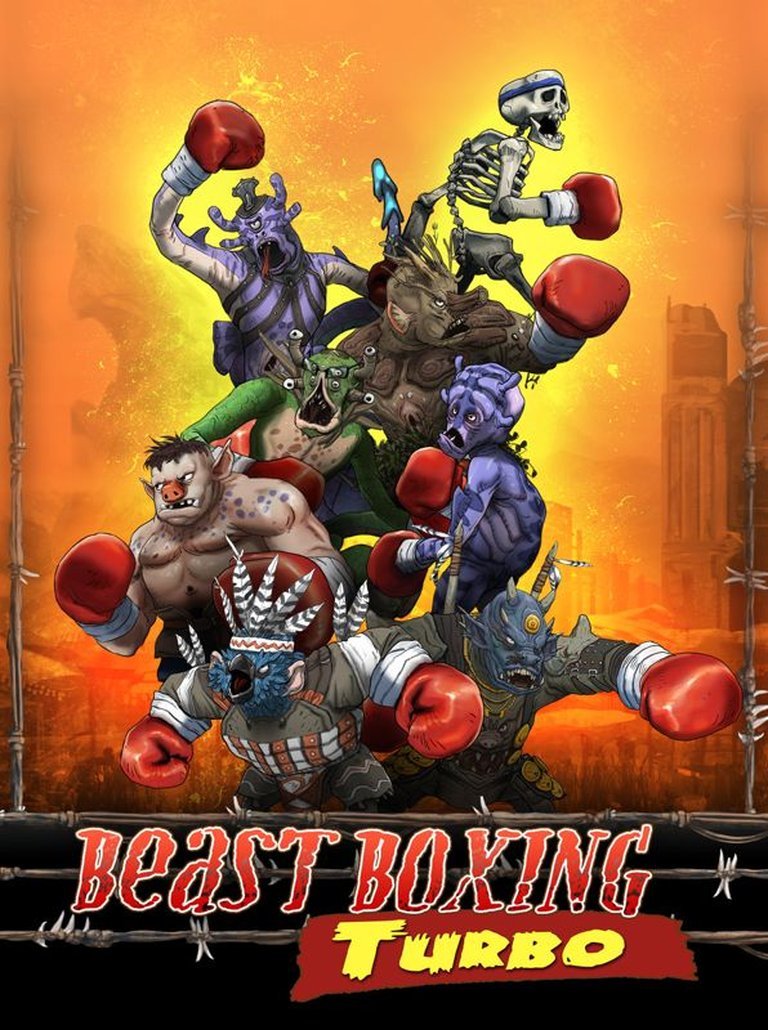
Beast Boxing Turbo is an arcade-style boxing game where you play as Char, a human who disguises herself in a monster costume to compete in the forbidden Beast Boxing Leagues. Guided by a washed-up pig coach, she battles through four leagues of beastly opponents, using prize money to upgrade over thirty-five pieces of gear and improve six skills in a quest for strength, fame, and human respect. The game features first-person perspective, knockout-only matches based on combos, and requires balancing health, fatigue, and hit streaks for fast-paced action.
Gameplay Videos
Where to Buy Beast Boxing Turbo
PC
Beast Boxing Turbo Free Download
Beast Boxing Turbo Cracks & Fixes
Beast Boxing Turbo Guides & Walkthroughs
Beast Boxing Turbo Reviews & Reception
metacritic.com (66/100): Beast Boxing Turbo features a totally unique fighting system that focuses on the zen of attack and defense, with deceptively simple, challenging gameplay, like the way boxing games used to be.
gamesreviews2010.com (80/100): Beast Boxing Turbo is a fun and challenging boxing game with a unique monster-themed setting.
hotwire3d.com : Beast Boxing Turbo is a great first-person action title. It strikes a good balance between being fun and challenging.
Beast Boxing Turbo: A Cult Classic of Monster Mayhem and Mechanical Mastery
Introduction: The Underdog in the Ring
In the vast, often homogenous landscape of sports simulations, Beast Boxing Turbo emerges not as a polished AAA contender but as a scrappy, fiercely independent indie fighter. Released in 2012 by the now-defunct Goodhustle Studios, this title represents a fascinating case study in iterative design, niche appeal, and the potent fusion of classic arcade sensibility with modern progression systems. It is a game that wears its inspirations—most notably the legendary Punch-Out!! series—on its sleeve while carving out a distinct identity through its monstrous rogues’ gallery, its punishingly deep combat systems, and its unwavering commitment to a specific, demanding fantasy. This review argues that Beast Boxing Turbo is a superb, if flawed, piece of game design: a title whose mechanical brilliance and artistic personality are occasionally hamstrung by its own austerity and brevity, yet which secures a lasting legacy as one of the most compelling and challenging boxing games of the 2010s.
Development History & Context: From Mobile Prototype to PC Redesign
Beast Boxing Turbo exists within a unique developmental lineage that speaks volumes about the ambitions and constraints of its era. Its origins lie in Beast Boxing 3D, a 2010 iOS title born from a prototype initially called Monster Boxing. Conceived and led by designer Gordon Luk with artist Khang Le (later art director on Hawken), the original mobile game was a product of its time: a smartphone-exclusive experience built around accelerometer-based movement and swipe controls. It was a competent, visually striking title that found an appreciative audience on the App Store, earning updates with new holiday opponents and an Endless mode.
However, Luk and Goodhustle Studios harbored larger ambitions. Drawing from two years of player feedback, they did not simply port Beast Boxing 3D to PC/Mac (and later Ouya and GameStick). Instead, they executed what Luk termed “a complete redesign.” The 2012 Turbo release jettisoned the mobile-specific control schemes for robust keyboard/mouse and gamepad support, overhauls the progression economy, expands the roster from 11 to 12 main opponents (reorganizing the league structure), and, most significantly, rewrote the narrative to fundamentally alter its thematic impact. This was an indie studio leveraging the relative accessibility of digital distribution platforms like Steam (via Greenlight) to refine and recontextualize its work, a practice that would become more common but was still relatively novel. The game’s eventual delisting from Steam in 2019 following Goodhustle’s closure tragically underscores the precarious existence of many such curated indie projects, transforming it from a purchasable title into a digital artifact preserved by archives and community memory.
Narrative & Thematic Deep Dive: The Human Disguise and the Weight of Prejudice
The narrative framework of Beast Boxing Turbo is deceptively simple, yet its execution carries significant thematic weight. The player assumes the role of Char, a human from the slums of Beasthalla who dreams of fighting in the exclusive Beast Boxing Leagues—a society where monsters dominate and humans are reviled as weak and inferior. To even step into the ring, she must don a “patchy monster costume,” a literal and metaphorical mask that defines her entire journey.
The genius of the Turbo revision lies in a crucial narrative change from the original 3D version. In the mobile original, Char’s humanity was a late-game twist. In Turbo, the secret is shared with the player from the outset, and her coach, the washed-up pig monster Piglas, knows her true identity from the moment she defeats him. This shifts the story from a simple reveal to a persistent, tense dramatic irony. Every fight is not just a sporting contest; it is a clandestine operation. The player is constantly aware that a single misstep—a torn costume, a revealing blow—could expose Char and shatter her dream. This infuses every bout with a layer of existential stakes beyond mere health depletion.
The thematic core is a potent allegory for prejudice and the underdog’s struggle against systemic bias. Char isn’t just fighting stronger opponents; she is fighting against an entire world’s preconceived notion of her worth. Her quest for “strength, fame, and respect for humans” is a fight for recognition and equality. The final twist—that the Ultra League champion, Darbech, is also a human in disguise—adds a layer of tragic complexity. It suggests that the price of success within the monster hierarchy is the erasure of one’s self, a fate Char ultimately rejects by fighting as her authentic self. The narrative, delivered through sparse but effective voice acting and Piglas’s grumbling mentorship, elevates the game from a pure mechanics tester to a story with a resonant, if straightforward, message about authenticity and perseverance.
Gameplay Mechanics & Systems: The Triangle of Tension
Where Beast Boxing Turbo achieves its greatest acclaim is in its meticulously crafted and brutally demanding combat system. It discards the realism of contemporary boxing sims like Fight Night for the tight, puzzle-box logic of arcade classics like Punch-Out!!, but with its own sophisticated tripartite resource management.
1. The Combat Triangle: Players have three core offensive tools—Jab (fast, low damage), Hook (medium speed/damage, requires lateral movement), and Uppercut (slow, high damage, vertical arc). Success hinges on reading an opponent’s “Guard Meter” (a boxing glove icon). If the opponent’s guard is high, a Hook or Uppercut will be blocked, leaving you vulnerable. If it’s low, a swift Jab becomes a prime opportunity. This creates a constant tactical loop: bait a block, punish the opening, manage your own recovery.
2. The Three Vital Meters: This is the game’s defining mechanical innovation.
* Power: Shared by both attacking and blocking. Every punch thrown or block held drains this meter. Depletion triggers Fatigue, slowing movement and resetting your crucial Streak meter.
* Streak: This builds with every clean hit landed and resets if you’re hit or fatigued. At maximum Streak, you enter a temporary “on fire” state with infinite Power and enhanced damage. This is the primary damage engine, making aggressive, uninterrupted combos the goal.
* Health: Standard regeneration over time, but “red damage” (sustained while fatigued) only recovers between rounds. This penalizes being overwhelmed and forces careful round management.
3. Match Structure & Progression: Matches are best-of-three rounds, won only by KO. This eliminates point-based decisions, making every round a desperate, all-or-nothing struggle. Between fights, the core loop is earning coins to spend in the gym on six permanent stats (Strength, Speed, etc.) and purchasing over 35 pieces of unique gear (gloves, shoes, armor, totems) that offer specific stat bonuses and visual flair. This gear system, a major evolution from the temporary power-ups of Beast Boxing 3D, allows for meaningful build-crafting—a “fast glass cannon” versus a “slow tank” approach—tailored to specific opponent patterns.
4. New Game+ & Endless: Unlocked after the main story, New Game+ retains all gear and stats but cranks up opponent difficulty, demanding near-perfect execution. Endless Mode provides a pure, score-attack challenge against a gauntlet of foes on one round with online leaderboards. These modes address the primary criticism of the main campaign’s brevity, offering substantial endgame challenge.
The system is elegant but exacting. A common Steam community criticism notes that certain “strafe-and-intercept” tactics can trivialize fights, revealing a potential balance flaw. Yet, for most players, the initial learning curve is severe. The game demands you internalize the rhythm of power expenditure, the cadence of your Streak building, and the unique tells of each monstrous opponent—a depth that rewards mastery immensely.
World-Building, Art & Sound: Beasthalla’s Brutal Ballet
Visually, Beast Boxing Turbo is a masterclass in stylized, readable animation within a modest technical scope. Khang Le’s monster designs are memorable and varied, moving away from generic beasts to specific, characterful archetypes: a fitness-obsessed skeleton (Steve), a snake-cyclops sensei (Kamander), a Frankenstein-esque brute (Frankenbeans). The first-person perspective is crucial; you see only your gloves and the opponent’s body, focusing attention entirely on the dance of punches and blocks. The animations are, as universally noted in reviews, “smooth” and “fluid,” with impactful, weighty feedback on connects. The “gorgeous” hand-drawn art style (described by Rock Paper Shotgun‘s Jim Rossignol as “lovely”) creates a cohesive, vibrant world that feels both cartoonish and violently physical.
The sound design is punchy and effective. The crack of a successful jab, the heavy thud of a hook landing, the guttural roars of the monsters—all provide critical auditory feedback. The music, by Shadi Muklashy and Kevin MacLeod, adopts an energetic, rock-tinged arcade vibe that drives the pace without overwhelming. Together, the audiovisual package “oozes style” (Gizmodo), selling the fantasy of a clandestine, high-stakes underground sport. The atmosphere is less gritty realism and more theatrical spectacle, perfectly matching the game’s over-the-top premise and demanding mechanics.
Reception & Legacy: The Niche Triumph
Upon its 2012-2013 release across PC, Mac, Ouya, and GameStick, Beast Boxing Turbo received a mixed-to-positive reception, aggregating to a 72% critic score based on the single MobyGames entry and a “Very Positive” ~89% user score on Steam from hundreds of reviews. Critics consistently praised its artistic style, fluid animations, and deep, rewarding combat system, frequently drawing favorable comparisons to Punch-Out!!. TouchArcade highlighted its strategic AI that adapts to repetitive moves, increasing replay value. The Mary Sue lauded it as a stand-out example of positive female protagonist representation, noting that “it’s a good boxing game” first and foremost, a significant achievement in a genre often criticized for its treatment of women.
However, criticisms were consistent: the game is too short (a point raised by Slide to Play, Gamezebo, and many user reviews), and its difficulty, while praised by some as “freakin’ hard” (the official description), was found by others to have exploitable loopholes that could trivialize the challenge. The lack of multiplayer was also noted, though the Endless and New Game+ modes were seen as partial remedies.
Its legacy is that of a cult classic. It did not achieve mainstream commercial success, and Goodhustle Studios’ 2019 closure, followed by the game’s Steam delisting, cemented its status as a lost gem. Yet, within specific communities—retro boxing fans, indie game aficionados, and those seeking challenging single-player experiences—its reputation has grown in esteem. It is remembered as a brilliant synthesis of old-school arcade design with modern RPG-lite progression, a game that respected the player’s intelligence and dexterity. Its influence is subtle but present: a reminder that sports games can be stylized fantasy, that first-person boxing can work, and that a deep, systemic combat loop can be built around a relatively simple controlscheme. It stands as a testament to the power of focused, iterative indie development.
Conclusion: A Flawed Gem of the Indie Rings
Beast Boxing Turbo is not a perfect game. Its campaign can be completed in a few hours by a skilled player, certain mechanics have balance quirks, and its obscurity means many will never experience it. Yet, to dismiss it on these grounds is to miss its profound achievements. It takes a heartfelt underdog story and marries it to a combat system of exquisite tension and reward. The frantic dance of managing your Power to build a Streak, while reading an opponent’s Guard Meter and choosing the correct punch type, creates a “flow state” that few games in the genre achieve. The gear and stat progression, while not endlessly deep, provide a compelling reason to replay and experiment.
In the pantheon of boxing video games, it sits alongside Punch-Out!! as a title that prioritizes pattern recognition and timing over simulation, but it carves its own niche with the monstrous setting and the relentless KO-or-nothing pressure. Its delisting is a loss to gaming preservation, but its echoes remain in the memories of those who fought through Beasthalla’s leagues. Beast Boxing Turbo is a definitive cult classic: a fiercely challenging, artistically distinct, and mechanically profound experience that demanded—and richly rewarded—its player’s dedication. It is a game that understands the core thrill of boxing is not in realism, but in the cathartic, sweat-inducing mastery of a brutal, beautiful dance. For those who seek that challenge, it remains a hidden title bout worth seeking out.