
- Release Year: 2001
- Platforms: Macintosh, Windows
- Publisher: EMME Interactive SA, Global Software Publishing Ltd.
- Developer: Lexis Numérique SA
- Genre: Adventure
- Perspective: 3rd-person, Top-down
- Game Mode: Single-player
- Gameplay: Action, Adventure, Inventory management, Minigames, Point-and-click, Puzzle
- Setting: Europe, Fantasy
- Average Score: 73/100
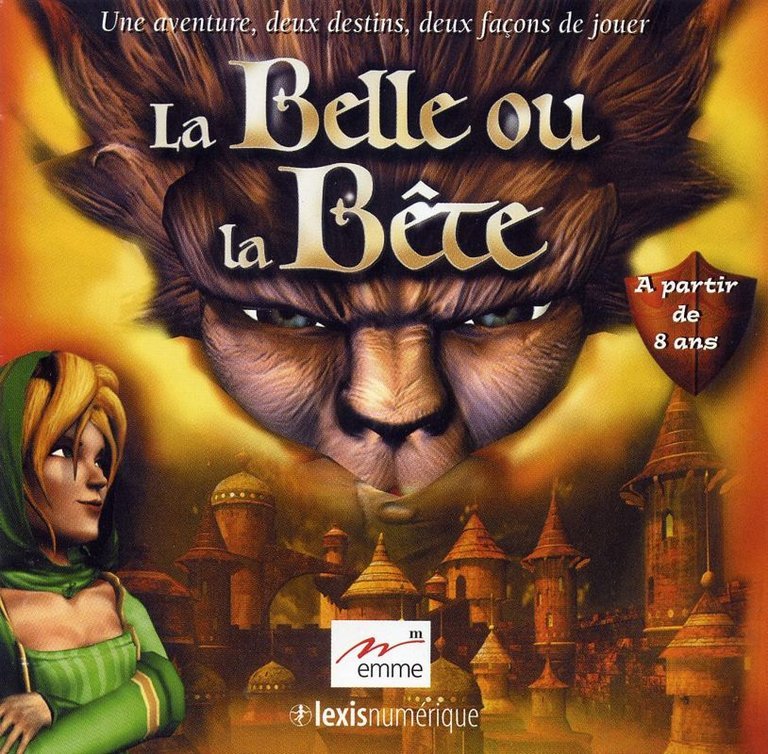
Description
Beauty or The Beast is a point-and-click adventure game set in a European fantasy castle, allowing players to experience the classic fairy tale from two unique perspectives: as Belle, who must rescue her imprisoned father from the Beast’s domain, or as the Beast, investigating intruders within his enchanted castle. The game features pre-rendered backgrounds, an automatically drawn map, and a variety of minigames including assembling armor, lighting torches, guiding frogs, and protecting moths, with owl brothers Horace and Boris providing assistance throughout the journey.
Beauty or The Beast Free Download
Beauty or The Beast Reviews & Reception
games.multimedia.cx : It’s a point and click adventure where she moves from room to well-illustrated room and generally finds a puzzle or minigame in each one.
Beauty or The Beast Cheats & Codes
Super Nintendo (SNES)
Enter Game Genie codes via a Game Genie device. Enter Pro Action Replay codes via a PAR device. For button sequences, pause the game and press the specified buttons.
| Code | Effect |
|---|---|
| 3CC8-3D0A | Don’t Take Damage From Some Enemies |
| 4AC8-47A8 | No Loss Of Light When The Candle Runs Off The Screen |
| C265-6407 | Infinite Flower Time |
| 3C6F-4F00 | Invinciible After Getting Hit |
| 3CC0-376A | Invincible (Turn Off To Pick Rocks Up – Spikes Still Do Damage) |
| 3CC0-37AA | Invincible (Turn Off To Pick Rocks Up – Spikes Still Do Damage) |
| EE66-4FAA | Death Flash Time Is Longer |
| C2E0-DF0F | Infinite Continues |
| 2D6F-4DA0 | Invulnerability |
| C2C8-3D0A | Unlimited Energy |
| C269-6407 | Unlimited Time |
| 4061-1706 | Hit Enemies From Anywhere |
| 4065-1FD6 | Hit Enemies From Anywhere |
| 4065-17A6 | Hit Enemies From Anywhere |
| 4066-1F66 | Hit Enemies From Anywhere |
| DD65-CD02 | Jump While In Mid-Air |
| 0A65-CD62 | Jump While In Mid-Air |
| 4065-CDA2 | Jump While In Mid-Air |
| BB65-CFD2 | Jump While In Mid-Air |
| C968-470A | Jump While In Mid-Air |
| EDB7-1DD3 | Moon Jump |
| Left, Y, L, Down, L+Select | Clear Stage |
| back, Y, L, Down, L+Select | Skip Levels |
| 7E1176:80 | Invulnerability |
| 7E1106:28 | Unlimited Health |
| 7E0420:09 | Unlimited Lives |
| 7E17C9:00 | Unlimited Misses Snowball Fight |
| 7E0DC8:00 | One Shot Kill Bosses |
| 7E15AD:0F | No Loss of Light When Candle Is Far |
| 7E15B1:99 | Stage 2 Stop Ascending Spikes |
| 7E10FA:01 | Time Never Depletes |
Sega Genesis / Mega Drive
Enter the button sequences at the appropriate times (e.g., at the title screen or during gameplay).
| Code | Effect |
|---|---|
| ⬆️, ➡️, Ⓐ, Ⓑ, Ⓐ, ⬇️, ⬅️, Ⓐ, ⬇️, Ⓑ, ⬆️, Ⓑ, Ⓑ, Ⓐ | Level Select |
| hold on Ⓐ+Ⓑ+Ⓒ | Level Skip |
Beauty or The Beast: Review
Introduction
In the pantheon of fairy-tale adaptations, few games dared to present a truly dualistic perspective until Beauty or The Beast graced Windows and Macintosh screens in 2001. Developed by French studio Lexis Numérique and published by EMME Interactive, this adventure game reimagined the classic tale not as a single narrative, but as two intertwined journeys—one through Belle’s eyes, the other through the Beast’s. This audacious choice—“Une aventure, deux destins, deux façons de jouer” (An adventure, two destinies, two ways to play)—promised a revolutionary experience. Yet, while its artistic ambition and inventive puzzles shine, the game’s execution is marred by technical quirks and pacing issues. This review dissects Beauty or The Beast as a product of its era—a flawed but fascinating artifact that dared to challenge adventure-game conventions while bearing the scars of early 2000s design constraints.
Development History & Context
Beauty or The Beast emerged from the fertile ground of European adventure-game development in the late 1990s and early 2000s. Lexis Numérique, known for its work on Alice in Wonderland (2000), crafted the game under the direction of Éric Viennot, who served as artistic director and dialogue writer. The studio leveraged pre-rendered 3D backgrounds—a popular technique at the time—to create the Beast’s castle, blending Gothic architecture with fantastical elements. Released in 2001 for Windows and later ported to Macintosh in 2003, the game operated under the shadow of Disney’s 1991 animated film, though its narrative diverged significantly, drawing instead from the original fairy tale’s thematic core.
Technologically, the game adhered to the point-and-click interface standards of the era. Its real-time pacing (unlike turn-based systems) and reliance on CD-ROM media for pre-rendered assets reflected the limitations and opportunities of the time. The industry landscape was dominated by LucasArts’ comedic adventures and Sierra’s narrative-heavy titles, but Beauty or The Beast carved a niche by emphasizing atmosphere and puzzle diversity. Its development involved 37 contributors, including voice actors Paul Bandey (Beast) and Barbara Scaff (Belle), whose performances added a layer of authenticity to the fantasy world.
Narrative & Thematic Deep Dive
The game’s greatest triumph lies in its dual narrative structure. Playing as Belle begins with her father’s imprisonment in the Beast’s castle, framing her quest as a rescue mission steeped in familial love and courage. Her journey through the castle—a labyrinth of cobwebbed halls, enchanted fountains, and sentient armors—unfolds with a fairy-tale logic that rewards curiosity. Conversely, the Beast’s storyline delves into introspection: a sepia-toned flashback reveals his cursed past as a prince transformed by a witch’s wrath. His investigation of “interlopers” becomes a metaphor for isolation and the duality of fear and vulnerability.
Themes permeate every scene:
– Inner vs. Outer Beauty: Belle’s grace contrasts with the Beast’s monstrous exterior, yet both share empathy.
– Redemption: The Beast’s quest mirrors his desire to break the curse through connection.
– Duality: Owl brothers Horace (Belle’s guide) and Boris (Beast’s advisor) symbolize opposing wisdoms—optimism vs. pragmatism.
Dialogue, while occasionally stilted, serves the narrative’s purpose. Unskippable cutscenes, a common point of contention, slow the pace but deepen character moments. For example, Belle’s interactions with enchanted objects hint at the castle’s sorrow, while the Beast’s gruff, world-weary voice (voiced by Bandey) humanizes him beyond his monstrous form.
Gameplay Mechanics & Systems
Beauty or The Beast operates on a classic point-and-click framework, but its minigames inject much-needed dynamism. Players navigate pre-rendered rooms, picking up items (keys, scrolls) and using them to unlock new areas. The automatic map streamlines orientation, yet the real-time pacing creates tension—players must solve puzzles before time runs out or face repetition.
Minigames are the game’s creative backbone:
– Frog Fountain: A Frogger-like puzzle where players guide amphibians across lily pads by clicking on them.
– Spider Moth Rescue: Click spiders to protect a moth navigating a web, requiring rhythm and precision.
– Armor Assembly: Reassemble knightly armor from scattered pieces—a spatial challenge.
– Torch Lighting: Click torches in sequence before they extinguish, testing reflexes.
These diversions prevent monotony but highlight the game’s flaws. Controls during minigames are often unresponsive or imprecise, and the inability to skip cutscenes or pause puzzles frustrates. The owl advisors provide hints, but their generic advice (“Look for clues!”) rarely solves specific deadlocks. Inventory management is straightforward, though some puzzles feel illogical—e.g., using a boat to traverse a subterranean lake without explanation.
World-Building, Art & Sound
The Beast’s castle is a character in itself. Lexis Numérique’s artists crafted gothic grandeur with lavish detail: towering staircases draped in cobwebs, suits of armor frozen in mid-stride, and gardens where frogs leap in fountains. Pre-rendered 3D backgrounds create depth, while 2D characters integrate seamlessly. Color palettes shift from Belle’s warm, village-inspired scenes to the Beast’s cold, sepia-toned memories, reinforcing duality.
Sound design enriches this world. Jean-Pascal Vielfaure’s score oscillates between melancholic piano melodies and whimsical woodwind passages, adapting to each character’s path. Voice acting, though occasionally accented, adds life—Paul Bandey’s gravelly Beast conveys hidden tenderness, while Barbara Scaff’s Belle radiates determination. Sound effects, like clanking armor or dripping water, amplify immersion. Yet technical glitches (e.g., audio desync during minigames) and repetitive environmental noises occasionally break the spell.
Reception & Legacy
Beauty or The Beast received a modest critical reception. Aggregated scores on MobyGames average 73%, with reviews reflecting its strengths and weaknesses:
– CyberMycha (83%) praised its “rewelacyjna fabuła” (fabulous storyline) and graphics but noted “fatalne sterowanie” (fatal controls).
– Adventure Island (70%) called it “sfeervol” (atmospheric) for children but criticized its brevity for adults.
– Feibel.de (67%) lamented “technisch eher mau” (technically mediocre) navigation.
Commercially, the game faded quickly, overshadowed by Disney’s multimedia dominance. Yet its legacy persists among adventure-game enthusiasts. It’s remembered for its innovative dual-path structure, a concept later explored in titles like Indigo Prophecy (2005). Abandonware communities (e.g., MyAbandonware) preserve it, though modern players often struggle with its technical quirks. The game’s minigame variety influenced puzzle design, and its artistic direction remains a benchmark for fairy-tale aesthetics.
Conclusion
Beauty or The Beast is a paradox: a game brimming with creativity yet hampered by execution. Its dual narrative and inventive puzzles represent a bold experiment in interactive storytelling, while its art and sound evoke a fairy-tale wonder few modern titles replicate. Yet, clunky controls, unskippable dialogue, and uneven pacing ground its ambitions. Historically, it stands as a testament to the risks of early 2000s adventure design—where artistic vision often outpaced technological capability. For players willing to overlook its flaws, it offers a unique journey through love and redemption. For historians, it’s a vital artifact of how fairy tales were reimagined before the indie revolution. Verdict: A flawed gem that enriches the adventure genre’s tapestry, even if it never reaches the heights it aspires to.