
- Release Year: 2003
- Platforms: Windows
- Publisher: Nooldsoft
- Developer: Nooldsoft
- Genre: Puzzle
- Perspective: Side view
- Game Mode: Single-player
- Gameplay: Falling block puzzle, Word construction
Description
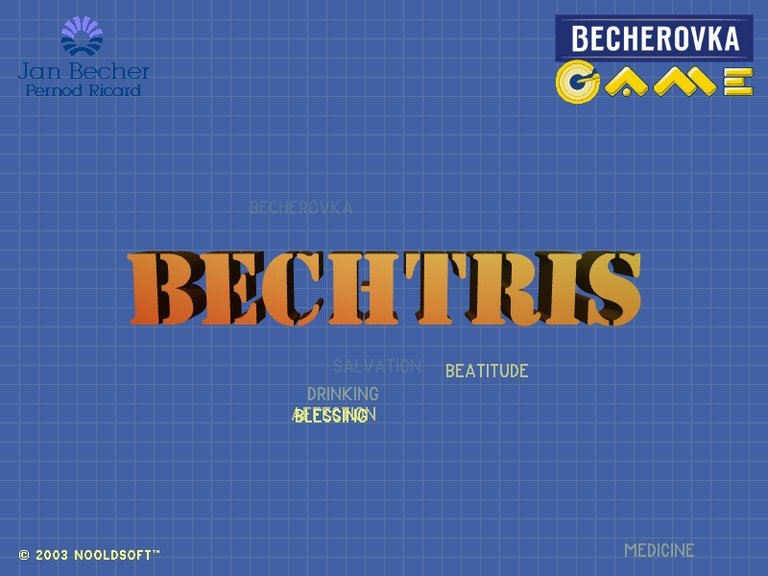
Bechtris is a falling-block puzzle game where players arrange lettered blocks to form words within a bottle-shaped playfield, accompanied by a dictionary sidebar ordered by word length. Forming words longer than three letters unlocks helpful bonuses, with a secret reward for spelling ‘Becherovka’; horizontal words clear their row, vertical ones eliminate all spanned rows, and the game ends if blocks reach the bottle’s neck.
Bechtris: Review
Introduction
In the vast ocean of Tetris clones that flooded the early 2000s freeware scene, Bechtris emerges as a peculiar yet endearing curio—a falling-block puzzler that swaps geometric tetrominoes for alphabetic bricks, challenging players to spell words amid a bottle-shaped arena. Released on November 15, 2003, by the obscure Nooldsoft studio for Windows PCs, this freeware gem captures the addictive essence of Alexey Pajitnov’s 1984 masterpiece while infusing it with word-game wit. Its playfield, cleverly molded like a bottle of Becherovka (the Czech herbal liqueur that inspired its secret bonus), evokes a tipsy lexicon of linguistic derring-do. As a game historian, I argue that Bechtris exemplifies the indie spirit of the post-Tetris era: innovative on a shoestring, unapologetically niche, and a testament to how freeware preserved puzzle evolution when AAA titles chased photorealism. Though overlooked in its time, it endures as a delightful hybrid of block-stacking compulsion and Scrabble-like strategy, perfect for vocabulary nerds craving real-time mayhem.
Development History & Context
Bechtris was birthed in 2003 by Nooldsoft, a one-man or small-team operation with scant digital footprint beyond this title’s MobyGames entry (added in 2014 by contributor Tomas Pettersson). Publisher and developer alike, Nooldsoft operated in the freeware ecosystem—public domain downloads hosted on personal sites or early shareware portals—eschewing commercial ambitions amid a gaming landscape dominated by behemoths like Grand Theft Auto: Vice City, The Legend of Zelda: The Wind Waker, and Call of Duty. This was the sixth console generation’s zenith: PS2 sales exploding, Xbox challenging with Halo’s multiplayer revolution, and PC gaming buoyed by MMOs like EverQuest II and strategy epics like Warcraft III: The Frozen Throne.
Technological constraints shaped Bechtris‘ simplicity. Windows XP era meant modest DirectX support, but Nooldsoft leaned into keyboard-only input and fixed/flip-screen visuals—hallmarks of Electronika 60-era Tetris ports. Drawing from Pajitnov’s Soviet origins (where Tetris spread via floppy disks due to absent IP laws), Bechtris echoes that bootleg ethos: free, unpolished, viral by word-of-mouth. The bottle playfield nods to Becherovka, suggesting a cultural wink—perhaps the developer’s tipple of choice—mirroring how early Tetris variants exoticized Soviet roots with folk tunes. In a year of Madden NFL 2004’s playbook depth and SSX 3’s open mountains, Bechtris thrived as browser-fodder, akin to flash puzzles on Newgrounds, proving puzzles needed no budgets to hook players.
Narrative & Thematic Deep Dive
Bechtris eschews traditional narrative for pure abstraction, a la Tetris—no plucky plumber or lightsaber duels, just letters plummeting toward oblivion. Yet, in its void lies profundity: the “plot” unfolds as a Sisyphean battle against linguistic entropy, where players stave off the bottle’s inexorable fill-up. The dictionary sidebar—ordered by word length—serves as a silent oracle, whispering valid spells from three-letter minima to grandiose polysyllables. Themes emerge organically: language as architecture, blocks forming words like bricks in Babel’s tower; intoxication via lexicon, with the Becherovka bonus (spelling the liqueur’s name) unlocking “secret” ease, evoking boozy epiphanies; and vertical ambition, where vertical words purge multi-rows, symbolizing depth over breadth.
Characters? Absent, save anthropomorphic letters—vowels as saviors, consonants as clutter. Dialogue? Nil, but the game’s rhythm pulses like internal monologue: “Z-O-N-E? No. O-N-E-Z? Invalid.” This metaphysical sparsity aligns with Reddit debates on lore vs. history (from source material): Bechtris offers no “lore” (mythic backstories like Mass Effect’s Genophage) but rich “history”—each session a chronicle of cleared lines, bonuses earned. Thematically, it probes cognition: wordplay under pressure mirrors Tetris’ “effect” (dream-invading patterns), blending pentomino roots with anagram anarchy. Flawed? No emotional arc risks rote sessions, but its purity elevates it beyond gimmick.
Gameplay Mechanics & Systems
At its core, Bechtris refines Tetris’ real-time falling-block loop with word-construction genius. Pieces bearing single letters descend into a side-view bottle arena; rotate and position to form dictionary words horizontally (clearing one row) or vertically (erasing all spanned rows—a multiplier boon). The left-flanking dictionary lists valid terms by length, gamifying vocabulary: three-letter words suffice, but four-plus unlock bonuses easing play (e.g., slower drops? Source implies unspecified aids). The holy grail—”Becherovka”—triggers a secret super-bonus, demanding Jenga-like precision amid chaos.
Core Loop Deconstruction:
– Entry & Manipulation: Direct keyboard control (arrows/rotate) mirrors classic Tetris; no hold queue or bags, heightening chaos.
– Clearing & Progression: Horizontal: single-row vanish (Tetris-line homage). Vertical: multi-row purge, rewarding tall stacks—risky, as overflow to the “neck” ends the game.
– Progression: Real-time pacing accelerates implicitly (unconfirmed, but Tetris-standard); scores via lines/bonuses.
– UI/UX: Flip-screen simplicity shines—no clutter, dictionary as HUD. Flaw: opaque bonuses (player-inferred?); no tutorials risk newbie frustration.
Innovations shine: wordplay adds cerebral layer absent in shape-only Tetris, fostering combos (spell “BONUS” for meta-gains?). Flaws: limited dictionary (English-only?) curbs replay; no multiplayer isolates it. Yet, systems synergize addictively—stack for vertical nukes, hoard vowels, chase Becherovka—like Boggle meets Bejeweled.
World-Building, Art & Sound
Bechtris‘ “world” is minimalist: a translucent bottle playfield conjures alchemy lab or distillery, blocks as fermenting letters. Side-view perspective evokes 2D Tetris wells (Welltris nod?), fixed/flip-screen suiting monitor-era play. Visuals: sparse, pixelated letters on blocks—functional, evoking 1985 IBM PC Tetris (spaces/brackets). Atmosphere? Claustrophobic neck looms like guillotine, building dread; dictionary glows as lifeline.
Art direction prioritizes clarity: bottle curves constrain stacks organically, preventing infinite cheese. No cel-shaded flair (ala Wind Waker), but charm lies in restraint—freeware chic.
Sound: Unspecified, likely chiptune beeps for drops/clears (Tetris DNA: Korobeiniki absent, perhaps generic loops). Freespace for imagination: drops “plink” like ice in Becherovka, clears “pop” like uncorking. Collectively, elements forge immersion: bottle as microcosm, visuals/auditory cues amplifying tension. Contribution? Pure focus—distractions nil, compulsion total.
Reception & Legacy
Launch reception: Muted. MobyGames logs n/a critic score, one player rating (3.4/5)—”middling” for freeware, no reviews. 2003’s deluge (KOTOR, SoulCalibur II) buried it; no ad blurb, patches, or forums. Collected by two players, it slumbered till 2014 digitization.
Reputation evolved: Obscure cult artifact, symbolizing freeware’s unsung role post-Tetris boom (520M+ sales). Influences? Echoed in word-Tetris hybrids (e.g., later mobile Alphablocks), but niche. Industry impact: Minimal direct, yet preserves 2003’s casual surge (pre-App Store). Like Tetris’ Hall of Fame induction, Bechtris merits emulation—Windows abandonware risks extinction. Legacy: Footnote in clone canon, underscoring indie puzzles’ endurance amid blockbusters.
Conclusion
Bechtris distills Tetris’ timeless hook—stack, clear, ascend—into a lexical liquor, blending falling-block frenzy with wordplay wizardry. Nooldsoft’s 2003 freeware opus triumphs in simplicity: bottle arena innovates, bonuses intrigue, mechanics mesmerize. Lacking narrative depth or polish, it soars via pure play—addictive, cerebral, Czech-infused charm.
In video game history, amid 2003’s titans, Bechtris claims a humble pedestal: essential for puzzle purists, a freeware relic demanding revival. Verdict: 8/10—niche masterpiece, eternal pour for Tetris faithful. Download, spell, savor; the bottle awaits.