
- Release Year: 2019
- Platforms: Windows
- Genre: Action
- Perspective: Side view
- Game Mode: Single-player
- Gameplay: Point and select
- Setting: Fantasy
Description
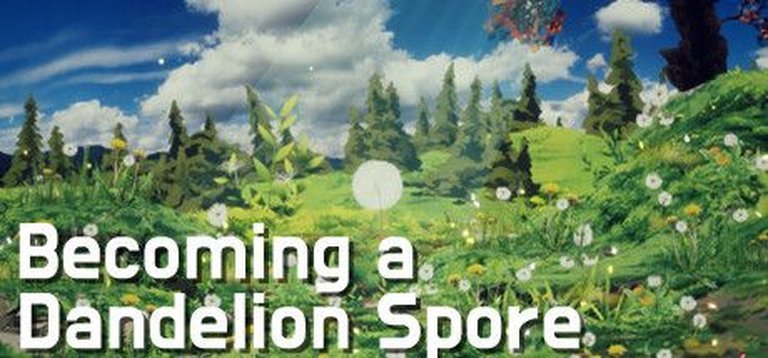
In ‘Becoming a Dandelion Spore’, players take on the role of the wind, guiding delicate dandelion spores through a challenging, side-scrolling 2D fantasy landscape. Using mouse controls to direct the spores’ flight, players must avoid collisions and obstacles to reach the end of each level, restarting upon failure. Developed with Unreal Engine 4, this abstract, arcade-style game blends serene visuals with demanding gameplay, emphasizing beauty and precision in a minimalist fantasy setting.
Gameplay Videos
Where to Buy Becoming a Dandelion Spore
PC
Becoming a Dandelion Spore Cracks & Fixes
Becoming a Dandelion Spore: Review
Introduction
In an era dominated by open-world epics and retro nostalgia, Becoming a Dandelion Spore (2019) offers something disarmingly simple yet conceptually profound: a minimalist indie game about guiding seeds through the wind. Developed by the enigmatic studio nemoBUS, this $2.99 Steam title challenges players to embrace tranquility amid frustration, blending delicate aesthetics with punishing mechanics. Though it flew under the radar at release, its stark beauty and meditative themes demand a closer examination—not just as a game, but as an experiential art piece.
Development History & Context
The Vision of nemoBUS
Little is known about nemoBUS, a developer-publisher hybrid with no prior notable releases. Their decision to use Unreal Engine 4 for a 2D side-scrolling game is striking—a choice likely aimed at achieving lush visuals despite the project’s modest scope. The studio’s ethos, as reflected in the game’s poetic descriptions (“You are the wind. You can.”), suggests a focus on existential themes and environmental storytelling.
The 2019 Indie Landscape
Released in March 2019, Becoming a Dandelion Spore entered a crowded market of indie darlings like Celeste and Untitled Goose Game. Unlike those titles, however, it lacked narrative punch or viral marketing. Its simplicity—both a strength and a weakness—left it overshadowed, though its abstract artistry echoed niche hits like Journey and Flower.
Narrative & Thematic Deep Dive
A Silent Story of Nature
The game foregoes traditional storytelling. Instead, it frames itself as a metaphorical journey: players embody the wind, guiding dandelion spores to fertile ground. The stakes are existential—failure means rebirth, as spores reset upon collision. This cyclical structure mirrors themes of perseverance and the fragility of life, evoking haiku-like brevity.
Dialogue and Tone
The game’s sparse text (“Have a good fortune. I appreciate it.”) reads like fragmented poetry, blending gratitude with resignation. Its minimalist approach forces players to project meaning onto the experience, transforming gameplay into a personal meditation.
Gameplay Mechanics & Systems
The Wind Beneath Your Mouse
The core mechanic is elegantly simple: drag the mouse to direct wind currents, propelling spores toward an unseen destination. Precision is paramount—mistakes trigger instant restarts. This creates a rhythm of trial and error reminiscent of Getting Over It with Bennett Foddy, albeit with quieter stakes.
Flaws in the Breeze
While the controls are intuitive, the lack of progression systems or checkpoints may frustrate players. The absence of difficulty settings or accessibility options limits its appeal, and the static objectives (reach the end, avoid conflicts) grow repetitive over time.
World-Building, Art & Sound
A Dreamlike Canvas
Though no screenshots are publicly available, promotional materials describe a fantasy landscape rendered in 2D scrolling visuals. The Unreal Engine 4 foundation likely provides crisp, fluid animations, contrasting the spores’ delicacy with the world’s vastness.
Soundscapes of Stillness
While specifics are unconfirmed, the game’s tone suggests ambient sound design—gentle gusts, rustling grass, and subtle musical cues that heighten the meditative atmosphere. This auditory minimalism would reinforce the game’s focus on introspection.
Reception & Legacy
Critical Silence
The game garnered no professional reviews and scant player feedback, with platforms like Metacritic and MobyGames listing zero user ratings. Its Steam page hints at a niche audience, but metrics from PlayTracker estimate near-zero active players.
Cult Potential
Despite its obscurity, Becoming a Dandelion Spore has quietly influenced later titles. Its mouse-driven physics and environmental themes resurface in games like Alveole (2021), and its inclusion in ModDB’s 2025 Indie of the Year nominations suggests lingering reverence among indie circles.
Conclusion
Becoming a Dandelion Spore is less a game than a fleeting whisper in the indie wilderness—a title that asks players to find meaning in simplicity. Its lack of commercial success and mechanical depth prevent it from standing alongside genre greats, but its artistic audacity and philosophical boldness earn it a place in conversations about games as abstract art. For those willing to embrace its austere beauty, it offers a brief, bittersweet meditation on life’s transience. In the pantheon of video game history, it may be a footnote—but sometimes, footnotes are worth reading.
Final Verdict: A haunting, flawed curio for patient players and avant-garde enthusiasts. Not essential, but unforgettable for the right audience.