
- Release Year: 2012
- Platforms: Windows
- Publisher: S.A.D. Software Vertriebs- und Produktions GmbH
- Genre: Compilation
- Game Mode: Single-player
- Gameplay: Match-3
Description
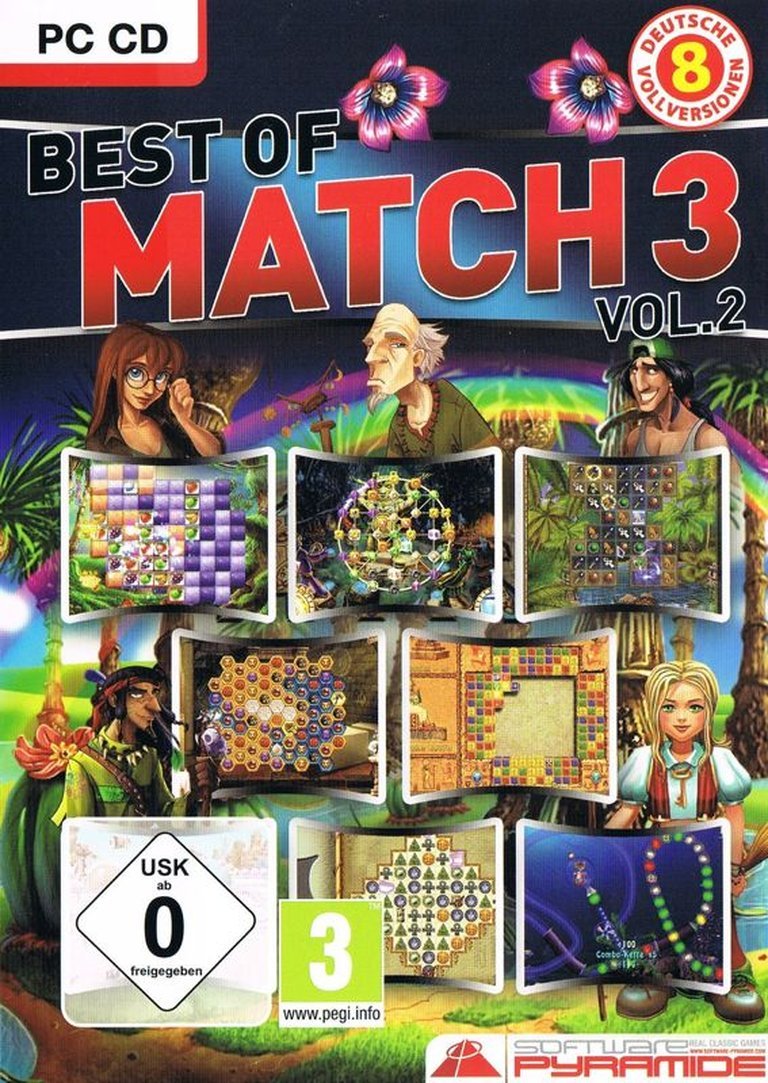
Best of Match 3: Vol.2 is a Windows-based game compilation released on August 22, 2012, featuring a collection of popular match-3 puzzle games such as Atlantis Quest, Brick Shooter Egypt, and Curse of Montezuma. Designed for casual players, this commercial CD-ROM package offers diverse puzzle-solving experiences set in various thematic worlds, all accessible under one retail title. With a PEGI 3 rating, it provides family-friendly entertainment suitable for all ages.
Best of Match 3: Vol.2: Review
Introduction
In the pixelated pantheon of casual gaming, few genres command as much universal appeal as the humble match-3 puzzle. Released on August 22, 2012, Best of Match 3: Vol.2 arrived not as a revolutionary title but as a curated anthology—a time capsule of an era when digital store shelves groaned under the weight of jewel-swapping, tile-matching comfort food. Published by Germany’s S.A.D. Software Vertriebs- und Produktions GmbH, this Windows-exclusive compilation promised an economical smorgasbord of puzzle-solving, bundling eight titles into a single CD-ROM. But does this collection offer a genuine “best of” experience, or is it a bargain-bin relic?
Development History & Context
The Studio and the Market
S.A.D. Software—a now-obscure entity—specialized in budget-friendly compilations during the late 2000s and early 2010s, capitalizing on the PC market’s appetite for affordable casual gaming. Best of Match 3: Vol.2 emerged during a transitional phase: mobile gaming was ascending, yet PC-centric casual titles still thrived via retail bundles targeting demographics less inclined toward app stores. The compilation’s design philosophy was utilitarian: maximize value by repackaging existing mid-tier match-3 titles under a single banner.
Technological and Creative Constraints
By 2012, match-3 mechanics were well-entrenched, tracing their lineage to Shariki (1994) and Bejeweled (2001). Yet this compilation’s included games—largely developed by eastern European studios—reflected the genre’s “cheaper” stratum: titles built with minimal innovation, prioritizing accessibility over ambition. Engine limitations meant static 2D art, rudimentary particle effects, and mouse-driven controls, aligning with the expectations of a pre-F2P (free-to-play) era audience.
The Gaming Landscape
This compilation landed amid match-3’s golden age. Candy Crush Saga would debut months later, redefining the genre’s monetization, while Puzzle & Dragons (2012) hybridized RPG elements with tile-matching. Against these titans, Best of Match 3: Vol.2 was a throwback: a no-frills anthology for players seeking offline, session-based play without microtransactions.
Narrative & Thematic Deep Dive
The Illusion of Storytelling
None of the compilation’s eight games (Atlantis Quest, Brick Shooter Egypt, et al.) feature meaningful narratives. Instead, they employ paper-thin thematic wrappers to contextualize gameplay:
- Atlantis Quest frames progression as uncovering sunken artifacts.
- Sprill: The Mystery of the Bermuda Triangle uses naval disappearances as a backdrop.
- Curse of Montezuma leans on Aztec iconography—a trope as ancient as the temples it depicts.
Dialogue is nonexistent; objectives are reduced to menus demanding “clear 50 gems” or “rescue 10 treasures.” Characters are static sprites or cursor stand-ins, and any “themes” serve only to palette-swap tiles (e.g., Egyptian hieroglyphs, Aztec masks).
Thematic Poverty as Comfort Food
This lack of narrative ambition isn’t a flaw but a design choice. These games cater to players seeking meditative repetition, not emotional engagement. The real “story” is the player’s own progression through level counters and high-score screens—a dopamine treadmill polished by years of genre refinement.
Gameplay Mechanics & Systems
Core Loop: Familiarity Over Innovation
Each title iterates on the genre’s foundational mechanics:
- Swapping: Align three or more identical tiles (gems, fruit, symbols).
- Collapsing: Matched tiles vanish, triggering cascading replacements.
- Objective-Based Challenges: Clear X tiles before move limits; break obstacles (e.g., Gems of the Aztecs’ locked stone blocks).
Variation exists but feels cosmetic:
– Brick Shooter Egypt repurposes Puzzle Bobble’s bubble-shooting.
– Lost Treasures of El Dorado adds “digging” via tile-clearing paths.
– Secrets of Six Seas incorporates light hidden-object elements.
UI/UX: Functional but Dated
Menus are serviceable but cluttered, favoring pragmatism over elegance. Tooltips are sparse, assuming player familiarity with genre norms. The cursor-driven control scheme works reliably, though the absence of touch optimization (a staple of post-2012 match-3) dates the experience.
Progression and Difficulty
Levels escalate predictably: early stages teach mechanics, while later ones introduce locked tiles, timers, and multi-step objectives. However, balancing issues plague some entries—Fruit Lockers 2’s erratic difficulty spikes defy casual accessibility. Power-ups exist (Sprill’s lightning bolts, Atlantis Quest’s dynamite), but their implementation lacks the strategic depth of contemporaries like Puzzle Quest.
Flaws: Repetition and Jank
Several games suffer from sluggish animations and uninspired sound cues. Curse of Montezuma’s tile-matching feels floaty, undermining precision, while Brick Shooter Egypt’s collision detection occasionally misfires. These aren’t dealbreakers for budget-conscious players but highlight the compilation’s B-tier status.
World-Building, Art & Sound
Visual Aesthetic: Generic Palette Swaps
Art direction leans heavily on stock themes:
- Aztec/Mayan: Gems of the Aztecs and Curse of Montezuma trade in jade greens and sandstone yellows.
- Tropical: Fruit Lockers 2 bombards players with candy-colored orchids and pineapples.
- Maritime Mysteries: Sprill and Secrets of Six Seas opt for blues and weather-beaten ship wheels.
Assets are competently drawn but lack polish, with some tilesets appearing stretched or pixelated at higher resolutions. Animations—gem explosions, bubble pops—are functional but lack the visceral crunch of premium titles.
Sound Design: Elevator Music and Cartoon SFX
Soundtracks blend MIDI-style loops with forgettable elevator melodies. Effects—tile clicks, match boops—are serviceable but generic, often recycled across games. Ambient audio (e.g., ocean waves in Sprill) attempts immersion but feels tacked-on.
Atmosphere: Comforting, Not Captivating
The compilation excels at fostering a low-stakes, zen-like state. Bright colors, uncomplicated goals, and repetitive audio create a workflow-friendly ambiance—ideal for players seeking relaxation over challenge.
Reception & Legacy
Launch Reception: Silence Speaks Volumes
No critic reviews archived on MobyGames or elsewhere reflect the compilation’s obscurity. Player reviews are equally absent—a testament to its bargain-bin anonymity. Commercial performance likely hinged on retail placement (supermarket impulse buys, discount electronics stores) rather than word-of-mouth.
Evolution of Reputation
By 2012, match-3 compilations were already relics. King’s Candy Crush Saga (2012) reoriented the genre toward mobile-first, live-service models, rendering static bundles like Best of Match 3: Vol.2 obsolete. Its legacy, if any, lies in preserving niche European casual titles that might otherwise fade into digital oblivion.
Industry Influence: A Footnote
This compilation neither innovated nor inspired. It reflected a business model—budget repackaging—that faded as digital storefronts prioritized individually monetized experiences. Modern analogues exist in Prime Gaming freebies or itch.io bundles, but none carry S.A.D.’s retail-era pragmatism.
Conclusion
Best of Match 3: Vol.2 is neither a hidden gem nor a tragic misfire—it’s a utilitarian artifact. Its eight games deliver competent, if unremarkable, match-3 gameplay, ideal for undemanding players seeking offline puzzles. Yet its lack of ambition, polish, and cultural footprint render it a curiosity rather than a classic.
For historians, it exemplifies a bygone era of physical casual compilations. For modern gamers, its value lies purely in nostalgia or as a dopamine-delivery machine stripped of predatory monetization. In the pantheon of match-3, it’s a respectable B-side—a reminder that even gaming’s comfort food deserves occasional reappraisal.
Final Verdict: A harmless, forgettable anthology—best suited for completionists or those craving pre-F2P simplicity. ★★☆☆☆ (2/5)