
- Release Year: 2020
- Platforms: Windows
- Publisher: S.A.D. Software Vertriebs- und Produktions GmbH
- Genre: Compilation
Description
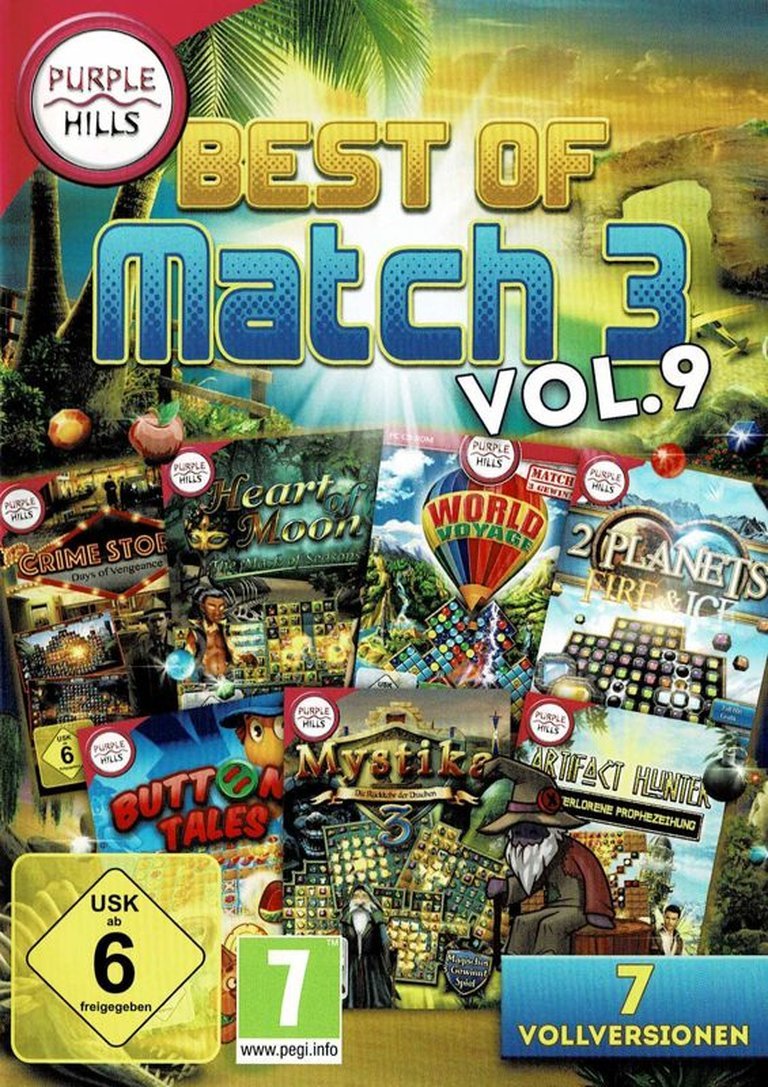
Best of Match 3: Vol.9 is a 2020 Windows compilation featuring seven diverse match-3 puzzle games, including Crime Stories: Days of Vengeance, Heart of Moon: The Mask of Seasons, and Mystika 3: Awakening of the Dragons. Published by S.A.D. Software, this commercial CD-ROM collection offers themed challenges ranging from crime-solving adventures to fantasy quests, delivering a variety of matching gameplay experiences in one package.
Best of Match 3: Vol.9: Review
A Budget Anthology in the Era of Genre Revolution
Introduction
Best of Match 3: Vol.9 (2020) arrives not as a pioneer but as a footnote—a compilation artifact in a genre reshaped by mobile monopolies and billion-dollar sagas. This Windows-exclusive anthology, packaged by German publisher S.A.D. Software, gathers seven lesser-known match-3 titles under one CD-ROM, offering a buffet of puzzles for casual enthusiasts. Yet in an era where Candy Crush Saga and Gardenscapes dominate with live-service hooks and narrative-driven progression, does this collection serve as a nostalgic time capsule or a relic of design obsolescence? Our analysis dissects its place in match-3 history—a genre paradoxically sustained by simplicity and transformed by relentless innovation.
Development History & Context
S.A.D. Software Vertriebs- und Produktions GmbH, a niche publisher specializing in budget compilations, helmed Vol.9 as part of a decade-long series beginning in 2011. Released November 24, 2020, the anthology emerged during peak mobile dominance—King’s Candy Crush franchise raked in $1.3 billion annually, while Playrix’s meta-feature-heavy Gardenscapes redefined player retention. Against this backdrop, Vol.9’s physical PC release felt anachronistic, targeting demographics resistant to free-to-play models or microtransactions.
Technologically, the included titles—developed between the mid-2010s and 2020—reflect pre-mobile boom constraints. Unlike mobile-first engines like Unity (used in Royal Match), these games rely on rigid grid layouts, limited particle effects, and static UI frameworks. The CD-ROM medium itself, with its 700MB capacity, restricted asset quality, resulting in compressed audio and lower-resolution sprites. S.A.D.’s vision was economical: repackage existing catalog titles like Mystika 3: Awakening of the Dragons (2017) and Button Tales (2016) into a bargain bin product, banking on volume over novelty.
Narrative & Thematic Deep Dive
Vol.9’s seven games span eclectic themes, though none delve beyond superficial storytelling:
- Crime Stories: Days of Vengeance adopts a noir-lite aesthetic, framing matches as “clues” in a procedural detective drama. Dialogue is functional (“Find the gem to unlock the briefcase!”), lacking character arcs.
- Heart of Moon: The Mask of Seasons invokes elemental fantasy, tasking players with restoring balance via lunar-themed puzzles. Its lore—delivered through scroll-like tooltips—evokes RPG aspirations but lacks interactivity.
- World Voyage and 2 Planets: Fire & Ice lean on geographical exoticism, using matches to “unlock” postcard-like locations (Paris, Iceland). Narrative exists solely as set dressing.
- Mystika 3: Awakening of the Dragons and Artifact Hunter: The Lost Prophecy mimic adventure tropes—dragons, ruins—but reduce quests to level completion screens.
Thematically, these games reflect match-3’s pre-2015 era, where “story” meant menu text rather than integrated progression. Unlike Lily’s Garden (2019), which wove romance arcs into renovation mechanics, Vol.9’s narratives are disposable, serving only to justify asset palettes (e.g., icy blues for 2 Planets: Fire & Ice).
Gameplay Mechanics & Systems
Vol.9’s core loop mirrors genre fundamentals: swap adjacent tiles to form rows/columns of three or more. However, its lack of innovation underscores its compilation nature:
-
Standard Modes:
- Timed Challenges (e.g., World Voyage’s airport-themed stages).
- Obstacle Clearing (e.g., Mystika 3’s dragon eggs blocking gem paths).
- Limited Moves (e.g., Button Tales’ 20-move clockwork puzzles).
-
Flawed Systems:
- Power-Ups: Primitive compared to Candy Crush’s cascading combos. Crime Stories offers a “Magnifying Glass” to clear one row—manual, unrewarding.
- Progression: Linear level menus with no meta-layers (e.g., Gardenscapes’ mansion-building). Unlocking Artifact Hunter’s stages feels arbitrary, not earned.
- UI Clutter: Persistent “Hint” prompts disrupt immersion; font scalability issues plague older titles like Heart of Moon.
The sole standout is Button Tales, which integrates light puzzle-platforming—players arrange buttons to build bridges—though its execution is rudimentary.
World-Building, Art & Sound
Artistically, Vol.9 is a kaleidoscope of stock assets:
-
Visuals:
- Crime Stories apes 1940s noir with fedora-clad detectives but relies on flat, reused sprites.
- Heart of Moon’s seasonal motifs (autumn leaves, snowflakes) are charming yet low-detail, akin to early 2010s Flash games.
- 2 Planets: Fire & Ice contrasts lava and glaciers but lacks animation—matched gems vanish without particle flourishes.
-
Sound Design:
- Looping MIDI tracks dominate (Mystika 3’s “epic” choir synth grates by Level 10).
- SFX are functional but thin; gem “pops” lack bass, reducing tactile satisfaction.
Atmosphere is transactional, not transformative. While Spooky Bonus (featured in Vol.3) earns praise for cozy Halloween vibes, Vol.9’s entries feel sterile, prioritizing quantity of themes over depth.
Reception & Legacy
Vol.9 sailed under critical radar—no professional reviews on MobyGames, and user impressions are sparse. Amazon.de’s 4.1/5 (23 ratings) suggests casual approval, likely from budget-conscious players valuing content breadth. Yet its commercial impact was negligible. By 2020, the match-3 market had bifurcated:
- Mobile Titans (Candy Crush Saga, Homescapes) leveraged cloud saves, events, and meta-progression to earn billions.
- Premium PC Niche (Puzzle Quest, Bejeweled 3) thrived on depth, mod support, and Steam integrations.
Vol.9 occupied neither space. Its legacy is archival—a reminder of physical compilation trends eclipsed by digital stores and subscription services. Notably, none of its included titles influenced genre evolution; Button Tales and Mystika 3 remain footnotes beside genre-defining RPG hybrids like Puzzle & Dragons (2012).
Conclusion
Best of Match 3: Vol.9 is gaming comfort food—a seven-course meal of familiar flavors, none memorable. For undemanding players seeking offline puzzles, it delivers functional diversity: solve crimes, tame dragons, tour the world, all via gem swaps. Yet its design ethos—static, disposably packaged—clashes with a genre now defined by relentless evolution (narrative integrations, UA-driven creatives, meta-features). This anthology isn’t bad; it’s peripheral, outmaneuvered by freemium titans and left to niche shelves. Casual historians may appreciate it as a relic; modern players will find its offerings quaintly archaic. In the pantheon of match-3, Vol.9 is less a “best of” and more a “sampler platter”—an unambitious footnote in a genre it once might have led.
Final Verdict: A harmless diversion for compilation enthusiasts, but overshadowed by the genre’s innovative giants.
Reviewed as a piece of genre history, not a contemporary contender.