
- Release Year: 2014
- Platforms: Windows
- Publisher: S.A.D. Software Vertriebs- und Produktions GmbH
- Genre: Compilation
- Game Mode: Single-player
- Gameplay: Hidden object, Puzzle-solving
- Setting: Adventure, Fantasy
Description
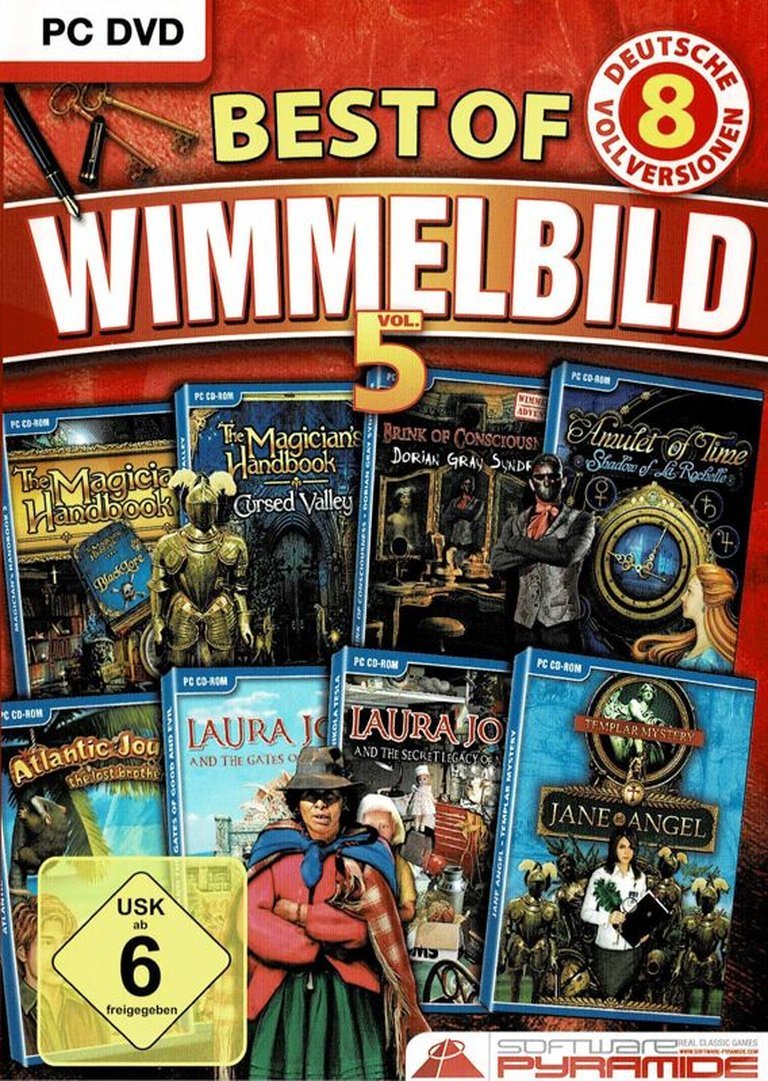
Best of Wimmelbild Vol. 5 is a retail compilation for Windows, released in 2014, featuring eight narrative-driven hidden object adventure games. The collection includes titles like The Magician’s Handbook: Cursed Valley, Laura Jones and the Gates of Good and Evil, and Brink of Consciousness: Dorian Gray Syndrome, offering players diverse settings ranging from magical valleys to mysterious historical locales. Designed for casual gameplay, the games challenge players to solve puzzles and uncover hidden items within intricate, visually rich scenes. This commercial DVD-ROM anthology caters to fans of the wimmelbild (hidden object) genre with its emphasis on exploration, storytelling, and discovery.
Best of Wimmelbild Vol. 5: Review
Introduction
In an industry dominated by blockbuster franchises and photorealistic spectacles, the Best of Wimmelbild Vol. 5 stands as a defiant monument to a quieter, contemplative era of gaming. Released in 2014 by S.A.D. Software Vertriebs- und Produktions GmbH, this Windows-exclusive compilation exemplifies the hidden object genre (Wimmelbildspiele—literally “teeming picture games”) at its most refined. Bundling eight narrative-driven adventures, it offers a masterclass in tactile discovery, environmental storytelling, and artistic craftsmanship. This review posits that Vol. 5 transcends its commercial trappings to become a cultural time capsule, preserving the design ethos, thematic preoccupations, and commercial realities of mid-2010s casual gaming. It may not redefine interactive art, but as a polished anthology of genre conventions, it represents the zenith of a rapidly vanishing tradition.
Development History & Context
To grasp Vol. 5’s significance, one must contextualize it within the casual game boom of the late 2000s–early 2010s. Publishers like S.A.D. Software and Germany’s Intenium GmbH thrived by targeting an underserved demographic: players seeking intellectually engaging yet accessible experiences outside mainstream AAA markets. This era saw digital storefronts like Big Fish Games flourish alongside physical DVD-ROM compilations, catering to regions with limited broadband access.
Technologically, Vol. 5 operates within stringent constraints. Its games—developed by studios like BC Soft, MagicIndie Softworks, and GFI—prioritized broad hardware compatibility over graphical innovation. Designed for Windows PCs of varying specs, they rely on pre-rendered 2D backgrounds, minimal voice acting, and mouse-driven interfaces. This limitation became a strength: resources funneled into art asset density and puzzle design rather than technical bravado.
The compilation’s 2014 release arrived as casual gaming faced existential threats—mobile free-to-play dominance, the decline of PC retail—but Vol. 5’s curation reflects confidence in a dedicated audience. Its included titles, originally released between 2009–2013, span hidden object subgenres: supernatural mysteries (The Magician’s Handbook), historical adventures (Laura Jones and the Secret Legacy of Nikola Tesla), and psychological thrillers (Brink of Consciousness: Dorian Gray Syndrome). This diversity signals a genre maturing beyond simple item hunts into narrative-driven experiences.
Narrative & Thematic Deep Dive
Vol. 5’s strength lies in its thematic variety, though all games share the genre’s foundational DNA: an outsider navigating a web of secrets. Below, we dissect narrative highlights:
-
The Magician’s Handbook: Cursed Valley / BlackLore: Twin tales of arcane peril. Cursed Valley tasks players with lifting a curse from a mystical valley, blending folkloric motifs (talking animals, enchanted forests) with environmental puzzles. Its sequel, BlackLore, escalates stakes with pirate magicians and trapped fairies, exploring power corruption and redemption through collectible spellbook mechanics.
-
Laura Jones Series (Gates of Good and Evil / Secret Legacy of Nikola Tesla): A globetrotting archaeologist confronts sci-fi mysticism. Gates of Good and Evil juxtaposes biblical artifacts with moral choice (albeit shallowly implemented), while Secret Legacy delves into Tesla’s suppressed inventions, critiquing corporate greed through electric-punk aesthetics.
-
Brink of Consciousness: Dorian Gray Syndrome: The compilation’s narrative apex. Inspired by Oscar Wilde, players investigate a psychiatrist’s disappearance amid surreal paintings that age in real-time. Themes of vanity, moral decay, and artistic obsession elevate it beyond genre trappings, with dialogue trees adding rare role-playing depth.
-
Jane Angel: Templar Mystery: A disposable entry, recycling Dan Brown-esque conspiracy tropes (Knights Templar, holy relics) with perfunctory storytelling.
Collectively, these games valorize intellectual curiosity—protagonists are researchers, detectives, or scholars—while moral complexity remains secondary to puzzle-solving catharsis. Environmental storytelling compensates for thin character arcs: hidden diaries, frescoes, and newspaper clippings flesh out worlds without expository dumps.
Gameplay Mechanics & Systems
Vol. 5’s core loop merges hidden object scenes (HOS) with point-and-click adventure logic. Each game follows a predictable but satisfying rhythm:
- Exploration: Navigate static screens (e.g., a gothic library, industrial lab) via map or directional arrows.
- Object Hunting: Find listed items within cluttered vignettes—a test of perceptual acuity amid deceptive red herrings (a coiled rope resembling a snake; a key obscured by foliage).
- Puzzle Integration: Use inventory items (e.g., a gear, magnifying glass) to bypass obstacles, often via conventional minigames (jigsaws, sliding tiles, logic grids).
Innovations and Flaws:
– Dynamic HOS Design: Brink of Consciousness innovates with multi-layered scenes—objects hidden within paintings that shift when inspected.
– Hint Systems: A rechargeable “Hint” button avoids frustration, though overuse trivializes challenges.
– Inventory Puzzles: Amulet of Time: Shadow of La Rochelle excels with multi-use items (e.g., a lens that deciphers codes and focuses sunlight), while Atlantic Journey: The Lost Brother suffers from moon logic (using a fish to distract a cat feels arbitrary).
– Repetition: The lack of fail states or difficulty settings underscores the genre’s relaxed ethos, yet protracted HOS sequences in Jane Angel test patience.
UI design is streamlined: cursor changes indicate interactivity; inventories auto-collapse when idle. While some games (Laura Jones) feature rudimentary skill trees (upgraded tools for faster searching), progression remains story-gated, not stat-driven.
World-Building, Art & Sound
Vol. 5’s artistry is its defining triumph. Each game offers a distinct aesthetic universe:
-
Visual Design: Painterly 2D backdrops overflow with micro-narratives. The Magician’s Handbook’s valley glows with pre-Raphaelite whimsy—dappled sunlight on mushroom cottages, owls perched atop grimoires. Conversely, Brink of Consciousness channels Gothic Expressionism: distorted perspectives, chiaroscuro lighting, and canvases that “bleed” when examined. Even lesser entries (Atlantic Journey) impress with technical precision—every rusted bulkhead and coral reef hand-rendered.
-
Character Art: Portraits employ zoomorphic exaggeration (wide-eyed protagonists, gaunt villains) reminiscent of children’s book illustrations, reinforcing the genre’s fairy-tale roots.
-
Soundscapes: Audio design enhances immersion. Dorian Gray Syndrome’s soundtrack melds string dissonance with Victorian music-box melodies, while Laura Jones employs diegetic sounds (scraping shovel, distant thunder) to sell archaeological digs. Voice acting is sparse but serviceable—accents in Nikola Tesla lean into Balkan stereotypes, regrettably—yet incidental effects (a creaking door, crackling fire) are meticulously crafted.
Reception & Legacy
Upon release, Vol. 5 garnered modest commercial success, particularly in German-speaking markets where physical PC compilations retained relevance. Mainstream outlets ignored it, but niche communities praised its curatorial coherence. User reviews on Amazon (averaging 4/5 stars) highlight “variety” and “visual charm” while critiquing uneven difficulty.
Its legacy is twofold:
1. Genre Preservation: As digital storefronts delisted older titles, Vol. 5 safeguarded obscure gems (Jane Angel remains unavailable elsewhere).
2. Design Influence: Its HOS-adventure hybrid model inspired later indie darlings like The Room series (2012–present), which mechanized object examination into tactile 3D puzzles.
While overshadowed by breakout hits (Myst, Hidden Folks), Vol. 5 epitomizes the last gasp of retail casual gaming before mobile dominance. Subsequent Wimmelbild compilations (Vol. 11–14) iterated without innovating, cementing Vol. 5’s status as a curational peak.
Conclusion
Best of Wimmelbild Vol. 5 is neither revolutionary nor flawed—it is definitive. For historians, it captures a pivotal moment: when casual gaming’s ambition (narrative depth, artistic polish) briefly matched its accessibility. For players, it offers eight richly imagined worlds teeming with secrets to uncover, each a testament to the genre’s quiet brilliance. Its mechanics may feel archaic in an age of open worlds and rogue-lites, yet its focus on observation, patience, and environmental storytelling remains timeless. Like the crowded paintings it celebrates, Vol. 5 rewards those willing to look closer. In the pantheon of hidden object games, it stands as a five-star classic of its kind.
Final Verdict: An essential artifact for genre enthusiasts; a charming diversion for curious newcomers.