
- Release Year: 1996
- Platforms: Windows 16-bit, Windows
- Publisher: DreamCatcher Interactive Inc., NEC Interchannel, Ltd., Virgin Sound and Vision
- Developer: Jones & Jones Multimedia, LLC
- Genre: Adventure
- Perspective: 1st-person
- Game Mode: Single-player
- Gameplay: Puzzle elements
- Setting: Atlantis, Egypt, Tibet, Yucatan peninsula
- Average Score: 66/100
Description
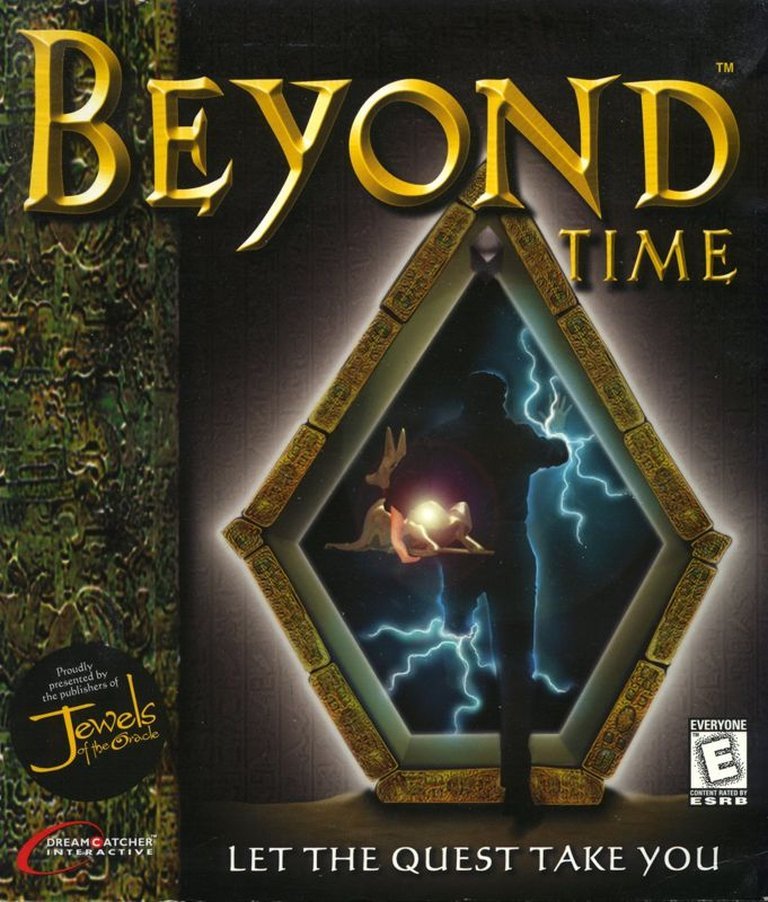
Beyond Time is an inventory-based, mouse-driven adventure game where players travel through time to recover lost artifacts and repair temporal rifts. Set across ancient Egypt, Tibet, the Yucatan, and Atlantis, the game challenges players with puzzles to prevent humanity’s doom, blending live-action cutscenes and a literary-inspired narrative.
Gameplay Videos
Where to Buy Beyond Time
PC
Beyond Time Free Download
Beyond Time Guides & Walkthroughs
Beyond Time Reviews & Reception
mobygames.com (55/100): A puzzle-based adventure game with time-travel elements.
en.wikipedia.org (78/100): A dry, humorless, dull, and pretty monotonous Myst-clone.
balmoralsoftware.com : Beyond Time is not a bad game, just one that repeats many themes and ideas from the adventure-game genre.
Beyond Time: A Flawed but Fascinating Relic of the Adventure Game Era
Introduction
Beyond Time (1997) is a first-person adventure game that emerged during the golden age of puzzle-driven narratives, a period dominated by titles like Myst and Timelapse. Developed by Jones & Jones Multimedia and published by DreamCatcher Interactive, the game is a curious artifact of its time—a blend of ambitious storytelling, flawed execution, and a development history as tangled as the time rifts it depicts. While it has largely faded into obscurity, Beyond Time offers a fascinating case study in the challenges of game design, the pitfalls of overreliance on full-motion video (FMV), and the enduring appeal of time-travel narratives in gaming.
This review will dissect Beyond Time from every angle: its troubled development, its narrative and thematic ambitions, its gameplay mechanics, its world-building and aesthetics, and its critical reception. By the end, we’ll determine whether it deserves its reputation as a “coaster” or if it holds hidden virtues beneath its rough exterior.
Development History & Context
The Studio and the Vision
Jones & Jones Multimedia was a small studio with a background rooted in theater, literature, and art. Their multidisciplinary approach is evident in Beyond Time, which sought to blend historical research, puzzle design, and cinematic storytelling. The team spent over a year conducting art history research to inform the game’s settings, aiming to create a “lived-in” world through 3D representations of ancient Egypt, Tibet, the Yucatan, and Atlantis. Their goal was to craft a game that was both educational and entertaining, with a focus on authenticity in its architectural and cultural depictions.
The game was originally titled Obelisk, based on a novel by Dr. Judith Kaye Jones, one of the studio’s co-founders. The novel’s premise—time rifts causing artifacts to disappear—served as the foundation for the game’s plot. However, the transition from literature to interactive media proved rocky. The game was completed in 1995 but faced publishing limbo when Virgin Sound and Vision, the original publisher, abruptly exited the business. DreamCatcher Interactive eventually picked it up, rebranding it as Beyond Time and releasing it in late 1996.
Technological Constraints
Beyond Time was developed during a transitional period in adventure gaming. The mid-1990s saw the rise of 3D acceleration, but many studios, including Jones & Jones, were still working with limited tools. The game’s engine was custom-built, but it struggled to deliver fluid animations or high-resolution graphics. The result is a game that feels visually dated even by 1996 standards, with static backgrounds, minimal animations, and a small viewport that restricts the player’s view of the world.
The game’s reliance on FMV was another double-edged sword. While FMV was a staple of the era (see Phantasmagoria or The 7th Guest), Beyond Time’s implementation was uneven. The live-action sequences, which primarily consist of video journal entries from the game’s characters, are stiffly acted and overly verbose. The decision to use FMV for exposition rather than gameplay moments further highlights the disconnect between the game’s narrative ambitions and its interactive design.
The Gaming Landscape of 1996-1997
Beyond Time entered a crowded market. Myst (1993) had already set the standard for first-person adventure games, and titles like Riven (1997) and Timelapse (1996) were pushing the genre forward with richer visuals and more cohesive narratives. Beyond Time’s release in late 1996 placed it in direct competition with these titles, and it suffered by comparison. Critics and players alike noted its similarities to Timelapse, which also featured time-travel mechanics and ancient civilizations, but Timelapse was praised for its tighter design and more engaging puzzles.
The game’s commercial performance was lackluster, and it quickly faded into obscurity. Today, it is remembered primarily by adventure game enthusiasts and collectors, often as a cautionary tale of what happens when ambition outstrips execution.
Narrative & Thematic Deep Dive
Plot Summary
Beyond Time begins in the present day, with the player summoned to investigate the mysterious disappearance of priceless artifacts from museums around the world. The setup is reminiscent of Indiana Jones or The Da Vinci Code, but the game quickly pivots into science fiction territory. The player is transported to ancient Egypt, where they learn that the artifacts’ disappearances are tied to a time-travel experiment gone awry. A group of scientists, known as the “Travelers,” have been using a time machine to steal artifacts from the past, but their actions have destabilized the fabric of time itself. The player’s mission is to recover the stolen artifacts and restore the timeline before reality collapses.
The narrative unfolds through a series of FMV sequences, which are primarily delivered via video journals left by the Travelers. These journals detail the team’s descent into madness as they grapple with the consequences of their actions. The story’s villain, a scientist named Howard, is revealed to be the mastermind behind the time rifts, though his motivations remain murky. The game’s climax involves confronting Howard in a space station, where the player must input codes derived from earlier puzzles to restore the timeline.
Themes
Beyond Time grapples with several ambitious themes, though it often struggles to explore them with depth:
-
The Ethics of Time Travel: The game’s central conflict revolves around the moral implications of altering the past. The Travelers’ actions have unintended consequences, leading to temporal instability and the erosion of history. This theme is reminiscent of classic time-travel narratives like The Time Machine or Back to the Future, but Beyond Time’s execution is ham-fisted. The game tells rather than shows the consequences of time manipulation, relying on exposition-heavy FMV sequences rather than interactive storytelling.
-
Hubris and Madness: The Travelers’ journey from scientists to unhinged villains is a common trope in adventure games (see System Shock or Half-Life). However, Beyond Time’s portrayal of their descent into madness is underdeveloped. The video journals are repetitive and lack emotional weight, making it difficult for players to invest in the characters’ fates.
-
The Preservation of History: The game’s premise—that artifacts must be returned to their rightful place in time—touches on the importance of cultural heritage. However, this theme is overshadowed by the game’s focus on puzzle-solving. The artifacts themselves are often reduced to macguffins, with little exploration of their historical or cultural significance.
-
The Illusion of Free Will: The game’s ending suggests that the player’s actions are part of a predestined loop, a common trope in time-travel stories. However, the narrative fails to explore this idea in a meaningful way, leaving the theme underutilized.
Characters and Dialogue
The characters in Beyond Time are largely forgettable. The player’s avatar is a silent protagonist, a common convention in adventure games of the era, but one that limits emotional engagement. The Travelers, meanwhile, are defined by their video journals, which are delivered in a monotonous, technobabble-heavy style. The acting is stiff, and the dialogue often feels like a poor imitation of The X-Files or Star Trek.
The game’s most memorable character is the villain, Howard, but his motivations are never fully explained. He is portrayed as a power-hungry scientist, but the game fails to give him depth or nuance. His final confrontation with the player is anticlimactic, consisting of a series of puzzles rather than a dramatic showdown.
Storytelling Techniques
Beyond Time’s storytelling is its weakest element. The game relies almost entirely on FMV sequences to convey its narrative, which creates a disconnect between the gameplay and the story. Players spend most of their time solving puzzles in static environments, only to be interrupted by lengthy video journals that halt the game’s momentum.
The game’s structure is also problematic. The narrative is fragmented, with the player jumping between ancient Egypt, Tibet, the Yucatan, and Atlantis with little rhyme or reason. The transitions between these locations are abrupt, and the game does little to explain how they fit into the larger story. This lack of cohesion makes the narrative feel disjointed and confusing.
Gameplay Mechanics & Systems
Core Gameplay Loop
Beyond Time is a first-person adventure game with a heavy emphasis on puzzle-solving. The core gameplay loop consists of exploring environments, collecting items, and solving puzzles to progress. The game is divided into several distinct locations, each with its own set of challenges:
- Ancient Egypt: The game begins in Egypt, where the player must recover a stolen amulet and solve a series of puzzles to gain access to a time gate.
- Tibet: The player travels to a Tibetan monastery, where they must solve a mandala puzzle to obtain a key.
- Yucatan: In the Mayan city of Tikal, the player navigates a ball court puzzle and retrieves power crystals from a sarcophagus.
- Atlantis: The player explores the ruins of Atlantis, solving an underwater maze to recover another power crystal.
- Space Station: The final act takes place in a space station, where the player must input codes to restore the timeline.
The game’s progression is largely linear, though there are moments of nonlinearity, particularly in the early stages. Players can tackle certain puzzles in any order, but the overall structure is rigid.
Puzzle Design
The puzzles in Beyond Time are a mixed bag. Some are clever and well-integrated into the environment, while others feel arbitrary or poorly designed. The game’s best puzzles include:
- The Snake Puzzle: A logic puzzle in which the player must arrange numbers on a grid to satisfy specific conditions. The puzzle is challenging but fair, and it rewards careful observation.
- The Boat Puzzle: A classic river-crossing puzzle in which the player must ferry three items across a river without leaving certain pairs together. This puzzle is well-executed and fits thematically with the game’s Egyptian setting.
- The Scale Room: A puzzle involving measuring liquids using containers of different sizes. The puzzle is reminiscent of classic adventure game challenges and requires logical deduction.
However, the game’s puzzle design is marred by several flaws:
- Arbitrary Solutions: Some puzzles, such as the Mandala Puzzle, have multiple valid solutions, but the game only accepts one. This design choice is frustrating, as it forces players to guess the “correct” solution rather than rewarding logical thinking.
- Poor Integration: Many puzzles feel disconnected from the game’s narrative. For example, the Mandala Puzzle in Tibet has no clear connection to the game’s overarching story, making it feel like a filler challenge.
- Lack of Feedback: The game often fails to provide clear feedback when the player makes a mistake. This is particularly evident in the underwater maze in Atlantis, where it’s easy to become lost without clear visual cues.
Inventory and Item Management
Beyond Time uses a traditional inventory system, with items stored in a bar at the bottom of the screen. The inventory is context-sensitive, with items only becoming usable when they are relevant to the current puzzle. This design choice streamlines the gameplay but can also feel restrictive, as players are unable to experiment with items in creative ways.
The game’s item descriptions are minimal, and there is no in-game journal to track clues or objectives. This lack of guidance can make the game difficult to navigate, particularly for players who are unfamiliar with adventure game conventions.
User Interface
The game’s UI is functional but unremarkable. The cursor is “smart,” changing shape to indicate interactive objects, but the small viewport and static backgrounds make it difficult to spot important details. The game also lacks keyboard controls for movement, relying entirely on mouse clicks for navigation. This design choice is cumbersome, particularly in the game’s larger environments.
The game’s menu system is accessible via a right-click, providing options for saving, loading, and accessing hints. The hints system is particularly useful, offering clues for the game’s more obscure puzzles. However, the hints are often vague, and players may still find themselves stuck.
Technical Issues
Beyond Time is plagued by technical issues, many of which stem from its custom engine. The game’s animations are choppy, and transitions between scenes are handled poorly. The game also suffers from occasional crashes, particularly during FMV sequences. These technical flaws further detract from the overall experience, making the game feel unfinished.
World-Building, Art & Sound
Setting and Atmosphere
Beyond Time’s world is one of its strongest aspects. The game’s settings—ancient Egypt, Tibet, the Yucatan, and Atlantis—are rich with historical and cultural detail. The developers’ research is evident in the game’s architecture, which draws from real-world influences while adding fantastical elements. For example, the Egyptian temples are based on actual historical structures, but they are embellished with supernatural elements like time gates and magical obelisks.
The game’s atmosphere is enhanced by its use of sound and music. The ambient soundtrack is moody and evocative, with tracks that evoke the mystery of ancient civilizations. The sound design is minimal but effective, with environmental effects like thunder and wind adding to the immersion.
However, the game’s visual presentation is its Achilles’ heel. The static backgrounds and low-resolution textures make the world feel flat and lifeless. The small viewport further restricts the player’s view, making it difficult to appreciate the game’s environments. The lack of animation also detracts from the immersion, as the world feels static and unchanging.
Art Direction
The game’s art direction is ambitious but uneven. The developers aimed to create a visually striking world, but the limitations of their engine held them back. The game’s environments are detailed, but the low-resolution textures and lack of lighting effects make them feel dated. The character models in the FMV sequences are particularly weak, with stiff animations and unnatural facial expressions.
The game’s use of color is one of its strengths. The Egyptian temples are bathed in golden hues, while the Tibetan monastery is awash in deep reds and blues. These color choices help to differentiate the game’s locations and create a sense of place. However, the game’s visual style is inconsistent, with some environments feeling more polished than others.
Sound Design and Music
The game’s sound design is one of its most successful elements. The ambient soundtrack is atmospheric and immersive, with tracks that evoke the mystery and grandeur of the game’s settings. The music in the Egyptian temples, for example, is reminiscent of traditional Middle Eastern instrumentation, while the Tibetan monastery features haunting choral arrangements.
The game’s sound effects are minimal but effective. Environmental effects like thunder, wind, and water add to the immersion, while the lack of intrusive sound effects ensures that the music remains the focal point. The FMV sequences are accompanied by a sparse soundtrack, which helps to emphasize the dialogue but also makes the scenes feel underwhelming.
Reception & Legacy
Critical Reception
Beyond Time was met with lukewarm reviews upon its release. Critics praised the game’s ambitious narrative and puzzle design but criticized its technical flaws and uneven execution. The game’s MobyGames score of 5.5/10 reflects this mixed reception, with critics and players alike noting its potential but ultimately finding it lacking.
Some of the most common criticisms included:
- Poor Graphics: The game’s visuals were widely panned as outdated and uninspired. Critics compared it unfavorably to contemporaries like Riven and Timelapse, which featured more advanced graphics and animations.
- Weak Storytelling: The game’s narrative was criticized for its disjointed structure and overreliance on FMV sequences. Many reviewers found the video journals tedious and the story difficult to follow.
- Arbitrary Puzzles: The game’s puzzle design was a point of contention. While some critics praised the variety of challenges, others found them frustrating and poorly integrated into the narrative.
- Technical Issues: The game’s technical flaws, including crashes and choppy animations, were frequently cited as major detractors.
Despite these criticisms, some reviewers found redeeming qualities in Beyond Time. Game Revolution gave the game a 75/100, praising its plot development and calling it “a great adventure that has been kept undercover because of poor graphics.” Other reviewers appreciated the game’s ambitious scope and the variety of its puzzles, even if the execution was flawed.
Commercial Performance
Beyond Time was not a commercial success. Its lackluster reviews and technical issues likely contributed to its poor sales, and it quickly faded into obscurity. Today, it is remembered primarily by adventure game enthusiasts and collectors, often as a curiosity rather than a classic.
Legacy and Influence
Beyond Time’s legacy is minimal. It did not spawn any sequels or spin-offs, and its influence on subsequent adventure games is negligible. However, it serves as a fascinating case study in the challenges of game development during the mid-1990s. The game’s ambitious narrative and puzzle design were hampered by technical limitations and poor execution, offering a cautionary tale for future developers.
The game’s time-travel premise and historical settings have been explored more successfully in other titles, such as Assassin’s Creed and The Secret World. However, Beyond Time’s unique blend of science fiction and ancient mythology remains an interesting footnote in the history of adventure gaming.
Conclusion
Beyond Time is a flawed but fascinating relic of the adventure game era. Its ambitious narrative, varied puzzles, and richly detailed settings are undermined by technical limitations, poor execution, and a disjointed story. While it is not a classic by any stretch, it offers a glimpse into the challenges and possibilities of game design during the mid-1990s.
For modern players, Beyond Time is a curiosity—a game that could have been great but ultimately falls short of its potential. Its puzzles are occasionally clever, its world is richly imagined, and its themes are ambitious, but these strengths are overshadowed by its many flaws. Adventure game enthusiasts may find it worth a playthrough for its historical significance, but casual players are likely to be frustrated by its arbitrary puzzles and tedious FMV sequences.
In the grand tapestry of video game history, Beyond Time is a minor footnote—a game that dared to dream big but lacked the polish and cohesion to realize its vision. It is a reminder that ambition alone is not enough to create a great game; execution, coherence, and player engagement are equally important. For those willing to look past its flaws, Beyond Time offers a glimpse into a bygone era of adventure gaming, warts and all.
Final Verdict: 5.5/10 – A Flawed but Fascinating Relic