
- Release Year: 2002
- Platforms: Macintosh, Windows
- Publisher: KIDDINX Entertainment GmbH
- Developer: KIDDINX Entertainment GmbH
- Genre: Adventure
- Perspective: Fixed / flip-screen
- Game Mode: Single-player
- Gameplay: Puzzle elements
- Setting: Fantasy
Description
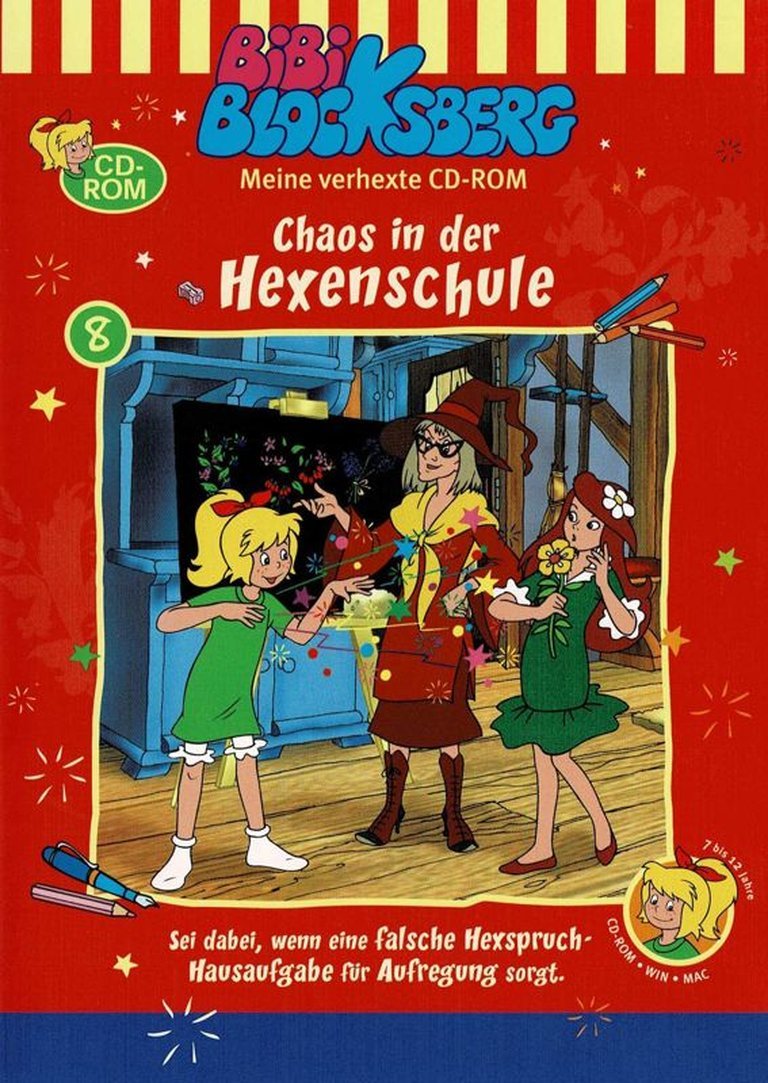
Bibi Blocksberg: Chaos in der Hexenschule is an adventure game designed for children. Set in a magical school, the game follows Bibi and her friends as they attempt to use new spells they’ve learned at a funfair. However, their plans go awry, leading to chaos. Players must help the three witches restore order through a series of puzzles and point-and-select interactions.
Gameplay Videos
Bibi Blocksberg: Chaos in der Hexenschule: A Nostalgic Portal to Early 2000s German Children’s Gaming
Introduction
In the early 2000s, the German gaming landscape saw a surge of titles tailored to younger audiences, many rooted in beloved local media franchises. Among these was Bibi Blocksberg: Chaos in der Hexenschule (2002), a whimsical point-and-click adventure based on the wildly popular Bibi Blocksberg audio plays. Developed by KIDDINX Entertainment GmbH, the game aimed to translate the mischievous charm of Bibi—a teenage witch—into an interactive experience. While far from a technical marvel, the title carved out a niche as a gateway to gaming for German children, blending accessible puzzles, vibrant aesthetics, and a lighthearted narrative about magical mishaps. This review argues that Chaos in der Hexenschule, though mechanically simplistic, remains a culturally significant artifact of Germany’s family-friendly gaming scene.
Development History & Context
Studio Vision & Licensing Roots
KIDDINX Entertainment, established in the 1990s, built its reputation on adapting German children’s media into games, including the Bibi Blocksberg and Benjamin Blümchen franchises. Chaos in der Hexenschule was part of a broader strategy to capitalize on Bibi’s popularity, leveraging her as a cross-media icon. The studio prioritized fidelity to the source material, enlisting voice actors like Detlef Bierstedt and Cathleen Gawlich, who had roles in the audio plays, to maintain sonic continuity.
Technological Constraints & Era
Released for Windows and Macintosh in 2002, the game arrived at a time when 3D graphics were ascendant but still inaccessible for many smaller studios. KIDDINX opted for a 2D, fixed/flip-screen visual style—a pragmatic choice that aligned with the limitations of CD-ROM storage and the technical capabilities of home computers. While visually unambitious compared to contemporaries like Harry Potter and the Chamber of Secrets, this approach ensured broad hardware compatibility.
Gaming Landscape
The early 2000s saw few German-developed titles reaching international audiences, with local studios focusing on domestic niches. Chaos in der Hexenschule entered a market dominated by educational games and licensed adventures, competing with titles like Pettersson und Findus and Laura’s Happy Adventures. Its release coincided with the rise of the Bibi Blocksberg gaming franchise, which would span over a dozen titles across platforms by the 2010s.
Narrative & Thematic Deep Dive
Plot & Structure
The game follows Bibi and her witch friends Flauipaui and Schubi as they attempt to showcase newly learned herbalism spells at a funfair. Predictably, their magic backfires, sparking chaos—think sentient plants, misplaced brooms, and a panicked populace. The narrative unfolds across episodic scenarios, requiring players to undo the mess while navigating the school and fairground settings.
Characters & Dialogue
Bibi embodies the archetypal plucky protagonist, balancing cheeky rebellion with good intentions. Her friends serve as foils: Flauipaui is the cautious one, while Schubi’s impulsiveness drives much of the conflict. Dialogue, delivered via text boxes and voice snippets, is deliberately simplistic, echoing the audio plays’ tone. Thematically, the story emphasizes responsibility (“magic has consequences”) and teamwork—standard fare for children’s media but effective for its audience.
Underlying Themes
Beneath the slapstick humor lies a subtle critique of overconfidence. Bibi’s eagerness to bypass her studies mirrors real-world youthful impatience, while the chaos serves as a metaphor for unchecked ambition. These themes resonate with the franchise’s broader focus on growing up, albeit without the depth of later entries like Das gestohlene Hexbuch (2009).
Gameplay Mechanics & Systems
Core Loop & Puzzle Design
As a point-and-click adventure, the game tasks players with solving environmental puzzles by collecting items and interacting with NPCs. For example, curing a carnivorous plant might require brewing a potion using herbs found in a classroom. Puzzles are linear and designed for children, lacking the complexity of Monkey Island but offering gentle cognitive challenges.
UI & Accessibility
The interface is minimalist: a cursor highlights interactable objects, and an inventory system allows drag-and-drop combinations. While intuitive for young players, the lack of tutorial prompts or hint systems could frustrate those unfamiliar with the genre.
Flaws & Innovations
The game’s greatest weakness is its repetitive structure. Many puzzles involve fetch quests or “combine X with Y” solutions, leading to diminishing returns. However, its integration of mini-games—like a broomstick-balancing competition—adds variety, foreshadowing the racing mechanics of later titles like Das große Hexenbesen-Rennen! (2010).
World-Building, Art & Sound
Visual Direction
The art style is brightly colored and cartoonish, echoing the franchise’s illustrated storybooks. Environments like the witch school and funfair are rendered in static but detailed 2D, with a playful aesthetic reminiscent of Sesame Street games. Character sprites are expressive, though animations are limited to rudimentary loops.
Atmosphere & Sound Design
Heiko Rüsse’s soundtrack leans on whimsical melodies dominated by flutes and pizzicato strings, evoking a fairy-tale ambiance. Sound effects—bubbling cauldrons, cackling witches—are punchy and exaggerated, heightening the comedic tone. Voice acting, while sparse, captures Bibi’s trademark energy, though purists may lament the absence of original audio play cast members.
Reception & Legacy
Commercial & Critical Performance
No formal critic reviews exist, but the game’s enduring presence in German bargain bins suggests moderate commercial success. Its niche appeal limited its reach beyond the Bibi Blocksberg fanbase, though it solidified KIDDINX’s reputation as a reliable steward of children’s licenses.
Cultural Impact
Chaos in der Hexenschule laid groundwork for the franchise’s later entries, establishing a template of light adventure mechanics and episodic storytelling. While not innovative, it demonstrated the viability of German-developed children’s games in an era dominated by American and Japanese imports.
Conclusion
Bibi Blocksberg: Chaos in der Hexenschule is neither a masterpiece nor a footnote. It is, rather, a time capsule—a reflection of early 2000s German children’s gaming, where accessibility trumped ambition, and licensed properties ruled. Its simplistic puzzles and charming aesthetic won’t dazzle modern players, but for those who grew up with Bibi’s antics, it remains a nostalgic portal to a time when magic was just a click away. In the pantheon of Bibi Blocksberg games, it stands as a modest but foundational entry, reminding us that even small-scale titles can cast enduring spells.