
- Release Year: 1998
- Platforms: Windows
- Publisher: Expert Software, Inc.
- Developer: Gunnar Games, Inc.
- Genre: Gambling
- Perspective: Top-down
- Game Mode: Hotseat, Single-player
- Gameplay: Cards, Tiles
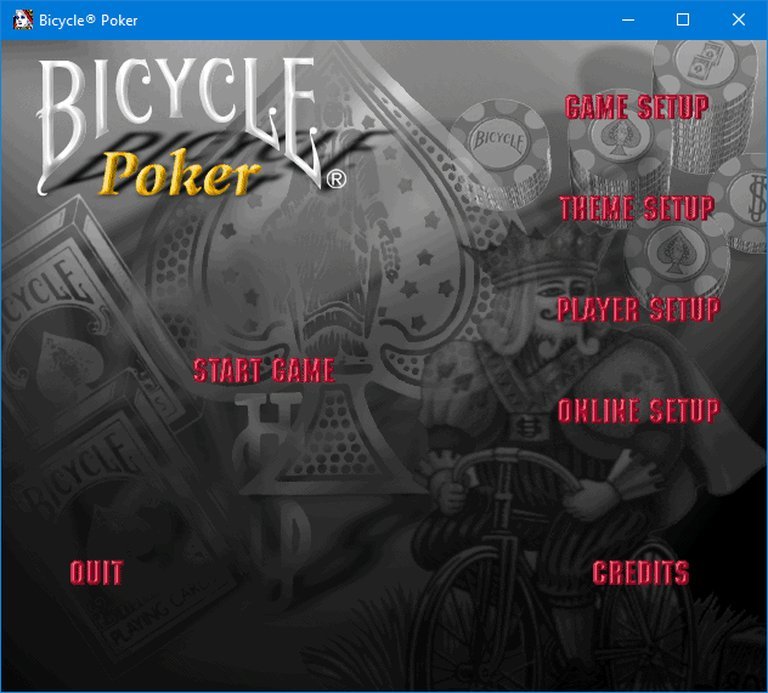
Description
Bicycle Poker is a digital simulation of poker designed for both single and multi-player experiences. It features 12 different poker variants, including popular games like Texas Hold ‘Em and Omaha, along with elements such as wild cards, tutorial modes and hints for beginners, undo/redo functionality, detailed statistics, sound effects, voice lines, animated characters, and a magnifier for easier card viewing, all presented in a top-down, fixed flip-screen interface.
Bicycle Poker Free Download
Bicycle Poker (1998): The Quintessential Card Game Simulator
Introduction: More Than Just a Flush
In the landscape of 1990s PC gaming, where 3D accelerators were beginning to redefine visual fidelity and online multiplayer was a nascent, dial-up dream, a quiet revolution was happening at the virtual card table. While giants like Doom and StarCraft battled for headlines, a humble title from Gunnar Games, published by Expert Software, was meticulously crafting the definitive digital experience of America’s classic pastime: poker. Bicycle Poker (1998) is not a game of explosive set pieces or cinematic narratives. Instead, it is a masterclass in functional design, educational accessibility, and the respectful simulation of a social and strategic pastime. This review argues that Bicycle Poker represents a pivotal, if understated, landmark in the history of game design—a title that successfully bridged the gap between arcade-style casino games and serious poker simulation by prioritizing clarity, customization, and pedagogical excellence over flash. It stands as the apex of the pre-online-poker-boom era’s approach to the game, a comprehensive digital rulebook that doubled as a genuinely engaging, if low-stakes, gaming experience.
Development History & Context: Building on a Legacy
To understand the 1998 Bicycle Poker, one must first trace its lineage. The game was not an original concept but the third major iteration in a series. The first, developed by Wesley Steiner and published by SWFTE International, debuted on DOS in 1991. Its 1993 Windows 16-bit port established the core template: a single-player, mouse-driven game against seven AI opponents, featuring customizable Draw and Stud poker with various rule mutations like “Anything Opens” and “Jackpots.” This original was a functional, if rudimentary, tool for solitary practice.
The 1998 version, developed by Gunnar Games, Inc. and published by Expert Software, Inc., was a ground-up rebuild for the modern Windows 32-bit environment. The key creative figures were Jamie Nye (Producer, Lead Programmer, Game Design) and Barak Karabin (Lead Artist & Art Design), with notable contributions from music composer Steve Newton and digitized voice artist Shanna Nye. Gunnar Games was no stranger to this niche, having previously developed titles like Perfect Chessmate and Ultimate Mahjongg, indicating a studio specializing in high-quality, accessible implementations of classic parlour games.
Technologically, the era was defined by the transition from DOS to Windows 95/98. The constraints were less about raw power (though 3D acceleration was now common) and more about designing an intuitive GUI for a non-gaming audience. The team leveraged the Windows API for a point-and-select interface that felt native, moving away from the old DOS menu systems. The “Fixed / flip-screen” perspective mentioned in MobyGames’ specs speaks to a design focused on clarity—the entire table is always visible, with no camera tricks. This was a deliberate choice for a game about reading hands and odds, not about environmental immersion.
The gaming landscape in 1998 was also significant. The poker “boom” fueled by televised tournaments (like Late Night Poker in the UK and the nascent World Poker Tour) and the rise of early online card rooms (Planet Poker, Paradise Poker) was beginning. Bicycle Poker entered this space not as a competitor to those real-money platforms, but as the ultimate practice tool—the trusted, offline “training wheels” for the coming wave of players. Its licensing from Bicycle Cards (the iconic playing card manufacturer) was a masterstroke of branding, granting it immediate credibility and association with the physical deck every player knew.
Narrative & Thematic Deep Dive: The Psychology of the Table
As a pure simulation, Bicycle Poker possesses no traditional plot or linear narrative. Its “story” is generated anew with every hand. The genius of its thematic design lies in how it constructs a believable, if generalized, social environment for poker—the saloon, the casino back room, the friend’s basement. This is achieved through three interconnected systems:
-
Animated Characters & Personification: The game features “eight different characters,” as noted in the LaunchBox description. While specific backstories are minimal (the source material doesn’t name them), each has distinct visual portraits and, crucially, a personality injected via digitized voice lines (voiced by Shanna Nye) and sarcastic comments during play. These aren’t just aesthetic; they are a core gameplay mechanic. The “hints” system, described by NeverDieMedia as offering “information on betting and drawing as well as sarcastic comments by other players,” uses these characters to simulate table talk and psychological pressure. A character might taunt your conservative play or remark on your apparent bluff, teaching the player the meta-game of poker—that the behavior of opponents is a data source itself. This creates a dynamic, emergent narrative: “The tight player ‘Victor’ just called my bluff on the river with a weak pair, making him appear stronger than he is. Next hand, I’ll exploit that table image.”
-
The Tutorial as Guided Apprenticeship: The game’s “tutorial play for those new to the game” is far more than a simple rules overlay. It is a structured learning journey. The NeverDieMedia description specifies “step-by-step guidance” that “fully explains all standard poker terms.” This isn’t just about hand rankings; it’s about the why of actions. A tutorial hand might pause to explain why a late-position raise is more valuable than an early-position one, or the pot odds calculation behind a call. The narrative here is one of mastery, positioning the player as an apprentice under the watchful (and sometimes mocking) eyes of the AI regulars.
-
The Illusion of Stakes and Progression: While using play chips, the game simulates the arc of a poker session. Starting with a $500 stake against seven others, players experience the thrill of building a stack and the despair of going bust. The “statistics” and “limited history for each player” (MobyGames) track your performance over time, creating a personal narrative of improvement. You are not just playing isolated hands; you are building a profile, a reputation, and a bankroll history within this closed ecosystem. The “animated characters” accompanying “big wins or losses” provide visceral feedback, punctuating the narrative beats of triumph and disaster.
The underlying theme, therefore, is the democratization and demystification of poker. It strips away the smoky, intimidating aura of the real-world casino and replaces it with a clean, helpful, and slightly cheeky digital opponent who is there to teach you, not just beat you. The game argues that poker is a skill-based game of mathematics and psychology, accessible to anyone willing to learn its systems.
Gameplay Mechanics & Systems: A Swiss Army Knife of Poker
This is where Bicycle Poker achieves its historic status. Its mechanics are a paragon of comprehensive, player-centric design for its genre and era.
Core Loop & Poker Variants: The fundamental loop is: Ante -> Deal -> Betting Rounds -> Draw/Showdown. Where the game explodes with variety is its inclusion of 12 distinct poker types:
* Draw Family: Five-Card Draw (the classic), plus “Shotgun,” “Spit in the Ocean,” “Wild Widow,” and “Woolworth” (all specific Draw mutations with unique wild card or dealing rules).
* Stud Family: Five-Card Stud, Six-Card Stud, Seven-Card Stud.
* Community Card Family: Texas Hold ‘Em (“Hold ‘Em”) and Omaha.
* Hybrid/Novelty: “Baseball” and “Football” (likely thematic variations with special 4’s or 9’s as wilds, common in home games).
This library is exhaustive for a casual player. It covers the entire spectrum from beginner-friendly Draw to the more complex, strategy-rich Hold ‘Em and Omaha. The inclusion of “Wild Widow” (where a specific card, like the Queen of Spades, is always wild) and “Woolworth” (where 10’s and 5’s are wild, referencing the old “five-and-dime” store) shows a dedication to documenting American folk poker variants, not just casino standards.
Innovative Systems & UX:
* The Magnifier: A critically important accessibility feature. For players with vision difficulties or on lower-resolution monitors, the ability to magnify card designs was a thoughtful inclusion often lacking in contemporaries.
* Undo/Redo: A lifesaver for learning. A player can rewind a hand to see “what if” they had folded or raised, a powerful tool for understanding consequence.
* Customizable Everything: From “customisable betting and raising limits” (MobyGames) to “a choice of wild cards or no wild cards” and “Anything Opens and Jackpots variations,” the game is a sandbox. You can simulate a tight, no-limit Hold ’em game or a loose, wild wild, anything-goes home game. This flexibility is its superpower.
* Hints & On-Demand Rules: The hint system provides real-time advice. Coupled with “online rules list the priority of hands,” the game actively teaches. It doesn’t punish ignorance; it corrects it.
* Multiplayer & Online: A forward-looking feature for 1998 was support for multiplayer “via the Internet at the Microsoft Gaming Network” (NeverDieMedia). While primitive by today’s standards, this placed it at the forefront of social poker gaming.
Flaws & Limitations: The AI, while providing character, is likely straightforward by modern standards—playing statistically sound but not adaptive. The “statistics” are probably basic (win rate, hands played). There is no persistent bankroll across sessions without manual save. The lack of a robust hand history replayer is a notable absence for serious study. However, within its scope as a feature-rich simulator, these are minor. The primary “flaw” might be its sheer breadth; a new player could be overwhelmed by the 12 variants and myriad options. Yet, the excellent tutorial system directly counters this.
World-Building, Art & Sound: The Aesthetic of the Felt Table
Bicycle Poker constructs its world not through a sprawling narrative environment, but through the meticulous simulation of the poker table experience.
Visual Direction: The “Top-down” perspective and “Fixed / flip-screen” view are imperative. The table is the world. The art, led by Barak Karabin, focuses on clarity. Card designs are legible, with multiple “front and back card designs” and size/font options (NeverDieMedia). The table felt is rendered in a clean, high-contrast style. The “eight different characters” are presented as static portraits that animate during play—leaning forward to bet, slumping after a loss. These animations, while simple by today’s standards, are effective narrative punctuation. The “environments (e.g., winter and summer)” mentioned by NeverDieMedia are likely cosmetic table skin changes, offering minor atmospheric variation without distracting from the cards.
Sound Design: This is a standout feature. Steve Newton’s music provides five different “sound themes,” allowing players to set a mood—perhaps a jazzy, smoky tune for a serious game or something lighter for a casual one. The “sound effects” are crucial: the crisp shush of shuffling, the clatter of chips being pushed into the pot, the distinct sound of cards being dealt. The digitized voice lines (Shanna Nye) are the crowning auditory achievement. They break the silence of the digital table, providing a continuous sense of presence and personality. The “optional narration” that “verbalizes every move” is akin to having a dealer announce the action, which is invaluable for learners and adds to the simulation’s realism.
Together, these elements don’t create a “world” in the RPG sense, but they perfectly simulate the social and sensory container of a poker game. The sights, sounds, and voices work in concert to make the player feel they are seated at a table with others, not just moving pixels on a screen.
Reception & Legacy: The Silent Workhorse
Critical reception data is nearly non-existent in the provided sources—MobyGames has no critic reviews, and Metacritic has no user reviews. This silence is itself telling. Bicycle Poker was not a title that generated magazine-cover hype or contentious forum debates. It was a utility, a reference product. Its commercial success is implied by its long shelf life (1998 release, with a series dating back to 1991) and the fact it spawned numerous successors: Bicycle Texas Hold ’em Poker (2010), Bicycle Casino (1995), and a whole suite of Bicycle-branded card games (Cribbage, Blackjack, Solitaire). It was part of a lucrative “edutainment”/serious-game niche that card game enthusiasts reliably purchased.
Its legacy is profound but quiet:
1. The Gold Standard for Accessibility: For years, if you wanted to learn poker on a PC without risking money, Bicycle Poker was the answer. Its combination of tutorials, hints, undo, and clear optics set the template.
2. Preservation of Folk Variants: By including “Baseball,” “Football,” “Woolworth,” etc., it served as a digital archive for American regional poker games that might otherwise have faded.
3. Foundation for the Genre: Later, more sophisticated poker sims (like Turbo Poker series or even early Poker Night at the Inventory) inherited its core philosophy: make the rules transparent, the interface clean, and the opponent personalities engaging. Its “character-driven” approach to AI opponents was ahead of its time.
4. Cultural Artifact: As a licensed Bicycle product, it represents the peak of the physical playing card industry’s foray into digital simulations, a bridge between tactile and virtual play.
Conclusion: A Definitive and Overlooked Masterpiece
Bicycle Poker (1998) is not the most glamorous game of its year, nor does it possess the narrative depth of a classic RPG. Yet, within its meticulously defined domain, it is unimpeachable. Gunnar Games, under Jamie Nye’s design, created a simulation that is simultaneously a perfect teaching tool, a robust practice sandbox, and a genuinely pleasant way to pass the time. It respects the player’s intelligence by offering unparalleled customization and educational resources, while also respecting the game of poker itself by accurately implementing a vast array of its variants.
Its lack of traditional “gamey” hooks—progression systems, unlockables, a story—is its strength. It is pure mechanism, and those mechanisms are engineered with exceptional care. The digitized voices, the magnifier, the undo function, the character animations: each is a feature that serves the player’s understanding and enjoyment of poker, not superfluous ornamentation.
In the grand history of video games, Bicycle Poker will never be ranked among the “most influential” for pushing hardware or spawning genres. But in the specific, crucial lineage of games that teach real-world skills and simulations that prioritize systemic clarity over sensory spectacle, it is a cornerstone. It is the definitive digital Bicycle deck—a trusted, reliable, and expertly crafted tool that made the complex, psychological dance of poker accessible to anyone with a Windows PC. For that, it earns a place not just in the collection of card game fans, but in the annals of exemplary, unsung game design. It is, quite simply, the perfect virtual card table for the pre-online poker revolution era.