
- Release Year: 2013
- Platforms: Windows
- Publisher: Jolly Bear Games, Inc.
- Developer: Jolly Bear Games, Inc.
- Genre: Adventure
- Perspective: 1st-person
- Game Mode: Single-player
- Gameplay: Hidden object
- Setting: Japan, Tokyo
Description
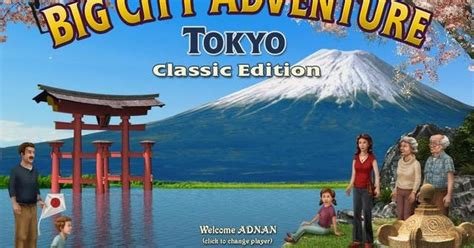
Big City Adventure: Tokyo is a hidden object adventure game set in the vibrant metropolis of modern-day Tokyo. Players explore iconic landmarks and bustling streets, searching for hidden items while solving puzzles and mini-games. Developed by Jolly Bear Games, this first-person, point-and-click experience blends cultural exploration with challenging gameplay, offering a virtual tour of Japan’s capital through immersive environments and interactive challenges.
Gameplay Videos
Big City Adventure: Tokyo Free Download
Big City Adventure: Tokyo Guides & Walkthroughs
Big City Adventure: Tokyo: A Cultural Expedition Masked as a Hidden Object Game
Introduction
In an era dominated by hyper-realistic action titles and sprawling open worlds, Big City Adventure: Tokyo (2013) carved out a quiet but steadfast niche as a casual exploration of Japan’s bustling capital. Developed by Jolly Bear Games, this entry in the long-running Big City Adventure series offers a tranquil yet methodical journey through Tokyo’s juxtaposition of neon-lit modernity and ancient tradition. While lacking in critical acclaim or industry-shaking innovation, the game serves as a time capsule of early 2010s casual gaming trends—a love letter to armchair travelers and hidden object enthusiasts.
Development History & Context
Studio Vision & Constraints
Jolly Bear Games, a studio specializing in accessible, family-friendly titles, leveraged its expertise in the hidden object genre to create Tokyo. Released in 2013, the game arrived during a transitional period for PC gaming, when indie experimentation and mobile gaming were beginning to challenge AAA dominance. Built for low-spec machines (requiring only a Pentium 3 processor), Tokyo prioritized accessibility over technical ambition, targeting casual gamers seeking bite-sized sessions.
The Hidden Object Landscape
The early 2010s saw a surge in hidden object games, particularly on platforms like Big Fish Games. Titles like Mystery Case Files and Jolly Bear’s own Big City Adventure: Vancouver (2010) laid the groundwork for Tokyo’s formula: scavenger hunts across meticulously illustrated backdrops, punctuated by mini-games. Tokyo adhered to this template but distinguished itself through its cultural tourism angle, a precursor to modern “edutainment” games like Monument Valley or Assassin’s Creed Discovery Tour.
Narrative & Thematic Deep Dive
A Postcard, Not a Plot
Tokyo eschews traditional storytelling in favor of environmental narrative. Players assume the role of an unnamed tourist collecting 60 postcards and 60 mementos across 120 rounds of gameplay. These artifacts—ranging from samurai helmets to sushi rolls—serve as vignettes of Tokyo’s history and culture. While devoid of characters or dialogue, the game’s thematic core lies in its celebration of urban diversity, contrasting Shinto shrines with skyscrapers and cherry blossoms with subway maps.
Underlying Themes: Nostalgia & Discovery
The game’s fixation on preservation—collecting postcards, documenting landmarks—mirrors the hidden object genre’s broader obsession with order and completion. It taps into a pre-Instagram yearning for curated travel experiences, offering a sanitized, puzzle-driven approximation of wanderlust.
Gameplay Mechanics & Systems
Core Loop: Seek and Find
The gameplay revolves around two modes:
– Timed Mode: For competitive players, demanding quick object identification.
– Relaxed Mode: A stress-free experience with no penalties for misclicks.
Each scene tasks players with locating 12–15 items from a textual list, often camouflaged within cluttered dioramas (e.g., a bustling sushi restaurant or a serene temple garden).
Mini-Games & Progression
Interspersed between hunts are rudimentary mini-games: jigsaw puzzles, memory matches, and spot-the-difference challenges. While lacking depth, they break up the monotony of object hunting. Progression is linear but satisfying, with each completed scene unlocking new locales and trivia-packed postcards.
UI & Accessibility
The point-and-click interface is intuitive, though the lack of hotspot highlighting—a common feature in later hidden object games—may frustrate newcomers. Tooltips and a hint system alleviate this somewhat, but the game assumes familiarity with genre conventions.
World-Building, Art & Sound
Visual Design: A Tourism Brochure Come to Life
Tokyo’s fixed, first-person perspectives mimic tourist snapshots, blending photorealistic backdrops with cartoonish object designs. The art direction emphasizes vibrancy: neon signs glow with artificial intensity, while cherry blossoms saturate scenes in pink. Though lacking animation, the static imagery captures Tokyo’s eclectic charm.
Sound Design: Ambient Escapism
The soundtrack leans on generic “Asian-inspired” motifs—shamisen plucks, ambient city noise—to evoke place. While repetitive, it complements the game’s meditative pace. Sound effects for item collection (a soft chime) and errors (a gentle buzz) are unobtrusive, reinforcing the relaxed vibe.
Reception & Legacy
Commercial Niche & Critical Silence
Tokyo flew under the radar at release, earning no major reviews or awards. However, its placement in the Big City Adventure series—which spans over a dozen cities—suggests a loyal fanbase. The game’s commercial lifespan extended through digital storefronts like Big Fish Games, where casual titles thrived.
Influence on Genre & Culture
While not groundbreaking, Tokyo exemplifies the hidden object genre’s shift toward thematic cohesion. Later games like Hidden Folks and The Room series owe a debt to its focus on environmental storytelling. Culturally, it serves as a low-stakes gateway to Japanese aesthetics, predating the Yakuza series’ urban exploration or Ghostwire: Tokyo’s supernatural take on the city.
Conclusion
Big City Adventure: Tokyo is neither a masterpiece nor a failure. It is a comfort food game—a polished, if unambitious, entry in a genre built on routine. For players seeking a zen-like diversion or a virtual tour of Tokyo’s landmarks, it delivers charm in spades. As a historical artifact, it underscores the hidden object genre’s role in democratizing game design, proving that even the simplest mechanics can foster a sense of place. In the pantheon of video games, Tokyo may not be a titan, but it is a heartfelt postcard from a bygone era of casual gaming.
Final Verdict: A leisurely, if dated, hidden object relic that pairs well with a cup of tea and a curiosity for Japan’s capital. Worth revisiting as a meditative time capsule, but unlikely to convert genre skeptics.