
- Release Year: 2009
- Platforms: Windows
- Publisher: UIG Entertainment GmbH
- Genre: Compilation
- Average Score: 44/100
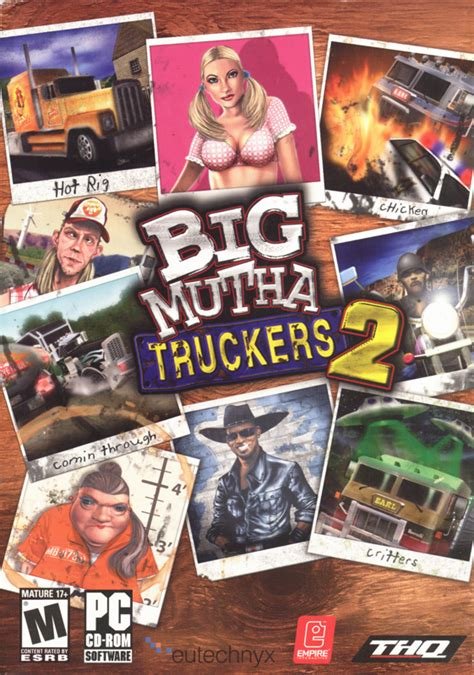
Description
The Big Mutha Truckers series, comprising the 2002 original and its 2005 sequel Truck Me Harder!, centers on Ma Jackson and her family operating a trucking business in a rugged, desert-based American Southwest to amass enough money for a lawyer to address Ma’s tax evasion charges. Players engage in profit-driven hauling by buying cheap goods in one town and delivering them to another at a higher price, while navigating chaotic side missions involving various vehicles and obstacles like police and UFOs, all within expansive open-road environments.
Gameplay Videos
Big Mutha Truckers + Big Mutha Truckers 2: Truck Me Harder! Reviews & Reception
en.wikipedia.org (44/100): The action is respectable when you’re on the road with your 18-wheeler, dodging UFO invaders, smacking sinister bikers with your trailer and outrunning the cops, but the bare-bones production value is clear when you visit towns.
eurogamer.net : Thankfully, things aren’t that bad. Okay, Big Mutha Truckers 2 was unlikely to be a smooth ride, but it isn’t festering road-kill either.
Big Mutha Truckers + Big Mutha Truckers 2: Truck Me Harder! Cheats & Codes
PlayStation 2
At the main menu, highlight ‘Trial by Trucking’ and press Triangle to access the cheat menu, then enter codes.
| Code | Effect |
|---|---|
| NODAMAGE | Invincible |
| MISSIONS | Unlocks All Missions |
| CASH | Get $115,000 |
| GALLERY | Unlocks All Gallery images |
| BRIDGE | Opens All Bridges |
| BIKERS | Adds lots of Bikers |
| COPS | Adds lots of Cops |
| NOCOPS | Removes All of the Police |
| PJ | Pay off next juror |
PC
At the main menu, press the SPACE BAR to display the cheat menu, then enter codes.
| Code | Effect |
|---|---|
| NODAMAGE | God Mode |
| MISSIONS | Unlock All Missions |
| CASH | Get $115,000 |
| GALLERY | Unlock All Images |
| BRIDGE | Open All Bridges |
| PJ | Pay Off Next Juror |
| BIKERS | More Bikers |
| COPS | More Police |
| NOCOPS | No Police |
Big Mutha Truckers + Big Mutha Truckers 2: Truck Me Harder!: Review
Introduction: The Last Lap of a Redneck Revolution
In the annals of mid-2000s video game history, few titles encapsulate a specific, fleeting moment of design philosophy quite like Big Mutha Truckers and its sequel, Big Mutha Truckers 2: Truck Me Harder. Released at the tail end of the PlayStation 2/Xbox era and bundled in a curious 2009 Windows compilation, these games represent the commercial and creative apex—and perhaps the final gasp—of the “budget open-world” experiment. Long before Grand Theft Auto perfected the formula on a grand scale, a handful of developers dared to ask: What if the open world was just… a really big map for driving trucks, selling hubcaps, and running from bikers? Developer Eutechnyx’s answer was a game that wore its crass, Southern-fried satire on its sleeve, offering a potent cocktail of illicit trading, chaotic vehicular mayhem, and humor so broad it bordered on abstract. This review will argue that while Big Mutha Truckers 2 is a critically maligned, mechanically repetitive relic, the compilation as a whole is a fascinating case study in niche design, regional parody as a core mechanic, and the struggle to find an identity between the pillars of Crazy Taxi‘s frantic delivery and 18 Wheels of Steel‘s methodical simulation. It is a game that is profoundly, stubbornly something, even if that something is often frustrating and forgettable.
Development History & Context: Born in the Budget Bin
The origins of the Big Mutha Truckers series are rooted in the economics of the early 2000s console landscape. Developed by the UK-based studio Eutechnyx, the original 2002 game was a product of a time when “budget” titles for PS2 and Xbox (often retailing for $19.99) were a viable commercial strategy. These games targeted a demographic hungry for specific, accessible experiences that the mainstream AAA titles overlooked. The first game’s relative success—reportedly selling upwards of 10,000 copies in the UK and nearly a million in the US—was a clear signal to Empire Interactive (EU publisher) and THQ (NA publisher) that a sequel was warranted.
Big Mutha Truckers 2: Truck Me Harder arrived in 2005, a pivotal year for open-world and driving games. Grand Theft Auto: San Andreas (2004) had already set an almost impossibly high bar for scale, density, and variety in an open world. Big Mutha Truckers 2 was explicitly, even defiantly, not competing on that level. Instead, it doubled down on its narrow premise: a sprawling but simple highway map focused exclusively on long-haul trucking. The technological constraints were those of the mid-cycle PS2/Xbox/PC era—capable of rendering vast draw distances for its desert highways but lacking the detail, AI complexity, or systemic depth of its contemporaries. The development vision, as evinced by the title and content, was pure parody. It sought to capture a specific, satirical vision of American South “redneck” culture, a trope widely understood and, at the time, frequently mined for comedy in media from Dukes of Hazzard reruns to Jackass. This was not a game aiming for realism or gritty drama; it was a cartoonish, exaggerated joyride through a stereotype, and its entire design was bent to serve that tone.
The 2009 Windows compilation, published by UIG Entertainment GmbH, is itself a historical artifact. It arrived after the peak of the series’ relevance, repackaging two three-year-old games for a PC audience that had largely moved on. Its existence points to a continued, if niche, demand for these titles, likely from players with fond memories of the console originals or those seeking a特定的, low-stakes driving experience.
Narrative & Thematic Deep Dive: Ma’s Trial and the Art of the Lowbrow
The narrative framework for both games is a flimsy, satirical plot device designed purely to motivate the core gameplay loop. In the sequel, the story is explicitly laid out: Ma Jackson, the proprietor of “Big Mutha Truckers Haulage Inc.,” has been arrested for tax evasion. Her offspring—the player chooses from four siblings: Bobbie-Sue, Rawkus, Cletus, or Earl, all rendered with the subtlety of a sledgehammer—must earn enough money to not only hire the family lawyer, Cousin Jacob, but specifically to bribe the six jurors in her upcoming trial. This sets the stage for a saga of underground dealing, police evasion, and general lawlessness across the fictional “Hick State County.”
The themes are aggressively unsubtle. Parody of Southern Stereotypes is the primary mode. Every character, locale, and radio station joke is hammered home with relentless force. Towns have names like “Booger’s Canyon” and “Belle’s Booty.” Non-player characters are caricatures: “Slits” the biker chick, buck-toothed men in overalls, and the ever-present “nature girl” whose nudity is conveniently obscured by her hair and a countertop (as noted in the Steam store’s content warning). The humor operates on three levels: puerile wordplay (the title itself), sexual innuendo, and redneck stereotyping (obsession with trucks, beer, and lawlessness). Reviews universally noted its hit-or-miss nature; when it lands, it’s a silly, knowing wink. More often, it trudges into tedious repetition, with the same jokes about inbreeding, moonshine, and corrupt sheriffs forever recycled.
The radio stations, a clear homage to Grand Theft Auto‘s satirical talk radio, are a key narrative delivery system. They attempt to build world atmosphere through fictional commercials, absurd public service announcements, and host banter. However, as Eurogamer’s review astutely observed, they lack the “sparkle of intelligent wit” of Rockstar’s work, often feeling like a checklist of Southern clichés rather than a cohesive, biting satire. The story is not meant to be about anything profound; it is the excuse for the action. The “thematic depth” is precisely the shallow, knowing celebration of its own trashiness. It’s a game that proudly wears a “Kick Me” sign on its back, daring you to take it seriously while simultaneously expecting you to laugh at its own expense.
Gameplay Mechanics & Systems: The Grind is the Thing
Big Mutha Truckers 2 represents a subtle but significant shift from its predecessor. The original mixed trading and driving fairly evenly. The sequel, as noted by sources like Squakenet and Neoseeker, streamlined the trading mechanics in favor of a greater emphasis on on-road action. The core loop remains: drive your semi-truck from town to town across the large, open map of Hick State County. At each depot, you buy cargo (from beer to “Wild Piggy” to illicit goods) and sell it elsewhere for a profit. The financial goal is to accumulate a set sum to progress the story (bribe the jurors).
The genius and flaw of the system is its pseudo-economic simplicity. There is no complex market simulation; prices are largely static and dictated by town type. Depth comes from player-created risk/reward decisions: Do you carry volatile, high-profit cargo that attracts more police and biker attention? Do you upgrade your truck’s engine, armor, or cargo capacity with your earnings? Do you take a dangerous shortcut to shave seconds off your time bonus, or play it safe on the main highway? A user review on Neoseeker intriguingly praised this as “intricate big-rig shipping economics,” finding a surprising hook in the optimization puzzle. For most, however, it quickly becomes a repetitive fetch-and-carry grind.
The on-road action is where the game attempts to inject chaos. Players are constantly assailed by:
* Police: Who will impound your cargo if they catch you speeding or causing wrecks.
* Biker Gangs: Who swarm your truck, trying to steal your trailer.
* UFOs: A series’ hallmark, aliens occasionally beam down to attempt cargo abduction—a bizarre, memorable nuisance.
* Environmental Hazards: Other traffic, destructible roadside objects.
The satisfaction here is destructive, physical. Your truck is a behemoth; smashing smaller vehicles out of the way feels powerful, a rare point of tactile joy in an otherwise floaty physics model. Bonuses are awarded for smashing things, delivering on time, picking up hobos, etc., encouraging a playstyle of aggressive, reckless efficiency.
However, this system is fraught with frustration. The truck’s handling, while manageable, is sluggish and has a significant sense of inertia. In high-stress, timed situations (like a timed parking bonus at a depot), this can feel unresponsive and unfair. A single crash or wrong turn can obliterate a time bonus, turning a mission from profitable to a loss. The Special Missions, which let you drive an SUV, pickup truck, or other vehicles, offer brief variety but are isolated, gated events and do not fundamentally alter the core loop.
The UI is functional but barebones. The map is clear, the cargo lists are simple, and the profit/route planning is straightforward—though this simplicity contributes to the eventual feeling of sameness. There is no meaningful character progression beyond truck upgrades; the four selectable drivers have no discernible different attributes, a baffling design choice that renders the choice purely cosmetic, as noted in multiple user reviews.
In essence, the gameplay is a tense, repetitive seesaw between the zen-like profitability of an optimal run and the white-knuckled fury of a messed-up delivery due to poor controls or bad luck. It lacks the emergent stories of GTA or the immersive simulation of 18 Wheels of Steel, settling into a unsatisfying middle ground that pleases neither hardcore sim fans nor arcade action seekers.
World-Building, Art & Sound: A Pretty, Empty Highway
Big Mutha Truckers 2 presents a world that is paradoxically expansive in scope but desolate in content. The map of Hick State County is frequently praised for its impressive scale and the illusion of open freedom, with numerous hidden shortcuts and alternate routes. This is a technical achievement for a budget title of the era, creating a genuine sense of driving a long-haul route across a sizable state. The visual style is bright, saturated, and intentionally exaggerated. The desert landscapes, gaudy truck stops, and cartoonish town centers are rendered with a PS2-era charm—textures are simple, geometry is blocky, but the art direction commits fully to its over-the-top, comic book aesthetic. There is a coherence to the visual tone that matches the game’s juvenile humor.
However, this world is profoundly underpopulated and underutilized. Towns are essentially service hubs—a depot, a garage, a bar, and a few NPCs who spout the same repetitive redneck lines. There are no dynamic events outside of the scripted biker/UFO ambushes. The open world is a beautiful, elaborate prop for a stage play with only a few actors. The promise of “go anywhere, any time” (as cited from Neoseeker) is hollow; there is almost nothing to do that isn’t directly tied to the cargo delivery objective. The world is a giant, gorgeous racetrack and nothing more.
The sound design is split. The sound effects—the roar of the diesel engine, the crunch of metal, the police sirens—are competent and serve the action adequately. The radio stations, however, are the game’s most divisive audio element. They are a deliberate attempt at creating a living atmosphere through parody. From country music to rock (including Free’s “All Right Now,” cited by Eurogamer as setting the initial tone), the music fits. The comedy sketches and ads, though, are where the game’s humor lives and dies. For some, they are a campy delight; for most critics, they are “endlessly repeated” and “unsubtle,” quickly becoming an annoyance to mute. The voice acting, as Eurogamer notes, is “generally good,” but the material is the weak link. It’s audio wallpaper that either enhances your immersion in the satire or shatters it completely.
Reception & Legacy: Trucks Stuck in Neutral
At launch, Big Mutha Truckers 2 received “mixed” reviews on PS2 and Xbox and “unfavorable” reviews on PC, according to Metacritic aggregates (51/100, 50/100, 44/100 respectively). The critical consensus was shockingly uniform. The Detroit Free Press praised the on-road action (“respectable when you’re on the road… dodging UFO invaders, smacking sinister bikers”) but derided the “bare-bones production value” of the towns. The Sydney Morning Herald found causing havoc “fun” but said the “novelty quickly wanes and the unsubtle gags often fail to amuse.” Maxim delivered the most scathing summary, comparing it unfavorably to Driver and Crazy Taxi and calling the truck “slow and sluggish like Eminem with his medicine.”
The common refrain was a game with a kernel of fun idea suffocated by repetition and a lack of depth. The formula—drive, trade, repeat—was found too thin to sustain interest beyond a few hours. The humor was a major point of contention, seen as either a charmingly dumb bonus or an irredeemable liability. The PC version’s lower score was often attributed to a port that felt even more like a console transplant, with control issues and a dated presentation.
Its legacy is one of cult obscurity and niche affection. It did not spawn imitators or significantly influence the industry. Instead, it occupies a specific space in the mid-2000s console library: the low-budget, high-concept driving game. Its influence is perhaps most faintly felt in the later, similarly themed but more polished American Truck Simulator series, which takes the interstate driving fantasy seriously rather than parodying it. For a certain generation of budget-conscious gamers, it is remembered with a wry smile as a perfectly okay way to spend a weekend, a game that knew its limitations and priced itself accordingly ($19.99). The existence of the 2009 compilation and its presence on Steam (with its own set of modern compatibility issues, as community discussions reveal—problems with Windows 10/11, widescreen, and Steam Deck) testifies to a persistent, if small, nostalgia. It is a footnote, not a milestone.
Conclusion: The Last Ride for the Mutha Truckers
Big Mutha Truckers + Big Mutha Truckers 2: Truck Me Harder! is not a lost classic. It is not a game that changed genres or captivated millions. It is, instead, a brilliant failure—a game that perfectly captures a specific, low-rent aesthetic and a narrow but genuine gameplay fantasy (the open-road trucker), but proves utterly incapable of sustaining that fantasy beyond its initial, crashingly obvious charm.
The sequel refines the original’s concept in small ways (bigger map, more shortcuts, special missions) but loses some of the economic “depth” that a few users appreciated. Its heart is in the right place: the sheer, unadulterated joy of piloting a massive truck, smashing through obstacles, and outrunning the law is viscerally satisfying in short bursts. But the surrounding systems—the repetitive trading, the cruel time bonuses, the unvaried world—grind that joy into dust with merciless efficiency. The humor, its defining characteristic, is its greatest weapon and its fatal flaw; it is too constant, too predictable, and too mean-spirited to be endearing for long.
The 2009 compilation is an ironic casket for this series. It packages two mid-tier console games from 2002 and 2005 for a PC audience that had just experienced the open-world behemoths of the late 2000s. Playing it today is an exercise in historical empathy. It is a game that feels like a time capsule of a specific moment when the concept of “open world” was still malleable enough to be applied to a trucking sim parody, before the genre’s expectations were set in stone.
Final Verdict: 5.5/10. For the historically curious or the collector of gaming oddities, this compilation has value as a well-preserved artifact of the budget open-world experiment. Its core driving mechanics offer a temporary, visceral thrill. However, as a cohesive, engaging, or memorable experience, it is a repetitive, humor-dependent slog that fails to evolve beyond its first hour. Big Mutha Truckers 2 didn’t just hit the wrong note; it played the same three chords for its entire run, expecting a standing ovation. The audience mostly just wanted to get off at the next exit.